A Class in Politics; Mexico
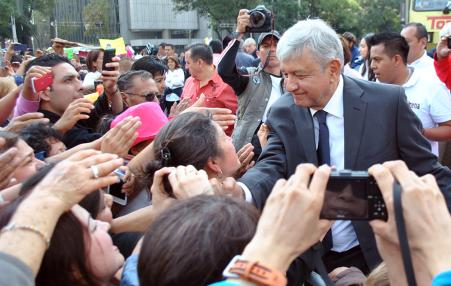 Former Mexican President Andrés Manuel López Obrador whose policies during his tenure created measurable advances for workers., (ProtoplasmaKid / WikiCommons)
EdEdwin F. Ackerman
December 29, 2024
Jacobin
How AMLO turned an anti-corruption campaign into an opportunity for economic redistribution.
Excerpt:
If there was a distinguishing feature of AMLO’s political style, it was his ability to treat neoliberalism as synonymous with corruption. Historically, anti-corruption politics has been the mainstay of the neoliberal right seeking to privatize graft-ridden state industries. In Latin America, at least, the middle and upper classes have been the most reliable constituency for this brand of politics. But AMLO adroitly repurposed anti-corruption politics to garner mass appeal without embracing neoliberal anti-statism or a technocratic anti-politics that empowers unelected officials.
“It sounds harsh, but privatization in Mexico has been synonymous with corruption,” AMLO said in his inaugural speech in December 2018. “Unfortunately, this malady has almost always existed in our country, but what happened during the neoliberal period is unprecedented in modern times — the system as a whole has operated for corruption,” he added. “Political power and economic power have mutually fed and nurtured each other, and the theft of the people’s goods and the nation’s wealth has been established as the modus operandi.”
The key features of the Mexican neoliberal state were an increase in outsourcing of services to private companies, subsidies to a private sector encouraged to compete with state-owned companies (electricity is one of the most egregious examples), mechanisms for ceding control of public monies through privately administered fideicomisos (trusts), and sanctioned and unsanctioned forms of tax evasion. At the heart of AMLO’s diagnosis of his country’s malaise lay a fundamental redefinition of neoliberalism. Contrary to the common belief, neoliberalism was not about the contraction of the state. For AMLO, it represented the instrumentalization of the state to serve the rich.
Republican Austerity
AMLO’s reinterpretation of neoliberalism has lent a sophistication to discussions of the economy that remains alien to much of the anglophone world. Thanks to Morena, the debate in Mexico is not, as in the United States, about small government versus big government — Mexico operated under “big government” during neoliberalism, but it consistently served the upper class through both legal and illegal means. Recognition of this fact provided the basis for a class politics of anti-corruption.
Editors Note.
https://jacobin.com/2024/12/a-class-in-politics
How neoliberalism shifted resources from the state ( taxes) to the oligarchy and upper classes.
Important: a similar process occurs within the U.S. Government budgets are restricted. Health care is privatize ( except for the VA). Public Schools are underfunded. Public universities are underfunded. Roads are not repaired. Homelessness is criminalized ( rather than building housing).
The money is extracted via taxes and goes to fund projects of the Oligarchy such as Musk’s space exploration, privatized health care, private (charter) schools, and , of course, the military equipment and munitions.
Paul Buhle