Martin Luther King, Economic Justice, Workers’ Rights,and Multiracial Democracy
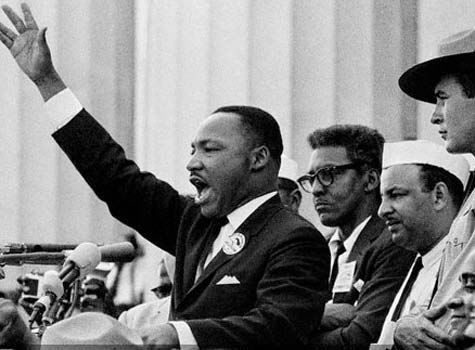
by Thomas Jackson
In 1968, a united black community in Memphis stepped forward to support 1,300 municipal sanitation workers as they demanded higher wages, union recognition, and respect for black personhood embodied in the slogan “I Am a Man!” Memphis’s black women organized tenant and welfare unions, discovering pervasive hunger among the city’s poor and black children. They demanded rights to food and medical care from a city and medical establishment blind to their existence.
That same month, March 1968, 100 grassroots organizations met in Atlanta to support Martin Luther King’s dream of a poor people’s march on Washington. They pressed concrete demands for economic justice under the slogan “Jobs or Income Now!”
King celebrated the“determination by poor people of all colors” to win their human rights. “Established powers of rich America have deliberately exploited poor people by isolating them in ethnic, nationality, religious and racial groups,” the delegates declared.
So when King came to Memphis to support the strike, a local labor and community struggle became intertwined with his dream of mobilizing a national coalition strong enough to reorient national priorities from imperial war in Vietnam to domestic reconstruction, especially in America’s riot-torn cities. To non-poor Americans, King called for a “revolution of values,” a move from self-seeking to service, from property rights to human rights.
King’s assassination—and the urban revolts that followed—led to a local Memphis settlement that furthered the cause of public employee unionism. The Poor People’s March nonviolently won small concessions in the national food stamp program. But reporters covered the bickering and squalor in the poor people’s tent city, rather than the movement’s detailed demands for waging a real war on poverty. Marchers wanted guaranteed public employment when the private sector failed, a raise in the federal minimum wage, a national income floor for all families, and a national commitment to reconstruct cities blighted by corporate disinvestment and white flight. And they wanted poor people’s representation in urban renewal and social service programs that had customarily benefited only businesses or the middle class. King’s dreams reverberated back in the movements that had risen him up.
It is widely believed that King’s deep dedication to workers’ rights and international human rights came late in life, when cities burned, Vietnamese villagers fled American napalm, and King faced stone-throwing Nazis in Chicago’s white working-class inner suburbs. But King began his public ministry in Montgomery in 1956, dreaming of “a world in which men will no longer take necessities from the masses to give luxuries to the classes.” He demanded that imperial nations give up their power and privileges over oppressed and colonized peoples struggling against “segregation, political domination, and economic exploitation”—whether they were in South Africa or South Alabama.
King’s commitments to economic justice and workers’ rights are becoming more widely appreciated today as we continue to confront all of the unresolved challenges King confronted in his day.
Beyond Civil Rights
Around 1964, King announced that the movement had moved “beyond civil rights.” Constitutional rights to free assembly, equality in voting, and access to public accommodations had marched forward with little cost to the nation, he said. Human rights—to dignified work, decent wages, income support, and decent housing for all Americans—would cost the nation billions of dollars. In other speeches, however, King recognized that human rights and civil rights were bound up with each other, part of a “Worldwide Human Rights Revolution.”
The practical experience of building a movement had already made these connections. In Montgomery’s struggle to desegregate bus seating, for example, King heralded the American “right to protest for right,” but discovered that it was inseparable from the human rights to work and eat.
Why? Hundreds of African Americans were fired or evicted or denied public aid for expressing themselves politically, and King was intimately involved in campaigns for their material relief.
This pattern continued throughout the 1960s. The southern struggle for rights became a struggle against poverty long before Lyndon Johnson’s wars in Vietnam and on poverty.
Similarly, in New York City in 1959, King joined A. Philip Randolph and Malcolm X in supporting the white, black and Puerto Rican workers of New York’s newly organized Local 1199. Over 3,000 hospital workers— laundry workers, cafeteria workers, janitors and orderlies—struck seven New York private hospitals. At the bottom of the new service economy they were legally barred from collective bargaining; excluded from minimum wage protections and unemployment compensation; and denied the medical insurance that might give them access to the hospitals where they worked. Harlem’s black community rallied to their defense. King cheered a struggle that transcended “a fight for union rights” and had become a multiracial “fight for human rights.”
Today We Continue the Struggles
King’s commitments to economic justice and workers’ rights are becoming more widely appreciated today as we continue to confront all of the unresolved challenges King confronted in his day. Joblessness is still pervasive under the official unemployment statistics, and wages remain too low to lift millions of people out of poverty.
Conservative politicians and globalizing corporations have relentlessly chipped away at union rights and workplace safety. Tattered safety nets have become even shoddier for poor people who are not capable of earning. Forty-seven million Americans are, medically, second-class citizens. Unequal landscapes of wealth and opportunity in housing and schools still make the words “American apartheid” a dirty but accurate epithet. And again, in a different part of the world, our military wages a war of empire cloaked in robes of democratic idealism. On the right, complacent religious leaders preach family morality and personal responsibility, while neglecting our collective moral commitments to materially supporting “the least of these.”
But across the country too, citizens are uncovering stones of hope and finding new democratic determination. We have come a long way, but we have a long way to go, as King would say. Lost ground and shattered dreams are bearable, he would have preached, as we continue the struggles for multiracial democracy, economic justice, and human dignity that were begun long ago, under even more challenging circumstances than we face today.
Thomas F. Jackson is Associate Professor of History at the University of North Carolina Greensboro, and author of the prizewinning From Civil Rights to Human Rights: Martin Luther King Jr. and the Struggle for Economic Justice (University of Pennsylvania Press, 2007) Originally published on Democratic Left.
Democratic socialists A. Philip Randolph and
Bayard Rustin worked closely with King
We also feature the Poor Peoples Campaign and an interview with Bayard Rustin's biographer about nonviolence:
https://www.religioussocialism.org/
And over at Democratic Left, we have
https://www.dsausa.org/democratic-left/saving-martin-luther-king-jr-and-others-from-the-capitalist-memory-hole/
https://www.dsausa.org/democratic-left/on-the-shoulders-of-others-three-black-giants-for-today/
Resources
- Poor People’s Campaign: National Call for Moral Revival on the Events of January 6, 2021 by Rev. Dr. William Barber, II and Rev. Dr. Liz Theoharis , visit: https://www.poorpeoplescampaign.org/january-6th-statement/
- 14 Policy Priorities to Heal the Nation: A Moral and Economic Agenda for the First 100 Days, visit:https://www.poorpeoplescampaign.org/resource/policy-and-legislative-priorities/
Comments
No comments yet.
Leave a comment
Comments are reviewed before they appear. Your name is shown with your comment.