ORGANIZING THE IGNORED, FORGOTTEN, AND SUPPRESSED: A POOR PEOPLE’S MOVEMENT ACTION AND AGENDA
By Kurt Stand, July 2024,
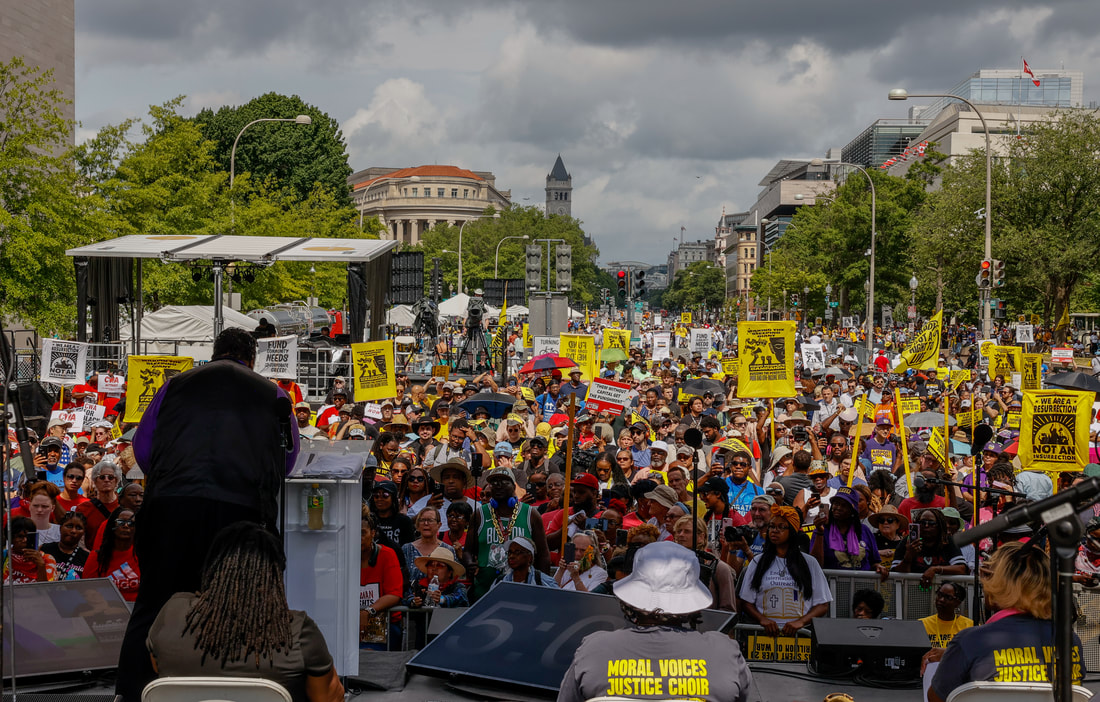
Inspired by a call to build a movement for a “resurrection of justice, love, truth,” as opposed to an “insurrection of injustice, lies, and hate,” a few thousand people assembled in Washington, DC, for the Poor People’s Campaign Assembly on Saturday, June 24. DSA members from Prince George’s County in Maryland were there, but it was clear that for many in this racially, socially, and age-diverse group, going to public protests was not a common occurrence.
Whether they had been mobilized by their church or union, whether they simply heeded the call and showed up on their own, they were serious about being there. As I wandered through the crowd toward the end of the rally, I ran into a group of hospital workers excited to be there, some coal miners who had come up from West Virginia just to be present, and many who sat on the ground listening (really listening) to the talks and nodding as they might in church.
As at other Poor People's Campaign gatherings, the political message was not directed at institutions or organizations but at those who find themselves trapped in poverty, whose everyday existence is defined by the need to tread water to avoid drowning. And the message delivered was clear: those living in poverty are the “swing vote,” the ones who in their numbers and their moral strength can ensure the defeat of Donald Trump and MAGA Republicans in the upcoming elections.
As PPC Campaign co-chairs Bishop William Barber II and Rev. Liz Theoharis expressed in their opening remarks, the choice is not about personalities, as the media might have us believe. It is about focusing on those issues the media, and most politicians, ignore: the realities of the grinding poverty that is the fourth leading cause of death in society.
Their opening addresses also drove home the point that change comes from the bottom up, and rather than be distracted by whether people are liberal or conservative, left or right, people have to focus on the needs of those in our society who endure housing insecurity, food insecurity, and job insecurity. Politicians must address the needs of those who live paycheck to paycheck. We cannot accept a politics that “accepts” homelessness, hunger, and violence as immutable realities.
Values
A resurrection is a rebirth, building “from the ashes of the old,” if you will. And so the assembly called for “Moral Revival,” directly challenging Christian nationalism. Repairers of the Breach, the organization Barber founded and leads, stands for centering the language of morality by building a movement united across lines of race, class, gender identity, sexuality, ethnicity, and faith in opposition to those who claim that the preeminent moral issues of our day are prayer in public schools, abortion, and property rights.
The program of the assembly reflected those values. Big-name speakers were not on the program, the aim of which was to give voice to the voiceless. The speeches were divided into three cohorts: church leaders, unions, and impacted individuals. Each speaker had one-and-a half minutes, and the timing was strict; music would start playing the moment they reached the 90-second mark. This allowed many voices to be heard and forced speakers to come to the point quickly.
In their own ways, each faith leader, regardless of affiliation, spoke to a sense of oneness: that we are each other’s keepers. This stands in opposition to any institutional religion corrupted by nationalism, racism, the idea that some countries or people are superior to others, and in opposition to church doctrines that proclaim that women should be subservient to men.
By contrast, the language of universality used by the faith leaders was embodied in the political program of unity in support of social and economic justice, in support of peace and environmentalism. And contrary to the uniformity demanded by religious nationalists, this kind of unity embraces individuality and the sense of identity (or perhaps, better put, the multiple identities) we all have. This is an expression of the “Moral Fusion” that is central to the Poor People’s campaign and can be summed up in the biblical injunction “to do unto others as you would have done to you,” for our individual and collective needs are inextricable combined.
A secular expression of this is embodied in union solidarity. And it is impossible to understand the significance of the assembly without recognizing that it was a “Poor People’s and Low Wage Workers” Assembly. Numerous unionists were present – hospital workers from 1199 Service Employees; hospitality workers from UNITE-HERE; members of the Amalgamated Transport Workers who have been engaged in big fights in Northern Virginia and Washington, DC; members of the American Postal Workers Union; and government workers from federal (American Federation of Government Employees) and state, county and municipal (AFSCME) unions, and many others. A union officer would speak, followed by a rank-and-file member. Bound by the same time limitation as faith leaders, their comments focused on the importance of organization in lifting wages and the need to mobilize voters to protect those gains. Rank-and-filers especially stressed the critical importance of the work they do. Underlying their comments was the key point that raising those at the bottom benefits all working people and is the only pathway to equality.
Finally – and crucially – the people who suffer the most impact from poverty spoke from direct experience. A woman from Philadelphia told about watching the apartment complex where she lived and raised her children bulldozed by a developer who decided he could make more money by displacing people from their homes, a disabled women from Miami described her feelings after being told that she should lower her expectations and drop out of her college program, a man from Wisconsin described what it felt like to be denied needed medical coverage even though he had health insurance – and so it went, on and on. And the chant in response to each was, “We are the swing vote!”
Past to Future
Here is the Swing Vote for this election.
Read more: Very valuable.
Reposted from the DSA Religion and Socialism blog. ReligiousSocialism.org
https://www.religioussocialism.org/organizing_the_ignored_forgotten_and_suppressed_a_poor_people_s_movement_action_and_agenda (opens in a new tab)
Comments
No comments yet.
Leave a comment
Comments are reviewed before they appear. Your name is shown with your comment.