DSA NORTH STAR
  • Welcome
  • Principles
  • Join Us
  • Our Strategy
  • Blog
  • About
    • About North Star
    • About DSA
    • Contact
  • Welcome
  • Principles
  • Join Us
  • Our Strategy
  • Blog
  • About
    • About North Star
    • About DSA
    • Contact

Blog, page 14 of 25

Defending Immigrants and Opposing the Authoritarian Enemy. With, or Without DSA.

7/13/2022

by Duane Campbell

The current hearings on the January 6 committee clearly indicate that  the authoritarian/neo fascist threat we described in our NS strategy (opens in a new tab)continues to grow.

We said “The authoritarian threat is global. Donald Trump’s collaborators include Narendra Modi in India, Victor Orban in Hungary, Jair Bolsonaro in Brazil, Vladimir Putin in Russia, and Rodrigo Duterte in the Philippines. Describing such demagogues as populist obscures their neo-fascist nature and their support from corporate interests. Theirs is a budding alliance that strengthens corporate interests’ ability to perpetuate climate-destroying fossil fuel consumption and accumulate wealth from wage theft, tax evasion, and financial deregulation. Their drive for profit runs roughshod over workers’ rights and concentrates growing economic power in fewer hands. Their neglect of the common good precluded effective responses to Covid-19 and enabled an anti-vax movement, leading to catastrophic loss of life. 
 
We in North Star would like to emphasize the gravity of this threat, but we also recognize the historical precedents for an effective movement against it. People of color are already playing a leading role in resistance to neo-fascism in the United States. Growing voices across the political spectrum support the fight for universal, fundamental human needs and human rights. White people are increasingly aware of the importance of white supremacy in corroding U.S. democracy."
We can clearly see that in  the coming battle to oppose the Republican authoritarian machine our opponents are using both fear of crime and fear of immigration as central organizing vehicles in their campaigns.  And we know that these kind of campaigns can work. 
https://talkingpointsmemo.com/cafe/chese-boudin-backlash-san-francisco-prosecutor (opens in a new tab)

Fear, and opposition to immigration has an equally powerful negative potential.
See here. How police security is constructed in Uvalde.
https://www.texasobserver.org/uvalde-and-the-border-security-scam/?://www.texasobserver.org/uvalde-and-the-border-security-scam/ (opens in a new tab)?

It is clear that migration will grow, and probably increase due to both climate change and the growing economic crisis in poor countries.
https://www.nytimes.com/2022/06/11/world/americas/mexico-migrant-caravan-photos.html (opens in a new tab)

It also seems to me clear, that national DSA is not going to respond to the growth of the authoritarian threat.  The national leadership  does not share the perspective of the North Star strategy. And, the Democrats have not made significant progress to deal with the approaching migration crisis.   For example, Biden has said he is willing to accept 20,000 more refugees this year but there are over 100,000 already waiting at the border (not including Ukranians). 

The DSA convention has committed itself in 2019 and 2021 to make Immigration a national priority.  The NPC has decided that they will not make it a priority. North Star participated in this advocacy. 

The group Immigrant Rights Working Group, including several members of North Star were working on immigrant rights within DSA, however that IMWG has been “restructured”  to oppose practical immigrant rights support with the cooperation of some of DSA’s leadership. 
Disciplined cadre ends the effective work of DSA Immigrants Rights Working Group (opens in a new tab)

I think that those of us who recognize the substantial role of immigration in building the U.S. working class, and who recognize the important battle lines being drawn by the authoritarian right ( Republicans) will need to take up the mantel of defending immigrants ‘ rights ( as recognized  to by the DSA conventions) . We will need to engage the battle as a part of the broader efforts to defeat the new fascists ( including Republicans).  This is in line with stated North Star strategy. We also  have as allies the democratic socialist Squad.

This is what a responsible left will do. This is what democratic activists  had to do as our participation in 2020 in the campaign to defeat Donald Trump. We won the first round.  The battle continues.  The threat to the nation continues. We will need to do it again in 2022 and 2024 (at least). 

Ideas on how to best promote such a campaign are welcome.  In the prior version of the IMWG, we adopted strategies of working closely with the activists immigrant rights groups such as Mijente, LCLAA,  Border Solidarity groups and others.  

0 Comments on Defending Immigrants and Opposing the Authoritarian Enemy. With, or Without DSA.
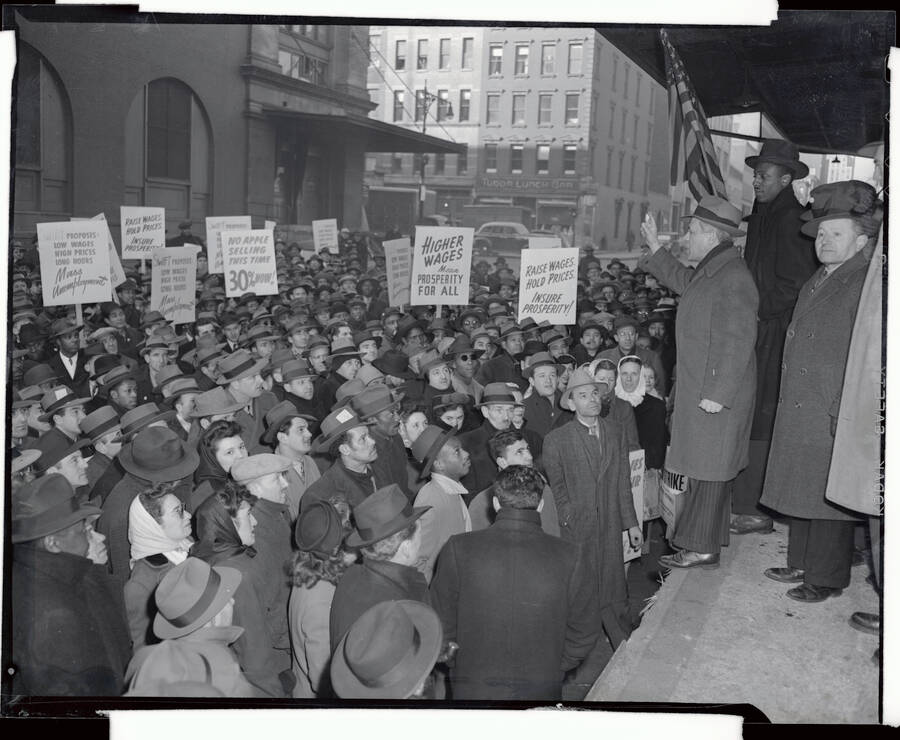
The CIO Was One of the Most Successful Anti-Racism Movements in U.S. History

7/9/2022

Black-and-white photo of a crowd of workers at a rally with signs reading “Higher wages mean prosperity for all” and “Raise wages, hold prices, insure prosperity”
MICHAEL BEYEA REAGAN  IN THESE TIMES
(opens in a new tab)

The following is an excerpt from the book Intersectional Class Struggle (opens in a new tab) (2021, AK Press).

In the 1930s, a new type of union, an “industrial” union that welcomed all workers in a single workplace emerged as the cutting edge of working-class struggle. Previously, unions and employers both had a long history of racism and support for white supremacy. Certain jobs were reserved for whites, and Black workers were kept out of factories and union halls. This had catastrophic consequences for the working class. For example, in the 1919Steel Strike, employers brought in 30,000 Black and immigrant workers to break the strike staged by white workers and their racially exclusive unions. Long prevented from joining those unions, and the labor movement in general, Black workers crossed the picket lines. With that, employers got production moving again, defeated the strike, and prevented worker organizing for the next 15 years.
In the 1930s, as the labor movement thought about how to win during the Great Depression, the lessons of the 1919 Steel Strike loomed large; workers’ movements would have to be anti-racist and intersectional if they were to win.
The strength of the model of industrial unionism was that it required overcoming racial divides within the workplace. New organizations, such as the Congress of Industrial Organizations (CIO), ran anti-racist trainings to facilitate Black and white workers organizing together to fight employers. It formed interracial social groups and sport teams, challenged public displays of racism, and highlighted the treatment Black workers faced on the job. This was largely the influence of the communist and other leftist organizers in the union, for whom anti-racism had long been part of their practice of labor organizing. But at its core were the ideas that Black and white workers have a common enemy in capitalists and capital, and that efforts to divide workers by race weaken working-class power. With these union campaigns, along explicitly anti-racist lines, unionization at places such as General Motors in Flint or in the mills of U.S. Steel finally became possible.

In the estimation of the historian and civil rights activist W.E.B. Du Bois, the CIO was one of the most successful anti-racist efforts in U.S. history. “Probably the greatest and most effective effort toward interracial understating among the working masses,” he writes, “has come about through the trade union.” He believed that shared class interests were a mechanism to overcome ingrained racial hostility. Because of the CIO, workers “in the steel and automotive industries have been thrown together, Black and white, as fellow workers striving for the same objects. There has been on this account an astonishing spread of interracial tolerance and understanding.” Those victories breaking down white supremacy were won through intersectional class struggle; in Du Bois’s words, “Probably no movement in the last thirty years has been so successful in softening race prejudice among the masses.” Black workers were harmed the most by racism and white supremacy, but white workers were harmed too as their unions were broken and their living standards eroded by taking the side of employers in supporting white supremacy against working-class solidarity. In short, all workers have a collective interest to overcome white supremacy and labor-market competition together. In practice, this often means prioritizing the Black freedom struggle or movements for civil rights to build that solidarity.


Read the rest here: https://inthesetimes.com/article/cio-anti-racism-civil-rights-industrial-unions-workers-organizing-black-lives-matter (opens in a new tab) 

0 Comments on The CIO Was One of the Most Successful Anti-Racism Movements in U.S. History

Frederick Douglas: What For A Slave is the Fourth of July ?

7/4/2022

0 Comments on Frederick Douglas: What For A Slave is the Fourth of July ?

A Socialist Response to the End of Roe: Don’t Mourn—Organize for Reproductive Justice

7/2/2022

DSA member DIANA MORENO  In These Times

(opens in a new tab)
Socialist feminists don’t want “choice”—we demand full abortion rights for all, without exception.
 
In the wake of the Supreme Court’s decision to overturn Roe v. Wade, defenders of abortion rights face a stark choice in how to respond. While many politicians and organizations have taken up a liberal individualist position on the question of abortion, by emphasizing personal choice rather than collective rights, it’s critical to highlight an alternative approach: Through a socialist feminist perspective, we can understand and speak about abortion as a class issue that impacts working people everywhere. This approach could help reproductive health activists organize a mass movement strong enough to win free abortion on demand, without apology. 

When feminism is detached from class struggle, it runs the risk of being distorted and commodified into a neoliberal, “lean-in” version of feminism that merely celebrates individual women’s achievements under capitalism while ignoring actions that ultimately undermine solidarity. Pop star Beyoncé, for example, can be celebrated for — and profit from — a hit single that quotes feminist writer Chimamanda Ngozi Adichie while also crossing (opens in a new tab) a picket line to host an Oscars after-party in the face of striking hotel workers calling for a boycott. 

Socialist feminism, meanwhile, is not about individual achievements but rather building collective power in order to achieve liberation and reproductive justice for all. 

Read the rest: https://inthesetimes.com/article/socialism-roe-abortion-dobbs-dsa-reproductive-justice (opens in a new tab)
 

0 Comments on A Socialist Response to the End of Roe: Don’t Mourn—Organize for Reproductive Justice

A Movement Declaration for the Reconstruction of American Democracy

6/30/2022

We – the thousands gathered here in active declaration of a rapidly growing front of organized moral fusion power – and in deep solidarity with those rising up across this country, who are demanding a reconstruction of this democracy and a reconstitution of the policy and legal priorities of this nation – say: we are in a time of emergency. We gather in Washington D.C. for a Mass Poor Peoples and Low-Wage Workers’ Assembly and Moral March on Washington and to the Polls in a dark summer, as our democracy is threatened by a state by state coordinated assault on the right to vote and imperiled by open violence, greed, obstruction, distortions, and denial, while more than 140 million poor and low wealth people of every race, creed, religion, in every region of this country are rising up daily against growing indignities, pain, injury, and death at the hands of immoral policies and interlocking injustices.
Even after historic numbers of people, including those gathered here, voted in 2020 and said we must do more in a collective act of faith,  during the grief of a global pandemic, our democracy remains in an untenable, fragile place: it is bending under the unrelenting weight of an orchestrated attack on our rights to vote for the purpose of further entrenching anti-democratic, non-majority power. And we are facing an attempt to stop the power of this movement and what our presence and witness represents.

We see the truth and so we say the truth: if the assault on this democracy prevails, the consequences will be felt across generations. We see and say that we come here in the shadow of mass death, insurrection, an attempted coup, and in a time in our nation’s history when it is openly known that there are those in political office – and running for political office – who are working with grotesque resources to seek to overthrow the will of the people of the United States again. And we come with the sight and insight to see ahead of us to the generationally transformative resurrection possibilities of a Third Reconstruction of this democracy and this country.

As we gather in Washington D.C. before Congress, before this Supreme Court that – unchecked – threatens to decay our constitutionally protected right to justice and equal protection under the law, and before this White House, we declare that we know there are 143 days between today, June 18, 2022, and the last day of the mid-term elections on November 8. On the ballot are 469 seats in Congress – 34 in the Senate and 435 in the House.

We stand together today without the full protections of a Restored Voting Rights Act. And we declare that we will use our full power to force this democracy to reckon with its people’s plight. We will not be silenced and we will not go unheard! This movement will not be turned around or turned back! Our votes are not supports but demands to be heard and to take action. A movement that votes does not vote for any party or any one person, we vote for our people and for our lives. We vote to summon a Third Reconstruction that can birth us out of an impoverished democracy and usher in a new world.

To this purpose: 
1. 
We demand that every member of Congress publicly acknowledge the reality and pain of 140 million poor and low wealth people – including 43 % of our entire population and 52% of our children, who have died at a rate 2 to 5 times higher during this pandemic, and 250,000 of whom died from poverty and inequality every year –  and recognize a moral crisis that must be corrected, reckoned with, and repaired. This is an emergency; and we need emergency action now to redress these injuries. 
2. 
We demand every member of Congress commit to creating and supporting legislation that reflects the Third Reconstruction Agenda developed by poor and low wage communities. No action that is available to this Congress to relieve this injury and protect our democracy should be taken off the table – no matter how close we are to an election.  
3. 
We demand a White House Poverty Summit with President Biden to allow this administration to meet with a delegation of poor and low-wealth people, religious leaders, and economists and to commit to an Executive Action Plan to Eliminate Poverty in 2022. 
4. 
We declare that this Campaign will engage in massive mobilization and outreach through every means available to us – by visits, letters, petitions, candidate forums, and phone calls – advocating for our current representatives to take action now to address the needs of 140 million poor and low wealth people in this country.
5. 
We pledge to return to Washington D.C. in September 2022, to join 5,000 poor and low-wealth people and religious leaders, along with 100 economists in nonviolent moral direct action in our next step of declaration and notification of these demands.
6. 
This Campaign announces its launch of a nationwide effort for the next 143 days to register and educate poor and low-income communities to vote in every election for candidates who commit to a Third Reconstruction Agenda to address poverty and low wealth from the bottom up. We must vote in historic numbers for our ancestors, for our children, and for the generations to come whose lives and planet are under threat today.
7. 
We declare that we are a movement that votes. We call on all poor and low-wealth people to march in mass assembly from here to the polls this November and to use your vote to make your voices heard! We will expand the “we” included in “we the people” and fight with every tool we have to ensure no voice is excluded from this democracy, no vote is denied, and no cry for justice rising up from this moral fusion movement is unrepresented at the ballot box.
Forward together, not one step back!
Poor People’s Campaign. 
https://www.poorpeoplescampaign.org/june18/ (opens in a new tab)

0 Comments on A Movement Declaration for the Reconstruction of American Democracy

Fight for Democracy, Fight to Protect Abortion

6/25/2022

DSA Protect Abortion Chapter Toolkit

The DSA National Political Committee condemns today’s Supreme Court ruling in Dobbs v. Jackson Women’s Health Organization, which eviscerates the right to privacy and bodily autonomy protected by Roe v. Wade for nearly fifty years, a right the vast majority of Americans support and agree should be protected by the Constitution. The far right wing of the Supreme Court, most of whom were appointed by a President who lost the popular vote, has demonstrated beyond all debate that the Court is an illegitimate institution, flouting the will of the people.
The ruling upholds a Mississippi state law banning all abortions after the 15th week of pregnancy, nullifying the right to privacy under the Fourteenth Amendment to the United States Constitution, overturning both Roe v. Wade and Planned Parenthood v. Casey, allowing individual states to ban abortion entirely. Abortion bans now go into effect immediately or upon swift action of their legislatures in 22 states, and four more states are expected to vote soon to ban abortion or ban it in all but name.

The dismantling of abortion rights by the far right and Christian nationalists could be just the beginning of future right-wing attacks on landmark decisions that rely on the right to privacy, including Obergefell v. Hodges, recognizing a fundamental right to same-sex marriage; Griswold v. Connecticut, recognizing a fundamental right to access contraceptives and prevent pregnancy; and Lawrence v. Texas, finding unconstitutional state sodomy laws. It is not just the rights to privacy and bodily autonomy protecting sexual and reproductive freedom this majority is bent on eviscerating, however; just this month the Court has knocked down one more brick in the wall between church and state in Carson v. Makin; ruled unconstitutional a 108-year-old New York law limiting concealed carry of guns in New York State Rifle & Pistol Asso­ci­ation Inc. v. Bruen, on the basis of a 13-year-old precedent; and issued a decision in Vega v. Tekoh that begs reactionary forces to bring the Court a case to allow them to overturn Miranda v. Arizona, a case so woven into the fabric of American life schoolchildren can recite its associated warnings.

These decisions are not apolitical rulings by a neutral court: the Supreme Court and too many of the lower courts have been captured by the reactionary far right who cannot enact their unpopular agenda democratically or legislatively. The Republican Party and their extremist justices advocate for an originalist interpretation of the Constitution that favors white nationalist and capitalist interests. Their ultimate goal is to dismantle the rights won through the civil rights movement, the Great Society, the New Deal, and even Reconstruction.

The leadership of the Democratic Party have proven time and time again that they cannot be depended upon to save us. Despite many opportunities to codify Roe v. Wade into law, the Democrats in Washington failed to act. Nor can we rely on our judicial system to guarantee us civil rights. Now more than ever, we need to build a vibrant, militant, majoritarian socialist movement to defeat Republican minority rule, win legislative power, and build a better world that guarantees healthcare as a human right, including the right to free abortions on demand without apology. As the largest socialist organization in the United States, DSA is building that democratic and majoritarian socialist movement.

DSA chapters across the country have been mobilizing on the ground in defense of abortion rights, including raising over $100,000 to provide abortions to those in need through the Abortion Fund-a-Thon. But, because of today’s decision, the National Network of Abortion Funds has asked for all fundraising to be halted as they consider the legal implications of raising funds, particularly in states with a ban.

Now is the time to join DSA and build a political mass movement to fight for abortion rights, fight for democracy, and fight for socialism.

Fight with us to Protect Abortion. (opens in a new tab)

https://www.dsausa.org/statements/fight-for-democracy-fight-to-protect-abortion/

0 Comments on Fight for Democracy, Fight to Protect Abortion

From Roe to Right Now: DSA Co-Founder On The Battle for Reproductive Justice

6/25/2022

 by Liz Weston Democratic Left

Today’s ruling on Roe v. Wade came in a week of already-crushing Supreme Court rulings on gun rights, Miranda warnings and school vouchers. This piece, already commissioned by DSA Socialist-Feminists as part of our 40th-anniversary coverage, feels crucial now. If you’re not plugged into your chapter’s pro-abortion action plan, now might be the time. Ed.)

The 1973 Supreme Court decision Roe v. Wade and the subsequent legalization of abortion across the United States did not end debates and activity around the question of abortion.  Although that decision was partly the result of years of organizing by women’s groups and by medical groups appalled by the rising number of illegal and often back-alley abortions, it did not settle many issues of reproductive rights, such as access to abortion and that of forced sterilization. In fact, those issues became central to the politics of the second half of the 1970s.
Even before Roe, when abortion was illegal almost everywhere in the United States, there was an organized anti-abortion movement--largely led by the Catholic Church, which coined the term “Right to Life.”  In the 1972 election, Richard Nixon adopted an anti-abortion position in order to win over Catholic voters.  Following Roe, the so-called Right to Life movement became more active, pressuring Congress to pass anti-abortion legislation.  Over time, the Right to Life movement expanded to include Protestant evangelicals, who called themselves the Moral Majority, and right-wing politicians, called the New Right. By 1977, Republicans in Congress passed an amendment to health care and family planning funding, banning the use of federal funds for abortion services.  The Hyde Amendment, still in force today, prohibited the use of Medicaid funds for abortion as well as the provision of abortion services by federally funded clinics.

Read the rest here (opens in a new tab)

0 Comments on From Roe to Right Now: DSA Co-Founder On The Battle for Reproductive Justice

Poor People's Campaign

6/21/2022

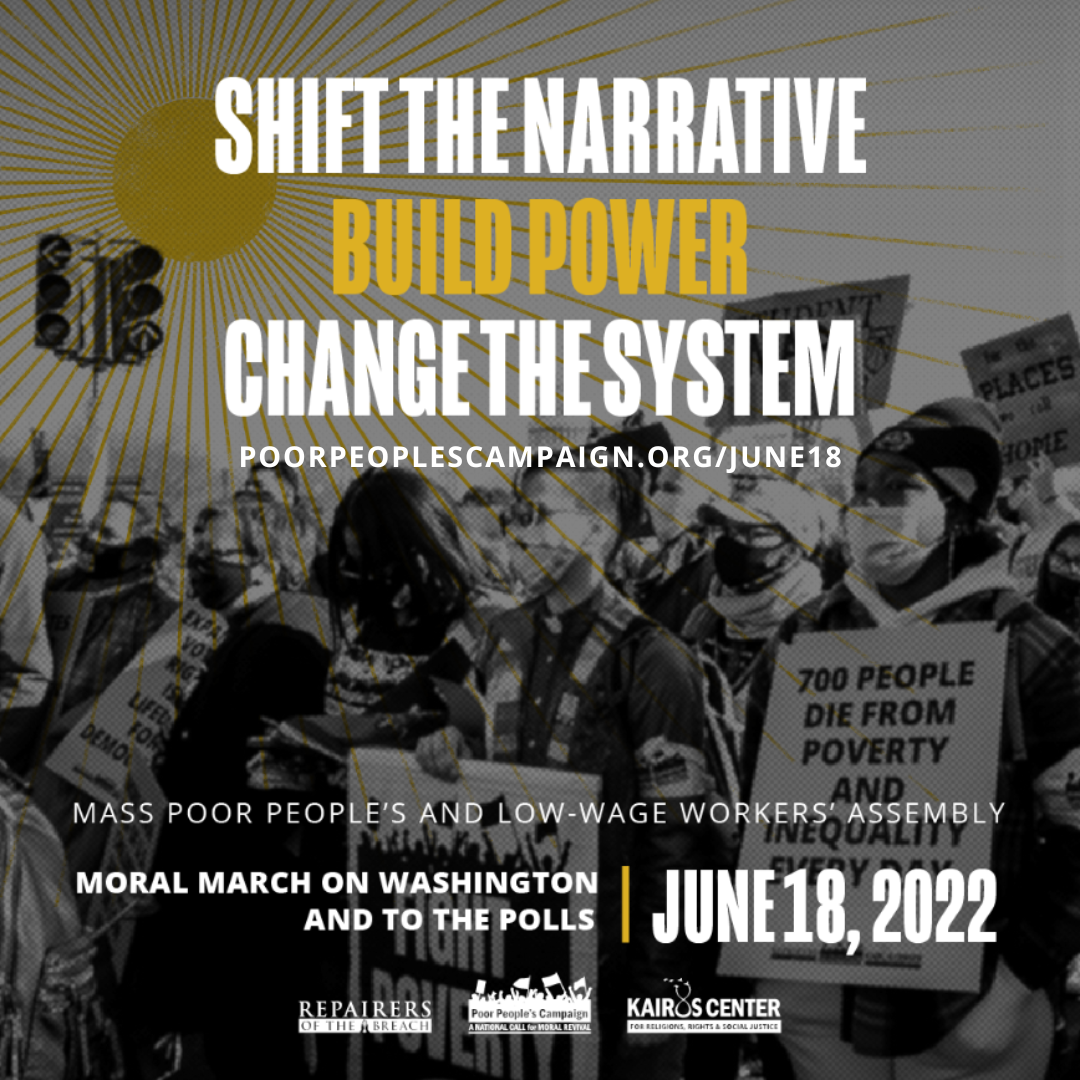
Shift the narrative, build power, change the system. Mass Poor People’s and Low-Wage Workers’ Assembly and Moral March on Washington and to the Polls, June 18, 2022. poorpeoplescampaign.org/june18

0 Comments on Poor People's Campaign

Disciplined cadre ends the effective work of DSA Immigrants Rights Working Group

6/13/2022

Conflict is inevitable, but acting in bad faith is a choice. Too often it is that choice that renders locals, national bodies, and even the NPC, at times useless. This was the case of the Immigrants Rights Working Group under my leadership. The intention in sharing these reflections is in hope of preventing further harm to the organization by other bad faith actors. 

Political conflict should be expected and encouraged, but always with a goal towards growth. When working through political conflict, and hoping to grow through struggle, growth becomes unobtainable when bad faith is involved. Hold no grudges, but if a pattern emerges, the issue must be addressed. 

We know bad faith is a tool used by the enemy to undermine our work. The ramifications of bad faith actors can ultimately render our movement useless, that’s why it’s important to identify and address. 

In the case of the IRWG, bad faith actors withheld information, overstated and fabricated harm towards achieving outcomes. A grievance should have been filed to address the problematic behavior, instead it was glossed over. No amount of substantive work will distract a bad faith actor; therefore the immediate response should be to address the behavior, and if left unchanged, root it out. 

Debate, Dissent, and Overstating Harm

Points of contention included subsuming the IRWG under IC, the Platform, and the Bowman Affair. The matters all debated, discussed, and believed resolved by convention and the IRWG itself. Yet throughout these discussions, information was withheld and overstating harm was repeatedly weaponized, derailing any work. (Multiple instances documented on IRWG listservs.)

On the Bowman Affair, the issue was debated at length with the IRWG SC voting down signing onto the BDS WG letter. At the following IRWG general meeting, the WG voted against revisiting the question. Several attempts were made by IRWG SC members to collaborate with the expel campaign without consulting the IRWG. When discussed, bad faith accusations were raised making efforts to reach resolutions difficult, but not impossible. 

On the Platform. The first draft was released with no input sought from the IRWG. This draft was criticized to varying degrees by members of the IRWG SC. One particular member condemned the proposed platform as a “white supremacist piece of shit” for its exclusion of Peoples movements, particularly the exclusion of Latinos. Going further, condemning the NPC for even bringing the proposed platform to convention, declaring, “This text should be thrown out. It is no good. It cannot be amended, corrected or improved. If it is put up for a vote I want an additional option to yes or no: fuck you.”

This polemic against the platform was followed by overstating harm and an NPC decision to intervene in the Working Group. 

The same kind of weaponization took place on the national Discussion Boards; seeing the same critique of the platform result in the suspension of an IRWG cochair. 

IRWG/IC

During the 2020 term, the issue of subsuming the WG under the IC became a point of contention between the IRWG and the NPC liaisons. 

The matter was brought before convention with resolution #1 On the Defense of Immigrants and Refugees, which reaffirms IRWG work and commitment to building power with working class communities of color currently outside of DSA. A clear message to the incoming NPC to take seriously the immigrants’ rights struggle. The resolution passed. 

Following convention’s affirmation, the IRWG appeared to be on track for a successful term with a surge of applicants for the SC election. IRWG went from not enough candidates to fill the 9 co chair positions in 2020 to 21 candidates in 2021. 

A new SC was elected. Work progressed, amending the WG bylaws to conform with convention resolution #1 and NPC recommendation to adopt standardized guidelines for national committees and working groups. To do so the WG work plan from resolution #1 was incorporated into the bylaws. With respect to standardized guidelines, the WG NPC liaison was made a full member of the WG steering committee. 

Looking towards resource allocations, IRWG submitted a budget to the NPC via Budget and Finance Committee. One item: Earmark for potential delegation to Mexico or IRWG Conference, as this became a focus from the WG passing a Proposal on Mexico, Mexican immigrants, Mexican Americans, US Socialism and beyond on 2/17. 

Subsequent dates are each 2022. 
 
Members of the IRWG SC that we’re also members of the IC discussed a Brazil Delegation Proposal with the NPC a few days later on 2/25. This was never brought to the IRWG and was not disclosed until 3/29 when the NPC SC meeting minutes were made available. 

The conflict instigated in bad faith culminated with an emergency meeting packed by allies of the bad faith actors on 3/10/2022. ( These persons were not members of the Working Group prior to the call.  Since then the IRWG membership listserv was shutdown and the WG has become inactive. 

It took a few bad faith actors with 17 collaborators to overturn a convention resolution and stop the work of what had been relative to the others, a thriving national body with little resources dedicated to it. 

Dissent should be expected in a healthy democratic organization. What should not be expected nor tolerated is acting in bad faith. After all, comradeship is built through trust in struggle. We cannot survive when bad faith actors operate without consequence. The truth has been before the NPC, but the question remains, will the NPC act? And if not, is there a bloc preventing any action? Delay is actively harming the organization; the result of the IRWG does not have to be duplicated yet another time. 
-- 
Alexander Hernandez | 


0 Comments on Disciplined cadre ends the effective work of DSA Immigrants Rights Working Group

Big Tent and Programmatic Unity Can Coexist in DSA

6/11/2022

by Jack Suria Linares

Max Elbaum’s recent piece analyzing the political struggle within Democratic Socialists of America (DSA) illuminates the clear necessity for a coherent national strategy amongst the entire US Left that can keep us from falling into irrelevance. Elbaum focuses on the decision by DSA’s National Political Committee (NPC) to reject a demand by a minority within the organization to expel Congressmember Jamaal Bowman for his vote in support of US imperialist military funding for the Israeli government.
This internal debate spilled into the public discourse despite the fact that a supermajority of the organization, in terms of the 2021 convention delegates, opposed disciplining elected DSA representatives who disagree with specific content within DSA’s platform. The public debate created an illusion that the minority opinion had grounding, while those holding the supermajority opinion failed to publicly defend the democratically mandated position.

Elbaum’s piece correctly identifies some of the political strategic debates, particularly a re-litigation of disciplinary questions answered during the 2021 DSA National Convention. Still, readers are left with gaps in understanding the structural challenges that DSA faces as we seek to avoid the mistakes of the 20th-century US Left and build a 21st-century socialist organization. The core question facing DSA in this moment centers organization, not immediate political strategy:
Read more: 
 https://convergencemag.com/articles/big-tent-and-programmatic-unity-can-coexist-in-dsa

0 Comments on Big Tent and Programmatic Unity Can Coexist in DSA

Labor Must Support the Unionization of Young Workers

6/10/2022

by Steven Greenhouse and Harold Meyerson  American Prospect (opens in a new tab)

Will today’s unions invest big-time in the young workers now beginning to rebuild American labor? Or will they remain AWOL and ensure the movement’s continued decline?

This is the first time in decades that America’s workers have a real opportunity to increase their power after it has steadily eroded for half a century. If organized labor fails to come in big to help, this may become the last time that workers have that opportunity
 For decades, the labor movement’s efforts to halt its long slide have been—to speak plainly—an utter failure. The U.S. has gone from having 35 percent of its workforce unionized in the 1950s to 20 percent in the 1980s to just 10 percent today.

But now, finally, comes a burst of unexpected hope: lopsided union wins at more than 100 Starbucks across the nation, the landmark unionization victory at an Amazon warehouse on Staten Island, the first-ever unionization of an REI store, wins at two Google Fiber stores in Kansas City, a growing campaign to organize video game companies and Apple Stores, and undergraduate student workers at Grinnell voting 327 to 6 to unionize. And that’s the tip of the iceberg.

This is exciting stuff. It reflects an overwhelming pro-labor sentiment among the young, 77 percent of whom approve of unions in the most recent Gallup poll. The same poll showed that among all Americans, 68 percent approve of unions, the highest level since the mid-1960s.

These numbers reflect broad public concern about the stratospheric levels of inequality that now define our economic life, about the emergence of a new generation of economic oligarchs, and about the decades of wage stagnation and economic insecurity that have dragged down tens of millions of Americans. Many Americans, most particularly the young, feel righteous anger about this cumulative assault on the prospect of broadly shared prosperity and a good and fulfilling life.

All this anger and energy have created the possibility of a rebirth for American labor unions. The current wave of pro-union action could build into something far bigger, something that reverses labor’s decades-long decline.

But that requires something that has yet to happen: the all-out backing of the nation’s strangely quiescent union movement. Instead of pitching in, instead of rushing to help, most labor unions seem to be sitting on their hands as these young workers bravely seek to unionize. It makes you wonder what happened to the notion of solidarity.

IN MANY WAYS, this moment resembles a landmark moment in labor history. It was the mid-1930s, and workers in America’s mass-production industries were flexing their muscles and seeking to unionize. But the leaders of many craft-based unions in the American Federation of Labor had zero interest in helping these workers unionize. They looked down on mass-production workers as less skilled. They were also appalled by these workers’ efforts to organize all of a factory’s thousands of workers into one union, rather than dividing them by craft (and then slotting them into the appropriate craft unions). Most AFL unions turned their backs on this fledgling movement to unionize mass-production industries.

But John L. Lewis, then president of the United Mine Workers, the nation’s richest, most powerful union at the time, reacted very differently. Lewis could see that wall-to-wall unionization was the future, and along with several other union presidents (particularly Sidney Hillman of the Amalgamated Clothing Workers), he threw his weight behind this newfangled strategy.

This moment won’t last forever. A recession and higher unemployment may be just around the corner.
Defying the AFL, Lewis decided to underwrite this movement of mass-production workers: autoworkers, steelworkers, and machinery workers. He hired more than 500 organizers to go to Detroit and Flint, to Johnstown and Akron, to Pittsburgh and Chicago, to organize the very factory workers his fellow union presidents had chosen to ignore. Thanks to Lewis’s foresight, the United Mine Workers’ very deep pockets, and the courage, solidarity, and organizing ingenuity of many mass-production workers, a modest trickle of unionization turned into a colossal wave. Union density among the nation’s nonagricultural workers nearly tripled, from 12 percent in 1935 to 32 percent in 1947.

One fear—or perhaps premonition—that drove Lewis was the idea that if the overall labor movement remained weak, that would inevitably erode the strength even of his own mighty Mine Workers. That same worry should weigh on today’s labor leaders. Unions can continue stumbling along with a sliver of the workforce, but labor leaders must ask how strong and effective their unions can remain in bargaining, in statehouses, and in Congress, if the percentage of workers in unions slips from 10 to 8 and then to 6 percent and below.

Lewis possessed the clarity of vision and sense of urgency to embrace the moment. His motto might have been: Damn labor’s inertia, full speed ahead.

That clarity and urgency are nowhere yet apparent among today’s labor leaders. But the opportunity to act is now squarely before them. Will they embrace the moment, or shrink from it?

BEGINNING THIS SUNDAY, the AFL-CIO will hold its first convention in five years (it was delayed for a year because of the pandemic). Barring a huge surprise, Liz Shuler, the federation’s well-liked president, will be elected to a full four-year term, after having succeeded Richard Trumka last August after he died of a heart attack. Several labor leaders told us that Shuler wants the nation’s unions to do considerably more to help today’s surge of unionization grow, but also that many unions in the federation feel little urge or compulsion to help.

As AFL-CIO president, Shuler doesn’t run the whole show. The federation works far more by consensus, with the biggest unions holding much of the power. According to labor leaders we spoke with, the three biggest unions in the AFL-CIO —the American Federation of State, County and Municipal Employees (AFSCME), the American Federation of Teachers (AFT), and the United Food and Commercial Workers (UFCW)—are saying all the right things, but haven’t yet stepped up to provide the money, lawyers, and other resources that are required to turn the current burst of unionization into a far larger, more lasting wave.

If not now, when? Not only is there a surge of youth-driven organizing in industries and companies that have not previously been organized, but Joe Biden is the most pro-union president in U.S. history, and his appointees at the National Labor Relations Board are enforcing workers’ legal protections more rigorously than they’ve been enforced during the past five decades. Moreover, millions of workers are angry about how poorly they were treated during the pandemic and are demanding better conditions at work. Today’s unusually low unemployment rate has emboldened millions more, as have the Black Lives Matter, #MeToo, and Fight for $15 movements.

This moment won’t last forever. A recession and higher unemployment may be just around the corner. Workers might soon start feeling less emboldened about sticking their necks out and unionizing.
And yet, organized labor remains mired in inertia. Most unions still do very little organizing. Last June, the Teamsters said they would launch a major effort to unionize Amazon’s warehouses, but a year later, there is little to show for it. (In fairness, the union’s new leadership has been in power for only two and a half months.) The unionization wave has been going strong for six months at Starbucks, but it hasn’t jumped to other fast-food companies like McDonald’s or Chipotle, where many workers complain of low wages. The UFCW seems to have all but given up seeking to unionize Walmart, Target, and many other major retailers.
Some unions, though, have been spending heavily on organizing. The Service Employees International Union (SEIU) underwrote the Fight for $15’s organizing efforts and has had huge success getting states to enact a $15 minimum wage, although it has failed to unionize any fast-food workers. The SEIU has also been organizing health care and airport workers, while its affiliate, Workers United, has been quietly backing the Starbucks organizing campaign with money and organizers. The Retail, Wholesale and Department Store Union organized the REI store in Manhattan and, with many challenged ballots still to be counted, hopes yet to prevail in its drive to unionize an Amazon warehouse in Bessemer, Alabama. National Nurses United has been aggressively organizing nurses in several states, and the AFT has been organizing charter schoolteachers, college faculty, and grad student workers.

But there is vastly more to be done, and it’s time for organized labor to step up.

AS JON HIATT, the AFL-CIO’s former chief of staff and general counsel, has written for the Prospect, these unions and others should use this moment to form a “Coalition of the Willing” that creates a multimillion-dollar fund to help today’s surge of unionizing at Starbucks and other food and retail chains. They should feed and fuel these bottom-up, youth-driven, self-organizing efforts. This coalition should include not just AFL-CIO unions, but also unions outside the federation, like the SEIU, Teamsters, Carpenters, and National Education Association.

The labor movement has massive financial resources available to invest in this project, just as Lewis’s Mine Workers did in the 1930s. According to an in-depth analysis in Jacobin (opens in a new tab) by Chris Bohner, who researches corporate finances for unions, America’s unions currently have $29 billion in net assets, of which $13.5 billion is in cash or cash equivalents. Some of that money is set aside for strike funds to support union members when they go on strike. But, as Bohner writes, “From 2010 to 2020, organized labor paid out on average $70 million a year in strike benefits, or just 0.35% of net assets annually.” To be sure, strikes have increased in number since 2018, but even prolonged large work stoppages would still leave plenty in the till to finance major organizing campaigns in retail and fast food, on campuses and elsewhere.

A key mission for the AFL-CIO and Coalition of the Willing should be to form a unified effort to organize Amazon. It would be far smarter to have one common campaign organizing a behemoth like Amazon than to have unions divided and fighting over jurisdictional lines. Christian Smalls, Derrick Palmer, and the Amazon Labor Union should of course play a major role in any unified Amazon effort, given their historic breakthrough in Staten Island and all they have to teach labor about bottom-up organizing at that company.
Many bottom-up unionization efforts seem ready to sprout at other companies, like Trader Joe’s (opens in a new tab), where workers at one store have filed for recognition for an independent union they’ve established. Such efforts badly need more money and resources, however. Established unions can provide that support, with the goal of maximizing union growth and worker power, while eschewing the old jurisdictional game of which union gets the members and dues money. Lewis and Hillman understood this when they formed the CIO to create new unions like the United Auto Workers and the United Steelworkers.

This ambitious organizing project, whether overseen by the AFL-CIO or the Coalition of the Willing, will need visionary individuals to oversee it, people with strong track records in organizing, like D. Taylor, president of UNITE HERE. It will need inspiring spokespersons—if you prefer, rabble-rousers—like Sara Nelson (opens in a new tab), president of the Association of Flight Attendants. (At the moment, Nelson is busy campaigning to unionize Delta’s flight attendants.) If unionists like Taylor and Nelson could lead these efforts, in conjunction with the heads of those unions that have actually been organizing, such as the SEIU’s Mary Kay Henry and the AFT’s Randi Weingarten, that could help ramp up organizing across the nation.
One simple thing that the AFL-CIO, and indeed all of the nations’ unions, could do is work to create an accessible online guide that explains how to organize your workplace and co-workers, while also explaining the rights and protections that workers have when they seek to unionize.

These unionization efforts will need plenty of lawyers, and together the nation’s unions should assemble a stable of attorneys who are ready to step in, for instance, when workers need help petitioning the NLRB to hold a unionization election or when workers believe they were illegally fired in retaliation for pushing to unionize.

FOR FAR TOO LONG, the nation’s labor movement has done far too little organizing, a stance that many union leaders defend by saying it’s too darn hard and expensive to win because the playing field is tilted against unions and in favor of corporations. That position has become harder to maintain as organizing drives by and for young workers have racked up one important win after another, often with overwhelming margins. And many other workers seem eager to ride this union wave.

Today’s labor leaders and labor unions have a crucial decision to make: Will they remain mere spectators to these efforts, thereby increasing the chances that this very promising moment will peter out? Or will they heed the example of John L. Lewis, and join in solidarity with the most pro-union generation this nation has seen in 80 years? Will they put up the money and resources required to turn this into a watershed moment for labor?

This is the first time in decades that America’s workers have a real opportunity to increase their power after it has steadily eroded for half a century. If organized labor fails to come in big to help, this may become the last time that workers have that opportunity.

From: https://prospect.org/labor/labors-john-l-lewis-moment/

0 Comments on Labor Must Support the Unionization of Young Workers

Review of Time for Socialism: Dispatches From a World on Fire, 2016–2021 by Thomas Piketty

6/2/2022

by Eric Blanc, Jacobin
 
It’s a sign of the times that one of the world’s most prominent intellectuals has just published a book of essays titled Time for Socialism. As Thomas Piketty explains in the volume’s long introduction, “If someone had told me in 1990 that I would publish a collection of articles in 2020 entitled Vivement le socialisme! in French, I would have thought it was a bad joke.”

Yet for Piketty, like countless others across the world, the past three decades of what he calls “hypercapitalism” pushed him to question accepted truths about the prevailing economic system. And while the author still shied away from advocating socialism at the time of the publication of Capital in the Twenty-First Century, his 2013 best-selling magnum opus on inequality, he’s now come to embrace the term — arguing that despite the baggage of its connotations of Stalinism, “It remains the most appropriate term to describe the idea of an alternative economic system to capitalism.”

There’s more to this than terminology. As Piketty explains, his embrace of socialism reflects his newfound conviction that “one cannot just be ‘against’ capitalism or neoliberalism: one must also and above all be ‘for’ something else, which requires precisely designating the ideal economic system that one wishes to set up.” Faced with rampant inequality and looming climate catastrophe, anger with capitalism is already widespread. What’s now needed above all, in his view, is a compelling and “clearly explained alternative.”

A New Socialism

Piketty summarizes his case for “a new form of socialism” as one that is “participative and decentralized, federal and democratic, ecological, multiracial, and feminist.” The vision he puts forward is decidedly in the democratic socialist tradition, which seeks to deepen and expand the representative institutions and political freedoms codified in today’s capitalist democracies. Far from projecting an insurrectionary uprising, Piketty argues that “it is quite possible to move gradually toward participatory socialism by changing the legal, fiscal, and social system.”

In his view, this transition has already begun: “If we take a long-term perspective, then the long march toward equality and participatory socialism is already well under way.” Though progress stalled out in the neoliberal era, he notes that the big story in capitalist countries since the nineteenth century is the “sharp reduction” in inequalities and the dramatic growth of the welfare state.

Entire review:
https://jacobin.com/2022/06/thomas-piketty-time-for-socialism-capitalism-book
In Western Europe — the geographic focus of his book — total public expenditure in the early twentieth century was only 10 percent of the national income. But it has now reached 40-50 percent, overwhelmingly dedicated to funding services such as education, health care, and pensions. According to Piketty, this progress was the result of popular pressure as codified in governmental policy — it was neither a ruling-class maneuver to forestall radical change, nor was it an inevitable by-product of capitalist development left to its own devices.

Though he argues that the further expansion of public services — including, crucially, measures to make higher education accessible to all is — is essential for moving toward socialism, Piketty’s vision is not reducible to rebuilding robust welfare states. For true equality, we need to rethink the “whole range of relationships of power and domination.” At the core of his conception of the transition to socialism is radical redistribution of wealth combined with an extension of employee influence within private firms.

One of the more innovative proposals in Time for Socialism is to dramatically scale up progressive taxation to provide a “minimum inheritance for all” of roughly $180,000 for everybody when they turn twenty-five years old. Through this policy, Piketty envisions building a society in which “everyone would own a few hundred thousand euros, where a few people would perhaps own a few million, but where the higher holdings . . . would only be temporary and would quickly be brought down by the tax system to more rational and socially more useful levels.”

Providing a generous financial cushion to all would, among its many benefits, free workers from being compelled by material necessity to accept bad working conditions, low pay, and workplace despotism. A sweeping top-to-bottom redistribution of wealth, in short, would “help to redefine the whole set of relations of power and social domination.”

To deepen this power shift, Piketty also proposes that all countries adopt workers’ comanagement, in which elected employee representatives constitute half of the boards of directors in all large enterprises. This proposal, he notes, has already been implemented in countries such as Sweden and Germany, resulting in “a considerable transformation of the classic shareholder logic.”

He nevertheless cautions against idealizing this comanagement system as it has been implemented in the past, arguing that more ambitious versions of it are possible. Piketty concludes his case by stressing his proposals’ provisional nature: the specific policies he puts forward “aim to open the debate, never to close it” because “the participatory socialism I’m calling for will not come from the top.”

A Welcome Shift

The fact that a thinker with Piketty’s intellectual influence has embraced socialism is significant in itself, paving the way for greater numbers of people to begin envisioning a world beyond capitalism. But what should we make of his vision of socialist transformation?

Talk of a relatively gradual and already underway shift toward socialism will no doubt raise eyebrows among radicals trained to expect that a break with capitalism will necessarily require some form of revolutionary rupture in the state and economy. Yet this gradualist vision should not be dismissed out of hand.
The truth is that we have no way yet to precisely predict the form that a transition to socialism will take in an advanced capitalist democracy. Piketty’s insistence that the radical reforms he envisions will be won through struggle against (rather than accommodation to) corporate power is likely sufficient as a strategic horizon for the foreseeable future. Though a more rapid and less peaceful revolutionary break may eventually be put on the agenda in the face of minoritarian employer reaction, there’s no need nor any political benefit to project immediate revolution as the only possible path forward.

Some radicals may similarly frown upon Piketty’s insistence that the transition to socialism is already underway, as seen in the growth of the welfare state and related declines in economic inequality. Yet here too the author is onto something: the reforms won by socialists, organized labor, and social movements over the past century have made significant incursions into market relations.
Despite neoliberalism’s ravages, the welfare state has not been dismantled even in places like the United States and the UK — current and future struggles for decommodification are thus being waged on a significantly higher social baseline than they were in, say, the 1930s. As such, the most pertinent criticism of social democrats — one shared by Piketty — is not that they were gradualists, but rather that they eventually proved incapable of being effective gradualists. Instead of continuing to shift power and control toward working people, social democratic parties largely abandoned this project in the face of economic crisis, globalization, and employer resistance from the 1980s onward.

Read more: https://jacobin.com/2022/06/thomas-piketty-time-for-socialism-capitalism-book

0 Comments on Review of Time for Socialism: Dispatches From a World on Fire, 2016–2021 by Thomas Piketty

DSA Organizers Need Better Political Education

6/1/2022

by Chris Riddiough, in Democratic Left (opens in a new tab)
 
Essay on political education with Jack Clark and Richard Healy, co-founders of DSA.  
 
The task of political education is to provide a grounding and the dynamics and strategy of building a larger front. this. How do you do it state by state? How do you build a left-center coalition that elects good people to the state legislatures, the cities, and most important, the Congress….
 
And yet, some people say, “We need to purge this or that centrist Democrat” even in the middle of this discussion about the United Front. That’s the opposite of the United Front. We need to figure out the broadest kind of coalition to win whatever we can win and turn back some very threatening forces that could make things make things a lot worse than Nixon and Reagan ever dreamed of….

The rest here: https://www.dsausa.org/democratic-left/dsa-co-founders-organizers-need-better-political-education/
 
Comments accepted here on NS. Posted by Duane

0 Comments on DSA Organizers Need Better Political Education

Max Elbaum on the State of DSA

5/18/2022

from Convergence (opens in a new tab) (formerly Organizing Upgrade). 

DSA can focus outward and continue on the path most connected to its recent growth: establishing itself as a socialist force within the progressive trend in U.S. politics whose most prominent figures are Bernie and the Squad. Taking that course would mean focusing, like the vast bulk of that trend, on both defeating the authoritarian right and building the independent strength of social justice and socialist forces in the process.

Full text here. (opens in a new tab)

0 Comments on Max Elbaum on the State of DSA

Between Sovereignty and Solidarity

5/9/2022

by Bill Fletcher, Paul Garver, Ron J,, Mirah W.
Socialist Forum (opens in a new tab) Spring 2022

Four DSA members discuss their conceptions of internationalism, imperialism, and the responsibilities of socialists living in the US.

What are the internationalist responsibilities of socialists living in the United States? Do the principles of international solidarity and non-interference in other countries’ affairs conflict, and if so how should socialists navigate that tension? If the world is entering a new multi-polar era, how will this affect our understanding of and practical opposition to imperialism?
 
The rest: https://socialistforum.dsausa.org/issues/spring-2022/between-sovereignty-and-solidarity/ (opens in a new tab)

0 Comments on Between Sovereignty and Solidarity

Food For Thought about DSA

4/29/2022

by Peter Dreier

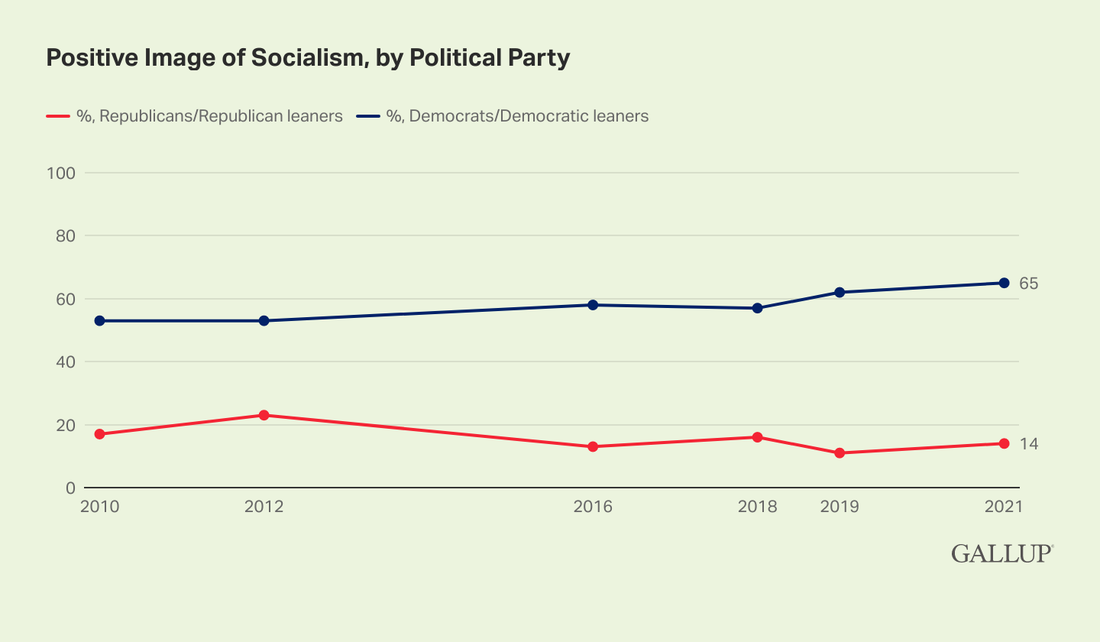
Despite over a century of anti-socialist propaganda, it is remarkable that 38% of all Americans over 18 have a positive view of socialism, according to a Gallup Poll survey (opens in a new tab) conducted in October 2021.
 
• There are 258 million Americans over 18, according to the 2020 Census. That means that 98 million Americans have a positive view of socialism. (That's different, of course, from calling yourself a socialist).
• The same poll found that 47% of Americans between 18 and 34 have a positive view of socialism.
• There are 76 million Americans between 18 and 34. That means that 36 million Americans between 18 and 34 have a positive view of socialism.
• The same poll found that 65% of Democrats (compared with 40% of independents and 10% of Republicans have a positive view of socialism. (Who are those 10% of Republicans, by the way?)
• The same poll found that 43% of women and 34% of men (over 18) have a positive view of socialism.
• In addition, 54% of non-white Americans over 18 (that's how the Gallup Poll categorized them), compared with 31% of white Americans over 18 have a positive view of socialism.
• Finally, 44% of Americans who are high school grads or less, 30% of Americans who have some college education, and 40% of college graduates have a positive view of socialism.
Gallup line chart: positive image of socialism by political party, 2010 to 2021. Democrats and Democratic leaners rise from about 53% to 65%; Republicans and Republican leaners fall from about 17% to 14%.
Any way you look at it, this is a huge number of people who have a positive view of socialism. Even if many or most of them can't specifically define what they mean by socialism, they are open to the idea.
 
The nation's largest socialist organization, the Democratic Socialists of America, has grown from about 6,000 members in 2015 to about 100,000 members today. That is larger than any socialist organization in the US since the 1920s, but it is still a tiny proportion of the people who told the Gallup Poll that they have a positive view of socialism. 
 
Plus, as we've seen in the past six years - since Bernie Sanders ran for president the first time -- a significant number of Americans are willing to vote for candidates who call themselves "socialists" or "democratic socialists." 
 
Another Gallup Poll, conducted in January 2020, found that 45% of Americans said they would be willing to vote for a socialist for president. More specifically, 76% of Democrats, 45% of Independents, and 17% of Republicans said they would be willing to do so. 
 
Currently there are more than 100 members of DSA who have been elected to municipal, county, state or national (House and Senate) offices, and many more who were endorsed by DSA. There are other candidates, like Sanders and Seattle City Council member Kshama Sawant, who identify themselves a socialists but who are not DSA members.
 
These poll results (which have been pretty consistent for almost a decade), and these election results, don't guarantee anything, but they do suggest that DSA has the potential to grow significantly if it had the resources to reach more people, That requires, however, that: 
 
(1) DSA find ways to talk about democratic socialism in ways that do not alienate people, 
 
(2) DSA's existing 100,000 members participate in – and where possible help lead - the many mass movements around the environment, labor, immigrant rights, women's and LGBTQ equality, civil rights, and other causes, 
 
(3) DSA expand its efforts to encourage members to participate in the Democratic Party (since 65% of identified Democrats say they have a positive view of socialism), which involves get involved in the party machinery and supporting progressive candidates in Democratic primaries (including candidates who are not socialists or DSA members), and 
 
(4) DSA end its self-defeating internal battles over ideological purity that undermines its ability to be more effective and reach more people.
 
Peter Dreier was on DSA’s founding national executive committee in the 1980s. He is Professor of Politics at Occidental College.

0 Comments on Food For Thought about DSA

Democracy isn’t corny but essential for equitable & decent society

4/28/2022

by David Anderson

Are the Republicans going crazy? They are banning books, criminalizing abortion, attacking public school teachers who talk about racism, passing anti-LGBT laws and indiscriminately accusing opponents of being pedophiles. Broadly speaking, this isn’t terribly popular and these issues aren’t what most people are concerned about.

Nevertheless, those issues are vehemently supported by a loud, well-funded and highly organized minority. In this midterm year, the Republicans need to win over moderate voters, but they calculate that many of them might not be paying attention.
In a New York Times op-ed in October 2020, political scientists Yanna Krupnikov and John Barry Ryan said that “most Americans—upward of 80% to 85%—follow politics casually or not at all.” Most commentators talk about hopelessly bitter partisan polarization but there is an “enormous gulf” between political junkies and the politically indifferent.

Krupnikov and Ryan note, “For partisans, politics is a morality play, a struggle of good versus evil. But most Americans just see two angry groups of people bickering over issues that may not always seem pressing or important.” On a number of issues, their survey reveals that many Americans don’t fit neatly into partisan camps: “For example, Democrats and Republicans who don’t follow politics closely believe that low hourly wages are one of the most important problems facing the country. But for hard partisans, the issue barely registers.”

Activists in the labor movement are aware of this situation. When they organize a workplace, they have to win over workers who have a variety of political viewpoints. Many working people are socially conservative or moderate, and too many voted for Trump (though the most fanatical Trump fans tend to be quite well-off). 

During get-out-the-vote campaigns, unions tend to stick to economic “bread and butter” issues. They can talk about racism and sexism but emphasize that bigotry divides worker unity and lowers labor standards for everyone.

Veteran labor journalist Steven Greenhouse notes that labor leaders this year are going to be talking about the wonky subject of saving American democracy. Shane Larson, the Communications Workers of America’s director of government affairs, told him: “Just a few years ago, some union leaders would complain, ‘Why are we focusing on these do-good democratic issues?’  They’d say we need to focus exclusively on labor rights and jobs, jobs, jobs. Now no one is complaining about this at all. There’s a real recognition that the entire labor movement has to be involved in this effort, that we have to do something for our democracy or we can lose it.”

“January 6 was a real wake-up call,” Larson said. “Part of our effort is to hold accountable a number of insurrectionists running for some of these offices.” 

Hopefully, the House’s January 6 committee will be holding hearings soon. It’s crucial that Americans realize how close we came to a fascist self-coup by Trump.

It’s hard to exaggerate how much the Republican Party has become an anti-democratic juggernaut of voter suppression, gerrymandering and administrative electoral sabotage.

A survey by the Brennan Center for Justice found that nearly 8-in-10 local election officials feel that threats against them and their colleagues have recently increased, and a majority say that they are either very or somewhat concerned about the safety of their fellow administrators.

An investigation by Reuters reporters documented a campaign of vicious and terrifying threats by Trump supporters against election officials across the country. Law enforcement took little action.

This month, the delegates and attendees at the Colorado GOP assembly and convention demonstrated that they don’t trust the state’s elections or the results of the 2020 elections. Tina Peters, the former Mesa County clerk indicted for election crimes, got the most votes for Secretary of State, and Ron Hanks, state representative for Cañon City, was the frontrunner for the U.S. Senate seat held by Michael Bennet. The party nominees will be determined in the primary.

Hanks participated in the “peaceful” January 6 rally and march to the U.S. Capitol. He admits to crossing police barriers.

He claims the insurrection was a “false flag” operation by Antifa and Black Lives Matter. 
He visited Arizona to observe the farcical Cyber Ninjas’ “audit” of the 2020 election. He promoted the
Q Anon conspiracy movie The Deep Rig, which makes unfounded claims of election fraud involving hundreds of thousands of fake ballots and hacked voting machines. 


A party led by such laughable, lying traitors should suffer a crushing defeat at the polls. But Americans can inhabit alternative realities and also choose to ignore politics. 

0 Comments on Democracy isn’t corny but essential for equitable & decent society

Whose Side Are We On? The War in Ukraine and the Crisis of the Left

4/22/2022

By Van Gosse and Bill Fletcher, Jr.
Portside
 
Whose side are we on? That is the question that anyone professing a commitment to anti-imperialism should be asking, when a sovereign nation is invaded by a Great Power.
 
Blinded by American Exceptionalism, however, many of the U.S. Left are not able to answer the question, and their silence speaks.
 
We must always oppose empire, under any heading. No nation has the right to dominate another, let alone invade and occupy it. That was the principle we as leftists affirmed in 2003, when George W. Bush led the United States into a war of aggression against Iraq.
 
We should state it plainly, in terms of international law. Aggressive war is the first crime of war, from which all the others flow. As the International Military Tribunal at Nuremberg stated, “To initiate a war of aggression, therefore, is not only an international crime; it is the supreme international crime differing only from other war crimes in that it contains within itself the accumulated evil of the whole.” 
 
Vladimir Putin has now committed this crime of war, and that is the premise from which we should analyze the crisis in Ukraine: Whose side are we on? That of the war criminals who started the war, or those who are defending their sovereignty? 
 
For ourselves, we are on the side of the Ukrainian people against an unprovoked war of aggression by an imperialist Great Power demonstrating in unmistakable terms what V.I. Lenin denounced as “Great Russian chauvinism.”
 
Here are some questions to consider.

Here are some questions to consider.
 
Does Russia have “legitimate security interests” in Ukraine and other nations bordering it?
That premise has been affirmed repeatedly by various antiwar organizations, so we need to underline: states large and small have one legitimate security interest, which is to have their sovereignty respected—not to be invaded, bombed, blockaded, or subverted.
 
That is the limit of Russia’s security interest regarding Ukraine. It has no “legitimate interest” in dominating, controlling, or dictating policy to the states bordering it, any more than the U.S. does. Many of us have spent decades denouncing the politics of the Monroe Doctrine, what Theodore Roosevelt defined in 1904 as the U.S.’s right to “the exercise of an international police power” in the Americas, which led to military occupations all over the Caribbean and Central America between 1898 and 1934, the CIA-organized coup in Guatemala in 1954, and the invasions of Grenada in 1983 and Panama in 1989. That is what it looks like when a Great Power claims “a sphere of influence.” No one claiming to be anti-imperialist should concede any legitimacy to a Russian “sphere of influence.”

But hasn’t NATO expansion threatened Russia?

As anti-imperialists we oppose militarism in any form, including permanent military pacts, and the aggressive militarism promoted by the U.S.-led NATO alliance. The best way to protect the rights of small nations is to seek demilitarization in Europe and everywhere else. But it is utterly wrong for us to dictate to nations in Eastern Europe whether or not they join an alliance because of the concrete threat that Russia poses to their sovereignty. This is the message the Left in those countries has sent us, and we must respect it as a basic principle of internationalist solidarity. We have no more right to tell them what to do than the U.S. does to pressure or subvert the government of Canada if it chose to leave NATO and conclude a treaty of friendship with China.

Doesn’t the United States share responsibility for this war?

Like all major historical events, the war in Ukraine has many causes, and many actors were involved. Focusing on what the U.S. did or didn’t do takes the focus off who started it, and absolves Russia from its sole responsibility for initiating a war of aggression. Beyond that, it betrays an Americo-centric view of the world that is at odds with reality. The United States is no longer a world hegemon, it does not determine the course of history, and presuming its centrality makes the U.S. into an exception, standing outside and above the normal relations between states.

Shouldn’t we focus on peacekeeping by opposing all weapons transfers to Ukraine?

The Ukrainians have a right to defend their country, and that includes the right to seek aid from anywhere they see fit. It is everyone’s interest to keep this war from spreading, so we should oppose any measures, such as a no-fly zone, that would widen the zone of war across international borders and draw in more nations.
 
We are not pacifists. The Left should avoid confusing pacifism, as in opposition to war in any form, with anti-imperialism. We cannot stand aside and simply condemn the violence. It is in Putin’s hands to stop the war now; until then, we take the side of the Ukrainians.
 
Van Gosse is a Professor of History at Franklin & Marshall College, and Co-Chair of Historians for Peace and Democracy.
 
Bill Fletcher, Jr. is a past president of TransAfrica Forum and a longtime trade unionist and writer.

1 Comment on Whose Side Are We On? The War in Ukraine and the Crisis of the Left

The Left is Rising, but which Left?

4/19/2022

by John Limaldi, Central New Jersey DSA
 
Many on the Left dream of the early days of the 20th century in which Eugene Debs had a chance for president and where Socialism was gaining popularity around the world. The Left in the United States was crushed for a variety of reasons, not limited to the liberalism of the New Deal “fixing” the capitalist crisis of 1929 rather than transition to socialism[1]. We see now that not only are the monopolistic giants gaining power fast[2] (with a weaker antitrust apparatus[3]) we see that the “gifts” given to workers were fragile because of their Liberal nature. The benefits excluded many industries and classes, and they remained in the privatized sphere. Combine this with the growing crisis of climate change, wage stagnation, and declining social mobility, and the class struggle is heating up. We are seeing quite clearly that the contradiction between labor and capital cannot be resolved within the capitalist mode of production. The workers are starting to accept this. 
Many members of the younger generation (here we mean Millennials and generation Z) think of socialism as social democracy if you use the Harris Poll [1], not primarily Anarchism or Marxist-Leninism. In fact they have very little awareness of those ideologies. What we can say is that the younger two generations are skeptical of capitalism both as we know it and as a system. They look across the Atlantic to see social democracies that have the highest happiness index, while the neoliberal United States falls in the rankings[2].

But it is true that the people of the United States are economically shifting to the left, and as the left begins to rise, so do its different forms.  We are going to take a brief look at what the left means.

We look at the capital L Left, which is most reasonably defined as the range of thinking and their movements that are anti-capitalist, meaning they oppose the combination of generalized commodity production, wage labor, and private ownership of the means of production that denotes the Economic system of Capitalism. These fall into two camps: Reformist Socialism, which stems primarily from Bernstein and Kautsky, and Revolutionary Socialism, which stems primarily from Lenin, with Anarchism as the Libertarian Socialist alternative to capitalism; another revolutionary school.

A central point to this article is understanding that different camps of an ideology are harder to detect in accordance with the class nature of the present society. In Tsarist Russia, the left opposition to the status quo was broadly both Liberalism and Socialism. Society was far away from modernity, and this led Lenin to advocate for all revolutionary Marxist groups, regardless of difference, to unite in the struggle against the autocracy in the form of an all-Russian political party: the Russian Social Democratic Labor Party[3].

By the same token, Lenin saw that Russia had not even achieved basic political freedoms that the West had won: freedom of the press, freedom of speech, freedom of assembly etc. It was this fact that led Lenin to advocate for Marxists to tactically support groups that struggled to bring the country closer to meeting those aims, even if in the long run they would have disagreements[4]. This two-part Lenin style strategy is exactly what the left needs today, which many organizations accept, but many Left-communists still refuse to aid in the defeat of the proto-fascists in the Republican party.

As we turn the corner into more left leaning values, the difference between the camps will become more noticeable, especially since socialism is resurging in the discourse. So let us explain broadly what the Left entails.

Democratic socialists are reformists who often want to keep the liberal separation of political powers and constitutional structures and negative freedoms, while eventually socializing the means of production into a combination of socialized industries in the commanding heights and in necessities, while leaving consumer goods, mom and pop shops, maybe intermediate goods, and luxury markets up to worker cooperatives. Contrary to the historical revisionism of raving American conservatism, an ideology such as this does not always want to go further.

Labor parties in Europe have generally fallen into this camp (there is always overlap) and have often been antagonistic to Communist movements and parties as the objective nature of class struggle is such that when different socialist camps are powerful enough to compete for State power (like the Bolshevik and Menshevik split), only violence resolves the competition between Reformism and Revolution. This is simply because revolutionaries want to fundamentally change the nature of the State’s operation, as we will explain below, whereas reformists want to either change the State more slowly or maintain the State in a slightly different form.

The antagonism between reformists and revolutionaries is what Marxists call an antagonistic contradiction, one where the contradictions that exist between these groups can’t be resolved, they can only be made dormant temporarily. The largest socialist organization in the US, the Democratic Socialist of America (DSA), lies between democratic socialism “on paper” and social democracy as the next step. Membership in this organization has been skyrocketing, led by socialists of the younger generations. This organization has many varieties of socialists, but it mainly consists of those who want to move beyond capitalism.

Revolutionary socialism on the other hand comprises two main camps, Communists, with a capital C who fall into the camp of Leninism, and anarchists. Communists are explicitly Marxist, holding that capitalist development should, or inevitably will, give way to communism, in which there is no State, no private property, no classes and no money. It is international in character, arguing for proletarian internationalism, by placing heavy emphasis on the global struggle against imperialism by discussing and supporting revolutionary movements abroad. Communists, also sometimes called “Marxist-Leninists” as the main current, argue that they eventually want to achieve a stateless, classless, moneyless society, but that the vanguard party must seize state power for that to happen.

Anarchists, on the other hand, argue that the State must be largely or completely avoided, arguing that States are tyrannical by nature, and that any party employing the state will be tyrannical, even under a socialist vanguard. Anarchists support this by saying that since the power of the capitalist derives from the State (private property rights and laws, special regulations, subsidies etc.) that to destroy the State would aid in also destroying capitalism. Anarchists thus support building up the forces of the workers without state assistance.

So which camp is on the rise? It should be clearly stated that DSA has a policy in their constitution that says expulsion is appropriate for members that work for an organization operating under "democratic centralism." Democratic centralism is the Leninist style of party organization, arguing for rigorous debate, but mandatory, unified, binding action of all members once a democratic decision is made. Thus, DSA explicitly rejects Leninist-style organization from the outset. DSA, now gaining massive support from younger members, gained around 10,000 members in the wake of the Pandemic[5]. As of 2021, DSA stands at 94,000 members.

We can also look at DSA membership in the US senate and House, as well as DSA membership at the local level as well[6]. In 2020, the DSA gained membership in the state legislatures. Over thirty DSA members and endorsed candidates were elected in sixteen states, including five in Pennsylvania and seven in New York.
DSA is not the only socialist organization on the rise. Communist Party USA gained 3,000 followers since September 2021 [7] now boasting around 5,000 members [8]. CPUSA positions itself further to the left than DSA, being inspired by Marxist Leninism, but remains engaged in the labor movement and has joined other parts of the Left in tactically supporting progressives to prevent GOP victory. Freedom Road Socialist Organization is explicitly Marxist Leninist and anti-revisionist, which saw growth in the 2010s and sits around 1,000 members currently [9].

Both DSA and FRSO advocate the Rank-and-File union strategy, in which members of the socialist organization attain jobs in clusters at key strategic industries to help unionize and leverage these sectors for worker power. Also, part of the Rank-and-File strategy is to help democratize liberal, bureaucratized unions, making them more accountable and expanding solidarity and class consciousness.

It is clear, however, that so long as the two-party system helps prevent the rise of other electable alternatives, the Left must combine its efforts to help move the United States to the left. Disagreements will always remain, but the least that the Left can do is help foster socialist sentiment in the labor movement and help defeat all GOP candidates. A just society would enable different socialist parties to battle for the support of the people, but before we can get there, we must ensure that democracy and liberty does not collapse under the specter of neo-fascism.

John Limaldi is a member of Central New Jersey DSA, and active in their Labor Commission, Mutual Aid Committee, and Social Media Outreach Team.

0 Comments on The Left is Rising, but which Left?

Report on the 2022 North Star Membership Survey

4/13/2022

by J. Hughes

The survey was fielded on April 4 to the 330 or so people who had joined North Star caucus, and to another 350 or so people who had signed a North Star statement. Of the 115 people who responded, 80% were DSA members, and 74% considered themselves members of North Star. So the response rate among North Star members was about one in four. Of those who were still members of DSA (92), 23 were considering leaving, and 20 of those are North Star members.
Survey results, number and percent of respondents: influence of sectarian organizations, 75 (65%); internally undemocratic or toxic behavior, 73 (63%); BDS Working Group controversy, 55 (48%); DSA statements on international questions, 47 (41%); congressional endorsements, including Jamaal Bowman, 43 (37%).
Only half of respondents are participating in their chapters at all, a quarter monthly or less, and a quarter more than monthly. About a third were involved in some kind of working group activism, including labor/DSLC, electoral committees, international committees and religious socialism.

In response to the question “Which issues are most disturbing about the development of DSA?” the most common complaints were toxic behavior and sectarian organizations.

The proposed “Conflicts in DSA” Zoom meeting was overwhelmingly endorsed (80%). Other Zoom meetings that respondents suggested included meetings on electoral and labor organizing, political education, new member orientations, and coalition meetings with progressive organizations.

Friends were the most common source of DSA news, followed by Democratic Left and the North Star list serv.

As to identities, we are almost all (78%) comfortable using the “democratic socialist” label for our politics. Compared to the 2021 survey of DSAers in general, the North Star respondents are more likely to be “Berniecrats,” “Democrats,” and “social democrats,” and less likely to be “Communists,” “anarchists,” and “revolutionary socialists.” We are also less comfortable just using “socialist” without the modifier “democratic.” Otherwise, it seems notable that we have roughly the same proportion of political types and interests as DSA as a whole. 

We encourage NS members to use this information in deciding upon issues, campaigns, and DSA membership.

Table: which terms would you use to describe your politics? All DSA in 2021 compared with North Star in 2022. Democratic socialist 61%, 78%; progressive 38%, 38%; socialist 58%, 38%; antiracist 56%, 36%; social democrat 16%, 36%; Berniecrat 19%, 29%; Marxist 38%, 27%; ecosocialist 34%, 25%; Harringtonite not asked, 25%; socialist feminist 25%, 24%; Democrat 9%, 24%; feminist 41%, 23%; radical 22%, 22%; Green 19%, 17%; religious socialist 8%, 11%; market socialist 8%, 10%; revolutionary socialist 17%, 9%; communist 27%, 8%; liberal 8%, 7%; anarchist 16%, 2%.
Download (For comparison, these are the results of the Summer 2021 DSA Member survey.)
(For comparison, these are the results of the Summer 2021 DSA Member survey.)
File Size: 591 kb
File Type: pdf
Download File

0 Comments on Report on the 2022 North Star Membership Survey

It’s Time for DSA Members to Rally and Help Save Democracy!

4/6/2022

by Susan Chacin, North Star Steering Committee Co-Chair
  
Democratic Socialists of America (DSA) is going through an internal crisis.  Members of the National Political Committee, NPC, have resigned and leaders from various tendencies are at odds with each other.  Many chapters have been weakened by sectarian disputes.  The details of these disagreements are less important than the fact that the dissention is distracting us from what should be our focus: building a broad political movement capable of winning influence and actual demands at the local, state, and national levels.
 
North Star, a caucus of DSA, is calling on everyone we know to organize and participate in the most urgent struggle of our times: the fight to save representative democracy in the U.S.  Many DSA members and friends are already active in such struggles.  They see that the Left has an important role to play in building people power.  As a “big tent” organization that includes a wide range of leftists, DSA members can disagree about how best to advance the struggle to meet human needs, defend working people’s rights, uproot racism, sexism and homophobia, and save life as we know it on this planet.  What we must not do is let our differences inhibit our role in building a left-center electoral force that rejects the authoritarian, right-wing assault being carried out on our imperfect democracy.  If we dare to struggle on this terrain, we have a good chance to defeat the MAGA-dominated Republican Party at the midterm elections.
The crisis in DSA is being perpetrated by ultra-leftist sectarians.  These members may believe that they represent Marxist principles, and that collaborating with people who disagree with them, whether they call themselves socialists, progressives, or liberals is a betrayal of a “correct line.”  What they are ignoring is the most important mandate of dialectical materialism: to understand the political forces in play, and defend workers’ hard-won gains in the actual contests being waged against us.  To put this in classic Marxist terms, the principal contradiction of our times is between the new alliance of capitalist elites with authoritarian neo-fascist populism attempting to destroy the growing strength of a pro-worker, anti-capitalist left mobilizing to protect and extend working people’s rights.
 
Many Democrats and socialists of all stripes were encouraged by Bernie Sanders’ campaigns and by the victories of Alexandra Ocasio Cortez and other members of the “squad.”  Pramila Jayapal’s leadership and the Progressive Caucus in Congress have shown that leftists can have an important impact even within the Democratic Party.  Favorable attention to Elizabeth Warren’s several plans for making capitalism more equitable have shown that even non-socialists can advance worthy reforms.  It is dawning on even some centrist politicians that giving voice to the needs and demands of working people of all races can be a winning strategy. 
 
Since the Occupy movement and especially since Bernie’s campaigns, the U.S. Left has seen its own progressive “spring.”  In the face of climate crisis, run away inequality, and the inadequacy of our for-profit medical system, capitalism is subject to more scrutiny than at any time since the great depression.  The tremendous growth of left-wing activity is exemplified by the Democratic Socialists of America (DSA) currently counting close to 90,000 members, up from only around 5,000 in 2015, an 18 fold increase.  The wide support for Black Lives Matter following George Floyd’s murder signifies a new awareness among white people of the effects of poisonous racism.  The MAGA movement is a backlash against this blooming Left as well as a reaction to the election of the first African American president. 

Can DSA help socialists avoid seizing defeat from the jaws of victory?

DSA’s rapid growth has brought many young organizers into leadership but it also poses serious risks based on their inexperience and alienation from more mainstream political tendencies.  The left is also plagued by resentful theoreticians of old controversies which, while they offer useful cautions, may deserve a place in the dustbin of history rather than animating endless debates about their applicability to current events.  In this climate, effective resistance to the outlandish transformation of the Republican Party into Trump worshiping neo-fascism becomes particularly difficult.  We must prevent these factors from pushing DSA into premature demands for political purity.  To do so would throw away the new respect for us as socialism among voters and organizers: we would be seizing defeat from the jaws of hard-won victory.
 
When I was a young, newly radicalized socialist in the late 1960s, I too thought that my generation was seeing the future more clearly than our elders and that revolution was just around the corner.  Now I cannot help but reflect on how arrogant we were.  We could hardly have expected to withstand COINTELPRO and its successors.  The FBI waged decades-long programs of domestic spying, assassination, and left wing disruption.  Not that we didn’t suspect that the “system” was capable of such crimes, we just didn’t imagine how vulnerable we would be to their effect.  I was spied on by an undercover Los Angeles Police Department agent in our chapter of the New American Movement, one of DSA’s two predecessor organizations.  The slimy bastard maintained a sexual relationship with a good friend of mine for years and was only exposed when it was found that he had married another LAPD secret agent.  The Left would stand much stronger if Fred Hampton, Martin Luther King, Malcolm X, and so many other less well-known leaders had not been assassinated and harassed relentlessly. 
 
It would be naïve to assume that DSA and others of our organizations are not similarly targets of government and right-wing spying and disruption programs.  The recent movie about Fred Hampton’s murder lays out a case of infiltration in tragic detail.  The best strategy for resisting the ravages of spies and agents provocateurs is not to hunt for them, it is to ask how they would be acting.  If what is taking place resembles the disruption that an agent would cause, it is time for a “time out,” and a reexamination of our organizational process.
 
Incorporating the benefit of elders’ experience with younger comrades’ expertise, it has fallen to the North Star Caucus and our allies to try to stem the ultra-leftism that is rampant in DSA.  Jamaal Bowman, Congressman from New York and a member of DSA, has been a target of this mistaken tendency.  Despite his strong progressive performance in the House, a coordinated campaign was waged against him in DSA based on his visit to Israel and votes for Israeli military aid.  This campaign incited many chapters of DSA to call for him be expelled from the organization even after the NPC voted to censure rather than expel him.  At this writing, the resulting controversy is still not resolved.  Bowman is not alone in the crosshairs of these ardent would-be revolutionaries.  They have also alleged that Alexandra Ocasio Cortez (AOC) has been soft on Israel and unable to deliver real change.  In 2020, such partisans refused Bernie Sanders’ calls to defeat Trump by supporting the election of President Biden, ignoring the crucial role Sanders had played in catalyzing the new respectability of democratic socialist positions and the growth of DSA itself.  Attacks on Bowman’s defenders, and on the DSA members who are urging support for the Progressive Caucus in Congress, have been vitriolic and threatening in a way that bizarrely echoes Right-wing rhetoric and tactics.
 
In this situation, the old adage to not let the best become the enemy of the good is more relevant than ever.  The North Star Caucus is determined to let the world know that there are life-long socialists who see the long view.  We are adamant that socialists must unite with the wide range of progressives who stand in strong opposition to the neo-fascists reigning in the Republican Party.  Seeing DSA members turning on elected representatives, many of them “people of color,” who have been carrying the standard of socialism bravely into Congress and the public marketplace of ideas is intolerable.  It summons the old sarcastic joke that when the Left appoints a firing squad, we draw up in a circle.
 
This ultra-Left dogmatism plays into the hands of the right-wing commentators on all platforms who are busy trying to resuscitate Cold War fears linking socialism to authoritarian communism.  Pro MAGA voices are all too happy to claim that calls to end brutality and murders of Blacks and protesters all amount to an Antifa agenda of abolishing or defunding the police.  Republican politicians in Congress and state legislatures have animated the fiction that educating young people about the history of our country and the legacy of slavery amounts to preaching hate for Whites.  Reproductive rights have been extinguished in many states and anti-gay and transgender repression is resurgent. And all of these measures, the right-wing talking heads claim, are necessary to stem the socialist agenda of abolishing the White Christian nation’s virtuous regime of world leadership.
 
It is by no means certain that the Democratic Party will lose control of Congress in the mid-term elections this year.  But that prospect, so deeply scary in the climate of Trump’s dominance over the Republican base, is made more likely by ultra-Left intolerance for the broad spectrum of progressive forces.  These dogmatic radicals make unity in defense of voting rights more difficult if not impossible.  Recent demonstrations of this dangerous tendency in Texas showed the Austin chapter of DSA refusing to participate in the successes enjoyed by Jessica Cisneros and Greg Casar.  These candidates were hailed nationally for standing up to the ultra-Right.  Thousands of primary ballots were thrown out by elections officers in the election due to newly instituted voter suppression laws.  But where were DSA members?  Not only was DSA missing in action, we actually alienated our allies in a state struggling to withstand vicious attacks on reproductive rights, racial justice, and immigrants.
 
Now that the world’s attention is focused on Putin’s aggression against Ukraine, we have seen another expression of DSA’s Achilles heel.  While condemning the invasion, the DSA National Political Committee’s statement on the war included a reference to NATO’s growth as provoking Russia’s attack, and called for U.S. withdrawal from the alliance.  With European democracies on high alert for further Russian aggression, DSA has placed itself in an untenable position of saying “a plague on both your houses.”
 
This is why the North Star Caucus of DSA is speaking out.  We are urging the National Political Committee to endorse DSA members who have represented us in Congress for re-election if they request it.  If “endorsement” is too strong a form of support for a candidate, DSA could develop other terms or categories to use in collaborating with community organizations and campaigns.  Slate cards can recommend votes for people without explicitly endorsing or state that electors should vote against other candidates.
 
We are also alerting the whole organization to the dangers of ultra-Left intransigence such as demanding unquestioning support for the Boycott Divestment and Sanction (BDS) policy from candidates.  North Star in no way accepts Israel’s policies and its oppression of Palestinians.  But BDS should not be a litmus test for support of progressive candidates.  DSA is too valuable an organization to be overtaken by dogmatic politics.  Whether our internal opponents are acting from an abundance of socialist optimism or a more partisan effort to draw us apart from liberal and centrist allies, North Star insists that DSA must reject ultra-leftism and secure its position as the socialist voice in a united front against the racist, authoritarian elements that are attempting to destroy the Left and representative democracy.
 
What can North Star do toward these ends?  We urge DSA members to join North Star and our “Democracy Defenders” project.  North Star plans to reach as many chapters and members as possible to find out how they are supporting voters rights, campaigning for progressive candidates, and working with other grassroots organizations to turn out voters.  DSA members who belong to labor unions can support active labor engagement in support of progressive candidates.  We plan to build communication, coordination, cooperation, and ultimately collaboration among as many individuals and groups as we can.  Each state and locality is different, but there are strategies suited to increasing electoral engagement in any setting.
 
If you agree with this assessment, there are many ways to spread the word that members of DSA are rejecting sectarian purity and organizing both inside DSA and with other comrades on the Left.  Here is an example of an “elevator speech” you could read at a DSA chapter meeting or local event, or use to contact comrades you know around the country:
 
I am a member of a group of DSA members determined to mobilize to defeat the neo-fascists currently dominating the Republican Party. We believe that the principal contradiction in the struggle for human rights today is the threat of a right-wing takeover in the U.S.  The North Star Caucus of DSA is uniting with the many organizations working to defeat the racist, authoritarian bullies who are bent on destroying representative democracy in this country.  DSA is going through a crisis, due in part to our “big tent” philosophy and the large number of new members who flocked to the banner of democratic socialism.  We insist that as we find ways to disagree, we join hands to win “non-reformist reforms” by electing democrats and left-wing independents and defeating Republicans at every level of government. Join us!
 
Click here to join North Star Caucus and the Democracy Defenders (opens in a new tab)
 
Susan Chacin, Co-Chair of the DSA North Star Caucus Steering Committee served two terms on the DSA National Political Committee 1999-2002 and was a co-facilitator for the East Bay DSA local for about 17 years.

1 Comment on It’s Time for DSA Members to Rally and Help Save Democracy!

To Save Democratic Socialists of America: “You Don’t Know What You’ve Got ‘Till It’s Gone”

4/1/2022

Max Sawicky (opens in a new tab)

In the U.S., upsurges from the left have come and gone. In recent decades there were mass demonstrations against predatory finance at ‘Occupy Wall Street,’ which turned out to set the stage for the Bernie Sanders’s campaigns in 2016 and 2020. I was well pleased by the breakthroughs in public awareness fostered by Sanders, as well as by the parallel, explosive growth of Democratic Socialists of America (DSA).

After my years in the political wilderness, I thought, “Isn’t this lovely. Bernie has broken the ice on socialist rhetoric in top-level U.S. political discourse, and the adorable Bernie youth are swelling the ranks of an explicitly socialist organization. Now I will join too.”
To my way of thinking, socialism is not an all-or-nothing thing. Victories accrue in increments, and the two-party system is hard-wired into the U.S. political process. To borrow from an old slogan, there is no way to democratic socialism. Democratic socialism is the way. The real action is in the national, state, and local legislatures, spurred on by non-violent mass mobilization. The system is rigged against third parties, and nobody is smashing the State.

Progressive policy change occurs through a complementary combination of mass mobilization and the initiatives of the most liberal Democrats in elective office. This path can be tedious and frustrating, and evidently it has driven many former Bernie partisans around the bend. Even so, the Sanders upsurges have given rise to an increasing number of avowed socialist members of Congress. Over one hundred members of DSA itself have won election to public office.

Now all of those gains are threatened, on two fronts.

From the Right, we face the rise of the anti-democratic Trump movement, openly dedicated to violent takeover and liquidation of all opposition from the left. The Democrats’ feeble resistance to this movement is immediately at risk of being extinguished by the likelihood of unfavorable outcomes in the national elections of 2022 and 2024. Now more than ever is the time to fight this future.

From the Left, the leadership of DSA has been intent on disarming the organization it is charged to lead by consistently ignoring the fascist threat and by holding itself aloof from necessary alliances with anti-fascist forces, both to resist Trumpism and to push for advances in democratic socialism.

Contradictions in DSA doctrine and practice have been growing for some time. The greatest one is the growing distance between the organization and our most progressive politicians, including some who are DSA members. Because the same motivation underlies support for Bernie and ‘The Squad,’ and the growth of DSA, something has got to give.

The most recent blow-up transpired around the trip to Israel of the newest Squad member, Rep. Jamaal Bowman of New York. Bowman met with Palestinians and Israeli peace groups, but he also sat with the Israeli Prime Minister, the execrable Naftali Bennett. Bowman also voted for U.S. funding of Israel’s “Iron Dome” missile defense system.

Bowman’s trip and vote were seized upon by purportedly left-of-left elements in DSA, including the leadership. Calls for his censure and/or expulsion from DSA have issued from an assortment of DSA chapters and other groups. Besides the sophomoric talk about his sit-down with Bennett (politicians meet with political adversaries all the time), the principal objection was Bowman’s purported violation of the Boycott/Divestment/Sanctions (‘BDS’) strictures on contacts with Israelis.

In lame gestures towards labor from our heavily bourgeois leftists, this has been described as a ‘picket line.’ It’s not a fucking ‘picket line’!

One has to wonder if this brouhaha is really about Palestine, for several reasons.

·  Bowman has been defended by Palestinian leaders in the U.S., including Rep. Rashida Tlaib.

·  Bowman has not been criticized by the leaders of BDS, on the ground, in Palestine.

·  Bernie Sanders and other members of The Squad have taken the same position on Iron Dome as Bowman but drawn no denunciations from DSA. It’s some weird kind of opportunism for a lefty faction to attack a progressive African American politician for the same politics espoused by white pols. But nobody is accusing these critics of political sophistication.

·  Bowman himself had the same positions when DSA explicitly endorsed him, when he first ran for office in 2020, not incidentally replacing one of the most rabid pro-Israel members of Congress.

· Bowman is much better on Palestine than almost all Democratic politicians, though he stops short of supporting BDS.

· Many of Bowman’s constituents are Jewish and easily riled by suspicion of excessive hostility to Israel, which a pro-BDS posture automatically triggers.

· The fact is that the Congressional districts in the U.S. where a BDS endorsement would be tolerated by voters can be counted on the fingers of one hand. Insistence that Bowman support BDS implies his inevitable replacement by a strident pro-Israeli Democrat like the one he replaced.

The root of all this is that DSA has been taken over by people who lack political common sense and are not democratic socialists. This is unfortunate because the nation badly needs a strong democratic socialist organization. What DSA instead trends towards is another sectarian outfit that drives away its most capable members and likely supporters.

There are many more Bernie people out here than the DSA leaders holding back the organization, whom nobody has ever heard of. The millions who have to be disappointed by the performance of Democratic Party leaders still have an opportunity to get effectively active. DSA provides that option, but the opportunity it signifies will not be available for long.

There are other progressive groups doing the Lord’s work, such as Justice Democrats and the Working Families Party, but none have the reach of DSA, and none are explicitly socialist. The meanings of socialism are diverse, but the brand is politically salient. As a signpost, it points to a full spectrum of objectives worth striving towards.

A 2022 Republican victory will roll up pending investigation and prosecution of the miscreants of January 6. A 2024 victory will roll up everything else. At that point, the window for any sort of Left will slam shut.

Sensible progressives can find groups other than DSA that are working to prevent a Republican victory in 2022. Of course it would be preferable for DSA to get involved as well, including working in cooperation with the broader Left. DSA holding itself apart from this struggle will have a negative impact on its own future, and because of that, will detract from the Left in the U.S.

Max Sawicky serves on the Steering Committee of the North Star Caucus.

3 Comments on To Save Democratic Socialists of America: “You Don’t Know What You’ve Got ‘Till It’s Gone”

Cesar Chavez, Dolores Huerta and Strategic Racism

3/31/2022

Black-and-white photo of Cesar Chavez in profile, with Duane Campbell behind him, 1972Cesar Chavez and author Duane Campbell, 1972,
from Democratic Left (opens in a new tab) and Talking Union (opens in a new tab)

On March 31, 2022,  Eleven  states will hold holidays celebrating  labor and Latino Leader Cesar Chavez. 
Let us be clear.  Chavez was religious, but he was not a saint. Neither were the growers, their  Teamster collaborators, nor corporate agribusiness saints.  Celebrations should not be about hero worship or uncritical praise, nor  should we ignore the present oppression of farm workers in the U.S.  

What they did  accomplish along with Philip Vera Cruz ,  Marshall Ganz, LeRoy Chatfield, Gil Padilla, Eliseo Medina and  hundreds of others was to   organize in California the first successful farm worker union against overwhelming odds. 

Each of the prior attempts to organize a  farm worker union  had been  destroyed by racism and corporate power.Chavez, Huerta, Philip Vera Cruz, and the  others deliberately created a multiracial union; Mexican,  Mexican American, Filipino, African-American, Dominican, Puerto Rican and Arab workers, among others, have been part of the UFW.  This cross racial organizing  was necessary in order to combat the  prior divisions and exploitations of workers based upon race and language. Dividing the workers on racial and  language lines, as well as immigration status  always left the corporations the winners.
 
The violent  assaults  on the farmworkers and UFW from 1960- 1980  along with the current reconquest of power in the fields  by corporate agriculture are examples of strategic racism, that is a system of racial oppression created and enforced because it benefits the over class- in this case corporate agriculture and farm owners.  Strategic racism as described by Ian Haney López  in Dog Whistle Politics: How Coded Racial Appeals Have Reinvented Racism & Wrecked the Middle Class ( 2014) is the development and implementation of  racial practices because they benefit a group or a class. 
 
Chávez chose to build a union that incorporated the strategies of social movements and community organizing.  They allied the union   with churches, students,  and organized labor.  The successful creation of the UFW changed the nature of labor organizing  in the Southwest  and contributed significantly to the growth  of Latino politics in the U.S.
 
The UFW and Chavez and Huerta have always had severe critics from the Right and  from corporate agriculture. Dolores Huerta  has  been  banned from the history text books in Texas and Arizona as too radical. Both also have critics from the left.  
 
Miriam Pawel in The Union of Their Dreams: Power, Hope, and Struggle in Cesar Chavez’s Farm Worker Movement(2009)  uses individualist, personality driven reporting to assert  that Chavez himself organized “Witch hunts” to expel union staff who disagreed with his leadership.  (See Steve Early’s essay (opens in a new tab)on Talking Union.) And, she argues that UFW support organizations “parlayed the memory of Cesar Chavez into millions of dollars of public and private donations.” (p.329).   These charges are well refuted in a review (opens in a new tab)of the book by LeRoy Chatfield of the Farmworker Movement Documentation Project. Yet they continue to be repeated as factual in other labor sources (opens in a new tab). 

On the other hand, Cesar Chavez was given the U.S. Presidential Medal of Freedom posthumously in 1994, and Dolores Huerta (a DSA honorary chair) was given the Medal of Freedom in 2012.  They have schools, scholarships, foundations, organizing institutes and political organizations named after them.  Few labor or Latino leaders have achieved such positive recognition.   

What the left critics allege

Frank Bardacke’s Trampling Out the Vintage: Cesar Chavez and the Two Souls of the United Farm Workers. (2011), Verso. is the view of a well- informed observer  who  worked in the lettuce fields near Salinas as is Lettuce Wars: Ten Years of  Work and Struggle in the Fields of California (2012) by Bruce Neuberger.  These books, along with Pawell’s have been reviewed in prior posts on Talking Union.  See review here (opens in a new tab). 

These books argue  a peculiar point of view:   they  strongly and persistently imply that the  current  problems of exploitation of workers  in farm labor was caused by the destructive behavior of  Cesar Chavez,  his instability, and his ego  - not by corporate agriculture; not by the racist state in rural California.

On the other hand Cesar Chavez was  given the U.S. Presidential  Medal of Freedom posthumously  in 1994, and Dolores Huerta ( A DSA Honorary Chair) was given the Medal of Freedom in 2012.   Teaching materials and videos have been made recording their work.  Schools, scholarships, foundations,  organizing institutes and political organizations  have been named after them.  Few  labor or Latino leaders  have achieved such positive recognition.   

I, for one, wonder why these authors and some  other left writers  see the major problem as the growth of  what they see as a legend and myths about Cesar Chavez ( and recognition of the UFW) rather than the major problem being the role of corporate agriculture, exploitation and racism.

When writers take this view,  they then  need to explain why and how the parallel decline of the Teamsters, the ILGWU, the Auto Workers , the Steelworkers, the IAM, and other unions  occurred during this  same era.   Compare the period of decline of 1977-1986 in the UFW to the complex battles of  the Reuther Brothers to gain control and to keep control of the  United Auto Workers, including the UAW’s relationship with the AFL-CIO . (1949-1970).  The UAW went from 1.5 million members in 1979 to 390,000 in 2010, and the United Steelworkers and other unions  suffered similar declines. 

It doesn’t require a theory of emotional instability and personal interventions  to explain that the smaller, less established, less well funded  union – the UFW-  suffered dramatic  declines  from racial oppression and the brutal assault on the union  in the fields of  Texas, Arizona and California.

The above critics under play the role of the corporate assault on unions, and in particular the assault on a union led by  Mexican American leaders. This was, after all,  the era when  Ronald Reagan came to power in California along with the organization of the forces that came to be called neo-liberalism.  It was also a time of  consolidation of racial power in agriculture.  (Marshall Ganz, who was a leader in the union and a participant in the internal struggles, tells a more complex and more complete story in his 2009 book, Why David Sometimes Wins. See the review (opens in a new tab)in Talking Union.) 

This isn’t to say that Chavez, Huerta and many on the UFW Executive Board  did not have shortcomings.  They did.  Ganz describes  several of these in his  book and in interviews he participated in for the new book, From the Jaws of Victory by  Matt  Garcia (2012).  Ganz provide some well researched and insightful observations on the dynamics of a union trying to transition from a movement to a union- or to something else.   This analysis is helpful to organizers trying to build unions. 

There were conflicts and internal contradictions.  Not many movements last for even ten years let alone thirty.    In addition to the assault from corporate agriculture, the Republican Party, Ronald Reagan, neoliberalism and racism, the UFW was confronted  with internal union struggles for democracy,  an intra union assault by the Teamsters,  and with the tumultuous and disruptive  politics on the left in the 60’s and 70’s. 

In my opinion, Bardacke, Pawell, and Neuberger under analyze the nature of the racial state and  the interaction of racial and economic oppression in the fields.  And, these critics significantly  failed  to see the they dynamics of  the struggle for  Chicano/Mexican American self determination within the UFW. 
The role of racism, and the individual reactions to systemic structural racial oppression are complex and  vary in part based upon the differences in experiences of the participants.  As the Chicano movement argued at its core- the experiences of U.S. born and reared  Mexican Americans and Chicanos were different than the experiences and the perceptions of racism of Mexican immigrants, both documented and undocumented.   There are a diversity of racisms and a diversity in the manner in which workers   learn to respond  to oppression.  Chicanos and Mexican Americans grew up, were educated, and worked in an internal colony.  Their schools, their unions, and their political experiences were structured along racial  lines.  They learned colonized structures.  The authors do not sufficiently  acknowledge the struggle of the UFW and the Chicano Movement in breaking this colonial legacy. 

Marshall Ganz in Why David Sometimes Wins,  does a better job of describing the internal dynamics of UFW organizing- after all he was there.  He describes  some of the racial fault lines of  farm worker organizing.  Ganz was the director of organizing  for the UFW in Salinas and a long time member of the UFW executive board.

Chavez knew well some of  the failings of unions  in the 1960’s, including  the problems of a growing internal bureaucracy, but the UFW in the 1980’s  was not able to create a viable  democratic union movement.  Marshall Ganz argues that Chavez deconstructed the organizational strength of the UFW in the 1979 -1981 period in an effort to keep personal control of the union.  (Ganz, p. 247 ) 

The critics  who blame individuals for the union’s decline  also miss the important rise of Latino politics in the Southwest today.   Chavez and the UFW played  a significant role by training  generations of future leaders as organizers as is well described  in Randy Shaw’s, Beyond the Fields: Cesar Chavez, the UFW, and the Struggle for Justice in the 21st. Century.   The UFW was a  place  where hundreds learned organizing skills, politics, discipline, and how to work in multi racial  movement politics – skills needed by many on the left.   Today hundreds of union and community leaders, particularly in California are veterans, trained in for the long distance struggle of  the UFW. 

The Current Situation – Strategic Racism

 The movement led by Cesar Chavez , Dolores Huerta  and others  created a union and reduced the oppression of farm workers for a time.   Workers learned to not accept poor jobs, poor pay,  unsafe working conditions as natural or inevitable.  Then the corporations and the Right Wing forces adapted their strategies of oppression.  
            
The assault on the UFW and the current reconquest of power in the fields are examples of strategic racism, that is a system of racial oppression created and enforced because it benefits the over class- in this case corporate agriculture and farm owners.  The current renewed oppression is a product  of strategic racism including  a complex structure of institutions and individuals from police and sheriffs, to immigration authorities and anti immigrant activists, and elected officials and their support networks.  These groups foster and promote inter racial conflict, job competition, and anti union organizing,  as strategies  to keep wages and benefits low and to promote their continuing white supremacy in rural California. 

As the union was weakened by the Right Wing corporate assault, the conditions in the fields returned almost to their prior level of exploitation.  The Agricultural Labor Relations Act had it budget cut  by 30 % for years under Governor Deukmejian in 1982- 1986 along with other assaults on the law.   Now, thousands of new immigrants harvest the crops and only a small percent are protected by  union contracts.  Over 200,000 indigenous workers, mostly from Mexico, harvest the crops in the Southwest.  They are Mixtec, Zapotec, Triqui and more.  They do have a few health, safety and wage protection by California labor laws,  along with the right to  farm worker collective bargaining elections and binding arbitration  established significantly by the political activity of the current UFW – more than farm workers have in any other state.  For a record of this period see David Bacon’s,  The Right to Stay Home: How US Policy Drives Mexican Migration (2013). 
 
Duane Campbell is a professor emeritus of bilingual multicultural education at California State University Sacramento, a union activist, and a former chair of Sacramento DSA.  He was a volunteer for the UFW from 1972- 1977. He is the Director of the Mexican American Digital History project. www.MexicanAmericanDigitalHistory.org

0 Comments on Cesar Chavez, Dolores Huerta and Strategic Racism

Putin Is Attempting to Center Russia as a Hub of the Global Right Wing

3/29/2022

Carl Davidson & Bill Fletcher Jr., 
From Truthout

In the current crisis, the left needs a full and thorough understanding of Vladimir Putin and his aspirations for Russia. We have been troubled by some of the statements from the U.S. left concerning the invasion of Ukraine. It seems when confronted with a complex array of contradictions, too many have lost an ability to sort out and grasp the principal contradiction: the Putin regime’s effort to subjugate Ukraine, end its sovereignty and deny its right to exist independently.
“Modern Ukraine was entirely created by Russia, more precisely, Bolshevik, communist Russia. This process began immediately after the revolution of 1917,” Putin said in a televised address in February. “As a result of Bolshevik policy, Soviet Ukraine arose, which even today can with good reason be called ‘Vladimir Ilyich Lenin’s Ukraine.’ He is its author and architect. This is fully confirmed by archive documents…. And now grateful descendants have demolished monuments to Lenin in Ukraine. This is what they call decommunization. Do you want decommunization? Well, that suits us just fine. But it is unnecessary, as they say, to stop halfway. We are ready to show you what real decommunization means for Ukraine.”

Putin here is clear enough: “Ukraine has no national rights that Russians are bound to respect. Prepare for reunification, reabsorption, or some other euphemism for subaltern status with Mother Russia.”

The difficulties among our left, however, are still understandable, given there are other major contradictions in this terrain. NATO’s expansion and press toward Russia’s border is a prominent one. The tension between the U.S. and the European Union regarding military expenditures in their respective budgets is another. Then there is the rise of pro-Putin right-wing populist parties in most European countries, with an echo in the U.S. right wing as well. The EU’s conflict with the Global South, both in military campaigns and refugee crises, also come into play. And in Ukraine, there are also the actual fascists of the Svoboda party and its armed militia — though their influence was sharply reduced by the recent election of Zelenskyy. And in both Russia and Ukraine, there are class and democratic conflicts with corrupt oligarchs among ruling elites.
Getting clear for the sake of both strategy and tactics will require a deep examination of Putin’s Russia and its political character and direction.

It is well known that Putin entered Russian elite circles as a KGB officer. Less well known are the circumstances of his rise. House of Trump, House of Putin, by Craig Unger tells the story: As a working-class youth in the old USSR, Putin’s sole ambition was to be an intelligence officer. The KGB told him to go to law school first, where he did well. After his KGB training, he was stationed in the German Democratic Republic (East Germany) to a mid-level position. When “the wall” came down and the USSR broke up, he was out in the cold. He made his way back to St. Petersburg, driving a cab to survive and hanging out in martial arts gyms, since he was reportedly good at judo. Along with sport and social solidarity, the gym crews also ran a lucrative drug trade, selling heroin from Afghanistan, among other contrabands. Putin used his money and connections politically, getting connected, first, to the city’s mayor, and later, to Russian President Boris Yeltsin. At every step, he brought his judo friends with him. They served as a “security” force and were rewarded with escalating levels of corruption in taking over the country’s wealth via trade and buyout deals. They remain with him today as the core oligarchs in his inner circle. It is said that Putin’s political rule is a three-legged stool — his loyal gangsters, the new intelligence operatives and state bureaucrats.

Under Yeltsin, the new Russian Federation was in considerable turmoil. U.S. neoliberal think tanks held sway for a time with a “privatize everything” policy that soon produced the ruling order accurately named a “kleptocracy.” It caused living standards to fall, along with life expectancy. Chechnyan fighters were wreaking havoc. On his way out, Yeltsin put Putin in charge, and to Putin’s credit, he got an economy functioning via central control of Russia’s immense oil and natural gas wealth. He also brutally crushed the revolt in Chechnya. Putin gained a popular majority for himself, if not for the semi-gangster crew around him.

After the Yeltsin years, the Russian Federation settled into a “Presidential Parliamentary” system, wherein the elected president picks the prime minister and cabinet. He can dismiss both, but parliament can only dismiss the prime minister. This shifts primary power to the executive, and Putin has made much use of it. After being elected as an independent, he oversaw the formation of his United Russia Party, which has always won solid majorities, partly because serious opponents have been jailed or otherwise forbidden to run. The Communist Party of the Russian Federation (CPRF) serves as a sizable but still second-place loyal opposition to United Russia, while the Liberal Democratic Party (LDP) serves as a more secure backup to the otherwise dominant United Russia. The LDP, as many wryly note, is neither liberal nor democratic — nor is it much of a party. Its politics are a mixture of right-wing populism and a monarchism connected with the Russian Orthodox Church.

Putin, closely aligned with the church, embraces the right-wing populism of the LDP as well. But his “conservative” politics have deeper roots. Some might think that as someone who was both a KGB operative and trained through a USSR law school, Putin might have some underlying fidelity to Marxism. If so, they would be wrong. How so? Note that Putin, as a KGB officer, had intimate knowledge of how the USSR actually worked. Then in the Yeltsin period, he watched the sweeping theft and privatization of vast state resources by the top sectors of the old Communist Party of the Soviet Union (CPSU) elites and their criminal hangers-on. If he had any illusions, they quickly evaporated.

Putin took charge in 2000. A few years later, in 2006, he visited the Donskoy Monastery cemetery in Moscow. He placed flowers on the new graves of three prominent Russians he had reinterred there: Gen. Anton Denikin, philosopher Ivan Ilyin and writer Ivan Shmelev. Many leftists will recognize the name Denikin, a military leader of the counter-revolutionary “whites” who tried to overthrow Lenin and restore reactionary rule. Shmelev is a lesser-known individual to us, but he was a popular Russian writer who joined the “whites.” (“Whites” was the term used during the Russian Civil War to denote the myriad counter-revolutionary forces. The “Reds,” of course, were the Communists.)

Ivan Ilyin is the most obscure and most important today. Ilyin was a Russian nationalist philosopher in Lenin’s time who turned fascist, even moving his work to Germany under the Nazis in the 1930s. Putin now has his officers studying Ilyin, along with Ilyin’s follower today, Alexander Dugin, a modern Russian fascist and favorite of Steve Bannon, formerly of team Trump. Both Ilyin and Dugin are theorists and advocates of “Eurasianism,” a worldview asserting that dominance of the central land mass “homeland” of both Europe and Asia is the key to world hegemony.

The point? Far from wanting to be a “new Stalin,” Putin’s dreams are more in tune with wanting to be a new Tsar of the Eurasian ”Third Rome.” The first “Rome,” naturally, was Rome (i.e., the Roman Empire), and the second was Constantinople (i.e., the Byzantine Empire and the Eastern Orthodox Church). When that center of the Byzantine Orthodox world fell to Islam, the Orthodox church moved north and eventually settled in the Moscow of the Tsars, thus the “Third Rome” to save the Orthodox church and all Christendom. Today’s Russian Orthodoxy, as well as Putin, see the main challenge to the church in the values of Western liberalism and the corrupting ideas of the Enlightenment, especially notions of equality that extend to the defense of LGBTQ+ people, the right to abortion and related causes. Putin’s jailing of the feminist rock group Pussy Riot is a case in point. A good number of U.S. Christian nationalists also look to this side of Putin as today’s anti-liberal chief defender of Christendom worldwide.

Putin claimed these departed anti-Lenin and anti-Soviet “whites” were “true proponents of a strong Russian state” despite all the hardships they had to face. He stated, “Their main trait was deep devotion to their homeland, Russia; they were true patriots” and “they were heroes during tragic times.” He also placed red roses on the grave of the prominent Russian monarchist, writer Alexander Solzhenitsyn, who was also laid to rest there.

“Eurasianism,” as the term suggests, stretches from the Great Wall of China to the coasts of the United Kingdom. To unite “the homeland,” then, requires purging all of Europe, especially the West, from the “Atlanticist” influence of the U.S. and the U.K.

“Proponents of this idea,” write Anton Barbashin and Hannah Thoburn in Foreign Affairs, “posited that Russia’s Westernizers and Bolsheviks were both wrong: Westernizers for believing that Russia was a (lagging) part of European civilization and calling for democratic development; Bolsheviks for presuming that the whole country needed restructuring through class confrontation and a global revolution of the working class. Rather, Eurasianists stressed, Russia was a unique civilization with its own path and historical mission: To create a different center of power and culture that would be neither European nor Asian, but have traits of both. Eurasianists believed in the eventual downfall of the West and that it was Russia’s time to be the world’s prime exemplar.”

The task of purging Europe of Atlanticism — its various forms of liberalism, socialism and social democracy — requires Putin allies within each country concerned. Hence over the past decade or so, we have watched Putin’s growing support, both financial and political, for a variety of right-wing populist parties and politicians. The Pew Research Center in 2017 published a study examining the trend of Europeans who favor right-wing populist parties being significantly more likely to express confidence in Putin. “The largest increases in confidence were in Germany and Italy, where 31% of the public in each country expressed confidence in Putin in 2016 compared with 22% of Germans and 17% of Italians in 2012,” the study says. “Notably, the survey was fielded before revelations of Russian hacking in the U.S. presidential election and the subsequent increase in anxiety ahead of European elections.”

It continues:
Within these countries, those who hold favorable views of right-wing populist parties — like the Alternative for Germany (AfD) or Italy’s Northern League — are more likely to express confidence in Putin than those who hold unfavorable views of those parties. Just about half of those who give positive ratings to the AfD and 46% who favor the Northern League say they are confident Putin will do the right thing regarding world affairs. In France, those partial to the right-wing National Front (FN) are about twice as likely as those with negative views of the FN to say they are confident in Putin’s leadership (31% vs. 16%). And those who view Geert Wilders’ Dutch Party for Freedom favorably are nearly three times as likely as the party’s detractors to express confidence in Putin (26% vs. 10%).

Putin may have miscalculated in his invasion of Ukraine, not only in terms of underestimating Ukrainian resistance, but also in terms of the response by forces on the political right around the globe. Putin seems to have underestimated the force of national identity among those trying to assert national identities and sovereignties of their own that they see challenged. This has traditionally been a difficulty for forces on the far right internationally, i.e., how can one be an internationalist when one is a fervent right-wing nationalist? As Jason Horowitz writes in The New York Times:

Marine Le Pen, the leader of the far-right National Rally party — which received a loan from a Russian bank — declared Russia’s annexation of Crimea was not illegal and visited Mr. Putin in Moscow before the last presidential elections in 2017. While she opposes NATO, Ms. Le Pen denounced Mr. Putin’s military aggression on Friday, saying, “I think that what he has done is completely reprehensible. It changes, in part, the opinion I had of him.” Her far-right rival in the presidential campaign, Éric Zemmour, has in the past called the prospect of a French equivalent of Mr. Putin a “dream” and admired the Russian’s efforts to restore “an empire in decline.

Like many other Putin enthusiasts, Zemmour doubted an invasion was in the cards and blamed the United States for spreading what he called “propaganda.” Horowitz runs through a number of other European countries and their rightist leaders with similar results.

At least one voice on the U.S. right is standing firm. Pat Buchanan has written a string of columns backing both Putin’s nationalist and religious “traditionalism.” Even with the invasion unfolding, he explains, “Putin is a Russian nationalist, patriot, traditionalist and a cold and ruthless realist looking out to preserve Russia as the great and respected power it once was and he believes it can be again.” He favorably compares Russia’s takeover of Ukraine to Teddy Roosevelt and Panama. (Roosevelt’s administration orchestrated the secession of Panama from Colombia and blocked Colombian troops from putting down the rebellion.)

Tucker Carlson on Fox News has been carrying on in a similar vein with more half-baked notions. Carlson, who has been accused of being “one of the biggest cheerleaders for Russia” during the conflict, asked viewers whether Putin had called him a racist or promoted “racial discrimination” in schools, made fentanyl, attempted “to snuff out Christianity” or eaten dogs. “These are fair questions,” claimed Tucker, “and the answer to all of them is ‘no.’ Vladimir Putin didn’t do any of that, so why does permanent Washington hate him so much?”

So, what does this tell us?

For much of the left, exclusive opposition to U.S. imperialism is equivalent to being on the “right side” of history. This is frequently articulated in terms of the notion that the priority for the U.S. left must be opposition to U.S. imperialism.

The problem here is that, first, it ignores that the U.S. is not the sole source of global violence and oppression on this planet and, second, that there have been times when the U.S. left has had to focus elsewhere, e.g., support for the Spanish Republic in 1936 in the face of a fascist uprising and the intervention of Italy and Germany. This reality coexists with the fact that the U.S. had not ceased to be imperialist.

What our examination should remind us is that Putin is part of a global right-wing authoritarian movement that seeks to “overthrow” the 20th century. In Putin’s specific case, we are looking at a complete repudiation of the founding principles of the USSR, most particularly, the notion of the right to national self-determination. But what is also underway is the positioning of Putin-led Russia as a pole for the global right. Opposition to socialism, for sure, but also opposition to constitutional rule as a whole.

A mistake made by several anti-imperialists, in the 1930s and early 1940s, was to see in Imperial Japan a savior from Western colonialism and imperialism. It is to the credit of communists such as those of the Viet Minh in Vietnam, the Communist Party of the Philippines and the Communist Party of China that they could see through the alleged anti-imperialism of Japan and recognize that what was being introduced through the so-called Greater East Asia Co-Prosperity Sphere was not “co-prosperity” but capitalist domination under Japan and a racial subordination of entire populations.

We should ponder this history as we reflect on Putin’s obsession with Eurasia and the white supremacist, homophobic, sexist, religious intolerant politics that rest behind that one term.

0 Comments on Putin Is Attempting to Center Russia as a Hub of the Global Right Wing

In Support of DSA’s Democratically Elected Leadership

3/21/2022

(We urge all DSA members to sign on to this letter. A link for that purpose is here (opens in a new tab).)

We, the undersigned DSA members, support the NPC’s unfortunate but necessary decision to decharter the BDS Working Group and move DSA’s critical BDS and Palestinian solidarity work to the International Committee. The BDS Working Group’s actions, as detailed by DSA’s National Political Committee, undermine legitimate decisions made by the NPC and are straightforwardly antidemocratic.  Whatever one’s position on the calls to expel Jamaal Bowman from DSA—indeed, on any of the hotly contested internal debates within the organization— national working groups and other similar entities must be subject to democratic governance.

DSA’s working groups and committees do crucial work carrying out democratically decided priorities, resolutions, and strategies. Some of these bodies are appointed by the NPC; others are self-selecting; all are subordinate administrative bodies that do not have the right to set DSA’s policy on behalf of our over 90,000 members, or to make strategic and tactical decisions that directly undermine the elected leadership of the organization.
While informal caucuses and individual members are rightly empowered to dissent from official organizational decisions, the use of official working group resources to undermine DSA’s official positions damages our capacity to function as a coherent political entity and makes us vulnerable to attacks from our enemies. As DSA matures as an organization, we must guard against the possibility of small factions co-opting and weaponizing official DSA bodies to undermine the democratic integrity of the organization. That is why the NPC’s decision to create social media guidelines for all national working groups, committees, and similar bodies was one we welcome; that is why every other DSA national working group, committee, and similar body accepted those guidelines and timely shared social media passwords to staff, as mandated by those guidelines.
What is apparent from the NPC’s statement is that some leaders and some members of the BDS Working Group have taken advantage of people’s genuine devotion to the struggle for Palestinian liberation to paint a false narrative about DSA, its leaders, and those members that have political, strategic, or tactical disagreements with them. The BDS working group members have not been elected by DSA as a whole; they have not been appointed by the NPC or any other generally elected body; they are a self-selecting group of volunteers. Any such group must be subject to elected leadership or we cannot claim to be a democratically run organization. The official BDS working group Twitter account has made posts attacking individual members for participating in chapter debates, endorsing particular NPC candidates, publicly questioning the motives of DSA members who have disagreements with them, and waging a campaign to undermine the NPC’s decision not to expel Jamaal Bowman. Simply put, it is not up to any national working group whether a member should be expelled; it is the decision of the democratically elected NPC. In the face of this repeated unwillingness to respect the democratic norms of the organization, the NPC had no real choice but to take action. 

DSA is full of committed members who are dedicated to working democratically and cooperatively to build a mass movement capable of winning socialism and international liberation. Wherever we stand on the question of expelling Jamaal Bowman, we have to be able to disagree without resorting to these destructive tactics. There is a cost to such disruption that goes beyond publicly embarrassing DSA—it takes time, energy, attention, and capacity away from DSA’s volunteer membership and leadership when they are forced to continually relitigate democratic decisions and defend themselves against bad faith attacks. In this critical historical moment, it is important for leaders and rank and file members to stand up to undemocratic actions, both for the health of our organization and the success of the socialist movement.

SIGN ON TO SUPPORT (opens in a new tab)


For background information on these events see
Inside Baseball for DSA. Part 1. 2022 (opens in a new tab)

2 Comments on In Support of DSA’s Democratically Elected Leadership

Newer posts >>
<< Older posts

Principles (opens in a new tab)
Join Us (opens in a new tab)

Our Strategy (opens in a new tab)
Blog (opens in a new tab)
Twitter (opens in a new tab)
Facebook (opens in a new tab)

The opinions expressed here are those of members and allies of DSA North Star Caucus meant to educate, inspire discussion and encourage comradely debate.


RSS Feed


North Star caucus members

antiracismdsa (opens in a new tab) (blog of Duane Campbell)

Authory (opens in a new tab) and Substack (opens in a new tab) of Max Sawicky

Socialist Education

Online University of the Left (opens in a new tab)

Left Periodicals

Democratic Left (opens in a new tab)
Socialist Forum (opens in a new tab)
Washington Socialist (opens in a new tab)
Jacobin (opens in a new tab)
In These Times (opens in a new tab)
Dissent (opens in a new tab)
Current Affairs (opens in a new tab)
Portside (opens in a new tab)
Convergence (opens in a new tab)


The Nation (opens in a new tab)
The American Prospect (opens in a new tab)
Jewish Currents (opens in a new tab)
Mother Jones (opens in a new tab)
The Intercept (opens in a new tab)
New Politics (opens in a new tab)
Monthly Review (opens in a new tab)
n+1 (opens in a new tab)
+972 (opens in a new tab)
The Baffler (opens in a new tab)
Counterpunch (opens in a new tab)
Black Agenda Report (opens in a new tab)
Dollars and Sense (opens in a new tab)

Comrades

Organizing Upgrade (opens in a new tab)
Justice Democrats (opens in a new tab)
Working Families Party (opens in a new tab)
Poor People's Campaign (opens in a new tab)
Committees of Correspondence for Democracy and Socialism (opens in a new tab)
Progressive Democrats of America (opens in a new tab)
Our Revolution (opens in a new tab)
Democracy for America (opens in a new tab)
MoveOn (opens in a new tab)
Black Lives Matter (opens in a new tab)
Movement for Black Lives (opens in a new tab)
The Women's March (opens in a new tab)
Jewish Voice for Peace (opens in a new tab)
J Street (opens in a new tab)
National Abortion Rights Action League (opens in a new tab)
ACT UP (opens in a new tab)
National Organization for Women (opens in a new tab)
Sunrise (opens in a new tab)
People's Action (opens in a new tab)
National Network for Immigrant and Refugee Rights (opens in a new tab)
Dream Defenders (opens in a new tab)


  • Home
  • Principles
  • Join Us
  • About
  • About DSA
  • Our Strategy
  • Blog
  • Contact

© COPYRIGHT 2019 - 2026. ALL RIGHTS RESERVED.