DSA NORTH STAR
  • Welcome
  • Principles
  • Join Us
  • Our Strategy
  • Blog
  • About
    • About North Star
    • About DSA
    • Contact
  • Welcome
  • Principles
  • Join Us
  • Our Strategy
  • Blog
  • About
    • About North Star
    • About DSA
    • Contact

Blog, page 4 of 25

The Resistance Starts Now !

11/6/2024

The Resistance Starts Now
I still have faith in America, but we must mobilize to protect those at risk if Trump achieves his worst impulses.
ROBERT REICH
NOV 06, 2024
Friends,
I won’t try to hide it. I’m heartbroken. Heartbroken and scared, to tell you the truth. I’m sure many of you are, too. 
Donald Trump has decisively won the presidency, the Senate, and possibly the House of Representatives and the popular vote, too.
I still have faith in America. But right now, that’s little comfort to the people who are most at risk.
Millions of people must now live in fear of being swept up by Trump’s cruel mass deportation plan – documented immigrants, as he has threatened before, as well as undocumented, and millions of American citizens with undocumented parents or spouses.
Women and girls must now fear that they’ll be forced to give birth or be denied life-saving care during an ectopic pregnancy or miscarriage.
America has become less safe for trans people – including trans kids – who were already at risk of violence and discrimination.
Anyone who has already faced prejudice and marginalization is now in greater danger than before.
Also in danger are people who have stood up to Trump, who has promised to seek revenge against his political opponents.
Countless people are now endangered on a scale and intensity almost unheard of in modern America.
Our first responsibility is to protect all those who are in harm’s way.
We will do that by resisting Trump’s attempts to suppress women’s freedoms. We will fight for the rights of women and girls to determine when and whether they have children. No one will force a woman to give birth.
We will block Trump’s cruel efforts at mass deportation. We will fight to give sanctuary to productive, law-abiding members of our communities, including young people who arrived here as babies or children.
We will not allow mass arrests and mass detention of anyone in America. We will not permit families to be separated. We will not allow the military to be used to intimidate and subjugate anyone in this country.
We will protect trans people and everyone else who is scapegoated because of how they look or what they believe. No one should have to be ashamed of who they are.
We will stop Trump’s efforts to retaliate against his perceived enemies. A free nation protects political dissent. A democracy needs people willing to stand up to tyranny.
How will we conduct this resistance?
By organizing our communities. By fighting through the courts. By arguing our cause through the media.
We will ask other Americans to join us – left and right, progressive and conservative, white people and people of color. It will be the largest and most powerful resistance since the American revolution.
But it will be peaceful. We will not succumb to violence, which would only give Trump and his regime an excuse to use organized violence against us.
We will keep alive the flames of freedom and the common good, and we will preserve our democracy. We will fight for the same things Americans have fought for since the founding of our nation – rights enshrined in the constitution and Bill of Rights.
The preamble to the Constitution of the United States opens with the phrase “We the people”, conveying a sense of shared interest and a desire “to promote the general welfare”, as the preamble goes on to say.
We the people will fight for the general welfare.
We the people will resist tyranny. We will preserve the common good. We will protect our democracy.
This will not be easy, but if the American experiment in self-government is to continue, it is essential.
I know you’re scared and stressed. So am I.
If you are grieving or frightened, you are not alone. Tens of millions of Americans feel the way you do.
All I can say to reassure you is that time and again, Americans have opted for the common good. Time and again, we have come to each other’s aid. We have resisted cruelty.
We supported one another during the Great Depression. We were victorious over Hitler’s fascism and Soviet communism. We survived Joe McCarthy’s witch-hunts, Richard Nixon’s crimes, Lyndon Johnson’s Vietnam war, the horrors of 9/11, and George W Bush’s wars in Iraq and Afghanistan.
We will resist Donald Trump’s tyranny.
Although peaceful and non-violent, the resistance will nonetheless be committed and determined.
It will encompass every community in America. It will endure as long as necessary.
We will never give up on America.
The resistance starts now.



0 Comments on The Resistance Starts Now !

Michelle Obama - Full Speech about Kamala Harris ,

11/3/2024

0 Comments on Michelle Obama - Full Speech about Kamala Harris ,

How Refusing to Vote for Harris Could Bring Mass Deportations to America

10/31/2024

A crying young child holding on to the bars of a wire fence

Justifiable fury at the loss of innocent lives in Gaza shouldn’t lead to the destruction of millions of innocent lives here at home.
by Harold Meyerson
October 31, 2024
 
With polls showing that Kamala Harris and Donald Trump are running even in nearly every swing state, this election will turn on the decisions of very small subsets of voters. One of those subsets surely isn’t contemplating voting for Trump, but may end up electing him anyway.
I refer to those voters so understandably appalled by Israel’s war on Gaza and the toll it’s taken in innocent lives that they may not vote, or vote for Jill Stein, as a way of protesting the Biden administration’s continued provision of arms for Netanyahu’s war, and Harris’s refusal to cleanly break with that policy.
It’s by no means clear how not voting for Harris will stop Israel’s destruction of Gaza and the attendant slaughter of innocent lives. It is perfectly clear, however, that it will imperil millions of innocent lives right here in the USA should it lead to a Trump victory.
 
I refer to the immigrants among us whose forced deportation is the fundamental plank in Trump’s platform, the one issue he stresses in every one of his otherwise disjointed speeches, the sine qua non of his pledge to make America great again. To accomplish that deportation, he’s made clear he’d order the National Guard to sweep through immigrant-heavy neighborhoods, and might well order the Army to clear out areas like the Bronx, East Los Angeles, and Chicago’s West Side as well.
 
The government’s count of undocumented immigrants in the U.S. is roughly 11 million, but Trump and JD Vance routinely inflate that number to 20 million or more. And even in the very, very, very unlikely event that deportations are confined just to the truly undocumented, they would still separate immigrant parents from citizen children, and banish Dreamers—undocumented immigrants brought here as children by their parents—to countries that are utterly alien to them. At minimum, the process will destroy hundreds of thousands of families and devastate entire communities. The toll in innocent lives—not killed, but effectively crippled—will be huge.
 
And this is the most predictable consequence of a Trump victory. His demonization of immigrants is the central message of his campaign, and a campaign (inevitably entailing some violence) to deport them follows as the night the day.
I don’t doubt that those campaigns will meet serious resistance in our cities, as those opposed to them will take to the streets in very large numbers. I also don’t doubt that the ranks of those demonstrators will include some of those whose opposition to the U.S. military aid that has enabled Israel’s war on Palestinians impelled them not to vote for Kamala. After all, if they’ve refused to vote for Harris due to their revulsion and rage at the loss of innocent lives, the assault on immigrants will likely lead them to feel comparable revulsion and rage.
 
It’s by no means clear, however, that those imperiled immigrants will welcome those Harris-abstainers to the ranks of their supporters. They may reason—actually, they almost surely will reason—that progressives who didn’t vote for Harris didn’t think that the innocent lives of the immigrants among them mattered very much. Some of them might even conclude that those Harris-refuseniks didn’t give a flying fuck about them.
This is something that voters infuriated by U.S. Gaza policy and still wrestling with how to vote might want to think about.
 
https://prospect.org/blogs-and-newsletters/tap/2024-10-31-refusing-vote-for-harris-mass-immigrant-deportations/ (opens in a new tab)

Also listen to an update to Timothy Snyder’s On Tyranny.
 
Update audio
https://snyder.substack.com/p/on-tyranny-right-now-audio      


0 Comments on How Refusing to Vote for Harris Could Bring Mass Deportations to America

Timothy Snyder Applies On Tyranny to this election. ( audio)

10/30/2024

https://snyder.substack.com/p/on-tyranny-right-now-audio


https://snyder.substack.com/p/on-tyranny-right-now-audio (opens in a new tab)


0 Comments on Timothy Snyder Applies On Tyranny to this election. ( audio)

Bernie Sanders on Kamala Harris

10/29/2024

 
Sanders 10/29/2024
 
I understand that there are millions of Americans who disagree with President Biden and Vice President Kamala Harris on the terrible war in Gaza. I am one of them.
While Israel had a right to defend itself against the horrific Hamas terrorist attack of October 7th, which killed 1200 innocent people and took 250 hostages, it did not have the right to wage an all out war against the entire Palestinian people.
It did not have the right to kill 42,000 Palestinians, two- thirds of whom were children, women and the elderly, or injure over 100,000 people in Gaza. It did not have the right to destroy Gaza's infrastructure and housing and health care systems. It did not have the right to bomb every one of Gaza's 12 universities. It did not have the right to block humanitarian aid, causing massive malnutrition in children and, in fact, starvation.
 

0 Comments on Bernie Sanders on Kamala Harris

How Mass Deportations Would ‘Devastate’ Texas

10/28/2024

Donald Trump smiling at a podium at a campaign rally
 Francesca D'Annunzio
October 21, 2024
Texas Observer (opens in a new tab)

The Lone Star State is home to millions of undocumented residents and members of mixed-status families critical to the state’s economic success, yet Texas leaders are cheering on Trump anyway.

 “This article was originally published by the Texas Observer, a nonprofit investigative news outlet and magazine. Sign up for their weekly newsletter (opens in a new tab), or follow them on Facebook (opens in a new tab) and X.”
 
Former President and current presidential candidate Donald Trump has promised, if elected, to implement the “largest deportation in the history of our country.” If such an operation were carried out, a second Trump regime could target around 11 million undocumented people in the United States. Trump’s running mate, vice presidential candidate JD Vance, has suggested starting with 1 million deportations a year—a figure that dwarfs the total reached in any year of Trump’s presidency or that of Barack Obama. The proposal has become a rallying cry for Trump’s base, with supporters brandishing matching signs at rallies reading “Mass Deportations Now.” 
Texas is home to some 1.6 million undocumented immigrants—second in the United States only to California—and another roughly 1.4 million U.S. citizens in the state live with at least one undocumented family member, per studies in recent years. Unauthorized workers form the backbone of crucial sectors; in the construction industry, up to 50 percent of laborers building the state are undocumented, according to a 2013 survey by the advocacy organization Workers Defense Project. All this means Texas would be uniquely disrupted by Trump’s plans, with the tearing apart of mixed-status families placing a possibly massive burden on the state’s meager social services systems, and the exiling of a chunk of its workforce imperiling the economic development and affordability known as the so-called Texas Miracle.
Yet Texas’ statewide Republican leaders are full-throated backers of a Trump return to the White House, leaving dissenters within the immigrant and business community and Democratic Party to advocate for millions of Texas families, workers, and consumers.

Trump has said that his deportation scheme would follow the “Eisenhower model”—an apparent reference to the 1950s immigration raid and roundup deportation program “Operation Wetback,” named after a racist slur. The raids, which lasted around a year, rounded up hundreds of thousands of Mexicans—including Mexican Americans—who were rounded up by truck, train, boat, and plane and deported. Around two decades prior, up to 2 million were deported, again including U.S. citizens, in a yearslong effort known as “Mexican Repatriation.” 
In an email to the Texas Observer, Democratic Congressman Joaquin Castro said Trump’s proposal was also a threat to Latino U.S. citizens. “The last time the United States launched a mass deportation effort … U.S. citizens of Hispanic descent were rounded up and sent to Mexico—a place that many had never been before. The mass deportations that Trump is proposing would be devastating for our economy and dangerous for American Latinos.” 
Stan Marek, CEO and owner of the Houston-based construction enterprise Marek Family of Companies and a cofounder of Texans for Sensible Immigration Policy, told the Observer that mass deportations would exacerbate an existing construction labor shortage. Plus, he added, there is no easy, reliable way for employers to verify someone’s immigration status—and there has not been any significant immigration reform or citizenship pathway created for undocumented people since Congress passed the Immigration Reform and Control Act of 1986.
Marek, a lifelong moderate Republican, instead proposes a mass work authorization plan to protect immigrant workers from the possibility of employer exploitation, increase the labor force, and ensure workers can pass background checks and pay federal income taxes.
“There hasn’t been any way for a worker, a blue-collar worker, to come into this country and get a job legally since 1986,” Marek said, referring to the Immigration Reform and Control Act. (Some short-term temporary and seasonal work visas for blue-collar workers do exist.) Now, Marek said, we have a situation where we have millions of undocumented in this country, “and now we’re totally dependent on it because we need them.” 
Beyond construction, heavily undocumented workforces labor in agriculture, food processing, house cleaning, and other industries. “Immigrants exist across our economic spectrum. They’re everywhere. They’re us,” said Jaime Puente, director of economic opportunity at the progressive think tank Every Texan. “When we talk about eliminating them from our society, it’s like not just talking about cutting off a finger. We’re talking about cutting off entire legs from the thigh down.”
Nationwide, the shock would be on par with the Great Recession of 2008, according to economic projectionsfrom the American Immigration Council. And, despite claims of politicians like Trump and Vance, “Mass deportations are not going to lead to more Americans getting jobs,” said Aaron Reichlin-Melnick, senior fellow at the American Immigration Council. “There’s no evidence for that whatsoever.”
In a recent X post, Trump announced more details of his envisioned machine for deportations and targeting transnational crime: He wants to invoke the Alien Enemies Act of 1798—the same law that formed the basis of the executive order that put Japanese Americans in internment camps during World War II. 
The likely scale would be much more massive than the internment of Japanese Americans during World War II, when approximately 112,000 people were displaced, said Reichlin-Melnick. And some civil liberties may have to head for the chopping block to achieve Trump’s goals.
Presently, Reichlin-Melnick explained, the United States does not have a system designed to find undocumented individuals who are not already on the government’s radar. Immigration Customs and Enforcement (ICE) does not know the identities and addresses of the majority of undocumented people. In order to carry out a mass deportation operation, agents would need to go out into communities around the country to find people—who are not already on their radar—and round them up. 
“You create a surveillance society in order to root out millions of people, because there’s really no other way to do it,” he said. “Creating an apparatus to hunt down and identify millions of undocumented immigrants would require turning the United States into a police state.”
ICE raids impact more than just immigrant families, according to Caitlin Patler, a researcher at the University of California, Berkeley focused on the detentions and deportation pipeline. These operations are “traumatizing for entire communities, whether somebody’s directly impacted or not,” she said. “Your kid would go to school and next to them there would be an empty desk.”
Raids also negatively impact the health of children whose families have been targeted for detention or deportation. Patler said even unborn children have been impacted, and her work has found the following outcomes: children having trouble sleeping, trouble eating, crying uncontrollably, and “clinging to their remaining parent, refusing to leave the house because they’re so scared that the other parent will disappear or be taken from them in the same way that the first parent was,” she said. “You can see a very clear pattern of worsening health among people exposed to the deportation and detention systems.”
The fear of a raid, detention, or deportation also pushes immigrant and mixed-status families to avoid interacting with law enforcement. University of Colorado Denver professor Chloe East said that creates problems for police, who rely on community members for tips and interviews when solving crimes.
Economically, however, there is one sector that would likely flourish under a mass deportation regime: the prison industry. Texas is already home to some of the nation’s largest immigration detention centers, many of which are operated by private, for-profit companies. 
If deportations increase, the feds would likely build or lease even more space for the detainees. Because Trump has proposed mobilizing troops for immigration enforcement, mass military camps also aren’t out of the question, said Bob Libal, an Austin-based consultant at Human Rights Watch who has worked on immigrant detention issues for years.
“I thought the idea of favorably talking about Japanese internment was over in this country,” Libal said. “And yet—here we have people talking about the utilization of mass deportations in a positive light. And frankly, that should terrify everyone living in Texas, whether you’re an immigrant or not.”
Francesca D'Annunzio is a Roy W. Howard investigative reporting fellow at the Texas Observer.D’Annunzio has reported on topics ranging from deportations in the Dominican Republic, Christian nationalism, US-Mexico border colonias, right-wing sheriffs, to zoning and housing policy in Texas. Her work has been published or syndicated in The Guardian US, The Dallas Morning News, Religion News Service, The Global Investigative Journalism Network, The Texas Standard, and The Arizona Republic, among others. She received her master’s in investigative journalism from the Walter Cronkite School of Journalism and Mass Communication at Arizona State University and is an alumna of the Arabic Flagship and Humanities programs at The University of Texas at Austin. She is proficient in Spanish, Portuguese, Italian, and Arabic.
Texas Needs an Observer.

Become a sustaining member to ensure that our mission can continue.   

https://www.texasobserver.org/how-mass-deportations-would-devastate-texas/
www.texasobserver.org/how-mass-deportations-would-devastate-texas/ (opens in a new tab)


0 Comments on How Mass Deportations Would ‘Devastate’ Texas

American Fascism - 1944 & 2024

10/27/2024

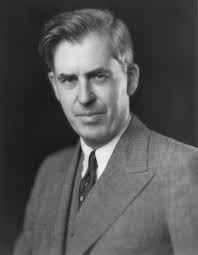
Black-and-white portrait of Henry Wallace
Henry Wallace. Vice President of the U.S.  1941-1945

The dangerous American fascist is the man who wants to do in the United States in an American way what Hitler did in Germany in a Prussian way,” Wallace wrote in his landmark essay “The Danger of American Fascism,” published in The New York Times Magazine on April 9, 1944.
Wallace’s thoughts and words are even more relevant today than they were then. Here are additional excerpts:
A fascist is one whose lust for money or power is combined with such an intensity of intolerance toward those of other races, parties, classes, religions, cultures, regions, or nations as to make him ruthless in his use of deceit or violence to attain his ends.…
The American fascist would prefer not to use violence. His method is to poison the channels of public information. With a fascist the problem is never how best to present the truth to the public but how best to use the news to deceive the public into giving the fascist and his group more money or more power.…
It has been claimed at times that our modern age of technology facilitates dictatorship. What we must understand is that the industries, processes, and inventions created by modern science can be used either to subjugate or liberate. The choice is up to us.…
The American fascists are most easily recognized by their deliberate perversion of truth and fact. Their newspapers and propaganda carefully cultivate every fissure of disunity, every crack in the common front against fascism. They use every opportunity to impugn democracy. They use isolationism as a slogan to conceal their own selfish imperialism.… They claim to be superpatriots, but they would destroy every liberty guaranteed by the Constitution. They demand free enterprise but are the spokesmen for monopoly and vested interests.…
Still another danger is represented by those who, paying lip service to democracy and the common welfare, in their insatiable greed for money and the power which money gives, do not hesitate surreptitiously to evade the laws designed to safeguard the public from monopolistic extortion.…
Monopolists who fear competition and who distrust democracy because it stands for equal opportunity would like to secure their position against small and energetic enterprise. In an effort to eliminate the possibility of any rival growing up, some monopolists would sacrifice democracy itself….
Their final objective toward which all their deceit is directed is to capture political power so that, using the power of the state and the power of the market simultaneously, they may keep the common man in eternal subjection.
Wallace saw the connection between Hitler’s preachments about racial “purity” and the language of Southern segregationists who spoke of a master race. “Those who fan the fires of racial clashes for the purpose of making political capital here at home are taking the first step toward Nazism,” he warned. And “the second step toward fascism is the destruction of labor unions.”
To avert the rise of American fascism, Wallace argued that America must champion “the democracy of the common man,” embracing “not just the Bill of Rights but also economic democracy, ethnic democracy, educational democracy, and democracy in the treatment of the sexes.”

0 Comments on American Fascism - 1944 & 2024

UAW Poll Shows Member Support for Harris Growing Significantly in Battleground States as Union’s Member Engagement Program Delivers Results

10/24/2024

Detroit, MI – New polling of UAW members and member households across key battleground states demonstrates strong support for Kamala Harris over Donald Trump, with Harris’ lead over Trump surging in the last month. 

The poll, conducted among union members in key swing states—Michigan, Pennsylvania, Wisconsin, North Carolina, Georgia, Arizona, and Nevada—shows Harris leading Trump by 22 points. These results underscore the impact of the UAW’s most ambitious political program in decades, which has engaged 293,000 active and retired members, as well as their families, in battleground states. 
The union’s comprehensive outreach program, aimed at connecting with every member, has been crucial in building support for Harris. In addition to a robust phone, text and mail program, UAW members are engaging in conversations at worksites and within their communities. In Michigan, they have participated in an intensive door-to-door campaign, reaching over 200,000 union households so far. 
Among members who reported hearing from the UAW about the presidential election, Harris’ lead over Trump grows to 29 points. These numbers highlight the effectiveness of the union's aggressive strategy to inform members about the candidates' positions on key economic issues, including protecting overtime pay, overhauling harmful trade deals, preventing offshoring, expanding retirement security, and taking on corporate greed. 
Polling data also show significant movement among key demographics. Among white UAW members without a college degree—a group that has leaned towards Trump in recent elections—Harris now holds a five-point lead. 
"When members hear directly from other members about what’s at stake and which candidate will have their backs, we’re able to break through," said UAW President Shawn Fain. "By engaging our members and highlighting the issues that matter – their paychecks, their families, and their futures -- the union makes a real difference.” 
Fain added, “The candidates’ track records speak for themselves. Harris has been in our corner in tough fights. Trump’s been a scab who passed NAFTA 2.0 and wants to bust unions. When you break it down like that and reach members in one-on-one conversations, the choice for president becomes clear.” 
Additional Poll Findings: 
  • Harris’ lead expands to 29 points among those who say they have been contacted by the union.
  • Michigan UAW members favor Harris by a 20-point margin, with 54% supporting her compared to 34% for Trump.
  • Support among non-college-educated men—a key demographic—shows a 14-point margin in favor of Harris.
  • UAW members support U.S. Senate candidate Elissa Slotkin by an 18-point margin.
The poll results make clear that the UAW's broad engagement program is not only resonating with members but also translating into increased support for Harris in states that could determine the outcome of the election. By focusing on face-to-face communication, worksite outreach, and personalized engagement, the UAW is driving a significant shift in voter sentiment, positioning the union as a powerful electoral force. In 2020, the UAW’s membership accounted for 9.2% of Biden-Harris' votes and 84% of their margin of victory in Michigan alone. 
The UAW’s plan to win stems from the vision that launched 2023’s Stand Up strike and movement. By putting out the facts, uniting the working class, and letting members lead the way, the UAW’s “Stand Up, Speak Up, Show Up” campaign has mobilized a mass campaign to defeat corporate greed at the ballot box. 


0 Comments on UAW Poll Shows Member Support for Harris Growing Significantly in Battleground States as Union’s Member Engagement Program Delivers Results

How to talk about immigration this election season

10/23/2024

 American Friends Service Committee
 
As we face anti-immigrant rhetoric from politicians and the media, here are five tips you can use to talk about immigration and build support for welcoming communities.
 
At AFSC,[ American Friends Service Committee]  we welcome all people no matter where they were born, or when or how they choose to migrate. We know that immigrants make our communities stronger, and we value the many contributions of immigrant leaders and organizers. 
We also know that as soon as we turn on the news in the U.S. today, we will be bombarded with anti-immigrant messages. And in this election season, the national conversation about immigration has only gotten worse.
Fortunately, the majority of people in the U.S.—74%—actually do want an immigration system that welcomes people and treats them with dignity. And there are effective messages we can use to break through the noise and vitriol of this moment. 
Whether you’re having dinner with family who disagree on politics or responding to a friend on social media, here are five tips to change someone’s mind about immigration in the U.S. These tips are the results of research from AFSC and others, such as the ACLU, Goodwin Simon Strategic Research, and The Opportunity Agenda.
1. Always start with shared values. 
Whenever you start a conversation on a touchy subject, lead with something you and your listener both value. That creates space in their minds for open conversation. 
For example, start with a message like “Everyone deserves a chance to build a good life for themselves and their families.” That helps frame a conversation on immigration with people who may never have met anyone from outside the U.S. but who share widely held values like freedom and opportunity. 
2. Focus on our shared humanity and the diverse contributions that we all make to our communities. 
We are all human. We all contribute to our communities. We all love our friends and family. And we all make mistakes. Talking about each other as full, complicated, messy humans—including immigrants—humanizes people and cuts through the demonizing rhetoric we see in the media.
Many times, pro-immigrant conversations focus on the economic contributions that immigrants make to communities. It’s important to go beyond these messages to talk about the kinds of contributions we all make to our communities. We’re not just workers but also neighbors, friends, family members, and more. This kind of messaging helps humanize everyone’s complexities and contributions, including immigrants.
3. Address listeners’ fears indirectly. 
It’s important to acknowledge people’s fears, which can be exacerbated by misinformation in the media. Some of these fears have nothing to do with immigrants.  
But we can also provide accurate information and real stories of immigrants that can help people work through those fears. AFSC is just one of many organizations that welcomes newcomers, supports immigrants as they pursue efforts toward residency and citizenship, and advocates to keep families together. You can indirectly address people’s fears by describing some of these efforts.
4. Model the change you want to see. 
Telling stories about your personal growth or how you have changed your own mind gives your listener permission to be open-minded. It also serves as a roadmap for how to grow, too.
Try sharing a story from your own life about meeting someone from another country and getting to know them as a full person, quirks and all. Show how you interacted with each other in some way. That might include helping each other at work or volunteering together in your community. Talk about how you grew or evolved in your own thinking as a result.
5. If your listener isn’t listening, talk past them to the people who are. 
Even if someone doesn’t agree with you right away, it doesn’t mean you haven’t planted a seed in their mind—or in the minds of other listeners.
To cut through the noise this election season, tell a story that starts with a shared value, focus on our shared humanity, calm someone’s fears, and, ultimately, show how you have grown.
Want to learn more about how to talk about immigration? Watch our webinar on how to have "hard conversations" about immigration from our recent webinar series.
 
American Friends Service Committee
October 18, 2024. 

https://afsc.org/news/how-talk-about-immigration-election-season?
 
For more information see.Carnegie Foundation.
https://www.carnegie.org/our-work/article/15-myths-about-immigration-debunked/        2021.
 
Adopted. 2023. DSA Policy on Immigration and Immigrant Workers.
2023 convention.
Call to the Convention: Defend Immigrants Rights
 
 
Our North Star  building a united front is here;
 North Star: Defeat MAGA/Fight for Democracy Action Opportunities
List of opportunities:  https://docs.google.com/document/d/1cRIJsSJwtF72ckJ8QLQu5cDCGnoeh5OIIjwqRkDKdBg/edit?usp=sharing (opens in a new tab)


0 Comments on How to talk about immigration this election season

Can Hotel Workers Save the Democrats?

10/22/2024

In the swing state of Nevada, the Harris campaign needs the Vegas hotel union’s ‘army’ to overcome Donald Trump.
BY HAROLD MEYERSON
 
OCTOBER 21, 2024
 
LAS VEGAS – When we met in his office at the sprawling and somewhat ramshackle Las Vegas headquarters of Culinary Union Local 226 last Monday, a day when the New York Times averages of the polls in the seven swing states had Kamala Harris leading Donald Trump in Nevada by less than 1 percent, Ted Pappageorge wasn’t buying it.
Expand
 
“We don’t really believe the polls,” said Pappageorge, who’s the secretary-treasurer of Culinary, as the local is commonly called. “Trump’s people generally under-poll, and if we had an election today, I think Trump wins.”
 
“But it’s not today,” he continued. “We’ve got three weeks to go and the Culinary army is out there, going to knock on hundreds of thousands of doors and talk to hundreds of thousands of people.”
In the context of actually existing American politics, the designation of his canvassers as an army is not an overstatement. With 60,000 members—the vast majority of them housekeepers and the wait and kitchen staffers at Las Vegas’s mega-hotel/casinos—Culinary may well be the largest local union of any kind in the United States. For several decades, hundreds of its members have taken an election leave from their jobs to knock on the doors of local registered voters and engage them in discussions of the candidates. It’s a full-time job. For a few, it lasts the better part of an election year; for some, it runs from summer to Election Day; and for the rest of the 400-plus who walk the precincts, it’s a monthlong gig for seven days a week.
In the pandemic year of 2020, when candidates and parties and outside groups and even other unions all eschewed canvassing, Culinary—almost all of whose members were jobless as the hotel/casinos had shuttered their doors—fielded canvassers who still went out in force, masked with special gear devised by epidemiologists. By Election Day, they’d contacted fully half of Nevada’s Black and Latino voters, and one-third of the state’s Asian voters, too.
 
UNITE HERE, Culinary’s national union, canvassed in three states (opens in a new tab) in 2020: Arizona, Nevada, and Pennsylvania. Joe Biden won them all, which produced the margin of victory in the Electoral College.
The day after I met with Pappageorge, Culinary’s 425 full-time canvassers packed themselves into a hall for a rally as they embarked on the final three weeks of the campaign. They heard from leaders of some far-flung UNITE HERE locals (New Orleans, Anchorage), who’d come to Vegas to help out; in turn, those visitors called out some other UNITE HERE members who’d arrived from non-swing states to help push Nevada into Harris’s column.
Once again this year, Nevada is one of three swing states where UNITE HERE locals are mounting efforts almost comparable to Culinary’s. More than 400 UNITE HERE members are now canvassing in Pennsylvania (most in Philadelphia, some in Harrisburg) and Arizona (most in Phoenix, some in Tucson). In those states, though, a higher share of the full-time canvassers come from out of state than in Nevada, where Culinary has numbers that the other states can’t match. The Philly canvassers are a mix of locals and members from New York, Baltimore, Washington, and Atlantic City; those in Arizona include Angelenos, San Diegans, and sundry Texans.
All told, UNITE HERE now has roughly 1,500 full-time precinct walkers in those three swing states, a figure that will rise to 2,000 by the campaign’s final week. By the metric of person-hours worked, its operations in those three states are the largest of any kind those states will see. The union also is fielding smaller operations in seven other states, focusing on races like Sen. Sherrod Brown’s very tight battle for re-election in Ohio, and swing House districts in California and New York.
That said, the work of the precinct walker ain’t what it used to be.

I WENT ON TWO PRECINCT WALKS while in Vegas. On the first, sponsored by the state’s AFL-CIO, I accompanied two members of the Machinists union who were canvassing full-time, seven days a week. The first was a leader of the local at Nellis Air Force Base, just outside Vegas; the second, a former leader of the local at Maryland’s Aberdeen Proving Ground, whom the national union had deployed to Vegas. The blocks they were given were in an economically precarious neighborhood of single-family homes in varying degrees of repair and disrepair. The list they were handed included only registered voters at households where at least one resident was a union member, and, as Las Vegas is a city with an uncommonly high share of such households, some blocks included as many as nine such homes.
Not many opened their doors to these canvassers. It was midday Sunday, with NFL games on the tube. At houses with as many as four cars parked in their driveways, nobody came to the door. Moreover, the residents, like all Nevada voters, have been inundated for months with election ads, mailings, information, and misinformation. (This inundation is why Culinary isn’t putting any ads on television; at this point, the union believes, only person-to-person exchanges on doorsteps can boost turnout or persuade an undecided voter.) As the canvassers walked up to one house, a woman emerged toting a ream of election mailings, walked to the sidewalk, and ceremoniously deposited those mailings in a trash bin awaiting the next day’s pickup.
A few residents did come to the doors. The more elderly ones welcomed the canvassers and expressed support for Harris; the canvassers then discussed the how-tos of voting by mail, early voting, or Election Day voting. With the vast majority of voters irrevocably committed to either Harris or Trump, canvassers are focusing disproportionately on making sure base voters get their ballots in.
When the canvassers encountered a union voter who needed convincing, they highlighted the differences between Harris and Trump on economic issues. I was surprised to hear that their brief presentation began with “Have you heard of Project 2025?” That’s the compendium of far-right proposals authored by Trump’s associates, which the canvassers used as an entryway into the horrors Trump would inflict on workers.
Not all respondents were pro-Harris or undecided. One young Black man declared his support for Trump, then refused to provide any reasons for his choice. It’s the prevalence of such preferences that leaves Democrats so worried. “Nevada’s not blue; it’s purple,” says Pappageorge, who notes that Biden carried the state by 30,000 votes in 2020 out of more than two million cast. This year, he says, if Harris wins, it will be by “10,000 or less.”
That’s why the Culinary canvassers, unlike those in the AFL-CIO canvass, don’t confine themselves to talking just to union households. Instead, they knock on the doors of every registered voter in most Vegas neighborhoods.
Most American workers live in communities and work in workplaces where unions and union perspectives are nowhere to be found.
Last Monday, on my second precinct walk, I accompanied two Culinary precinct walkers who were traversing a relatively new (most houses built in the 2000s) suburb. Claudia handles room service orders at one of Vegas’s mega-hotels, and Maria Teresa works as a server at another local behemoth.
Going off a list of all registered voters, they encountered a distinctively Vegas population: Most of the people who came to the doors of these homes were Black and Latino, reflecting an aspect of the local economy that makes Vegas almost unique among American cities: Due to Culinary’s clout at winning contracts, many of the city’s service-sector workers (chiefly those in the big unionized hotels) have historically been able to afford home purchases. If they tried to buy today, however, the stratospheric rise in prices would put such homes well out of reach, which was one of the canvassers’ talking points: Even if you could afford a home like this ten years ago, will your kids be able to ten years from now?
In fact, the rising price of housing (up by more than a third in just the past few years) was the topic most respondents brought up at their doorways when Culinary walked precincts in the midterm election of 2022. It’s one of the two most frequently raised issues that respondents are bringing up today, along with the price of food. Culinary canvassers respond that the price of housing has been raised in large part by “Wall Street”—that is, private equity firms like Blackstone—buying up as many as 40 percent of the homes in some Vegas neighborhoods and then renting them out, which substantially reduces the number of houses on the market for potential homebuyers.
Pappageorge notes that they stressed the primacy of this issue in Nevada in discussions with the Harris campaign; while watching a Dodgers-Mets playoff game on Vegas’s Fox affiliate, I saw a Harris ad pledging she’d stop Wall Street from cornering the housing market.
Like the Machinist canvassers one day earlier, Claudia and Maria Teresa found only a limited number of people willing to come to their doors. As this was a more upscale neighborhood, however, they were frequently greeted by recordings saying nobody was home. They weren’t daunted, leaving literature in the doorway and knowing that they’d return several times before Election Day. The most enthusiastically pro-Harris voters they encountered were elderly Blacks and younger Latinas.
The substance of their message often changes, if only by nuance, day by day. Culinary gets data from all its precinct walkers at the end of each day’s canvass on which issues are raised by which groups of voters, and has the capacity to print new literature or alter the doorstep pitches overnight. As their canvassers are encountering a wider panoply of voters than just union members, those canvassers are prepared to address a range of topics that go beyond the union’s most common bread-and-butter concerns. Our canvassers “lead with economic issues,” says Gwen Mills, UNITE HERE’s international president, “but if a voter raises reproductive freedom, our members are prepared to talk about it.”
Expand

NEVADA DEMOCRATS APPEAR LESS WORRIED about the most prominent down-ticket contests than they are about the presidential outcome. Sen. Jacky Rosen is up for re-election, but has drawn a weak, far-right challenger who’s been the state chair of the Faith and Freedom organization, which is one of Nevada’s foremost opponents of abortion and LGBTQ rights, not exactly popular positions in a notably libertarian state. Rosen’s union bona fides are in very good order; when she was a young woman needing to supplement her income, she went to work as a waitress at Caesars Palace, so she’s a Culinary alum.
In addressing a rally of workers from a wide range of unions before the AFL-CIO canvass, Rosen cited any number of issues of particular concern to union members, including the far-right proposals in Project 2025 that would strip workers of some of their most basic rights.
But the story of this year’s election, of course, increasingly centers on the drift of working-class voters into Donald Trump’s column. The ultimate swing vote, in Nevada and across the country, “isn’t Blacks and Latinos,” Mario Yedidia, UNITE HERE’s national elections director, told me at Culinary’s Monday rally. “It’s the working class.”
Cesar Mendia is not surprised by this dispiriting phenomenon. A former Mexican journalist who came to America 35 years ago, he is now a retired union member who came to Nevada from Texas to work on the election as part of the AFL-CIO’s canvass. He’s been at it now every day for the past several months, just as he was in the 2016 and 2020 presidential elections. In 2016, going door-to-door among Vegas’s union households, he estimates, 95 percent of Latinos said they wouldn’t vote for Trump. But “not today,” he says, estimating the breakdown of Latinos in the union households he’s spoken to at just 65 percent Harris, 35 percent Trump. “We have to do a lot of work to educate the community,” he says.
The root problem, though, may be the nature of that community more than the union-led or Democratic efforts to educate it. When the American working class was the base of the Democratic Party and the linchpin of the New Deal coalition, working-class communities were unionized. In the mid-20th century, nearly 40 percent of private-sector workers in the United States were union members; today, that figure is a bare 6 percent.
That means most American workers live in communities and work in workplaces where unions and union perspectives are nowhere to be found. Their friends at work certainly don’t talk union, and they may well get their news from sources, in both legacy and social media, that increasingly are slanted either to the right or far-right. Those media, almost as much as Trump himself, are relentlessly xenophobic, and are as dedicated as Trump to depicting Democrats as apostles of civilizational breakdown.
This disorganization of the American working class has been the long-term strategic project (opens in a new tab) of American conservatives and business leaders, one whose implications Democrats were slow to understand and combat. Particularly during the 1990s, with the passage of NAFTA and permanent normal trade relations with China, Democrats were all too happy to abet this project. Now, Democrats depend on the remaining handful of potent working-class organizations like UNITE HERE to stanch the defections to Republican xenophobes and faux populists.
As in the other swing states on which the outcome of this profoundly nerve-wracking election depends, the polling in Nevada is well within the margin of error. The election’s outcome, says UNITE HERE president Mills, will be determined by “the margin of efforts,” none more intense or effective than those of the housekeepers and wait and kitchen staffers who keep Las Vegas running, and on whose efforts the future of American democracy may well depend.


https://prospect.org/politics/2024-10-21-can-hotel-workers-save-democrats-nevada/

0 Comments on Can Hotel Workers Save the Democrats?

Georgia Voter Mobilization

10/21/2024

Knocking on Doors 
 A report in response to our Web meeting. See post below.

Mijente PAC has about 75 people knocking on Latino doors full-time in Georgia, following a "civic engagement" non-partisan door-knocking educational campaign about elections and their importance since January carried out by non-profit GLAHR. which is formally not involved in Mijente PAC's anti-Trump campaign, although most of the people Mijente has hired are local GLAHR activists.
 
I believe there is a similar mijente Latino campaign in North Carolina. in addition to the one Duane mentioned in Arizona. The one in Georgia is perhaps the strongest because of GLAHR's community roots (we're celebrating a quarter century of organizing this year).

And because similar Georgia campaigns in 2020 and 2022 were decisive in Biden's razor-thin electoral college victory in GA and his preserving a Democrat majority in  the Senate in 2022. 

Georgia has an immigrant Latino population that overwhelmingly arrived since 1990,and especially in the construction boom for the 1996 Atlanta Olympics which continued for years afterwards., The 2010 census surprisingly showed that HALF of GA Latinos were U,S.-born -- and their median age was 11.  

And this has to do with the central lesson I learned in my two decades at CNN, as the lead producer in the Spanish-language operation for pre-election polls and especially election night exit polls. Elections in the United States are NOT decided by who "the people" vote for, but by which people vote. 
 
Jose Perez.
 
 
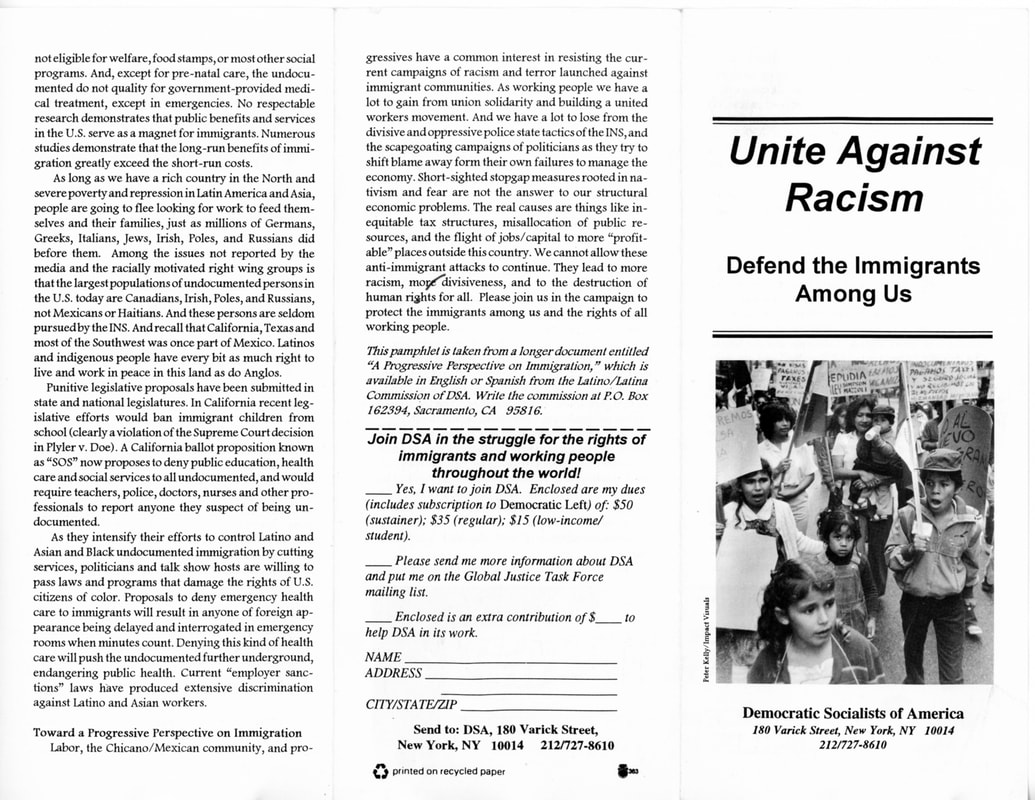
1994 DSA pamphlet, “Unite Against Racism: Defend the Immigrants Among Us”, with a photo of children marching and a form to join DSA
Campaign in 1994 in California
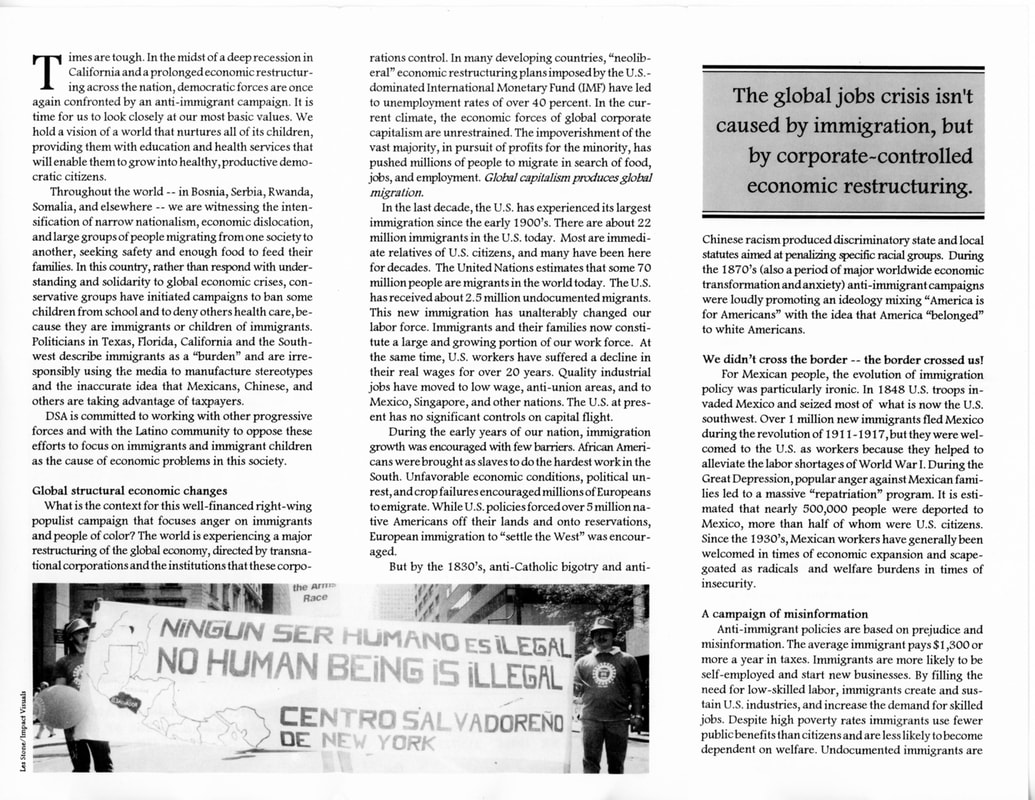
Inside of the 1994 DSA pamphlet, with a pull quote reading “The global jobs crisis isn’t caused by immigration, but by corporate-controlled economic restructuring” and a photo of a banner reading “Ningún ser humano es ilegal / No human being is illegal, Centro Salvadoreño de New York”

0 Comments on Georgia Voter Mobilization

Engaging in the Immigration Battle and the Fight Against Trump and MAGA Republicans.

10/17/2024

Woodcut of a worker holding up a newspaper
 
North Star Webinar. ( and a meeting)
The Case for Engaging in the Immigration Battle and contributing to the Fight Against Trump and MAGA Republicans.
 
The Border, Immigration, Dog Whistle Politics and Political Reality.
Videos, updates from the border, and strategy.
Sunday, October 20, 2024.    2 PM Pacific.  5 PM Eastern.
Presented by North Star Caucus.
 
Speaking. Oct 20,2024.   Via video recording.
Kamala Harris, Donald Trump, Ian Haney-Lopez.
Host;
Duane Campbell.  DSA. Over 50 years in the immigration struggles.
Also speaking. Participants/Dialogue 
Members of the North Star community.
 
Join Zoom Meeting
https://us02web.zoom.us/j/84624125150?pwd=9dm2OaZaBOm68ikY8XgfK60QGHIM6J.1
  (opens in a new tab)

Meeting ID: 846 2412 5150
Passcode: 000357
 
Community members may request participation link here. demsoc18@gmail.com


0 Comments on Engaging in the Immigration Battle and the Fight Against Trump and MAGA Republicans.

The 2024 Elections: Knife-edge but mayhem could result

10/14/2024

 
By   Paul Garver
 - 
14/10/2024
One month before the November Presidential election, its outcome remains unpredictable. There are simply too many unknown variables.
The Harris -Walz Democratic ticket will surely win the national popular vote by a wide margin, as was also the case for Democrats in 2016 and 2020. Seven swing (or purple) states are hotly contested (Pennsylvania, Michigan, Wisconsin, Nevada, Arizona, North Carolina, Georgia). Both parties are focusing their advertising and personal campaign appearances on those “battleground” states, where the likely victory for either side will be slender.  Current polling in these states indicate a very tight race.
Michigan poses an especially difficult challenge for Harris-Walz. Michigan is home to a substantial Palestinian-American community, where the pro-Palestinian Uncommitted movement remains frustrated with the failure of Harris to make a decisive break with Biden’s unconditional military support for Netanyahu. Palestinian-American U S Congressperson Rashida Tlaib [representing the Detroit area] is the most visible political spokesperson for Palestinian rights. She supports Harris-Walz because Trump’s election would be even more catastrophic for Palestinians, but in a close election, abstention by campus activists and the Arab-American communities could swing Michigan to Trump.
Pro-Palestinian activists are still looking for some indication from Harris that she will pay more than lip service to curbing Israeli attacks that are killing civilians in Gaza, the West Bank and Lebanon. Responding to this danger, Senator Bernie Sanders and UAW President Shawn Fain, both strong advocates for embargoing U S offensive military weapons to Israel, a key demand of the Uncommitted movement, campaigned recently on the campus of Michigan State University. 
Both campaigns face serious challenges in the other swing states. A minority of the conservative Republican leaders who survived the MAGA takeover of the Republican Party support Harris.  Conversely, parts of the electorate that normally support Democrats in national elections appear to be wavering. Polling reported by the National Center for Working Class Politics indicates a yawning gender gap. Men of all educational levels and races are much more likely to support Trump than women with comparable demographics.  This may be simple misogyny. (Why else would the Firefighters Union refuse to endorse Harris after endorsing Biden?)
Predictably Harris-Walz are campaigning hard towards the “center” on immigration and military policy, while Trump-Vance are doubling down on spreading canards about Haitians eating your family pets, and announcing plans for mass deportations of migrants and refugees.
It is not likely that the electoral results will be clear before January 2025. A core problem for Democrats is that its candidates not only have to win a majority in the Electoral College, but must do so by wide enough margins that the corrupt pro-Trump Supreme Court majority cannot throw contested elections to Trump.
Most of the sane US Left are increasingly aware that the imperfect US democracy must be defended against the MAGA threat in November and the ensuing months.  Most progressive organizations and unions are trying to mobilize their memberships to canvass, phone bank and write postcards to voters in the swing states.  DSA is divided, with some ideologically ultra -left caucuses asserting that the election does not matter to socialists, while many individual members of DSA are participating in the electoral mobilizations of progressives.  The most pragmatic DSA caucuses have created a campaign called “Socialism Beats Fascism” which is using webinars and social media to mobilize for down ballot elections and referenda in the swing states.  DSA’s National Elections Commission is organizing phone banks for down ballot DSA candidates in Georgia and Michigan, which should have the practical impact of fighting MAGA while skirting the internal challenges of DSA endorsing the national Democratic ticket (which would probably not be welcomed by the Democrats).
One month ahead of the November election I will venture a guess. The Democrats should win a slender majority in the national House of Representatives, while the Republicans may eke out a slight majority in the Senate. Harris-Walz will win enough of the swing states to achieve the 270 electoral votes needed to win a majority of the Electoral College.  I think this will happen not because of any major ideological shift, but because women will defend their reproductive freedoms, and because Trump is becoming increasingly weird on the campaign trail – even more rambling, incoherent and forgetful than before.
However, Trump will not concede the election, and will try every legal and illegal means to usurp power in January 2025. The ensuing chaos may be greater than in January 2021.  Nevertheless, the US military high command and national security apparatus is not likely to intervene in support of a MAGA semi-coup even if legitimated by a Supreme Court majority. But a national U S government capable of effectively addressing the urgent underlying national and global challenges may not emerge from these elections.
I think that the U S will emerge from the November elections with Trump and the MAGA movement stymied, but without a clear progressive mandate. This requires no crystal ball.  The Republican Party remains the tool of an amoral solipsistic demagogue who is pursuing his personal interests – mainly staying out of prison – with no fixed general political principles.  Vance is a younger smoother scion of this MAGA cult who dangerously may believe in the ultra-reactionary program of the Heritage Foundation’s Project 2025.  On the other hand, the Democratic Party, though its Convention celebrated cultural unity and extricated itself from a failing Biden presidential bid, still lacks a coherent political program capable of unifying the diverse working and middle classes into a governing bloc.  And the U S Left remains too fragmented and/or mesmerized by illusions of a Leninist messiah to provide a backbone for a new majority democratic left coalition.  But in the short run at least, I think we will muddle though another four years with most of our democratic rights and constitutional framework intact.
 
Paul Garver is a member of Democratic Socialists of America


0 Comments on The 2024 Elections: Knife-edge but mayhem could result

October 10th, 2024

10/10/2024

0 Comments on October 10th, 2024

Bernie On the Campaign Trail

10/7/2024

In the most consequential election in our lives, I’m happy to report that we spent last week on the campaign trail working hard for Kamala and progressive candidates. On Monday, Tuesday, and Wednesday we were in Texas, on Thursday and Friday we were in Nevada, and on Saturday and Sunday we were in Michigan. We spent a lot of time traveling on planes and cars - but it was worth it. We drew large and enthusiastic turnouts, are reaching undecided voters and are expanding our grassroots movement.

Texas

In my view, Texas has huge political potential, and there are some great people in the state who are working hard to turn it progressive. And let’s be clear. If that happens it will transform politics in America.
In San Antonio we had a great event with Congressman Greg Casar - one of the outstanding young progressives in Congress. We were joined by an old friend of mine, Congressman Lloyd Doggett.
At the University of Texas, Austin we were joined by Congresswoman Alexandria Ocasio-Cortez who, as usual, did a great job in firing up the standing room only crowd. Beto O’Rourke who, 6 years ago, came within 2 points of defeating Senator Ted Cruz, also spoke. And by the way, Beto is now heading up a very strong and effective voter registration campaign which could make all the difference in Texas.
While we were in Austin I joined Congressman Casar and members of the Austin City Council in addressing a rally in support of workers at a local Hyatt hotel who are facing strong and illegal opposition from the corporation as they attempt to form a union. I had the opportunity to chat with two very brave workers there who were fired for their union activities.
At the University of Texas at Austin with Beto, Lloyd, Greg and Alexandria
In East Austin, Texas with Hyatt hotel trade unionists

Nevada

In Las Vegas we had a great town meeting with Congressman Steven Horsford. Hundreds of people came out to discuss housing policy — an issue that’s on the minds of Nevadans as they face the greatest shortage of affordable housing for low-income earners in the country. We also discussed health care, prescription drugs and the war in Gaza.
On Friday morning Congressman Ro Khana and I joined a room full of Harris- Walz volunteers. They understand, as I hope all of us do, that in the next month we’ve got to knock on doors, make phone calls, and talk to our friends and neighbors about how we can increase the voter turnout and defeat Trump.
In Las Vegas, Nevada at a community town meeting

Michigan

The last state on this trip was Michigan, where we held events in Warren, Saginaw, Grand Rapids, and East Lansing. The polls suggest that Michigan is up for grabs and could well decide who becomes the next president.
We started off in Warren, where I was joined by UAW president Shawn Fain for a rally against corporate greed. Shawn is one of the leading progressive trade union leaders in America and has not only helped win an excellent contract for his members, but is inspiring workers all across the country to stand up and fight for their rights.
I then traveled to Saginaw, where a large crowd joined me in demanding that we have a government and an economy that works for all, not just the people on top and wealthy campaign contributors.
Finally, on Sunday, we held two more town halls with the Harris-Walz campaign in Grand Rapids and East Lansing. The turn outs were great and people are fired up. Our trip ended with me joining a picket line in Detroit with Teamster workers who are on strike against Marathon Oil.
At a town hall in Saginaw, Michigan
With UAW president Shawn Fain in Warren, Michigan
In the last month of this campaign all of us have got to do everything possible to see that Donald Trump is defeated and Kamala is elected. We cannot have in the White House someone like Trump who is a pathological liar, someone who is undermining American democracy, someone who thinks that climate change is a “hoax” and someone who believes that women do not have the right to control their own bodies. We also have to fight hard to see that Democrats control the House and the Senate.
Later this week, I will be hitting the campaign trail again. If we’re in your community, please join us. If not, join us online when we livestream.
In solidarity,
Bernie
 
For how you can be involved, see the two posts below.
 

0 Comments on Bernie On the Campaign Trail

NS Forum:The Border, Immigration, Dog Whistle Politics and Political Reality

10/2/2024

Woodcut of a worker holding up a newspaper


The Border, Immigration, Dog Whistle Politics and Political Reality.
Videos, updates from the border, and strategy.

Plus, Break out rooms to promote open discussion/dialogue. 
 
Sunday, October 20, 2024.    2 PM Pacific.  5 PM Eastern. 
Presented by North Star Caucus.
Via video recording.
Kamala Harris, Donald Trump, Ian Haney-Lopez.
Speaking; 
Host; Duane Campbell.  DSA. Over 50 years in the immigration struggles. 
Also speaking. NS Participants/Dialogue  
Members of the North Star community. 
 
Community members; Request participation link  here. demsoc18@gmail.com
 
 demsoc18@gmail.com

0 Comments on NS Forum:The Border, Immigration, Dog Whistle Politics and Political Reality

The Battle Ahead: Latino Civil Rights vs. Project 2025

9/28/2024

LULAC shield logo
The Battle Ahead: Latino Civil Rights vs. Project 2025
Prepared by Adriana Varea, Ari Kittrie, and Joaquin Macias, LULAC Policy and Legislation Fellows

Introduction

The 2025 Mandate for Leadership, The Conservative Promise, more publicly recognized as “Project 2025” is a roadmap for the first 180 days in office for a conservative presidency. It was drafted by The Heritage Foundation, which is a right-leaning, conservative think tank based in Washington, D.C. charged with crafting policies that align with the Republican party. The Heritage Foundation gave the first Mandate for Leadership to Reagan to “repair the executive branch” after Jimmy Carter’s presidency.
Former President Trump has recently distanced himself from Project 2025 by tweeting:
“I know nothing about Project 2025. I have no idea who is behind it. I disagree with some of the things they’re saying and some of the things they’re saying are absolutely ridiculous and abysmal. Anything they do, I wish them luck, but I have nothing to do with them.” (@realDonaldTrump)
However, this was refuted by a 2022 statement from former President Trump:
“[The Heritage Foundation] is a great group, and they’re going to lay the groundwork and detail plans for exactly what our movement will do and what your movement will do when the American people give us a colossal mandate to save America.” (Bennen, 2024)
Additionally, several authors, editors, and contributors of Project 2025 have previously worked for the Trump administration. Roughly 64% of policy recommendations from the 2016 Mandate for Leadership were either implemented or taken into consideration by the Trump Administration in 2017 (The Heritage Foundation).
In this article, we will outline ten specific ways in which Project 2025 disproportionately negatively impacts Latino civil rights.

1. Establish a Unitary Executive Branch

2. Mass Deportations

“Prioritizing border security and immigration enforcement, including detention and deportation, is critical if we are to regain control of the border.” (Project 2025, pg. 135)
Project 2025 plans to repeal parts of the Trafficking Victims Protection Reauthorization Act of 2008 to allow for the large-scale use of detention facilities to mass incarcerate migrants. It also will change Title 8 of U.S. Code § 1226 to require mandatory detention for unauthorized migrants caught within the U.S. interior (pg. 150). To compound this, Project 2025 will also increase Immigration and Customs Enforcement (ICE) capabilities by removing all sensitive zones where ICE personnel are prohibited from operating, allowing for raids in schools, churches, and businesses (pg. 142).
Project 2025 calls to authorize state and local law enforcement to participate in immigration and border security actions (pg. 150). Through deputizing local law enforcement, there will be a lack of oversight and accountability, allowing for abuses of the system that would disproportionately hurt the Latino community. Additionally, Latinos would have a more difficult time receiving impartial hearings and legal representation, especially because detainees are not entitled to public defenders as criminal defendants are. To compound upon this, the Supreme Court Case Loper Bright Entreprises vs. Raimondo, which repealed the Chevron Deference, has the potential to take immigration hearings away from the United States Immigration and Citizenship Services and shift them to the local courts. These local courts notoriously have long backlogs and a limited understanding of immigration policies and laws, which would force Latinos to have long and unjust trials.

3. Cutting Off Legal Immigration

“Victimization should not be a basis for an immigration benefit.” (pg. 144) “If CISOMB continues as a DHS component, a policy should be issued that prohibits CISOMB from assisting illegal aliens to obtain benefits. Currently, approximately 15 percent–20 percent of CISOMB’s workload consists of helping DACA applicants obtain and renew benefits, including work authorization. This is not the role of an ombudsman.” (Project 2025, pg. 166)
Project 2025 proposes to cut down on legal immigration by limiting interim immigration into the United States. For example, it calls for an increase in visa application fees. It plans to limit the issuance of H-2A and H2-B visas for seasonal agricultural workers, as well as the complete elimination of T and U visas meant to protect trafficking or crime victims who are actively cooperating with law enforcement as a witness (pg. 612, 141). Project 2025 calls to remove and deport all Temporary Status designations for migrants whose home countries are considered unsafe to live in (pg. 145). Finally, Project 2025 will phase out DACA for the over 500,000 recipients by eliminating staff time for reviewing and processing renewal applications which will make it very hard for DACA recipients to renew their status given the proposed lack of staff present to do so (pg.145).
 
And More 
Project 2025 
https://lulac.org/project_2025/
 
We will have a North Star webinar on this topic on Oct.20, 2024. Watch this site for details.
and on our Electoral Fight Back site below. 
 
 Our building a united front is here;
 North Star: Defeat MAGA/Fight for Democracy Action Opportunities
List of opportunities:  https://docs.google.com/document/d/1cRIJsSJwtF72ckJ8QLQu5cDCGnoeh5OIIjwqRkDKdBg/edit?usp=sharing (opens in a new tab)

0 Comments on The Battle Ahead: Latino Civil Rights vs. Project 2025

Our North Star  campaign site has a new addition.

9/25/2024

Our strategy is here.  Our Strategy
 
DSA and the broader Left must join forces to confront the international rise of authoritarianism. Together we should work to build a center-left coalition in defense of democracy. DSA must jettison a growing tendency towards a  “go it alone” approach that devalues coalition work and glosses over the importance – indeed, the necessity – of a center-left coalition to defend democracy from neo-fascism.
  Our building a united front is here;
 North Star: Defeat MAGA/Fight for Democracy Action Opportunities
List of opportunities:  https://docs.google.com/document/d/1cRIJsSJwtF72ckJ8QLQu5cDCGnoeh5OIIjwqRkDKdBg/edit?usp=sharing (opens in a new tab)
 
 We have a new addition. 
 
Volunteer opportunities around the nation. 
***
KAMALA  HARRIS/TIM WALZ CAMPAIGN
on-going volunteer opportunities
kamalaharris.org (opens in a new tab) 
https://txt.democrats.org/c7b4 (opens in a new tab) 


0 Comments on Our North Star  campaign site has a new addition.

Cornel West as a Candidate

9/22/2024

Cornel West applauding


Bill Fletcher Jr. 
Excerpts from a longer piece,,

Which brings us to the Cornel West campaign and other third-party bids during the 2024 election cycle. What is the essence of such ventures?
If one is interested in building a struggle for power, one does not begin by running a presidential campaign, and certainly not a campaign with no organized base and no possibility of victory. If, however, one is concerned more with asserting one’s beliefs and expressing one’s frustration and antipathy toward the existing system, one can view a campaign for the presidency as an ongoing platform to both hear oneself talk, and to try to captivate and entertain an audience. Such politics become, not the politics inherent in a struggle for power, but the politics of self-expression. The objective becomes expressing one’s views, anger, etc., rather than seeking to achieve anything. In effect, it becomes the politics of defeat, in that one has no plan, knows one cannot win, and therefore cries out in hopelessness.
The West campaign and other third parties will virulently object. They will assert they are taking a stand against the two-party system of the capitalist class, against imperialism, against the criminality of the US support for Israeli genocide. And they will be correct! They are. Yet, they have neither plan nor sufficient organization to transform their assertions into political power. Thus, they can only rely on magical thinking in the hopes—and this is a best-case scenario—that their plea to the masses will resonate and result in a great wave of revulsion against the system, thrusting them into office…alone. 

…. 

The political moment

Leaving aside, for a moment, that minor parties in the USA have rarely been successful due to the undemocratic nature of the US electoral system, the actions of the Cornel West campaign and other third parties would be comical if less were at stake. And there have been times when comedians have run for president to make a satirical statement, such as Pat Paulsen.
Current third-party candidacies, including West and Jill Stein, either ignore or deny the dangers inherent in the current moment. West, for instance, acknowledges the dangers of a Trump victory but asserts, in part due to the Israeli genocide in Gaza, that there was no difference between Trump and Biden and, apparently, no difference between Trump and Harris. Stein’s views carry on from the historic and, unfortunately, dogmatic stand of the Green Party on the need for formal political independence from the two-party system.
None of them are coming to grips with the dangers on the horizon. There is nothing, for instance, on the Harris side that is comparable to the plans of the MAGA movement such as Project 2025, the Heritage Foundation’s hatched idea for a rightwing authoritarian overhaul of the US government. There is nothing comparable on the Harris side to proposals such as the American Legislative Exchange Council’s ongoing work to advance a Constitutional Convention to alter the US Constitution in favor of business and the Christian Right. Nothing.
One cannot conclude ignorance on the part of any of these campaigns. One cannot imagine that any of these campaigns believe that progressive politics and policies will survive a second Trump presidency. Or perhaps they do? As many of us have heard over the months, there are those who believe that Trump will not be so bad and, yes, there will be suffering, but we will come through it.
 
Read the entire piece.
 
https://liberationroad.substack.com/p/the-cornel-west-campaign-third-parties?


0 Comments on Cornel West as a Candidate

Re: DSA Statement on Anti Immigrant Violence

9/17/2024

Statement by National DSA

Solidarity with Springfield’s Haitian Community: DSA’s Statement on Anti-Immigrant Violence

September 17, 2024
DSA condemns in the strongest possible terms the hateful lies promoted by Donald Trump, J.D. Vance, and other Republican officials targeting Haitian immigrant communities in Springfield, Ohio. These lies have led to ongoing school and hospital closures over bomb threats, smashed windows, acid thrown on cars, death threats, and the canceling of beloved local cultural events due to safety concerns. The goal is clear: Trump’s lies intend to incite violence and harassment against working-class immigrant communities, not just in Springfield, but toward Black people living all over the country. In the lead up to their second term, he’s touting plans to launch mass deportations targeting millions. The far-right wants to divide and conquer the working class by using xenophobia and racism to pit workers against one another in a race to the bottom. 
 
Democrats, including presidential candidate Kamala Harris, have enabled this rhetoric by remaining silent about the attacks on Springfield, while also affirming her plans to expand border policing. This is nothing less than appeasement to growing fascist anti-immigrant rhetoric.
 
The Presidential debate last Tuesday made clear that Trump’s hateful Project 2025 agenda would be catastrophic for the working class, both at home and abroad. Opposing the far right, as represented by the Republican Party under Trump’s neo-fascist leadership, is a necessity for the working class and for our movement.
 
The truth is that working people everywhere have a common humanity and shared struggle against the exploitative capitalist economic system, which is the real root cause of the increasing precarity and insecurity in our society. DSA is fighting for a world where all people live together in peace, regardless of race, ethnicity, or national origin. Immigrants are welcome here. People everywhere are hurting, struggling to pay bills, buy groceries, and live beyond paycheck to paycheck. But this is not because of the immigrants who are living in this country: our suffering is due to the insatiable greed of the billionaire class.
We will stand against anti-immigrant hate anywhere and everywhere it appears, and we continue to fight against the greed of billionaires like Donald Trump and the lies they tell to keep us from achieving working class solidarity.
----------          --------------            -----------
National DSA has made the statement above.  Most of the statement is a good statement of the situation and policy. https://www.dsausa.org/statements/solidarity-with-springfields-haitian-community/
 
The following part of the statement is in error.
 
Democrats, including presidential candidate Kamala Harris, have enabled this rhetoric by remaining silent about the attacks on Springfield, while also affirming her plans to expand border policing. This is nothing less than appeasement to growing fascist anti-immigrant rhetoric.
See here for the errors.
https://www.nytimes.com/2024/09/17/us/politics/harris-trump-haitian-migrants-pets.html
 
This  unfortunate view is also in error.
This is nothing less than appeasement to growing fascist anti-immigrant rhetoric.
 
We propose that DSA members unite with others on the left in a popular front  to participate in the effort to defeat the growing anti fascist movement as advanced by the Republican – MAGA movement and the  2024 effort to elect Donald Trump as President .
 
Here are ways you can join with other North Star members in building our electoral effort.

** North Star: Defeat MAGA/Fight for Democracy Action Opportunities
opportunities:  https://docs.google.com/document/d/1cRIJsSJwtF72ckJ8QLQu5cDCGnoeh5OIIjwqRkDKdBg/edit?usp=sharing


0 Comments on Re: DSA Statement on Anti Immigrant Violence

LULAC on Trump's Dangerous and Xenophobic Comments

9/11/2024

Trump’s claims about immigrants "pouring into our country" from prisons and mental institutions, as well as his baseless accusations of widespread "migrant crime"1, are not only false but dangerous. 
League of United Latin American Citizens (LULAC) logo
The face of the Statue of Liberty blended with an American flag
LULAC Response to Presidential Debate on September 10
Washington, D.C. — Last night’s debate highlighted the need for both candidates to focus on the issues that matter most to Americans, not on falsehoods, distractions, and hysteria.
The League of United Latin American Citizens (LULAC) strongly condemns the xenophobic and inflammatory comments made by former President Donald Trump during last night's debate. His rhetoric on immigration not only misrepresents the facts but also promotes fear and division, unfairly targeting immigrant communities, particularly Latinos.
We are encouraged by Vice President Harris’s commitment to delivering bipartisan immigration reform in Congress, which would uphold our nation’s dedication to addressing the humanitarian crisis at our southern border, tackle the root causes of displacement abroad, and strengthen our homeland security. We urge Vice President Harris to maintain her commitment to the critical goal of creating a more fair and humanitarian immigration system.
LULAC remains committed to advocating for the rights of all Latinos and immigrants, and we will continue to stand against divisive rhetoric that seeks to undermine the progress we have made. We urge the American public to reject hate and instead focus on the positive role that Latinos and immigrants play in building a stronger and more united nation.

Donald Trump’s Xenophobic Comments on Immigration

Trump’s claims about immigrants "pouring into our country" from prisons and mental institutions, as well as his baseless accusations of widespread "migrant crime"1, are not only false but dangerous. These comments are rooted in fearmongering and are designed to vilify immigrants as threats to American society. Such rhetoric only serves to harm the Latino community, a vital part of the fabric of the United States.
Let’s be clear: Donald Trump’s hateful rhetoric is not just inflammatory—it’s dangerous. It incites division and violence, and it ignores the tremendous contributions that immigrants, particularly Latinos, make to this country every day.
One of the most egregious examples is Trump’s false and outrageous claim that immigrants are “eating pets” in American towns. This statement has no foundation in truth. Not only is it completely baseless, but it also serves as a reprehensible attempt to dehumanize immigrants by spreading ridiculous and harmful lies. Fact-checkers have already debunked this claim, and it is nothing more than an insult to the hard-working immigrant communities who contribute so much to this country2.

0 Comments on LULAC on Trump's Dangerous and Xenophobic Comments

NS Electoral Action Opportunities

9/7/2024

As the election gets closer you are again invited to join us in engaging and organizing North Star members and allies into campaigns to defeat Maga /Authoritarian efforts and to Fight for Democracy  by participating in the campaigns  to defeat the Trump/Vance ticket, to elect Kamala Harris as President and to win a majority in the House and the Senate. 
To organize our work, we have created a platform, a google docs site to learn from each other and share activist opportunities including Block and Build, battleground states and districts, left coalition efforts and more. The google site is for the recording of opportunities for political participation; phone banks, canvasing, donations, union contacts, links to important documents (such as Project 2025).  The categories on the site were determined by a poll of North Star members.
 Please continue also  to announce your relevant activities and urge electoral participation on the list serve.
 
Here is the link to the Google site.
 
Organizing North Star members
 
If you have items, events, projects that you recommend for posting go here.
 
Recommend add items
 
We hope you will participate. Please go to the site and see the opportunities to engage and participate.  If you know of campaigns to defeat fascism and elect a progressive majority, use the link above to share your information.  For example, there may be a critical swing district race you are working in. Please share the contact information and how to get involved. 
 
Our immediate tasks.
 At this time, key primary steps are to unite with others and build the campaigns to defeat the Trump/MAGA/ anti democratic forces.
  Defeating MAGA candidates up and down the ballot in November.
 
Supporting the re-election of members of the Squad.

Powering Cori Bush to victory, winning a Ceasefire, and ending US complicity with Israels long war against the Palestinian people.

 Beating back the current wave of misogynist and anti-immigrant demagogy and laying the basis for serious positive reform under a new administration.
 
All are invited to participate. Thank you for your participation.  
The NS  Steering Committee

0 Comments on NS Electoral Action Opportunities

Labor Day. Some Very Good News

9/2/2024

Portrait of Bernie Sanders

Bernie Sander
Public approval of labor unions, at 70%, is higher today than it has been in decades. Over the last year major unions like the UAW have won some highly publicized strikes, while many other unions have negotiated trail-blazing contracts for their members. Young people at Starbucks and on college campuses are now more involved in labor organizing than ever before. And, for the first time in American history, a president of the United States, Joe Biden, walked a picket line with striking workers.
It is not an accident as to why we are now seeing more militancy and growth in the labor movement. The working people of our country are increasingly aware of the unprecedented level of corporate greed and power we are now experiencing, and the outrageous level of income and wealth inequality that exists. They understand that never before in American history have so few had so much, while so many continue to struggle. And they are fighting back. They know that workers in unions can negotiate contracts that give them better wages, working conditions and benefits than non-union workers. They appreciate that when you’re in a union you have some power against the arbitrary decisions corporate bosses. 
Working people today are more than aware that, over the last 50 years, there has been a massive transfer of wealth from the bottom 90% to the top 1%. They are disgusted that, despite huge increases in worker productivity, real inflation-accounted for wages for the average American worker are lower now than they were over 50 years ago as 60% of Americans live paycheck to paycheck. They are insulted that CEOs of major corporations make almost 350 times as much as their average employee. They are concerned that the American dream is ending and that their kids may have an even lower standard of living than they do. And they worry that with the rapid growth of Artificial Intelligence and robotics, they have no power as to what will happen to their jobs as the economy undergoes major transformations.
The average American worker also understands that his/her political power has been significantly diminished as billionaires pour huge amounts of money into both political parties as they undermine our democracy. It is no great secret as to who now has the clout in Congress. It is the billionaires, the corporate CEOs, the campaign donors and their well-connected lobbyists.


Purchase affordable magnetic Harris/Walz bumper stickers (2 for $5) and give them to other volunteers.
Purchase Harris/Walz window decals for car/home and give them to other volunteers. 

Purchase affordable magnetic Harris/Walz bumper stickers (2 for $5) and give them to other volunteers.
Purchase Harris/Walz window decals for car/home and give them to other volunteers. 

Bottom line: The average American worker is sick and tired of status quo economics and politics. He/she knows that in the richest country on earth we can and should have an economy and political system that works for all, and not just the wealthy few, and that a strong union movement is the vehicle for bringing about the changes that we need.
On this Labor Day, as we reaffirm our support for the trade union movement and for labor solidarity throughout the world, as we continue to fight the day to day struggles against corporate greed, it’s important that we not lose sight of our vision for the future and what kind of country we want to become. Here, in my view, are just a few components of the agenda we need to fight for. 
We must establish a vibrant democratic political system. One person, one vote. We must end the disastrous Citizens United Supreme Court decision and the billionaire funding of campaigns through super-PACs. We need to move to the public funding of elections and give political power back to ordinary Americans. 
We need to pass the PRO Act and end the ability of companies to illegally intimidate and fire workers who want to join a union. Corporate interests spend an estimated $400 million a year on anti-union consultants who do everything possible, legal and illegal, to fight the right of workers to join unions.
We need to end starvation wages in America and raise the $7.25 an hour federal minimum wage to a living wage. People should not have to work two or three jobs just to pay the bills for their families.
We need trade policies that benefit workers in the U.S. and abroad, not just the CEOs and stockholders of major conglomerates. We need to rebuild our manufacturing sector and create good paying jobs here.
We need to join the rest of the industrialized world and guarantee health care to all people as a human right through a Medicare for All, single payer system. No one should go bankrupt because of a hospital stay. Everyone in America, regardless of income, should have the right to see a doctor. 
We must finally guarantee paid family and medical leave to every worker in America. New moms and dads should be able to spend the first few months after delivery with their newborn child. Family members should be able to care for a loved-one who is sick without having to worry about missing a paycheck. 
Like health care, education and job training must be considered a human right from childcare to graduate school. At a time when, in a highly competitive global economy, we need the best-educated workforce in the world, no one should be forced to go deeply in debt to get the education and training they need to be productive members of our society. 
At a time when 50% of older workers have nothing in the bank for retirement, and 25% of seniors are trying to live on $15,000 a year or less, we must re-establish Defined Benefit Pension plans and increase Social Security benefits. Workers are entitled to a secure and dignified retirement.
And finally, we must address the unprecedented and outrageous level of income and wealth inequality that currently exists. No. It is not acceptable that three multibillionaires own more wealth than the bottom half of American society. It is not acceptable that many billionaires pay an effective tax rate that is lower than truck drivers or nurses. We need a progressive tax system that demands that the wealthiest people in our country finally start paying their fair share of taxes. 
Let’s be clear. None of these progressive concepts are “radical.” While they are opposed by the Big Money interests and marginalized by the corporate media and the political establishment, they are strongly supported by a majority of the American people. Most of these ideas, in one form or another, are already in place in other wealthy countries around the world.
So, on this Labor Day, let us redouble our efforts to grow trade unionism in America and create the kind of grassroots movement we need to take on the power of the Oligarchy. Let us, in the wealthiest nation in the history of the world, create an economy that provides a decent standard of living for all, and not just massive and obscene income and wealth inequality. 
 
As we enter the last two months of the election season, please contribute $54 to my campaign. I will use the donations we receive to travel the country with trade union and progressive leaders to defeat Donald Trump and to elect the most progressive Congress possible this November. We’ve already had great events in Wisconsin, Minnesota, New Hampshire, Maine and New York. But much more needs to be done. 
 
If you've stored your info with ActBlue, we'll process your contribution instantly:
And let us never forget: When we stand united, and not let authoritarians and bigots divide us up, there is nothing that we cannot accomplish.
Happy Labor Day! 
Bernie


0 Comments on Labor Day. Some Very Good News

This Labor Day : Remember MLK's Last Campaign Was for Workers Rights.

9/2/2024

Black-and-white photo of Jesse Jackson, Martin Luther King Jr. and Ralph Abernathy on a motel balcony in Memphis, 1968
Peter Dreier,
When Rev. Martin Luther King Jr. was assassinated on April 4, 1968 in Memphis, Tennessee, he was there supporting African American sanitation workers whose picket signs relayed a simple, but profound, message: "I Am A Man."
Today we view King as something of a saint, his birthday a national holiday, and his name adorning schools and street signs. But in his day, the establishment considered King a dangerous troublemaker. He was harassed by the FBI and vilified in the media. He began his activism in Montgomery, Alabama, as a crusader against the nation's racial caste system, but the struggle for civil rights radicalized him into a fighter for broader economic and social justice.
This Labor Day, labor unions are on the upsurge. In the past year, workers at Starbucks, Amazon, REI, Apple, and Trader Joe’s and many other companies have been organizing to gain a voice and a collective bargaining contract at their workplaces. Earlier this year, workers at Volkswagen’s 4,300-employee factory in Chattanooga voted 73% to 27% for the United Auto Workers, an historic victory in an historically anti-union Southern state. The United Auto Workers won a pathbreaking contract earlier this year, and President Joe Biden joined their picket line – the first president ever to do so.  More than 40,000 hotel workers in the Los Angeles area won an historic contract this year after a months-long strike, and more hotel workers are currently on strike in Seattle, Boston, San Francisco, and other cities.  In addition, actors, school teachers, nurses, screenwriters, and graduate students have recently won contracts to improve working conditions.
More than at any time in memory, the Democratic Party convention offered union leaders prime-time speaking moments, while elected officials spoke enthusiastically about creating  “good union jobs” and passing legislation to penalize corporations that engage in union-busting.  According to a new Gallup poll, 70% of Americans have favorable views toward unions  -- higher than at any time since the mid-1960s, when they began asking the question.
But every day should be Labor Day – a celebration of the people who do the work that makes our economy and society operate.
Dr. King understood that. “All labor has dignity,” he said. He was committed to building bridges between the civil rights and labor movements.
Invited to address the AFL-CIO's annual convention in 1961, King observed:
"Our needs are identical with labor's needs: decent wages, fair working conditions, livable housing, old-age security, health and welfare measures, conditions in which families can grow, have education for their children, and respect in the community. That is why Negroes support labor's demands and fight laws which curb labor. That is why the labor-hater and labor-baiter is virtually always a twin-headed creature spewing anti-Negro epithets from one mouth and anti-labor propaganda from the other mouth."
He added:
"The labor movement did not diminish the strength of the nation but enlarged it. By raising the living standards of millions, labor miraculously created a market for industry and lifted the whole nation to undreamed of levels of production. Those who today attack labor forget these simple truths, but history remembers them."
Several major unions reciprocated King's support. When he was jailed in Birmingham for participating in civil disobedience, it was Walter Reuther, the charismatic leader of the United Auto Workers (UAW) union, who paid his bail.
Several major unions, especially the UAW and the International Ladies Garment Workers, had donated money to civil rights groups, supported the sit-ins and freedom rides, and helped organize the massive 1963 March on Washington, where King delivered his famous "I Have a Dream" speech.
We often forget that its official name was the March on Washington for Jobs and Freedom and that its manifesto called on Congress not only to pass a civil rights bill but also "a national minimum wage act that will give all Americans a decent standard of living." The manifesto pointed out that "anything less than $2.00 an hour fails to do this."
In 1963, the minimum wage was $1.25 -- the equivalent of $12.81  in today's dollars. A $2 minimum wage in 1963 would be $20.49 an hour today.
In the 1960s, the sit-ins (a tactic adopted from workers' sit-down strikes in the 1930s), Freedom Rides, mass marches, and voter registration drives eventually led Congress to enact the Civil Rights Act of 1964 and the Voting Rights Act of 1965.
King was proud of the civil rights movement's success in winning the passage of those important laws. But he realized that neither law did much to provide better jobs or housing for the large numbers of low-income African Americans in the cities and rural areas. He recognized the limits of breaking down legal segregation.
"What does it profit a man to be able to eat at an integrated lunch counter if he doesn't earn enough money to buy a hamburger and a cup of coffee?" King asked.
King observed: "Negroes are not the only poor in the nation. There are nearly twice as many white poor as Negro, and therefore the struggle against poverty is not involved solely with color or racial discrimination but with elementary economic justice." To achieve economic justice, King said, "there must be a better distribution of wealth within this country for all God's children."
"There is nothing but a lack of social vision to prevent us from paying an adequate wage to every American whether he [or she] is a hospital worker, laundry worker, maid, or day laborer," said King.
In a speech to the Illinois AFL-CIO in 1965, King said:
"The two most dynamic movements that reshaped the nation during the past three decades are the labor and civil rights movements. Our combined strength is potentially enormous. We have not used a fraction of it for our own good or for the needs of society as a whole. If we make the war on poverty a total war; if we seek higher standards for all workers for an enriched life, we have the ability to accomplish it, and our nation has the ability to provide it. If our two movements unite their social pioneering initiative, thirty years from now people will look back on this day and honor those who had the vision to see the full possibilities of modern society and the courage to fight for their realization. On that day, the brotherhood of man, undergirded by economic security, will be a thrilling and creative reality."
King warned about the "gulf between the haves and the have-nots" and insisted that America needed a "better distribution of wealth."
Thus, it was not surprising that Memphis' civil rights and union leaders invited King to their city to help draw national attention to the garbage strike.
The strike began over the mistreatment of 22 sewer workers who reported for work on January 31, 1968, and were sent home when it began raining. White employees were not sent home. When the rain stopped after an hour or so, they continued to work and were paid for the full day, while the black workers lost a day's pay. The next day, two sanitation workers, Echol Cole and Robert Walker, were crushed to death by a malfunctioning city garbage truck.
These two incidents epitomized the workers' long-standing grievances. Forty percent of the workers qualified for welfare to supplement their poverty-level salaries. They had almost no health care benefits, pensions, or vacations. They worked in filthy conditions, and lacked basic amenities like a place to eat and shower. They were required to haul leaky garbage tubs that spilled maggots and debris on them. White supervisors called them "boy" and arbitrarily sent them home without pay for minor infractions that they overlooked when white workers did the same thing. The workers asked Memphis Mayor Henry Loeb and the City Council to improve their working conditions, but they refused to do so.
On February 12, 1,300 black sanitation workers walked off their jobs, demanding that the city recognize their union (the American Federation of State, County and Municipal Employees, AFSCME) and negotiate to resolve their grievances. They also demanded a pay increase to $2.35 an hour, overtime pay, and merit promotions without regard to race.
For the next several months, city officials refused to negotiate with the union. In private, Mayor Loeb reportedly told associates, "I'll never be known as the mayor who signed a contract with a Negro union."
The city used non-union workers and supervisors to pick up garbage downtown, from hospitals, and in residential areas. Even so, thousands of tons of garbage piled up. Community support for the strikers grew steadily. The NAACP endorsed the strike and sponsored all-night vigils and pickets at City Hall. On February 23, 1,500 people -- strikers and their supporters -- packed City Hall chambers, but the all-white City Council voted to back the mayor's refusal to recognize the union.
Local ministers (led by Rev. James Lawson (opens in a new tab), who died in June at 95)) formed a citywide group to support the strikers. They called on their congregants to participate in rallies and marches, donate to the strike fund, and boycott downtown stores in order to get business leaders to pressure city officials to negotiate with the union. On Sunday, March 3, an eight-hour gospel singing marathon at Mason Temple raised money for strikers. The next day, the beginning of the fourth week of the strike, 500 white labor unionists from Memphis and other Tennessee cities joined black ministers and sanitation workers in their daily downtown march.
reposted from Portside. https://portside.org/2024-09-02/labor-day-remember-mlks-last-campaign-was-workers-rights
portside.org/2024-09-02/labor-day-remember-mlks-last-campaign-was-workers-rights (opens in a new tab)
 
 
This Labor Day, Remember That MLK’s Last Campaign Was for Workers’ Rights
 
When Rev. Martin Luther King Jr. was assassinated on April 4, 1968 in Memphis, Tennessee, he was there supporting African American sanitation workers whose picket signs relayed a simple, but profound, message: "I Am A Man."
Today we view King as something of a saint, his birthday a national holiday, and his name adorning schools and street signs. But in his day, the establishment considered King a dangerous troublemaker. He was harassed by the FBI and vilified in the media. He began his activism in Montgomery, Alabama, as a crusader against the nation's racial caste system, but the struggle for civil rights radicalized him into a fighter for broader economic and social justice.
This Labor Day, labor unions are on the upsurge. In the past year, workers at Starbucks, Amazon, REI, Apple, and Trader Joe’s and many other companies have been organizing to gain a voice and a collective bargaining contract at their workplaces. Earlier this year, workers at Volkswagen’s 4,300-employee factory in Chattanooga voted 73% to 27% for the United Auto Workers, an historic victory in an historically anti-union Southern state. The United Auto Workers won a pathbreaking contract earlier this year, and President Joe Biden joined their picket line – the first president ever to do so.  More than 40,000 hotel workers in the Los Angeles area won an historic contract this year after a months-long strike, and more hotel workers are currently on strike in Seattle, Boston, San Francisco, and other cities.  In addition, actors, school teachers, nurses, screenwriters, and graduate students have recently won contracts to improve working conditions.
More than at any time in memory, the Democratic Party convention offered union leaders prime-time speaking moments, while elected officials spoke enthusiastically about creating  “good union jobs” and passing legislation to penalize corporations that engage in union-busting.  According to a new Gallup poll, 70% of Americans have favorable views toward unions  -- higher than at any time since the mid-1960s, when they began asking the question.
But every day should be Labor Day – a celebration of the people who do the work that makes our economy and society operate.
Dr. King understood that. “All labor has dignity,” he said. He was committed to building bridges between the civil rights and labor movements.
Invited to address the AFL-CIO's annual convention in 1961, King observed:
"Our needs are identical with labor's needs: decent wages, fair working conditions, livable housing, old-age security, health and welfare measures, conditions in which families can grow, have education for their children, and respect in the community. That is why Negroes support labor's demands and fight laws which curb labor. That is why the labor-hater and labor-baiter is virtually always a twin-headed creature spewing anti-Negro epithets from one mouth and anti-labor propaganda from the other mouth."
He added:
"The labor movement did not diminish the strength of the nation but enlarged it. By raising the living standards of millions, labor miraculously created a market for industry and lifted the whole nation to undreamed of levels of production. Those who today attack labor forget these simple truths, but history remembers them."
Several major unions reciprocated King's support. When he was jailed in Birmingham for participating in civil disobedience, it was Walter Reuther, the charismatic leader of the United Auto Workers (UAW) union, who paid his bail.
Several major unions, especially the UAW and the International Ladies Garment Workers, had donated money to civil rights groups, supported the sit-ins and freedom rides, and helped organize the massive 1963 March on Washington, where King delivered his famous "I Have a Dream" speech.
We often forget that its official name was the March on Washington for Jobs and Freedom and that its manifesto called on Congress not only to pass a civil rights bill but also "a national minimum wage act that will give all Americans a decent standard of living." The manifesto pointed out that "anything less than $2.00 an hour fails to do this."
In 1963, the minimum wage was $1.25 -- the equivalent of $12.81  in today's dollars. A $2 minimum wage in 1963 would be $20.49 an hour today.
In the 1960s, the sit-ins (a tactic adopted from workers' sit-down strikes in the 1930s), Freedom Rides, mass marches, and voter registration drives eventually led Congress to enact the Civil Rights Act of 1964 and the Voting Rights Act of 1965.
King was proud of the civil rights movement's success in winning the passage of those important laws. But he realized that neither law did much to provide better jobs or housing for the large numbers of low-income African Americans in the cities and rural areas. He recognized the limits of breaking down legal segregation.
"What does it profit a man to be able to eat at an integrated lunch counter if he doesn't earn enough money to buy a hamburger and a cup of coffee?" King asked.
King observed: "Negroes are not the only poor in the nation. There are nearly twice as many white poor as Negro, and therefore the struggle against poverty is not involved solely with color or racial discrimination but with elementary economic justice." To achieve economic justice, King said, "there must be a better distribution of wealth within this country for all God's children."
"There is nothing but a lack of social vision to prevent us from paying an adequate wage to every American whether he [or she] is a hospital worker, laundry worker, maid, or day laborer," said King.
In a speech to the Illinois AFL-CIO in 1965, King said:
"The two most dynamic movements that reshaped the nation during the past three decades are the labor and civil rights movements. Our combined strength is potentially enormous. We have not used a fraction of it for our own good or for the needs of society as a whole. If we make the war on poverty a total war; if we seek higher standards for all workers for an enriched life, we have the ability to accomplish it, and our nation has the ability to provide it. If our two movements unite their social pioneering initiative, thirty years from now people will look back on this day and honor those who had the vision to see the full possibilities of modern society and the courage to fight for their realization. On that day, the brotherhood of man, undergirded by economic security, will be a thrilling and creative reality."
King warned about the "gulf between the haves and the have-nots" and insisted that America needed a "better distribution of wealth."
Thus, it was not surprising that Memphis' civil rights and union leaders invited King to their city to help draw national attention to the garbage strike.
The strike began over the mistreatment of 22 sewer workers who reported for work on January 31, 1968, and were sent home when it began raining. White employees were not sent home. When the rain stopped after an hour or so, they continued to work and were paid for the full day, while the black workers lost a day's pay. The next day, two sanitation workers, Echol Cole and Robert Walker, were crushed to death by a malfunctioning city garbage truck.
These two incidents epitomized the workers' long-standing grievances. Forty percent of the workers qualified for welfare to supplement their poverty-level salaries. They had almost no health care benefits, pensions, or vacations. They worked in filthy conditions, and lacked basic amenities like a place to eat and shower. They were required to haul leaky garbage tubs that spilled maggots and debris on them. White supervisors called them "boy" and arbitrarily sent them home without pay for minor infractions that they overlooked when white workers did the same thing. The workers asked Memphis Mayor Henry Loeb and the City Council to improve their working conditions, but they refused to do so.
On February 12, 1,300 black sanitation workers walked off their jobs, demanding that the city recognize their union (the American Federation of State, County and Municipal Employees, AFSCME) and negotiate to resolve their grievances. They also demanded a pay increase to $2.35 an hour, overtime pay, and merit promotions without regard to race.
For the next several months, city officials refused to negotiate with the union. In private, Mayor Loeb reportedly told associates, "I'll never be known as the mayor who signed a contract with a Negro union."
The city used non-union workers and supervisors to pick up garbage downtown, from hospitals, and in residential areas. Even so, thousands of tons of garbage piled up. Community support for the strikers grew steadily. The NAACP endorsed the strike and sponsored all-night vigils and pickets at City Hall. On February 23, 1,500 people -- strikers and their supporters -- packed City Hall chambers, but the all-white City Council voted to back the mayor's refusal to recognize the union.
Local ministers (led by Rev. James Lawson (opens in a new tab), who died in June at 95)) formed a citywide group to support the strikers. They called on their congregants to participate in rallies and marches, donate to the strike fund, and boycott downtown stores in order to get business leaders to pressure city officials to negotiate with the union. On Sunday, March 3, an eight-hour gospel singing marathon at Mason Temple raised money for strikers. The next day, the beginning of the fourth week of the strike, 500 white labor unionists from Memphis and other Tennessee cities joined black ministers and sanitation workers in their daily downtown march.
 
-----
On several occasions, the police attacked the strikers with clubs and mace. They harassed protestors and even arrested strike leaders for jaywalking. On March 5, 117 strikers and supporters were arrested for sitting in at city hall. Six days later, hundreds of students skipped high school to participate in a march led by black ministers. Two students were arrested.
At the rallies, ministers and union activists linked the workers' grievances with the black community's long-standing anger over police abuse, slum housing, segregated and inadequate schools, and the concentration of blacks in the lowest-paying, dirtiest jobs.
Despite the escalating protest, the city establishment dug in its heals, refusing to compromise and demanding that the strikers return to work or risk losing their jobs. The local daily newspaper, the Commercial Appeal, consistently opposed the strikers. "Memphis garbage strikers have turned an illegal walk out into anarchy," it wrote in one editorial, "and Mayor Henry Loeb is exactly right when he says, 'We can't submit to this sort of thing!'"
Mayor Loeb and City Attorney Frank B. Gianotti persuaded a local judge to issue an injunction prohibiting the strike and picketing. The union and its allies refused to end their protests. Several union leaders -- AFSCME's international president Jerry Wurf, Local 1733 President T.O. Jones, and national staffers William Lucy and P. J. Ciampa -- were cited for contempt, sentenced to 10 days in jail, fined $50, and freed pending appeal.
With tensions rising and no compromise in sight, local ministers and AFSCME invited King to Memphis to re-energize the local movement, lift the strikers' flagging spirits, and encourage them to remain nonviolent. On Monday, March 18, King spoke at a rally attended by 17,000 people and called for a citywide march. He said:
"One day our society will come to respect the sanitation worker if it is to survive, for the person who picks up our garbage, in the final analysis, is as significant as the physician, for if he doesn't do his job, diseases are rampant. All labor has dignity."
His speech triggered national media attention, and catalyzed the rest of the labor movement to expand its support for the strikers.
King returned to Memphis on Thursday, March 28, to lead a march. The police moved into crowds with night sticks, mace, tear gas, and gunfire. The police arrested 280 people. 60 were injured. A 16-year-old boy, Larry Payne, was shot to death. The state legislature authorized a 7 p.m. curfew and 4,000 National Guardsmen moved in. The next day, 300 sanitation workers and supporters marched peacefully and silently to City Hall -- escorted by five armored personnel carriers, five jeeps, three large military trucks, and dozens of Guardsmen with bayonets fixed. President Lyndon Johnson and AFL-CIO President George Meany offered their help in resolving the dispute, but Mayor Loeb turned them down.
King came back to Memphis on Wednesday, April 3 to address a rally to pressure city officials to negotiate a compromise solution to the strike. That night, at the Mason Temple -- packed with over 10,000 black workers and residents, ministers, white union members, white liberals, and students -- King delivered what would turn out to be his last speech. He emphasized the linked fate of the civil rights and labor movements:
"Memphis Negroes are almost entirely a working people. Our needs are identical with labor's needs -- decent wages, fair working conditions, livable housing, old age security, health and welfare measures, conditions in which families can grow, have education for their children and respect in the community. That is why Negroes support labor's demands and fight laws which curb labor. That is why the labor-hater and labor-baiter is virtually always a twin-headed creature spewing anti-Negro epithets from one mouth and anti-labor propaganda from the other mouth."
The next day, James Earl Ray assassinated King as he stood on the balcony outside his room at the Lorraine Hotel.
As Time magazine noted at the time: "Ironically, it was the violence of Martin Luther King's death rather than the nonviolence of his methods that ultimately broke the city's resistance" and led to the strike settlement.
President Johnson ordered federal troops to Memphis and instructed Undersecretary of Labor James Reynolds to mediate the conflict and settle the strike. The following week, King's widow, Coretta Scott King, and dozens of national figures led a peaceful memorial march through downtown Memphis in tribute to King and in support of the strike. Local business leaders, tired of the boycott and the downtown demonstrations, urged Loeb to come to terms with the strikers.
On April 16, union leaders and city officials reached an agreement. The City Council passed a resolution recognizing the union. The 14-month contract included union dues check-off, a grievance procedure, and wage increases of 10 cents per hour May 1 and another five cents in September. Members of AFSCME Local 1733 approved the agreement unanimously and ended their strike.
The settlement wasn't only a victory for the sanitation workers. The strike had mobilized the African American community, which subsequently became increasingly involved in local politics and school and jobs issues, and which developed new allies in the white community.
Like the civil rights movement of the 1960s, there is a growing movement in the United States today protesting the nation's widening economic inequality and persistent poverty.
One of the most vibrant crusades is the ongoing battle to raise the minimum wage. Since 1968,  the  federal minimum wage has lost half of its purchasing power. It was $1.60 at the time, which,  adjusting for inflation, would $14.18 today. But it has been  stuck at $7.25 since 2009 because Republicans in Congress have refused to act.
Over the past two decades, coalitions of unions, community organizations, faith-based and immigrant rights groups have  successfully pushed cities and states to adopt higher minimum wage laws.  Early this year,  voters in Long Beach, California approved Measure RW, guaranteeing hotel workers in the city the highest minimum wage in the nation. The measure, which raised Long Beach hospitality workers wages to $23 an hour this July 20, includes an escalator that will reach $29.50 an hour by the 2028 Olympics.
Workers for fast-food chains,  big box retailers – including , janitors, security guards, day laborers, baristas, and others --  have successfully  pressured  employers (like Walmart, Starbucks, and McDonalds) to raise starting salaries and benefits.
A recent Data for Progress poll (opens in a new tab) found that 64% of all Americans, and even 45% of Republicans, think that Congress should raise the minimum wage to $17 an hour.   And a new Gallup  poll revealed (opens in a new tab) that 70% of Americans approve of labor unions, while only 23% disapprove – a huge increase over the number of supporters in 1965, when it first began asking that question. 
In recent years, 14 states –including New York, New Jersey, Illinois, Oregon, California, Nevada, Connecticut, Massachusetts, Hawaii, New Mexico, and Virginia – as well as the cities of Seattle, Chicago, Washington, D.C. and Philadelphia –have adopted different versions of the Domestic Workers' Bill of Rights that provides new protections for nannies, babysitters, senior care aides, housekeepers and others -- primarily women and many of them immigrants -- who are excluded from federal labor protections.
Thirteen  states -- including California, Connecticut, Massachusetts, New Jersey, New York, Rhode Island, Washington, Colorado, Delaware, Maine, Maryland, Minnesota, and Oregon, as well a number of cities and counties -- have mandatory adopted paid family leave laws.
These laws require employers to pay workers' salaries if they take time off from work to care for a new child following birth, adoption, or foster placement, to recover from a pregnancy or childbirth-related disability, and/or to take care of sick family members. This is a right that workers in most other countries already take for granted.
"Injustice anywhere is a threat to justice everywhere," King wrote in his Letter From Birmingham Jail. "We are caught in an inescapable network of mutuality, tied in a single garment of destiny. Whatever affects one directly, affects all indirectly."
Just as King helped build bridges between the labor and civil rights movements, today's union activists are forging closer ties to the immigrant rights, women's rights, and environmental justice movements, as well as to struggles to reform Wall Street and to challenge the proliferation of guns and the mass incarceration of people of color.
In his final speech at Memphis' Mason Temple on April 3, 1968, King, only 39 at the time, told the crowd about a bomb threat on his plane from Atlanta that morning, saying he knew that his life was constantly in danger because of his political activism.
"I would like to live a long life," he said. "Longevity has its place. But I'm not concerned about that now. I just want to do God's will. And he's allowed me to go up to the mountain, and I've looked over, and I've seen the promised land. I may not get there with you. But I want you to know tonight that we as a people will get to the promised land."
We haven't gotten there yet. But King is still with us in spirit. The best way to honor his memory this Labor Day and every day is to continue the struggle for human dignity, workers' rights, living wages, and social justice.

Thank you to the author for the post.
Peter Dreier Is the E.P. Clapp Distinguished Professor of Politics and Founding Chair, Urban & Environmental Policy Department at Occidental College and is author of several books including Baseball Rebels: The Players, People, and Social Movements That Shook Up the Game and Changed America (opens in a new tab), published in April, 2022.


0 Comments on This Labor Day : Remember MLK's Last Campaign Was for Workers Rights.

Migration, the Election Campaign, and After

8/29/2024

Black-and-white photo of farmworkers at a rally, one speaking into a microphone, with a sign reading “Expect our resistance”
TREATING MIGRANTS AS THE ENEMY PROVIDES NO VISION ..
 
David Bacon.
 
...In that bill, President Joe Biden agreed (opens in a new tab) that he would close the border to asylum applicants if their number rose beyond 5,000 per day, while making it much harder to gain legal status for those even allowed to apply. Biden said he would cut short the time for screening asylum applicants by asylum officers, which would make winning permission to stay much more difficult.
 
To keep people imprisoned while their cases are in process, instead of releasing them, Biden proposed an additional $3 billion for more detention centers (opens in a new tab), a euphemism for immigrant prisons. There are already over 200, according to the group Freedom for Immigrants (opens in a new tab). Under a law signed by President Obama, Congress required that 34,000 detention beds (opens in a new tab) be filled every night. At the end of 2023, those beds held 36,263 people, and another 194,427 were in “Alternatives to Detention (opens in a new tab),” which required wearing the hated ankle bracelets that bar travel for more than a few blocks. Over 90 percent of these jails are run for profit by private companies like the Geo Group (opens in a new tab), (formerly the Pinkerton Detective Agency).
 
These proposals respond to a media-driven frenzy that constantly refers to an immigration “crisis” and calls the border “broken.” That media coverage, and the response by centrist Democrats and Republicans, treats migrants as criminals, as an enemy. Political operatives in Washington then take polls, announce that the public wants draconian enforcement, and advise candidates that going against this tide will lead to election losses.
 
Yet this accepted political “wisdom” in Washington is not actually based on facts.

Let’s Look at the Numbers

Department of Homeland Security statistics (opens in a new tab) show that over the decades the number of people crossing the border, and subject to deportation, rises and falls, while displacement and forced migration remain constant. In 2022, about 1.1 million people were expelled after trying to cross, and another 350,000 deported. In 1992, about 1.2 million were stopped at the border and 1.1 million deported. Over a million people were deported in 1954 during the infamous “Operation Wetback.” Arrests at the border have totaled over a million in 29 of the last 46 years....

Criminalizing the Undocumented

Should Trump win election in November, he promises to reinstitute the notorious family separation policy. Children who survive the crossing might easily be lost, as so many were, in the huge detention system. Senator James Lankford (R-OK) wants to reintroduce (opens in a new tab) the “Remain in Mexico” policy, under which people wanting asylum were not allowed to enter the United States at all, to file their applications. The Mexican government was forced to set up detention centers just south of the border to house them while they waited.
 
Trump and other Republicans would imprison all migrants who face a court proceeding that allows them to apply to stay or stop a deportation. Pending cases now number in the millions, because the immigration court system is starved for the resources for processing them.
 
Texas Governor Abbott has pushed through a law that makes being undocumented a state crime. Republicans in Congress last year proposed (opens in a new tab) to build more border walls, create barriers to asylum, force the firing of millions of undocumented workers, and permit children to be held in detention prisons with their parents. Centrist Democrats are very willing to agree to modified proposals like these.
 
No money, running from something or someone, trying to keep a family together and give it a future, or just needing a job at whatever wage—these are the commonalities of the thousands who arrive at the U.S. border every year. Winning public understanding of immigration is the only way to decisively defeat this anti-immigrant hysteria, rather than caving into its illogic, and to the media frenzy and the onslaught of Republicans and MAGA acolytes.

Roots of Migration

President Obama made some acknowledgement of the poverty and violence that impels people to come but drew the line at recognizing this migration’s historical roots, much less any culpability on the part of the U.S. government. President Biden sent Vice President Kamala Harris (opens in a new tab), now the Democratic candidate for president, to Central America in his first year in office with a similar message—don’t come.
 
So far, the new presidential campaign of Vice President Kamala Harris has not taken a different direction. In Arizona she gave a speech recommitting to the Biden-brokered compromise and criticizing Trump for killing it. In a new TV ad, she promised to hire thousands of additional border patrol agents. The three enforcement arms of the Department of Homeland Security—the Border Patrol, Customs and Border Protection, and Immigration and Customs Enforcement today account for 52,300 officers, making it the largest law enforcement agency in the country.  The numbers mushroomed by 22,000 in the past 20 years; the Border Patrol alone tripled from 2,700 to 8,200.
  
Survival in Venezuela became impossible for many as its economy suffered body blows from U.S. political intervention and economic sanctions. If the United States moves further to increase sanctions in response to the recent elections, it will produce even more migration.
 
These interventions produce migrants and then criminalize them. In 2023, the Border Patrol took 334,914 Venezuelans into custody (opens in a new tab), along with 163,701 Haitians. And while promoting military intervention in Haiti and regime change in Venezuela, the Biden administration put people on deportation flights back home, in the hope that this would discourage others from starting the journey north.
 
The disconnect is obvious to anyone born south of the Mexican border. Sergio Sosa, a Guatemalan exile who heads the Heartland Workers Center in Omaha, observes: “People from Europe and the U.S. crossed borders to come to us, and took over our land and economy. Migration is a form of fighting back. We’re in our situation, not because we decided to be, but because we’re in the U.S.’s backyard.”  While President Clinton was the author of many anti-immigrant measures, he did recognize this historic truth, and apologized to the Guatemalan people for the U.S. support of the military dictatorships that massacred thousands.
 
The Democrats have to tell people the truth, and political campaigns are the times when this is most important. Agreeing with Trump that immigrants are the enemy to be detained at the border, and then only disagreeing on the numbers and methods, contradicts any commitment to a fact-based policy, while making immigrant communities scapegoats.

An Alternative Approach

The goal of these marchers is to win support for a bill that could make a profound difference in the lives of millions of people. Today, anyone who entered the United States without a visa before January 1, 1972, can apply for legal permanent residence. From 2015 to 2019, however, only 305 people received legal status this way because over 90 percent of undocumented immigrants came after that date. As the years go by, ever fewer numbers qualify.
 
Known as the Registry Bill, HR 1511 would allow anyone in the country for seven years to apply for legal status. Emma Delgado, a leader of Mujeres Unidas y Activas (United and Active Women) in San Francisco says, “I haven’t seen my children in many years because there is currently no way for me to apply for legal residency.” She called the family separation produced by current immigration law “immoral.”
 
Angelica Salas, director of the Coalition for Humane Immigration Reform in Los Angeles, challenges the idea that Democrats can’t campaign for it during an election year, and that a Republican majority in the House dooms it. “Think of all the millions of U.S. citizens who have immigrant parents,” she urges, “and how many have had their fathers or mothers deported. All over the country. Immigrant workers are a big part of the workforce. They’re all part of a base that can force change. We can’t depend on political winds or what people tell us is possible.”
 
No matter how many walls and migrant prisons the government builds, people will come. Over the years they will become part of communities here, and with progressive immigration policies, eventually voting citizens. Democrats need a long-term vision that sees the future in organizing and defending them, in turning those old anti-immigrant arguments around, rather than reinforcing them.
 
By David Bacon,
 
Full piece: 
https://davidbaconrealitycheck.blogspot.com/2024/08/treating-migrants-as-enemy-provides-no.htm ldavidbaconrealitycheck.blogspot.com/2024/08/treating-migrants-as-enemy-provides-no.html (opens in a new tab)

0 Comments on Migration, the Election Campaign, and After

Newer posts >>
<< Older posts

Principles (opens in a new tab)
Join Us (opens in a new tab)

Our Strategy (opens in a new tab)
Blog (opens in a new tab)
Twitter (opens in a new tab)
Facebook (opens in a new tab)

The opinions expressed here are those of members and allies of DSA North Star Caucus meant to educate, inspire discussion and encourage comradely debate.


RSS Feed


North Star caucus members

antiracismdsa (opens in a new tab) (blog of Duane Campbell)

Authory (opens in a new tab) and Substack (opens in a new tab) of Max Sawicky

Socialist Education

Online University of the Left (opens in a new tab)

Left Periodicals

Democratic Left (opens in a new tab)
Socialist Forum (opens in a new tab)
Washington Socialist (opens in a new tab)
Jacobin (opens in a new tab)
In These Times (opens in a new tab)
Dissent (opens in a new tab)
Current Affairs (opens in a new tab)
Portside (opens in a new tab)
Convergence (opens in a new tab)


The Nation (opens in a new tab)
The American Prospect (opens in a new tab)
Jewish Currents (opens in a new tab)
Mother Jones (opens in a new tab)
The Intercept (opens in a new tab)
New Politics (opens in a new tab)
Monthly Review (opens in a new tab)
n+1 (opens in a new tab)
+972 (opens in a new tab)
The Baffler (opens in a new tab)
Counterpunch (opens in a new tab)
Black Agenda Report (opens in a new tab)
Dollars and Sense (opens in a new tab)

Comrades

Organizing Upgrade (opens in a new tab)
Justice Democrats (opens in a new tab)
Working Families Party (opens in a new tab)
Poor People's Campaign (opens in a new tab)
Committees of Correspondence for Democracy and Socialism (opens in a new tab)
Progressive Democrats of America (opens in a new tab)
Our Revolution (opens in a new tab)
Democracy for America (opens in a new tab)
MoveOn (opens in a new tab)
Black Lives Matter (opens in a new tab)
Movement for Black Lives (opens in a new tab)
The Women's March (opens in a new tab)
Jewish Voice for Peace (opens in a new tab)
J Street (opens in a new tab)
National Abortion Rights Action League (opens in a new tab)
ACT UP (opens in a new tab)
National Organization for Women (opens in a new tab)
Sunrise (opens in a new tab)
People's Action (opens in a new tab)
National Network for Immigrant and Refugee Rights (opens in a new tab)
Dream Defenders (opens in a new tab)


  • Home
  • Principles
  • Join Us
  • About
  • About DSA
  • Our Strategy
  • Blog
  • Contact

© COPYRIGHT 2019 - 2026. ALL RIGHTS RESERVED.