Sending In the Troops: A Brief History
By Harold Meyerson
https://prospect.org/civil-rights/sending-in-the-troops-a-brief-history/
Within just a single hour on Monday afternoon, Donald Trump broke new ground for an American president in two distinct ways. First, in awkwardly and hesitantly brandishing a Bible outside St. John’s Church, he became the first U.S. president to publicly demonstrate how unaccustomed he is to actually holding a book. (“A Bible? I won’t have to read from it, will I? Is this the same one I got sworn in on? Can I just take the oath for my second term and be done with all this election shit?”)
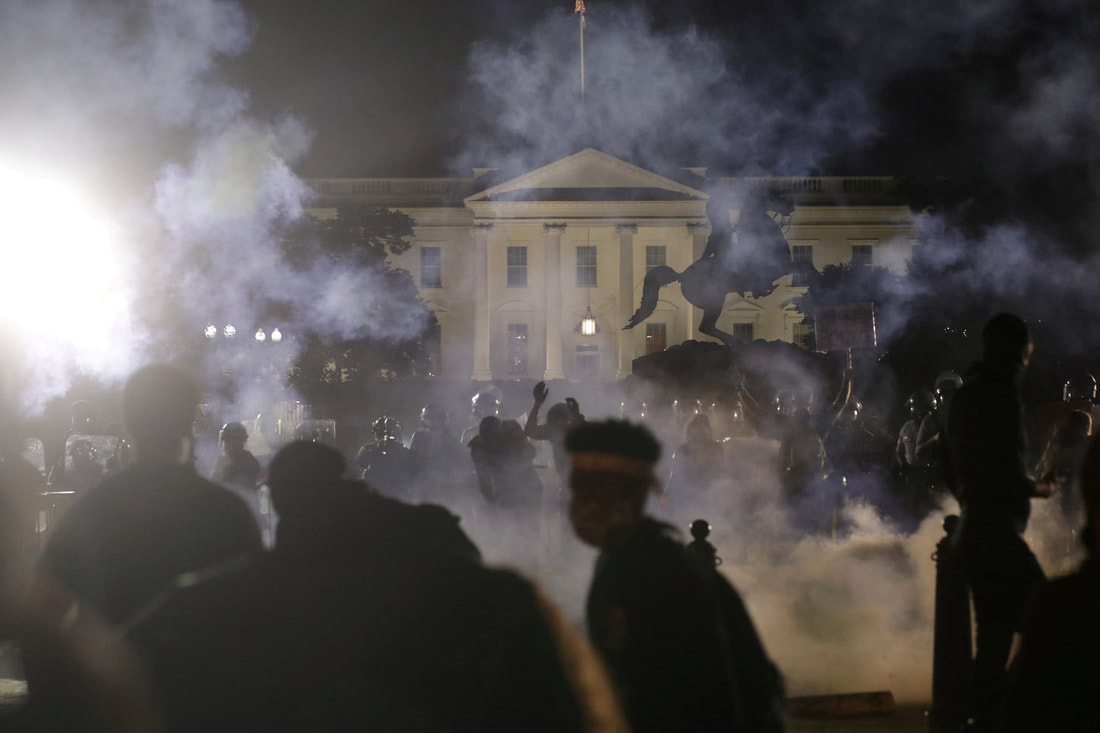
Second, and more importantly, Trump also casually announced he’d send in the troops—which could mean federalizing the National Guard or actually unleashing the Army on America’s cities—if he thought governors and mayors weren’t sufficiently beating the crap out of protesters or rioters (it wasn’t clear which from what he said, and from the way such actions usually play out). What was clear was that he saw such action as a way to intensify his campaign against the Democrats in this year’s election: He’d come off as the tough guy (and presumably more effectual than he’s been in dealing with the pandemic and the economic collapse), while painting the Democrats as the world’s worst wusses.
It’s the absence of all calculations save the political that makes Trump’s intervention something new under the American sun. After all, presidents have sent in the troops before under a range of conditions. Rutherford B. Hayes sent in the Army to break the nationwide railroad strike of 1877, while Grover Cleveland did the same during the Pullman Strike of 1894. Interventions on behalf of equal rights have happened, too: In 1863, Abraham Lincoln sent Union troops (some of whom were still recovering from fighting at Gettysburg) to New York to suppress an anti-draft riot that had turned into a mass lynching of African Americans. In 1957, Dwight Eisenhower sent troops to Little Rock to protect the first nine black children to integrate a school there. And throughout most of his two terms as president, Ulysses Grant deployed federal troops to the South to enforce Reconstruction and suppress the Ku Klux Klan. Though the actions Grant ordered were increasingly unpopular in not just the white South but the white North, too, and though Grant understood full well the depth of their unpopularity, his sense of duty and fairness compelled him to keep dispatching the troops.
It’s the absence of all calculations save the political that makes Trump’s intervention something new under the American sun.
Sometimes, a sense of duty and fairness, abetted by prudence and calculation, has kept a president from sending in the troops when powerful interests have clamored for it. I’ve written on several occasions that the most radical thing Franklin Roosevelt ever did was … nothing. When San Francisco and Minneapolis were shut down in 1934 by general strikes, American big business and conservatives demanded FDR send in the troops; many of them did the same when autoworkers illegally occupied General Motors factories in Flint, Michigan, in the winter of 1936-1937. During the San Francisco strike (at which time, Roosevelt was Hawaii-bound in mid-Pacific, on the cruiser Houston) and the other worker uprisings, however, Roosevelt declined to deploy the Army. As he told reporters, off the record but recorded nonetheless, “In the San Francisco strike a lot of people completely lost their heads and telegraphed me, ‘For God’s sake, come back; turn the ship around.’ Everybody demanded that I sail into San Francisco Bay, all flags flying and guns double-shotted, and end the strike.” By refusing to move against striking workers in 1934, FDR laid some of the groundwork for the enactment of the National Labor Relations Act one year later. By refusing to move against the GM sit-downers, he midwifed the birth of industrial unionism and the creation of a decently paid working class, which endured for the next 40 years.
But even among presidents who did send in troops, not a one did so for such purely electoral calculations as Trump—as ever, blazing a new path in America’s journey, albeit straight to hell.
(Ed.: See post below. The Fierce Urgency of Now.)
Comments
No comments yet.
Leave a comment
Comments are reviewed before they appear. Your name is shown with your comment.