DSA NORTH STAR
  • Welcome
  • Principles
  • Join Us
  • Our Strategy
  • Blog
  • About
    • About North Star
    • About DSA
    • Contact
  • Welcome
  • Principles
  • Join Us
  • Our Strategy
  • Blog
  • About
    • About North Star
    • About DSA
    • Contact

Blog, page 11 of 25

Tribulations of the U.S. Democratic  Left

4/10/2023

Paul Garver

The Squad is neither a political party nor a formal caucus, although its members also belong to the larger, more inchoate House Progressive Caucus. Squad members support each other on issues and in fundraising, sometimes together with Senator Bernie Sanders. The post-Sanders campaign organisation Justice Democrats, together with the national Working Families Party and several progressive NGOs, is closely aligned with the Squad. Although several Squad members are also members of DSA and received initial backing from local DSA chapters, DSA is not a consistent ally for the Squad.

DSA membership is becoming an albatross for democratic socialists serving in Congress. DSA is a ‘big tent’ organisation that has grown dramatically since 2016 in numbers and influence, mainly among the generation under 35 years old. Although the impetus for many of its new members was the Sanders campaign, many of them do not support Sanders/Squad politics, including working within the general framework of the Democratic Party. A few thousand new DSA recruits were entryists from existing or defunct hard-left socialist organisations. For them, the growing Squad represents a dangerous political evolution that could help revitalise the Democratic Party rather than contributing to a purely ‘socialist’ or independent third party under hard-left influence.

Campaigns within DSA to break off any alliance with the Squad have taken several forms. ..
 
Published in The Chartist.  A U.K. Focused Magazine.
https://www.chartist.org.uk/tribulations-of-the-us-democratic-left/ (opens in a new tab)

0 Comments on Tribulations of the U.S. Democratic  Left

Uniting Against the Ultra Right

4/4/2023

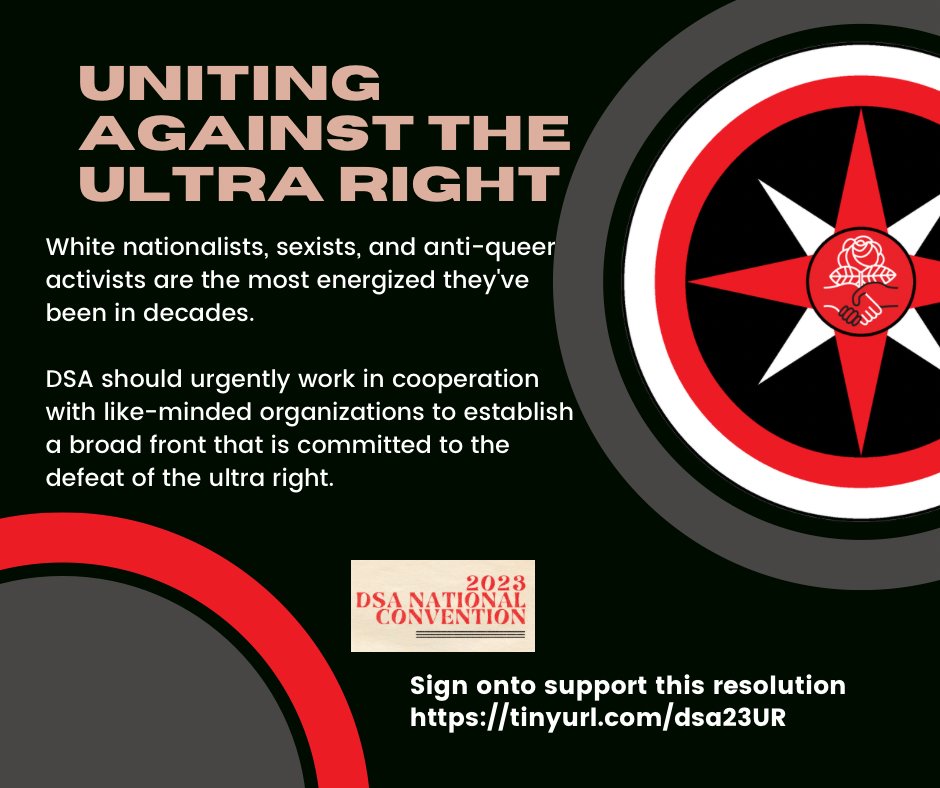
Uniting Against the Ultra Right. White nationalists, sexists, and anti-queer activists are the most energized they’ve been in decades. DSA should urgently work in cooperation with like-minded organizations to establish a broad front that is committed to the defeat of the ultra right. 2023 DSA National Convention. Sign on to support this resolution: https://tinyurl.com/dsa23UR

0 Comments on Uniting Against the Ultra Right

The Threat of the Far Right

4/3/2023

 Trump lost the 2020 presidential election but the forces he represented and the ideas he furthered – the contemporary US right – have not gone away. These forces are continuing their efforts to push the US – both at in the electoral and the extra-parliamentary terrains – further towards their anti-democratic vision for the U.S.

 NPEC is sponsoring an upcoming zoom session, Confronting the Threat of the Far Right.   

Session date: April 3, 2023
Session time: 5 PM PT/8 PM ET
Three sets of questions will be addressed in this session:
 
1.        Who is the right, both electorally and in the larger cultural front?  What groups are the  most active?  What are the historical roots of the U.S. right?  How are these groups organized?  
2.        The “right” has several ideological strand and beliefs.  What are these differences?  Is it possible to exploit potential divisions between libertarians, white evangelical Christian nationalists, para-militarists, white supremacists, etc. and other segments the right?
3.        What should the broad left do to counter today’s right?  How should we organize and with what goals?  Where does DSA fit into in the effort to create a progressive counter-offensive to the right?
 
We will hear from and ask questions of Bill Fletcher, John Huntington, and Nancy McLean.  These three presenters have engaged with the US far right as analysts, organizers or both.  .  The presentations and discussion will help DSA members in our day-to-day organizing and will provide important context for our political thinking and work through the 2023 convention and beyond.
Join us on April 3.
Register for this exiting and important session here:

https://www.dsausa.org/calendar/confronting-www.dsausa.org/calendar/confronting-the-threat-of-the-far-right (opens in a new tab)the-threat-of-the-far-right
 
 We request that some members participating this webinar  bring up our own resolution on Fighting the Right.  This is a good outreach opportunity.A concrete way to act upon this threat is to build a united front  now. Sign and endorse the  Unite Against the Right  resolution for DSA convention. Time is running out. Signatures are needed by April 14, 2023.

The resolution is here on this blog.
 
Sign the resolution – Unite Against the Right
 

0 Comments on The Threat of the Far Right

DSA: Where do you go from here?

3/31/2023

 By Carl Pinkston, 
On April 8, 2020, Senator Bernie Sanders suspended his national electoral campaign to win the nomination for the Democratic Party. Sander’s campaign was a grassroots, multiracial, and multigenerational crusade that focus on fighting for progressive causes i.e. Medicare for All, New Green Deal, free college education, etc. Or as Sanders stated, “We have taken on Wall Street, the insurance companies, the drug companies, the fossil fuel industry, the military-industrial complex, the prison-industrial complex, and the greed of the entire corporate elite.” To progressive activists, this was an important struggle against the corporate elite, but at the end of the day, this was essentially an electoral campaign. 

Electoral History

Let us  be clear, there has not been a major national electoral endeavor by a commanding socialist since Eugene V. Deb. In 1912, Debs ran on a ticket as Socialist Party of America and received 901,551 votes. Not since that time and with all the combined left organizational members and supporters together has a socialist candidate been able to reach a quarter of Deb’s numbers. We would have to wait until 2016, when Bernie Sanders, a democratic socialist, entered the electoral race within the Democratic Party. Bernie Sanders has been able to elevate the word socialism which for a short moment dominated working people’s consciousness.  In the 2016 Democratic primary, Bernie Sanders received 13,168,222 (43.14%) votes and in 2020, Sanders received 7,708,599 (23.07%) votes. Moreover, in the last CNN debate, 9.9 million national viewers, 848,000 Spanish-language viewers, and 608,000 live-stream viewers watched Bernie Sanders educate the public about socialism. This is after the ruling class had declared socialism dead, and Bernie brought back socialism onto working people’s kitchen tables. Even the combined left platforms (newspaper, radio, TV) in the United States can not compare to Sanders’s reach and impact.
 
However, Bernie Sander’s campaign was not a movement for socialism, but for a form of regulated capitalism. The political demands were not revolutionary, no matter how Bernie described it, but, in fact, was demanding concessions from the system by advocating for more government control in health, infrastructure, and social safety net. 

Impact on DSA

During Bernie Sanders’s presidential election campaign, the Democratic Socialist of America membership added about 10,000 new members, but Bernie’s exit brought into the organization with phenomenal members over 85,000. Let’s be clear this new membership base was activists from the Bernie election campaign and not principally from the social movements of the day: Black Live Matter, Environmental, anti-poverty campaigns, and others. In many ways, DSA has become the home of an emerging new electoral movement that is trying to find a way to hold everyone together. It had many demands, no clear focus, but to build an electoral base. 
This formation is a united front of various forces newly held together under a rubric of building an electoral force. DSA is unable to be the electoral united front, because of  the many fractions contending to move DSA in various directions. One fraction suggests that DSA should move in the direction of a purely political party that would lead the masses to liberation. Drawing a line of absolute demarcation by using a rotating political firing squad to knock out some folks and make DSA a small vanguard for the people. Well, I’m sorry to inform some of them, but we have been here before in the 70s and now we do not exist as a force for change.  The ultra-left has a tendency to attack before building for change – they love the revolution without the work. More importantly, DSA, whether we want to want to recognize this or not, is consolidated around one strategy – the electoral arena. 

Next Steps

Since, the 2009-10 economic crisis, the ruling class has been trying to address the contradictions of neo-liberalism and emerging movements. The 2016 election opened the door for the ascend of neo-confederates and neo-fascist to challenge liberal democracy. The question before DSA is what it should do next. I would like to suggest that it build a mass movement to fight the neo-confederates and neo-fascist. In other words, support initiatives that create a united front for an expanded democracy. This democracy is in the workplace, ending voter suppression, proportional representation, ending filibusters and other anarchic rules, participatory budgeting, and others. This united front is based on uniting the many to defeat the few – democrats, progressives, independents, activists, labor and led by people of color. 
Second, the electoral arena is one, but not the only one, of the key battlegrounds in the movement. Socialists will need to continue to struggle within the Democratic Party to raise the contradictions, but until the activists from labor and person of color fully recognize the bankruptcy of the party, a critical mass for a new electoral party will not be sustainable. Thus, at this time, a working-class electoral party led by people of color will have to come thru the Democratic Party. The struggle for a new electoral working-class party should take place within and outside of the Democratic Party. 
Yes, at this moment and at this time, this is the principal contradiction – the mass majority against the reactionary forces. This is not a question of supporting Biden or any democratic candidate, but about how we will unite the many to defeat the reactionary forces that will limit and push us back in our struggle for working people. I know this will not be easy, but no concrete material struggle is. Thus, I ask you now should we engage in this fight or sit this out? The working-class demand that we are not talker but doer; that we are conscious builder and not ivy league intellectual; and that we will walk with the working class in the most difficult of struggle and not simply write about them from afar.  
Socialists are open, never hide their agenda, and are clear about their immediate and long-term goals for change. 
Carl Pinkston. Operation Director of Black Parallel School Board (Sacramento) and Director of the African Research Institute. as well as   former member of Liberation Road and Institute for Social and Economic Studies.
For more on the history of this political  direction see. Manning Marable 1950–2011, A Radical Intellectual – A DSA Founder
 
Editor’s note. A concrete way to implement this direction now, is to sign and endorse the  Unite Against the Right  resolution. Time is running out. Signatures are needed by April 14, 2023.
The resolution is here.
Sign the resolution – Unite Against the Right


0 Comments on DSA: Where do you go from here?

Defend Immigrant Rights at the Convention: Sign One More Resolution

3/30/2023

 
Alexander Hernandez and I ( Duane Campbell) urge you to sign the resolution to establish Immigrants Rights as a priority in DSA.
 
The resolution on the Defense of Immigrants and Refugees was written by members of the national Immigrants' Rights Working Group. This resolution reaffirms our commitment to building with working-class communities of color currently outside of DSA. The proposal is intended to prioritize this crucial work with action and calls for a modest budgetary allocation. 
 
Delegates to DSA’s 2017, 2019, 2021 conventions voted to make the defense of immigrants and refugees a priority, but since the Immigrants’ Rights Working Group peak in March 2022 with 1,003 members, at least 31 chapters having a formal immigrants rights group and 50 others interested in forming one, the work has been neglected by a lack of attention from the NPC and a lack of resources. 
 
The North Star Caucus endorsed and supported the Immigrants Rights Resolutions in 2019 and 2021. While the conventions supported these efforts, there has not been significant national support.  In 2021 the IMWG was subject to significant disruption, explained here.
 
Defending Immigrants and Opposing the Authoritarian Enemy. With, or Without DSA.
 
Now, a restructured IMWG is working to renew this work.  This proposal calls for support of this pro immigrant agenda and we again ask for North Star’s support. 
 
The proposal also calls for “immigrants and their communities to lead this struggle and determine its tactics.” A key component for this work is the sensitivity of organizing in immigrant and undocumented people’s communities. And that sometimes means our role is not in the spotlight and that sensitivity migrants in the United States under the current legal framework are disenfranchised from basic legal protections. This is reflected across the immigrants rights movement in legislative battles and nonviolent action. 
 
This work, centering the communities impacted means DSA is not always the visible partner; and until the makeup of our base changes, we should not be expected to be leading, but continue to prioritize relationship building and learning to listen to members of  these communities. The relationship and trust building between movement bases takes time, showing up and listening is just the start.
 
Please sign the resolution here.  And, share it with your DSA friends.
 
https://docs.google.com/document/d/12jxNfyUny_IY2NeE5YyQ2k-SwyMl2Tfq1aQT8TWOkgE/edit


We also support the following resolutions.
 
  • Unite Against the Ultra Right: https://tinyurl.com/dsa23UR (opens in a new tab)
  • On the Defense of Immigrants and Refugees: https://forms.gle/mjT8X8SEAtt4VUkd8 (opens in a new tab)  
  • Big Tent amendment: https://tinyurl.com/dsa23BT (opens in a new tab)
 
 
Thank you for your consideration.
 
Alexander Hernandez,  
Duane Campbell 
 
Also, in Celebration of Cesar Chavez Day in some elevent states, see this.from our blog.
 
Cesar Chavez, Dolores Huerta and Strategic Racism
 

0 Comments on Defend Immigrant Rights at the Convention: Sign One More Resolution

Sign the Unite Against the Right Resolution.  Set DSA policy.

3/29/2023


Urgent. Action Needed.
 I and the NS Caucus urges you to endorse the resolution- Unite Against the Maga-Right as a guide to popular political participation at the August DSA convention,
The resolution is here.
Sign the resolution – Unite Against the Right
 
If you have already signed, thank you.  But, read on. We need more assistance. 
 
By this resolution DSA commits to engage in the electoral arena to fight the MAGA -Fascist Right wing in the U.S.  This  resolution is an application of our NS strategy for DSA. We argue that DSA should contest campaigns in the electoral season, not stand outside of electoral politics.  There are competing views within DSA which we oppose. 
 
We propose to form a broad front against the US ultra-right which includes MAGA. neo confederates, Oath Keepers, Proud Boys, ALEC, militias, too many Republicans, and numerous reactionary super PACs, foundations, and think tanks.  The resolution also proposes improving cooperation among DSA and its sister organizations that is necessary in order to organize the broad front against the right. 
 
For your information, here is the draft electoral resolution being prepared for consideration by the national DSA electoral committee for the convention.
Draft electoral resolution:
https://docs.google.com/document/d/1mRB4CPfimNv-7WH45I11pAnu6jgg-NF5iPNzepc_Fds/edit
This proposal is radically inadequate !  Instead, we are preparing for DSA’s 2023 convention by presenting our own resolution about politically confronting the ultra-right.
 Notice please, in their world,  there is no right wing threat. There is no danger of Maga – Republicans and the insurrectionists.  There is no neo confederacy.  There is no danger to democracy.  There is no plan for practical, realistic, political participation in preparation for 2024. 
We need to get our resolution accepted by 300 DSA members in order to have an alternative on the floor at the convention.  This is our North Star strategy in action. Please assist. 
A second resolution has been posted on our blog along with text on building a broad tent organization.. 
 
Build a Big Tent Organization: Please sign the resolution
 
Please sign both resolutions.
 
Ultra Right: https://tinyurl.com/dsa23UR
 
Big Tent: https://tinyurl.com/dsa23BT
 
You could draft your personal  appeal by creating your own message using the links provided or  by linking to the North Star blog. 
 
Sign the resolution – Unite Against the Right
 
We need your assistance now. Please sign the resolutions. And, reach out to your friends and allies and ask them to sign. 
 
Thank each of you for your assistance in building and retaining a democratic DSA. 
 
In socialist solidarity,
Duane Campbell
Co chair. North Star Caucus.


0 Comments on Sign the Unite Against the Right Resolution.  Set DSA policy.

Build a Big Tent Organization : Please sign the resolution

3/28/2023

A majoritarian strategy

On March 24 The DSA North Star Caucus for Socialism and Democracy emailed our 350  Caucus members asking them to spread the word for DSA members to sign the Convention Resolution Against the Ultra-Rightwritten by North Star members, as well as a member-authored Bylaws Amendment titled the DSA 2023 Big Tent Bylaw Amendment. For typable links to each, see here: Ultra-Right: https://tinyurl.com/dsa23UR and here: Big Tent: https://tinyurl.com/dsa23BT (opens in a new tab).

Over 300 signatures are needed before April 15; please do not delay!
Together, the resolution and the bylaws amendment will help build DSA as a democratic socialist organization which can unite the majority of people to oppose the ultra-right in this nation. We can do so in a way consistent with a Purpose which has attracted well over 100,000 people to join DSA over the years.
Earlier on this blog we posted the text of the Uniting Against the Ultra-Right resolution. Both the resolution and the amendment were written by North Star members and approved by our Steering Committee. But any DSA member in good standing can sign on to ensure that they are debated at the 2023 Convention, without necessarily supporting our Statement of Principles. 
The Big Tent Amendment was motivated by a disturbing tendency among hardline tendencies within DSA to surrender the urge to purge our ranks of those who may disagree with one or another of our national or chapter positions or may say or do thinks the hardliners feel are inconsistent with what they feel are the principles and/or policies of the organization. Our Constitution and Bylaws do not specify what those principles and policies are, yet the expulsion clause of the Bylaws current permits expulsion by either the NPC or by chapters for “substantial disagreement with the principles or policies of the organization.”
This can lead to among DSA members who hold public office or are seeking office or are active in their chapters or in mass organizations that things they say or do can result in charges being brought against them, leading to possible expulsion. This can create an atmosphere that inhibits debate and disagreement within DSA. A number of us concluded that the DSA Constitution’s Statement of Purpose is the best standard for defining our principles. It is re-printed below in the Rationale for the Bylaws Amendment. By striking out “principles or policies of the organization” and substituting DSA Constitution Article II Purpose we hope to reinforce the democratic nature of our organization. Members who violate specific policies designed to provide for a democratic DSA—such as theft or misuse of membership records, or violations of HGO policies could still face appropriate discipline or be expelled on the grounds already in the Bylaws: “if they consistently engage in undemocratic, disruptive behavior.”
But dissent for particular platform planks, convention resolutions, or local statements would not be grounds for expulsion unless they rose to the level of demonstrating substantial disagreement with the purpose of the organization. The Big Tent Amendment makes no changes in other provisions of Section 3 Expulsion, some of which have long been controversial. But we think that the minor clarification we propose deserves support from across the spectrum of views within DSA. Following is the text: 

Text of the DSA 2023 Big Tent Bylaws Amendment

Authors: Bill Barclay (Ventura County), Duane Campbell (Sacramento), Michael Dover (Cleveland), John Heppen (Twin-Cities), Alexander Hernández (Pasco-Hernando), Michele Rossi (Philadelphia), Mark Schaeffer (Albany NY)
 
Rationale:
 
As a democratic socialist organization, DSA members should always have the privilege and even responsibility to debate or publicly dissent from specific convention resolutions, NPC statements or local statements.
 
The DSA Bylaws Article I Section 3 allows expulsion of members in “substantial disagreement” with “principles or policies of the organization”, but these principles and policies are not specifically defined anywhere in the DSA Constitution or Bylaws.
 
The DSA Constitution Article II Purpose states these principles at length: "We are socialists because we reject an economic order based on private profit, alienated labor, gross inequalities of wealth and power, discrimination based on race, sex, sexual orientation, gender expression, disability status, age, religion, and national origin, and brutality and violence in defense of the status quo. We are socialists because we share a vision of a humane social order based on popular control of resources and production, economic planning, equitable distribution, feminism, racial equality and non-oppressive relationships. We are socialists because we are developing a concrete strategy for achieving that vision, for building a majority movement that will make democratic socialism a reality in the United States of America. We believe that such a strategy must acknowledge the class structure of U.S. society and that this class structure means that there is a basic conflict of interest between those sectors with enormous economic power and the vast majority of the population."
 
These principles have motivated well over 100,000 people to join DSA over the years. It is important that DSA retains our character as a large democratic socialist organization with a variety of points of view.
 
Amended Language:
 
The DSA Bylaws shall be amended as follows:[to substitute DSA Constitution Article II Purpose for “principles and policies of the organization”; no other changes to existing Article 1]
 
DSA Bylaws, Article I (Membership), Section 3 (Expulsion):
 
Members can be expelled if they are found to be in substantial disagreement with the [Add: DSA Constitution Article II Purpose] [Delete: principles or policies of the organization] or if they consistently engage in undemocratic, disruptive behavior or if they are under the discipline of any self-defined democratic-centralist organization. Members facing expulsion must receive written notice of charges against them and must be given the opportunity to be heard before the NPC or a subcommittee thereof, appointed for the purpose of considering expulsion.
 

0 Comments on Build a Big Tent Organization : Please sign the resolution

Sign the resolution -- Unite Against the Right

3/23/2023

The North Star Caucus for Socialism and Democracy has proposals for the DSA Convention this summer. The first one put forward here -- “Unite Against the Ultra-Right” -- is aimed at building a broad front against the incipient neo-fascism of the Republican Party. We urge all members of Democratic Socialists of America to sign on. A minimum of 300 signatures is required for a resolution to be considered at the convention. After you have signed, please circulate it among your comrades for support.

Here is the text:

Uniting Against the Ultra-Right

Authors: Duane Campbell (Sacramento), Itzhak Epstein (New York City), Barbara Joye (Greater Atlanta), Max Sawicky (Metro DC)

Preamble:

Democratic socialists must take seriously the threat to our democracy posed by the extremist right-wing elements in the US that have coalesced around the MAGA movement and its allies and gained control of the Republican Party to the point where it is barely distinguishable from them. The ultra-right’s rule would  undermine our already inadequate constitutional order in favor of  authoritarian rule by the propertied classes, combined with weakening of the federal government and the suppression of basic civil rights, environmental protection and public services.

To say that the ultra-right is the principal enemy does not mean that it is the only enemy. It means, however, that we must focus on uniting democratic socialists, progressives and all those willing to build towards a majority which can defeat this threat. This broad front must be multi-racial and cross-class.  It cannot be an alignment of the Left alone nor can it be limited to those who are in total agreement with a left/progressive agenda.

We are aware that the necessary organized nucleus of such a broad front does not exist and that DSA is not a part of such an alliance. Therefore, we are taking the first steps toward its formation and also addressing the issue that the democratic left is splintered among many organizations that often act with little coordination.  Improvement should start by DSA approaching its nearest sister organizations.

Budget and Staff Implications:

One staff person  will collaborate with other organizations in establishing the broad front and serve as a resource person to DSA on fighting the ultra-right. The broad front may establish its own staff and financial resources.

There will be a need for a staff person, if there isn't one yet, to look after cooperation and coordination with other democratic left organizations. This person will assist DSA bodies in working with their opposite numbers.

Resolved:

DSA should  urgently work in cooperation with  like-minded organizations to establish a broad front that is committed to the defeat of the ultra-right. The foundation of this block should rest on improved  cooperation and coordination among democratic left organizations  on issues such as the defense of democracy, the Green New Deal, labor organizing, reproductive choice, universal health care, racial justice, and progressive taxation.
 
PLEASE SIGN HERE (opens in a new tab)

We urge you to circulate this blogpost URL.

3 Comments on Sign the resolution -- Unite Against the Right

Confronting the Threat of the Far Right

3/21/2023

Trump lost the 2020 presidential election but the forces he represented and the ideas he furthered – the contemporary US right – have not gone away. These forces are continuing their efforts to push the US – both at in the electoral and the extra-parliamentary terrains – further towards their anti-democratic vision for the U.S.

 NPEC is sponsoring an upcoming zoom session, Confronting the Threat of the Far Right.   

Session date: April 3, 2023
Session time: 5 PM PT/8 PM ET
Three sets of questions will be addressed in this session:
 
  1. Who is the right, both electorally and in the larger cultural front?  What groups are the  most active?  What are the historical roots of the U.S. right?  How are these groups organized?  
  2. The “right” has several ideological strand and beliefs.  What are these differences?  Is it possible to exploit potential divisions between libertarians, white evangelical Christian nationalists, para-militarists, white supremacists, etc. and other segments the right?
  3. What should the broad left do to counter today’s right?  How should we organize and with what goals?  Where does DSA fit into in the effort to create a progressive counter-offensive to the right?
 
We will hear from and ask questions of Bill Fletcher, John Huntington, and Nancy McLean.  These three presenters have engaged with the US far right as analysts, organizers or both.  .  The presentations and discussion will help DSA members in our day-to-day organizing and will provide important context for our political thinking and work through the 2023 convention and beyond.
Join us on April 3.
Register for this exiting and important session here:

https://www.dsausa.org/calendar/confronting-www.dsausa.org/calendar/confronting-the-threat-of-the-far-right (opens in a new tab)the-threat-of-the-far-right


0 Comments on Confronting the Threat of the Far Right

The Proposal to the Convention on DSA Media is Misguided

3/19/2023


We need to invest and expand our publications and media, not liquidate. 
 
By Alexander Hernández 
 (Includes Proposed Amendments) 

Since 2019 there have been four instances the convention has taken up questions referencing Editorial Boards. In one instance a reference to the Democratic Left Editorial Board and another to the NPCs role in overseeing all Editorial Boards. 
 
Two other instances were with reference to an Editorial Board orienting towards Latinx communities. In the first case, 2019 resolution Orienting towards Latinx communities was the most voted for resolution to pass on the consent agenda. The 2019-2021 NPC failed to implement this convention mandate. 
 
While an attempt to bring the issue to convention 2021, via resolution #36 Prioritizing Working-class Latino Organizing in DSA,  was ultimately tabled due to lack of time; the 2021-2023 NPC allowed for the originally passed mandate and follow up resolution to remain tabled. 
 
If the goal is to revitalize our publications, you do not do so by cutting the budget or consolidating the work. You do so by investing into our publications and media. And one crucial way already mandated is to create the editorial board for Latinos Socialistas. 
 
The reason our Democratic Left went from 18 pages to 4 is not from lack of volunteers and membership input, rather from a failure in leadership to act or rather even realize that a 20% budgetary cut across the board included the organization's publication
 
The current proposal circulating is misguided and should be rejected as currently presented.  In the event the proposal reaches convention, I would offer the  amendment  below to truly revitalize our publications and media as a top national priority. Starting by fulfilling our commitment of orienting and organizing Latinx communities. 

Proposed amendment to revitalize and expand DSA publications as national priority

 ( Editor's note. It has become clear through posts on social media that the original post below did not show all the details.  This was an error in our posting. 

Note; the substitute proposal is here.


https://drive.google.com/file/d/1-6IqVB0oCvJPhuRjTNpZpJxFCxHJe4DK/view?usp=drivesdk

This resolution  may not get to the convention.  It was developed to illustrate what was wrong with the original proposal. 

Proposed amendment to revitalize and expand DSA publications as national priority

Be it therefore resolved that the revitalization and expansion of DSA publications and media will be a top national priority.
Resolved the National Political Committee will initiate the selection of an Editorial Board as mandated by 2019 resolution #6 Orienting to Latinx Communities, that the Latinos Socialistas Editorial Board be composed of 9 4 Editors elected no later than 3 months after this each national convention by the NPC following a public call for nominations open to all DSA members in good standing,
 
Resolved that DSA’s publications will continue to be open to the participation of members in good standing; to that end, the NPC  will create a public sign-up form for DSA members to volunteer in producing  any publication (Latinos Socialistas, Democratic Left Print, Democratic Left Blog or Socialist Forum), and will follow up with each member who submits the form,
 
Resolved that the Editorial Board will choose among itself an Editor-in-Chief, functionally the chair, responsible for organizing meetings and ensuring tasks are bottom lined, and that all Board members have equal votes on matters,


https://drive.google.com/file/d/1-6IqVB0oCvJPhuRjTNpZpJxFCxHJe4DK/view?usp=drivesdk

Resolved that the Editorial Board will choose among itself an Editor-in-Chief, functionally the chair, responsible for organizing meetings and ensuring tasks are bottom lined, and that all Board members have equal votes on matters,
 
Resolved that, at least once a month the Editorial Board will review the articles submitted for consideration, and, for every article submitted, will take a vote on whether or not to publish, either as a whole board or in subcommittee,
 
Resolved that the Editorial Board prioritizes publishing content centered around DSA’s political stances,
 
Resolved that the Editorial Board publication geared towards current and future members of the wider U.S. left, publishing articles around 800 to 1,800 words that touch on political topics of interest to DSA members through news commentary and analysis, chapter and campaign report-backs, focused political discussion, and cultural criticism,
 
Resolved that the NPC will develop and implement a plan to expand the digital and physical reach of Democratic Left and Socialist Forum, including but not limited to a plan to expand the print issues of Democratic Left (in number of pages and word count) by August 2024,
 
Resolved that the NPC provide DSA publications  with a budget to carry out their respective missions  and expansion of Democratic Left and Socialist Forum,
 
Resolved that the NPC will ensure that the print version of Democratic Left solicits and features regular reports, including from national committees, the NPC, chapters, and DSA-endorsed socialists in office,
 
Resolved that the Democratic Left and Socialist Forum continue to promote content using email and social media, including but not limited to circulating publication news and announcements, engaging with DSA members and chapters to solicit and republish content, and sharing individual articles,
 
Resolved that the NPC ensures that Democratic Left and Socialist Forum publish content primarily created or co-created by DSA members, including but not limited to content republished from other publications.

Resolution with mark ups

https://drive.google.com/file/d/1-6IqVB0oCvJPhuRjTNpZpJxFCxHJe4DK/view?usp=drivesdk (opens in a new tab)

 https://drive.google.com/file/d/1-6IqVB0oCvJPhuRjTNpZpJxFCxHJe4DK/view?usp=drivesdk (opens in a new tab)

0 Comments on The Proposal to the Convention on DSA Media is Misguided

More on the Banking Mess

3/16/2023

North Star member Bill Barclay breaks down the Silicon Valley Bank collapse here (opens in a new tab).

Excerpt:

Where is Powell? Where is Yellen? Stop this crisis NOW. Announce that all depositors will be safe.
– David Sacks, PayPal co-founder and Silicon Valley libertarian commentator, 3/10/2023

OK. We can all enjoy some schadenfreude as the Silicon Valley techno-libertarians discover that maybe there is a role for government, after all. Especially when their money in Silicon Valley Bank (SVB) might vanish. Of course, it didn’t. It didn’t because those burdensome government agencies decided to make them whole, 100 cents on the dollar, including the more than 90% of deposits that were above the $250,000 Federal Deposit Insurance Corporation insurance limit. . . .


0 Comments on More on the Banking Mess

Casualties of SVB’s Collapse

3/14/2023

Silicon Valley libertarianism, every congressional Republican, 50 congressional Democrats—and why are some still sitting on the banking committees? 
Harold Meyerson


The implosion of Silicon Valley Bank has brought with it—or, at least, should bring with it—the implosion of the reputations of certain key groups and individuals in America’s political and economic infrastructure. The list begins with SVB’s own leaders, of course, most particularly CEO Greg Becker, who repeatedly urged Congress in 2018 to eliminate the Dodd-Frank regulation requiring midsize banks like his to maintain a prudent amount of ready money lest nefarious forces cause a run on the bank. But Becker is just one of a number of public figures whose credibility just now is at Tucker Carlson levels.

Silicon Valley was already going through a hard time before SVB went under, as the nation’s consumption of digital products declined with the waning of the pandemic. (Just today, Meta [aka Facebook] announced it would lay off another 10,000 employees.) But Silicon Valley’s defining ideology—a libertarianism that extolled private markets and condemned government efforts to regulate them—has been shown to be as hollow as Marjorie Taylor Greene’s head. I won’t enumerate all the pleas to the feds to step up and rescue their deposits from the very same Valley libertarians who’d been disparaging any governmental role in the economy as recently as the middle of last week. Michael Hiltzik in the Los Angeles Times and Adam Lashinsky in The Washington Post have both done excellent jobs laying out this epic of hypocrisy.

Libertarianism will surely survive this setback; it’s as American as mass shootings. But the one wing of libertarianism with cultural cachet was Silicon Valley’s super-cool version. (Compare and contrast Steve Jobs and Ron Paul.) Now that version has been shown to be as phony as a three-dollar bill (for which, doubtless, there is a crypto equivalent).

Reputational damage also attaches to the members of Congress who voted in 2018 to roll back the keep-cash-handy provisions of Dodd-Frank on midsize ($50 billion to $250 billion in assets) banks. That list includes every Republican save one, as well as 33 House Democrats and 17 Democratic senators. None of the Democrats whose districts were even remotely close to Silicon Valley voted for the measure, nor did California’s senators (Feinstein and Harris). The yes votes came instead from a mix of the pro-corporate Democrats usually hailed by centrist publications for their bipartisanship (Virginia’s Mark Warner, West Virginia’s Joe Manchin, New Jersey’s Josh Gottheimer), from the senators and representatives of states dominated by banks (Delaware’s Tom Carper, Chris Coons, and Lisa Blunt Rochester), and from a small number of inner-city representatives doing the bidding of their cities’ midsize banks. A number of those Democrats in both houses served on the congressional committees that oversaw banking and thus received ample campaign funding from the banks; those who served on the Senate’s committee, Warner in particular, played a decisive role in passing that legislation. (Warner won the chutzpah prize of the month last weekend when he defended the 2018 deregulation on a Sunday talk show.) Why their fellow Democrats would want to keep these deregulators on those committees now, given their appalling lack of judgment, is a good question. There should be some price attached to having lit the deregulatory fuse in 2018; commendably, Arizona Rep. Ruben Gallego, currently seeking Kyrsten Sinema’s Senate seat, has taken her to task for voting for the measure back when she was in the House. 

And then there’s the reputation of the mega-banker who didn’t step up: Jamie Dimon. His bank, JPMorgan Chase, is much the nation’s largest, and best equipped to take over the remaining assets and debts left by SVP. Old J.P. Morgan himself, it’s worth recalling, ended the financial panic of 1907, in which banks were toppling like tenpins, by pledging his bank’s reserves to stabilize the system, and strong-arming the heads of other big banks to do the same. Dimon is the one banker, and Chase the best-suited bank, capable of doing the 21st-century version of that today. It’s time for President Joe to give CEO Jamie a friendly call. 

 
The American Prospect 
Meyerson on TAP
 
https://americanprospect.bluelena.io/index.php?action=social&chash=c45008212f7bdf6eab6050c2a564435a.1955&s=f3196cb603d6d11dedcd326ed6daf0e3 (opens in a new tab)

0 Comments on Casualties of SVB’s Collapse

UTLA/Reclaim Strike Showed What Labor + Community Can Do

3/9/2023

By. Alex Caputo-Pearl
 
In the strike, we won enforceable class size caps (which very few districts have) for the first time in the Los Angeles Unified School District (LAUSD).  Before the strike, LAUSD put class size numbers on a page, but they meant nothing because they were not legally enforceable.  There were hundreds of K-3 classes with over 30 students in them, and many high school classes with over 50.  Our victory required every class to come down to cap numbers, impacting classes all over the district at every grade level.  The strike put us in the driver’s seat on class size for the first time--winning enforceable caps in 2019 means we can use every round of bargaining from the strike forward to push caps down. 
In the strike, we won a salary increase among the highest in the state at the time and beat back the district’s attempt to create a two-tier healthcare plan, one of the most insidious attacks on workers and unions.  LAUSD wanted educators hired after 2019 to have a weaker healthcare plan than those hired before 2019.  If we had not won this, our union would have had a divisive dilemma at its core.   
In the strike, we won unprecedented Common Good bargaining victories on racial justice, including:,,,,,
https://convergencemag.com/articles/utla-reclaim-strike-showed-what-labor-community-can-do/
 

0 Comments on UTLA/Reclaim Strike Showed What Labor + Community Can Do

The Danger of Factionalism in DSA -2

3/6/2023

If the Left is to succeed where past generations have failed, it can’t allow sectarian organizations to operate as “parties within a party.”
BILL BARCLAY, LEO CASEY, JACK CLARK, RICHARD HEALEY, DEBORAH MEIER, MAXINE PHILLIPS, CHRIS RIDDIOUGH AND JOSEPH M. SCHWARTZMARCH 30, 2021


The remarkable growth of Democratic Socialists of America (DSA) over the past four years, from a group with a few thousand members to one with fifteen times that number, has made it the most significant U.S. socialist organization in nearly a century. Successful campaigns to elect open democratic socialists to public office have given the DSA real, if still embryonic, political influence. Four members--Jamaal Bowman, Cori Bush, Alexandria Ocasio-Cortez and Rashida Tlaib--now sit in the House of Representatives. Together with Bernie Sanders in the Senate, this is the largest number of self-avowed democratic socialists ever to hold Congressional office simultaneously, to say nothing of the scores of DSA members who have been elected to state legislatures, county boards and city councils in recent years. 
As DSA has grown in size and political influence, so too has the interest it has attracted from small political groups to its left. These “sects,” short for sectarian organizations, see opportunities for themselves in the large numbers of young people new to politics who have joined DSA, viewing them as potential recruits for their emaciated ranks. 

The recent announcement of the Trotskyist organization Socialist Alternative (SAlt) that its members were coming aboard, followed by a similar declarationfrom its leading member, Kshama Sawant, has simply made public a process that has been underway for some time--that various marginal Trotskyist organizations have infiltrated the DSA in a practice known as “entryism.”

What is entryism and what kind of impact could it have on DSA? 
Let’s start with this disingenuous passage in the SAlt announcement:
We realize that DSA has a national “ban” on members of democratic centralist organizations joining. However, many DSA members we’ve talked to oppose this Cold War holdover and are excited about Socialist Alternative members joining. While this rule was originally created to prevent Marxists from joining DSA, in recent years, a new generation of DSA activists have changed the organizations’ politics for the better, many of them identifying as Marxist. We think DSA should remove this exclusionary rule as another useful step towards transforming the socialist left into an important component for the emerging class struggles. 

We, the undersigned, were involved in the crafting and adoption of the DSA Constitution that the SAlt communiqué alluded to. We have been a part of DSA’s first generation of national leadership, and we have served in its two predecessor organizations, the New American Movement and the Democratic Socialist Organizing Committee. SAlt’s claim that Marxists have been “banned” from joining DSA is a self-serving fiction, and they know it. 

Many in the original leadership of DSA identified as Marxists. Michael Harrington, one of our two national co-chairs and our most prominent leader at the time of DSA’s founding, wrote a number of widely read books in which he made a case for Marx’s vision of socialism as democratic. Others of us who did not call ourselves Marxists never considered that they should be excluded from DSA. 

Even if DSA’s founders had not included many self-avowed Marxists, simple logic dictates that if we did not want them in our ranks, our Constitution would have explicitly prohibited them from joining. It did not. Contrary to the fables of SAlt, there are no political or ideological tests for joining DSA, no “bans” on who can join, and no approval process for new members. Don’t take our word for it: Read the document as it’s written. Ask yourself how any member of SAlt, past and present, could have joined DSA. 

DSA’s founders believed that we should assume the good faith of those who wanted to join our ranks, but we were not naïve. We were experienced and battle-hardened democratic socialists who had come from every part of the U.S. Left: women and men who had been leaders of the Socialist Party, the Communist Party, and various Trotskyist organizations, who were part of the Old Left of the 1930s and the New Left of the 1960s, and who came out of trade unions and civil rights, feminist and LGBTQ groups. 

Assumptions notwithstanding, our rich collective memory told us that there would be small numbers of people who joined DSA in bad faith, that these people would behave in ways that were injurious to the mission and work of DSA, and that this behavior would need to be addressed. We knew from our history that the more successful DSA became, the more people would enter it for reasons other than advancing its mission. In the most extreme of these cases, DSA could well find that it needed to use the most serious penalty a democratic organization can levy against a member--expulsion. And given the gravity of such a step, we wanted to make sure that the Constitution specified its conditions so it would not be employed capriciously. Moreover, we wanted to ensure that there was due process for the member being expelled.

With this in mind, we wrote the following:
Members can be expelled if they are found to be in substantial disagreement with the principles or policies of the organization or if they consistently engage in undemocratic, disruptive behavior or if they are under the discipline of any self-defined democratic-centralist organization. Members facing expulsion must receive written notice of charges against them and must be given the opportunity to be heard before the NPC or a subcommittee thereof, appointed for the purpose of considering expulsion.

The first two grounds for expulsion are self-explanatory. The last ground--that a person was “under the discipline of any self-defined democratic centralist organization”--requires some historical background.

Entryism in the 1930s

In 1928, the U.S. Communist Party banished a small group of individuals from its ranks on the grounds that they were associates of Leon Trotsky, the Bolshevik leader who had been purged from the Communist Party of the Soviet Union during a factional struggle that had broken out after Lenin’s death. For years, these renegades were spurned by the rest of the U.S. Left while they sought readmission to the CP in vain. By the mid-1930s and the start of the Moscow Trials in the Soviet Union, it was clear that their expulsion would not be reversed, and the Trotskyists began to look for ways out of the political wilderness in which they found themselves. 

In the American Workers Party (AWP), organized by labor educator A. J. Muste, they saw a path back to relevance. The AWP was an attempt to form a uniquely American revolutionary Marxist party that broke with a U.S. Left whose politics were beholden to different strains of European socialism and communism. In its very brief existence, the AWP had done impressive labor organizing, highlighted by its leadership of the Toledo Auto-Lite strike--one of the epic work stoppages of the 1930s. 

Muste was initially skeptical of Trotskyist appeals to combine forces. The AWP was a more substantial organization with deeper roots in the labor movement, and he found the Trotskyist leaders to be dogmatic and uncreative in their politics. Nonetheless, New York intellectuals Sidney Hook and James Burnham convinced him that a merger was a good idea. But Muste did place one condition on agreeing to the merger: that the Workers Party (WP) would not enter the Socialist Party. 

This was a key point for Muste because the French Trotskyists, acting under the direction of Trotsky himself, had just allied with the French Socialists in a maneuver that came to be known as the “French turn.” After a short stay in the French Socialists, during which they garnered recruits and promoted their politics, the Trotskyists split its ranks, denounced the Socialists, and reorganized as a purely Trotskyist party. Muste was promised that this would not happen in the United States.

Almost immediately, the Trotskyists went back on their word, forcing the question of entry into the U.S. Socialist Party. Weakened by the loss of long-term political associates who were unwilling to join forces with the Trotskyists, Muste lost the vote and the Workers Party, now firmly under Trotskyist control, entered the Socialist Party. 

Once inside, the Trotskyists acted as a “party within a party,” maintaining their own leadership structure (which regularly plotted factional moves within the Socialists) and publishing their own newspaper (which criticized the policies of the Socialist Party and promoted such Trotskyist projects as the founding of a Fourth International). Most important, all of the Trotskyists in the Socialist Party acted as one, under a single organizational discipline: they followed a pre-established “political line” Trotskyist leadership had laid down in all debates and votes inside the Socialist Party. 

In short order, the Trotskyists forced a split in the Socialists and left with a thousand new members for their Socialist Workers Party (SWP), including much of the Socialists’ youth section. After this stratagem was complete, Trotskyist leader James Patrick Cannon boasted not only of the Trotskyists’ success in growing their numbers, but also of the fact that they had left the Socialist Party in shambles. 

Cannon took pride in having engineered a major setback for the U.S. Left: By the 1930s, the ranks of the Socialist Party had grown dramatically, making it into a potentially significant force in U.S. politics. But after a series of misjudgments and internal crises, cresting with its disastrous co-habitation with the Trotskyists, the Socialist Party ended the decade as a shadow of its former self. For U.S. socialists of the 1930s, a number of whom would co-found the DSA decades later, this was a searing political ordeal they would not forget. Muste himself was deeply shaken by these events, which he would describe as a violation of “working class ethics,” and he left the Trotskyists.

The Trotskyists’ entry into the Socialist Party, organized as a disciplined “party within a party” to garner recruits and split its ranks, established the template for what we now call “entryism” on the U.S. Left.

Entryism in the 1960s

Entryism is not a practice limited to Trotskyist sects, as the experience of Students for a Democratic Society (SDS) in the 1960s shows. The 1960s were a period of mass upsurge, much like the 1930s and our current time. The civil rights movement and the opposition to the war in Vietnam generated unprecedented levels of political activism among young people, and SDS grew mightily among white students, approaching an estimated 100,000 members at its peak. Much like DSA and the earlier Socialist Party youth section, the vast bulk of the SDS recruits were new to politics, making it a rich hunting grounds for small, disciplined ultra-left groups. 

One of these was the Progressive Labor Party (PLP). Founded in 1962 after splitting from the Communist Party, PLP was initially supportive of Maoist China but would soon decide that even Mao was insufficiently communist for their tastes. It would then position itself as the most dogmatically Stalinist sect on the U.S. Left. 

By 1966, PLP was recruiting inside the SDS, where it urged members to adopt its ultra-Stalinist politics and seize control of the SDS organizational infrastructure. PLP’s efforts at taking over SDS set off a destructive cycle, producing counter-factions that included a group that later became the Weathermen. Within a decade, the SDS would be destroyed.

Herein lie the dual dangers of entryism. On the one hand, it poses a threat to the organizational integrity of an open and democratic organization. Entryism is the sectarian equivalent to a hostile corporate takeover designed to split or seize control of its target organization. At a minimum, it seeks to poach members new to politics who may not be aware of the stratagem being employed. On the other hand, it disrupts the internal democratic processes of that organization, which depend on members engaging in honest debate and deliberation over policies and political strategies.

Entryists enter all debates and votes not with an open mind and a willingness to be persuaded, but with the express intent of advancing a political line that has already been decided in advance. Such tactics can quickly poison democratic political cultures, especially when opponents resort to the kinds of tactics they did in SDS.

To be politically effective, democratic socialist organizations need to develop methods of unity in action. These include open and full discussions of issues, democratic decision-making processes, and a commitment by all not to impede or undercut decisions once they have been democratically made. When entryist sects function as a disciplined “party within a party,” they undermine that unity in action.

Just as DSA’s founders remembered what the Trotskyists did to the Socialist Party in the 1930s, its first generation of members saw what Progressive Labor did to SDS in the 1960s. Two organizations that gave the Left its best chance to exercise real political power in the U.S. had ended disastrously, in large measure because of sectarian entryism. (These techniques similarly sabotaged a promising national movement of socialist-feminists in the 1970s.)

DSA’s Constitution singles out members “under the discipline of any self-defined democratic-centralist organizations” for possible expulsion to prevent these very outcomes. The drafters chose their words carefully: they do not specify a political belief or even membership in an organization, instead targeting those who aim to form a “party within a party” like the Trotskyists and the Stalinist PLP before them. This language has everything to do with ensuring the survival of an open, democratic institutions and absolutely nothing to do with “Cold War” politics.

The Socialist Alternative understands this, despite its claims to the contrary. After all, SAlt is the progeny of one of the best-known entryist projects in international socialist history, the Militant Tendency of the British Labour Party. From their founding in 1964 to their expulsion in the 1980s, these Trotskyists operated as a disciplined “party within a party” inside of Labour, using the entryist tactics described above. 

SAlt was founded as Labor Militant in 1986 by members of the British Militant Tendency who had moved to the United States as part of an organized effort to create a Trotskyist international. (It adopted its current name in the late 1990s.) Perhaps unsurprisingly, the organization has splintered into several smaller factions since its founding amid personality conflicts, and there now exist competing internationals, although SAlt remains the largest group in the United States.

Why, then, is it trying to join DSA? SAlt’s own statement indicates that it opposes the very strategy that has allowed DSA to grow over the last four years--campaigns to elect democratic socialists to office, using the Democratic Party ballot line--so it would be hard to make a case for a political convergence. In this light, SAlt’s call to eliminate any barriers to entryism in DSA constitution is telling.

Openings for socialists don’t come along often in United States: only three times in the last 100 years has the Left had a change to make a major political breakthrough. DSA, with its rapid growth and electoral victories, could be central to such a breakthrough. Which is why we must acknowledge the deleterious role entryism played in the radical movements of the 1930s and 1960s. If we are to succeed where past generations have failed, it is vital that we not repeat their mistakes.

BILL BARCLAY is an economist who served as Political Secretary of NAM and was a member of its National Committee; he was a member of DSA’s National Political Committee at its founding.
LEO CASEY is a teacher unionist who was a member of NAM’s National Committee; he served as the National Field Director of DSA and a member of its National Political Committee at its founding.
JACK CLARK is a workforce educator who was the first national organizer of DSOC and member of its National Committee; he was a member of DSA’s National Political Committee at its founding.
RICHARD HEALEY is a political organizer and strategist who served as National Director of NAM and was a member of its National Committee; he was a member of NAM’s National Political Committee at its founding.
DEBORAH MEIER is an educator who was a Vice-Chair of DSOC and a member of its National Committee; she was a member of DSA’s National Political Committee at its founding.
MAXINE PHILLIPS is an editor who served in that role for the national publication of DSOC and DSA, Democratic Left; she was a member of DSA’s National Political Committee at its founding, and would later serve as its Executive Director.
CHRIS RIDDIOUGH is a strategic planner in the field of information technology who was a member of NAM’s National Committee; she was a member of DSA’s National Political Committee at its founding, and would later serve as its Executive Director.
JOSEPH M. SCHWARTZ is a political scientist who was a national organizer of DSOC’s Youth Section and a member of its National Committee; he was a member of DSA’s National Political Committee at its founding and for many decades after.
Comments welcome.
Originally published as Opinion, in In These Times. March 30,2021


0 Comments on The Danger of Factionalism in DSA -2

n 1996, There Was Union Summer. This Year, There’s “Labor Spring.”

3/1/2023

Cindy Hahamovitch, William P. Jones, Joseph A. McCartin 
February 24, 2023

In These Times

Something is stirring this spring. People in the U.S. are becoming increasingly interested in what commentators once called “the labor question,” following recent organizing victories at Starbucks, Amazon and Apple stores; well-publicized strikes of teachers, nurses and railway workers; and the unionization of staff, graduate assistants and even faculty at scores of campuses, including the recent successful strike of nearly 50,000 academic workers on the campuses of the University of California. 
Evidence of this mood shift is unmistakable this spring as students, campus staff and faculty, together with unions and community allies, are coming together on or adjacent to more than 50 campuses nationwide — including ours — to engage in a remarkable national teach-in on worker rights and organizing called Labor Spring (opens in a new tab).
Read more. In These Times.
Labor Spring Teach-Ins this Spring. 


0 Comments on n 1996, There Was Union Summer. This Year, There’s “Labor Spring.”

Women's History Month

3/1/2023

Women’s History Month collage of notable women, including Dolores Huerta, Malala Yousafzai, Alexandria Ocasio-Cortez, Sojourner Truth, Michelle Obama, Ruth Bader Ginsburg, Rosie the Riveter, Deb Haaland and Maxine Waters

0 Comments on Women's History Month

ORGANIZING  WORKERS  FOR   POWER

2/26/2023

James Young
Review of Labor Power and Strategy.
 
            Confronted by modern capitalism’s sociopathic pursuit of ever-greater profits, Karl Marx sought to critique that vast economic machine and to imply redemptive alternatives. In the following century Harry Braverman mapped industrial employers’ strategies for greater exploitation of production workers that stretched out profit-seekers‘ power through their faux search for efficiencies. In our time John Womack Jr presents an order of battle for the repulsion of capital’s relentless attacks upon workers and for advancing a step or two toward reorganizing work and society. In selected responses the author’s strategies and tactics are explored by the observations and recommendations of ten noteworthy leftist activists . The main author’s responses, in return, conclude the most stirring foray into the subject during this historical moment: Labor Power and Strategy. 
            In explaining to interviewer Peter Olney why he sees private sector workers in specific industries as the most important targets for labor organizing, Womack seems for a moment the voice of an AFL official of 1900 – but he reaches far beyond that limited perspective, which was based often on attitudes about race, gender, and skill sets. Instead, Womack emphasizes workers’ locations and positions in industries and networks, factors that change over time in determining who, because of their strategic place in the technological mix of industrial necessities, can inflict the most damage on their adversary. Where are the crucial choke points of the operation of a company or a whole industry, he asks: Production? Transportation? Communication? Maintenance? Finance? No factor can qualify or be dismissed at a glance, Womack insists. So, deep research must be undertaken in systems analysis or network study, prepared and executed following the education of workers, chiefly through their own work and by other workers.
            To the discomfort of some of the ten commentators, Womack also warns firmly against reliance on lasting gains from organizing campaigns among workers whose primary characterizations spring not from their strategic leverage but from an associational power based upon mutual sentiments, even if aided by public support. The author acknowledges that such power may indeed create disruptions and accomplish short-term gains for workers but lacks the deepened knowledge structure and long-term worker comradeship of educationally and ideologically prepared leadership backed by a group consensus that offers the hope for lasting changes. What victories may be achieved by hot shops or other situational opportunities will soon fade, Womack holds.
            It is probably not surprising that commentators’ objections to Womack’s overall theses arise mainly over his near dismissal of associational power. The book’s minimalist section “About the Authors” offers sparse information, but clearly a majority of the eleven, including interviewer and co-editor Peter Olney, have worked as labor organizers and overlapping  allows that seven have also worked as social justice organizers. Some, no doubt, have celebrated that unexpected success as well as that gut-punch of the surprise defeat. For his part, Womack wrote gently in response to his ten comrades, for “Comrades don’t go easy on each other. They can’t. They know the stakes are too high.” And they came.
            Commentator Bill Fletcher saw little about race and gender in Womack’s work but found him “spot on” concerning the need for sustained engagement with both workers and their communities on matters of social justice, and Dan DiMaggio praised the strike-winning West Virginia teachers – an associational group – for renewing some faith in strike action, as did Jane McAlevey who connected their strike effectiveness to the large public appeal of public sector defiance within their communities. She also noted, however, in her “How to Read Womack” piece that his treatment of material power is “maybe not thoroughly theorized” perhaps because his own gender bias may have caused education and health care industries to be categorized as associational, their economic power undervalued.
            Participatory education received encouragement by virtually all who shared the efforts that created this book, as did its implicit companion union democracy. Melissa Shetler observed that the education of organizers, leaders, and members is “woefully underfunded” in many unions, for various reasons. One of these relates to the question “Why should I approve classes that someone will take and  then use later as credentials in running against me for my office?” Another problem – recognized by Womack and others – lies in the top-down classroom setting in which one person educates the rest, frequently with only legal and contractual information, rather than stirring discussions of how to build workers’ power “and for what?” Many such discussions may begin with a reading of this small book
 
John Womack Jr, Labor Power and Strategy, ed. P. Olney and Glenn Perusek. Oakland, CA: PM Press,    2023        

0 Comments on ORGANIZING  WORKERS  FOR   POWER

Where the Spirit Meets the Bone: Prison, Crime, Freedom

2/24/2023

On how the prison system affects the left,  labor and us all.
Kurt Stand,

Turns of struggle/twists of fateNinety-three [Industrial Workers of the World members] were convicted in Judge Landis’ court and received brutal sentences … [They] were of heroic mold. Several died, many came out ill and their health was broken. Prison could not kill their spirits. But prison can kill and does maim the human body. Let those outside never forget that.Footnote2
Elizabeth Gurley Flynn’s comment about IWW unionists arrested in 1918 remains all too contemporary
The fact that we can talk of the continued imprisonment of people who were members of the Black Panther Party and the American Indian Movement over 50 years ago, organizations effectively destroyed 40 years ago due in large measure to unrelenting government hostility, reflects the reality that our system of justice is not based on a desire for justice but on the bedrock of vengeance. And it is the reason compassionate release for aging or infirm prisoners is so rare – and so profoundly important. Important for the individuals themselves and their loved ones, important too for society because lack of compassion for those behind bars infects our culture as a whole. Be the crime serious or minor, be the charges true or false, it is far too common to keep people confined long after there can be a pretense of public safety as reason. This is true of political prisoners like Shoatz and Gilbert, it is true of “ordinary” prisoners whose choices and circumstances landed them in jail for any number of reasons.
 
How the prison system impacts the left and labor…
 
Brutalities, injustices, violence are perpetrated by authorities against people every day, be they black, white, of Spanish, Asian or Native heritage. But the kind of impersonal, almost passionless violence, violence done in public with a complete air of impunity, that resulted in the murder of Michael Brown, George Floyd, Ahmaud Arbery (and so very many more) is where racism reveals its corrosive face, blinding those whose lives are distorted by its grip. Once it becomes possible to view another human being as somehow not fully human, the genie of hatred spreads outward and afflicts ever widening circles of people. Just like the lawlessness of our militarized imperial foreign policy (and the accompanying neglect of the needs of those who serve after they return home), that reality has a growing consequence in undermining democratic rule, manifested in a real decline in standard of living and quality of life for most Americans – even people whose lives are far removed from the experience of those imprisoned.
 
Read more:

https://www.tandfonline.com/eprint/2EUETIBGHCSCHGI4MUJK/full?target=10.1080/08854300.2021.2102466 (opens in a new tab)
 

0 Comments on Where the Spirit Meets the Bone: Prison, Crime, Freedom

LABOR POWER AND STRATEGY, A Review

2/21/2023

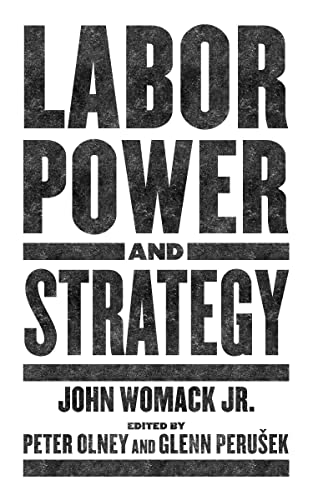
Book cover: Labor Power and Strategy, by John Womack Jr., edited by Peter Olney and Glenn Perušek


Jack Womack, Jr.  LABOR POWER AND STRATEGY, ed. by Peter Olney and Glenn Perusek (PM Press, Oakland CA 2023)


LABOR POWER AND STRATEGY began with the “Foundry Interviews” of John Womack Jr conducted by Peter Olney in early 2018 at a Somerville MA restaurant. The interviews were transcribed by Glenn Perusek.  Ten other labor organizers and researchers were invited to comment.  The final collaborative anthology is now presented in a small-format paperback suitable for a back pocket.
This innovative and multi-layered project results in a fresh and instructive book that I recommend to all serious socialist and labor organizers and analysts.
Womack, a tenured professor of Latin American history at Harvard, has taken a deep plunge into the history of Mexican workers.  From his research he posits that, in order to defeat capitalist exploitation, organized workers must learn how to exercise strategic power targeting the choke pressure points and seams where capital is most vulnerable.   His prime historical examples are how railway and electric workers exerted strategic power during the Mexican Revolution, and how the Bolsheviks organized  key sectors of the Russian proletariat.   While insisting that socialist and labor organizers must constantly work to scientifically analyze where the crucial vulnerabilities of capital can be located in every specific case, Womack notes that workers themselves already possess key parts of that knowledge through their multiple interactions on the job.
During his interviews with John Womack, Peter Olney asks probing questions about possible variants of or alternatives to this analysis.   The ten responders also enrich this high-level dialogue with reflections based on their own experiences and research.    Gene Bruskin, for example, who was hired by the UFCW to coordinate its organizing campaign at Smithfield, revealed precisely where the vulnerable choke point was located at the giant pig processing plant in Tar Heel, NC.  Even though I had been involved for some years in the international segment of the Smithfield campaign, I only learned from this book what creative tactic had finally forced Smithfield into agreeing to accede to a fair election.  No teaser here – Read the Book!
With all the careful qualifiers and modifications built into the long dialogic process of creating this book, Womack’s basic thesis holds up rather well, or at least illuminates some aspects of new labor organizing campaigns that at first glance seem tangential or even contrary to Womack’s emphasis on concrete material interference with the vital node points of capitalism.
There is of course no mention of the Starbucks organizing campaign, which is barely a year old today.    We may joke about how crucial coffee is for fueling the national intellect.  But no one seriously believes that even closing down every Starbucks by a national strike would seriously impair the capitalist economy, or even dent the enormous wealth of Howard Schultz.  Yet this does not mean that DSA Labor is strategically incorrect in urging that DSA locals to go all out in support of the Starbucks Workers United organizing campaign.   Labor organizing in 2022 has clearly been revitalized by the spirit and resilience of thousands of baristas struggling against the odds to establish unions and improve their working conditions.  And in a surprising leap in the Buffalo area, an original Starbucks organizer, Jaz Brisack, is now leading an organizing campaign for Workers United at a Tesla auto plant, with an initial focus on programmers for self-driving electric vehicles.  By every parameter, this is a strategic campaign along Womackian lines, that would not have been conceivable without the “non-strategic” Starbucks campaign!
Second, the teachers’ strikes in Chicago, West Virginia and other states were already available for analysis before this book was completed.  Womack, his editors and responders frequently cite the strategic importance of the education and healthcare sectors, even though they usually do not directly confront private capitalism itself.   Yet these are massive industries, often the largest employers in their states and cities.   Jane McAlevey notes that healthcare and educational unions often have strong elected women leaders, who focus on bargaining for the common good of their students or patients.   [Parenthetically I note that in Massachusetts the leaders of the state nurses association and AFT are members of DSA, and that Massachusetts Teachers’ Association, with its former president Barbara Madeloni, now an educator and organizer for Labor Notes, has emerged as the largest progressive force in the Commonwealth].

And last, though far from least, let’s consider the railway workers.   One responder in this book is Carey Dall, then an organizer for the Brotherhood of Maintenance Way Employees [BMWED-IBT] and former ILWU organizer, who well before the public emergence of the rail dispute, identified rail workers and longshore workers as potentially key actors in the most vulnerable logistics area of capital.  In the span of the last three months, driven most recently by the train wreck in Ohio, the mainstream media has joined the Left media in talking a lot about the safety of the railroads and about the working conditions and rights of rail workers. Two rail rank-and-file caucuses, Railroad Workers United and the BMWED Rank & File Caucus, are growing and accumulating new resources. [See my article in Democratic Left, https://www.dsausa.org/democratic-left/railroad-workers-can-build-on-seeds-of-change/]

After a shaky start, caused in part by the distracting internal DSA attack on three Squad members for their votes on the Railway Labor Act strike ban,  relationships between DSA and the rail rank-and-file caucuses have improved. Several rail rank-and-file leaders joined the Off the Rails call of the National Labor Commission which had wide participation from DSA members.
On February 16, Railroad Workers United issued a public call asking support for its campaign to nationalize the railroads.  On February 17, DSA issued an official statement drafted by the NLC and by the Eco-Socialist Committee in support of this campaign and also focusing on the rail public safety issue and the working conditions on railroad workers.
https://www.dsausa.org/statements/get-rail-back-on-track-public-ownership-now/
In all of these areas, from Starbucks and Amazon organizing, through health care and educational organizing, and the railroad workers, I found that this book stimulated and refreshed my thinking.
Paul Garver.
Also read: Which Workers Are “Strategic” to Organize?
Jacobin.   Eric Dirnbach. 
 

1 Comment on LABOR POWER AND STRATEGY, A Review

Hard Truths and Good Signs for Labor’s Role in Defending Democracy

2/18/2023

by Bob Master in Convergence (opens in a new tab)

February 14, 2023

Midterm wins bought organizing time for pro-democracy forces, but MAGA authoritarianism still menaces US politics. In “Pro-democracy Organizing Against Autocracy in the United States (opens in a new tab),” scholar/activists Erica Chenoweth and Zoe Marks map the threat and steps that could help defeat it. Convergence interviewed the two and will be publishing reflections and responses to the report. Bill Fletcher Jr. got the responses rolling. Here, Bob Master takes a close look at labor’s role in defending democracy. 

In “Pro-democracy Organizing Against Autocracy in the United States,” Erica Chenoweth and Zoe Marks issue a clarion call to progressive and social movement leaders to begin strategizing about how to defeat the authoritarian regime the ascendant faction of the Republican Party seems intent on imposing in this country. The two professors warn that the US is not immune from what they call a global “third wave of autocratization,” and identify key pillars of an effective pro-democracy, anti-authoritarian strategy. The centerpiece of this strategy is the construction of a broad, multiracial, cross-class united front, comprised of a wide range of state, local and national progressive, constituency and movement organizations, which could begin planning a multi-faceted resistance to authoritarianism. 

The authors argue that the labor movement has a crucial role to play in this alliance, including organizing strikes and slow-downs to build “coercive” pressure on an anti-democratic government, should one come to power. But interviews with half a dozen high-ranking current and former union staffers suggest that the US labor movement is largely unprepared for—if not downright skittish about—taking up the question of how to contest a fundamental assault on democracy. Only in states like Texas—where far-right assaults on voting rights, local government autonomy, and educational free speech pose an existential threat to workers’ rights—has the labor movement fully engaged in the struggle to safeguard democracy.  
Bob was the  longtime political and legislative director of District One of Communication Workers of America, and a co-founder and organizer of Working Families Party.

Read the rest at Convergence (opens in a new tab)

0 Comments on Hard Truths and Good Signs for Labor’s Role in Defending Democracy

Russia Out ! Solidarity

2/14/2023

Russia Out! Solidarity with the Ukrainian Resistance. With Yuliya Yurchenko, Vladyslav Starodubtsev, Kirill Medvedev, Kavita Krishnan and Bill Fletcher. Saturday, Feb. 25, 2PM ET

Register here (opens in a new tab)

0 Comments on Russia Out ! Solidarity

There is nothing new about poverty. MLK

2/13/2023

Black-and-white photo of Martin Luther King Jr. speaking at a bank of microphones


We can learn from Black History

“There is nothing new about poverty. What is new, however, is that we now have the resources to get rid of it…Why should there be hunger and privation in any land, in any city, at any table, when man has the resources and the scientific know‐how to provide all mankind with the basic necessities of life?…There is no deficit in human resources, the deficit is in human will…The time has come for an all‐out world war against poverty.”
– “Where Do We Go from Here?” 1967
 
A True and Visionary Radical, Martin Luther King Jr. Was No Moderate

King called himself a democratic socialist. He believed that America needed a "radical redistribution of economic and political power."


0 Comments on There is nothing new about poverty. MLK

Lula Visits Washington and Working People

2/11/2023

Bernie Sanders 
Yesterday I had the honor of meeting one of the world’s greatest champions for working people, Brazilian President Luiz Inácio Lula da Silva, better known as Lula.
During our meeting Lula and I discussed the importance of defending democracy, advancing worker’s rights and increasing environmental and climate cooperation around the world.
Lula came to Washington to meet with President Biden, but what he did during the rest of his visit speaks loudly to who he is and has always represented. He spent time, not only with me, but also with members of the Congressional Progressive Caucus and with labor leaders at the AFL-CIO.
When world leaders visit our nation’s capital, almost all of them focus their attention on establishment figures: wealthy and powerful individuals, corporate CEOs or mainstream politicians. Lula did it differently. He met with progressive and labor leaders, because that is where he comes from and who he has represented throughout his entire life.
Lula, who left school after the second grade, was a metal worker who became president of Brazil’s steelworker’s union. At the time a CIA-backed military dictatorship ruled Brazil. Those who opposed them were jailed and often tortured. Lula risked his life leading strikes and protests against the undemocratic regime. In 1980 he founded the Workers Party. Remarkably he was elected president of Brazil in 2002. Because of the policies he put in place as president, 20 million Brazilians were able to rise out of poverty, while inequality, infant mortality, and illiteracy all declined. Lula demonstrated to the world the power and popularity of a government that stands for working people. When he left office in 2010 his approval rating was over 80%.
Lula was elected to a third term in October, defeating incumbent president Jair Bolsonaro, who was called the "Trump of the tropics."
In July, several months before their election, a group of civil society leaders from Brazil visited my office and spoke with me about the threat to Brazilian democracy coming from Bolsonaro and his supporters. Just like Donald Trump, Bolsonaro was telling lies about the election being stolen months before anyone cast a ballot. They asked me to speak out, not in support of Lula, but in support of democracy.
That is why, along with Senator Tim Kaine, I introduced a Resolution in Support of Brazilian Democracy. This bill unanimously passed the Senate sending a clear message that the United States would stand with the people of Brazil and would not accept any attempts to undemocratically overturn the results of their election.
This threat turned out to be very real. On January 8, thousands of Bolsonaro supporters stormed the buildings housing all three branches of government in Brazil calling for a military coup to bring Bolsonaro back to power. Since that day many questions have surfaced about the role of members of Bolsonaro’s government and of the military in these riots.
Lula and I spoke in our meeting about the need to work to stand up for democracy around the world. This means not only standing against those who would try to overturn the results of elections, but also against the oligarchs who only care about their ability to exploit working people for profit.
Progressives around the world need to work together and that is exactly what Lula and I will continue to do. Now more than ever we need international solidarity.
Thank you,
Bernie Sanders

0 Comments on Lula Visits Washington and Working People

Biden Forges a New Democratic Paradigm

2/8/2023

Joe Biden giving the State of the Union address, with Kamala Harris and Kevin McCarthy applauding behind him
 
Biden Forges a New Democratic Paradigm
Harold Meyerson 
February 8, 202
 
The president repudiates the neoliberal ideologies of the past and puts the party on solid economic and political ground
Well, that was a Joe Biden who could win re-election.
In his second State of the Union address, the president exhibited such a surprising display of vigor, such a capacity for empathy, such a knack for storytelling, and such a mastery of political improvisation that it’s easy to overlook the fact that the speech itself was almost a refoundation of American liberalism. 
…All of which may eclipse just how thoroughly Biden’s speech set the Democratic Party and American liberalism on sounder economic and political ground than they’ve been since the New Deal. Compare Biden’s analysis of what ails the American economy to those put forth by some previous Democratic presidents—Carter and Clinton most particularly, but at times, Obama as well—and what you see is a thorough repudiation of what once was the Democratic establishment’s holy writ. Biden declared that globalization, once touted as a solution, was really the problem. The doctrine of “Buy American,” so ridiculed by Wall Street Democrats and the self-proclaimed pragmatists who viewed corporate globalism as the inevitable way of the world, was not only affirmed by Biden but made a requirement for federally funded infrastructure projects.
https://prospect.org/politics/2023-02-08-biden-state-of-the-union-democratic-party-economy/


0 Comments on Biden Forges a New Democratic Paradigm

Five Fallacies About Electoral Action by Democratic Socialists

2/6/2023

By Michael A. Dover

Leo Casey's five theses, published here 1/23/2023, Jessica Benjamin’s 1/30/23 Combatting Authoritarianism: Don’t Forget Gender Politics and Abortion Rights, and Alexander Hernandez’s  The Case for Re-Alignment, reprinted here 12/8/2022 from Socialist Forum,  are all on target. They suggest full engagement with electoral politics should be a key element of DSA member activism. They also build upon the earlier advocacy of Susan Chacin’s It’s Time for DSA Members to Rally and Help Save Democracy.

But there are still Five Fallacies which prevent many DSA members from recognizing the wisdom of such perspectives, and the dangers of not engaging in electoral activism along with other forms of activism. 
Fallacy One: Adopting these the left/center coalition strategy of the Five Theses means tailing after neoliberal Democrats instead of building socialist power. 

Here is why this is a fallacy. Both at the local and national level, the results of the November 2022 and previous elections at all levels show that when democratic socialists run for office and are also qualified and personable candidates who run on a progressive and pragmatic platform, they are not only democratic socialists in long-term vision--who propose transformational changes--but also progressive pragmatists in short-term commitment.

If they demonstrate they are ready to work with other progressives and with liberals and moderates to win real reforms that can address human needs in the meantime, they can be elected and re-elected to office, even in the face of hostility by hardliners in DSA and others on the left who reject the Five Theses. 

In some cases, such as the Pittsburgh election of Congresswoman Summers, the more "mainstream" Democrat and his supporters—who had opposed Summers in the primary—supported her in the general election. The bottom line is that running and sincerely seeking to elect such democratic socialists—and their introduction of critiques of contemporary capitalism—helps to build the power of socialist ideas. They move the entire political debate to the left.

Fallacy Two: Some might feel that the Five Theses mean that DSA should drop everything and liquidate itself as an independent political force in each election cycle, by merely supporting Democrats, many of whom are moderates, liberals or declared "centrists

Here is why that is a fallacy. DSA can and should decide—at each appropriate level—the extent to which we should encourage or recommend that our members support such Democrats as DSA members. However, such Democrats are also typically endorsed by the political action arms of unions, professional associations and issue-oriented groups we belong to. Sitting out the political action efforts of these groups is not an option. 

Democratic Socialists should actively participate in calling for social and political action within such organizations. We should also, both as DSA members and through membership in such organizations, look to influence the platforms of those candidates, with the goal of gaining their support for progressive legislation that addresses the immediate needs of our constituencies and of working people and oppressed people specifically.

Also, by having permanent electoral campaign committees within our DSA locals—whose leadership is made of members in a variety of types of electoral action—we can reinforce the work of our other campaigns such as labor and issue-oriented campaigns. 

Such electoral campaigns can encourage members to individually support candidates for office; support or oppose ballot measures and constitutional amendments; engage in voter registration, or support Working Families Party-endorsed candidates.

In my personal opinion, we may find a policy of non-endorsement of candidates builds DSA unity. It may be better if instead of debating whether to endorse particular candidates, we instead strongly encourage members to be involved in electoral action such as precinct-level canvassing, running for office, and supporting candidates without fear of censure and expulsion. This would empowers members to be independent-minded democratic socialists who will win respect across the political spectrum for socialist ideas.

Fallacy Three: The Five Theses prevent DSA from running the kinds of "cadre candidates" who can raise advanced demands and help build our “pre-party formation.” 

Here is why this is a fallacy. A politically mature DSA can and must decide what kinds of candidates they should run in primary campaigns, based upon how red, purple or blue the voter base is in the areas where they are running and the nature of the race itself.

This is a tactical matter not a strategic matter or a matter of principle. In some cases, especially where there is an incumbent Democrat or Democrat-leaning non-partisan elected official, decisions have to be made based on the viability of winning such a race and the impact of the race on the possibility that our actions would end up boosting the likelihood of the election of a Republican or reactionary. Also, our commitment to what Bella Abzug called the struggle for representation of woman, people of color, and members of the LGBTQ+ community should be kept in mind in our decisions. 

In some cases, DSA could very well decide to run a candidate who runs a largely educational campaign which focuses on advanced demands and criticism of the problems of our current public policies. But it is important that the issues raised be related to the office at hand. You don't run for dog catcher by calling for the abolition of dog catchers or run for a non-partisan mayoral race down East by calling for closing of the Keystone pipeline. You do not run like a third party candidate who has complete disrespect for the Democratic Party’s registered voters, or who thinks there is a mass of independent or unregistered voters that are ready for the revolution, of only we reached out. I think that itself is a fallacy. 

Fallacy Four: It makes no difference who is elected, Democrat or Republican. Given the highly unjust nature of the current system, supporting Democrats is merely supporting a lesser evil. 

Here is why this is a fallacy. Thinking this way may have been more valid in periods when an entrenched MAGA-majority in the Republican party did not threaten our very democratic system. Furthermore, we must be careful, in our critiques of the flaws in our electoral processes and lack of sufficient voting rights, not to mirror the far right’s condemnation of the democratic process. We should very firmly uphold the Constitution and call for amendments, not call for fighting it or call for a new republic of some strange-to-Americans kind. 

A reading of Lincoln on the Verge: Thirteen Days to Washington and its epilogue is instructive in that regard. The stakes are especially high for our very democracy at the present time. The election of Republicans will mean serious threats of growing authoritarianism and fascism in this country, growing attacks on the rights of women, and increased anti-immigrant violence and discrimination. Also, racism is at the root of MAGA Republicanism now just like it was at the roots of anti-Lincoln sentiment then. 

Fallacy Five: Supporting the re-alignment strategy of the Five Theses merely postpones or even undermines the building of a worker's party which can advance a socialist revolution. 
Here is why this is a fallacy. This is the least widely held fallacy among DSA members. But the hardline coalition in DSA is growing in strength and its key partners adhere to such a utopian belief system. This is pseudo-scientific socialism at its worst, often clothed in a misinterpretation of the lessons of the Marxian tradition.

For instance, as Vijay Prasad has recently pointed out, the left must avoid maximalist demands. Likewise, we must avoid absolutist interpretations of the nature of capitalism. As Kavita Krishnan has also eloquently pointed out, the essence of democratic socialism is respect for democracy, human needs and human rights. 
The reality is that every major contemporary economy is a mixed economy of public, nonprofit, corporate, small business and family/household production and reproduction. The democratic socialist goal is to pragmatically ascertain the best mix of these sectors within each policy domain that can meet human needs in a way consistent with human rights, even if it means severely limiting and constraining certain property rights, particularly of monopoly and transnational corporations.

Such transformational changes are more likely during periods of rising expectations, when a foundation of progressive public policies has already been established of, and there is clamoring to advance them further and establish new entitlements and opportunities.  We should work to advance the social, economic and constitutional rights enjoyed by the people, both gradually and in periods of major "omnibus" changes made possible by sustained periods of Democratic Party control of the Presidency and Congress. 

This is a non-utopian means of winning truly significant advances for democratic rights and human rights. Furthermore, a commitment to such a peaceful road to democratic socialist-influenced social changes is what must distinguish DSA from hardline and far left leftist political trends of the kind which will never win majority support in the United States of America. This is the path forward for building DSA into a truly multiracial, mass voluntary association of democratic socialists who are independent of any cadre-like constraints on their freedom of action with the mass movements and electoral processes of our nation.


0 Comments on Five Fallacies About Electoral Action by Democratic Socialists

Newer posts >>
<< Older posts

Principles (opens in a new tab)
Join Us (opens in a new tab)

Our Strategy (opens in a new tab)
Blog (opens in a new tab)
Twitter (opens in a new tab)
Facebook (opens in a new tab)

The opinions expressed here are those of members and allies of DSA North Star Caucus meant to educate, inspire discussion and encourage comradely debate.


RSS Feed


North Star caucus members

antiracismdsa (opens in a new tab) (blog of Duane Campbell)

Authory (opens in a new tab) and Substack (opens in a new tab) of Max Sawicky

Socialist Education

Online University of the Left (opens in a new tab)

Left Periodicals

Democratic Left (opens in a new tab)
Socialist Forum (opens in a new tab)
Washington Socialist (opens in a new tab)
Jacobin (opens in a new tab)
In These Times (opens in a new tab)
Dissent (opens in a new tab)
Current Affairs (opens in a new tab)
Portside (opens in a new tab)
Convergence (opens in a new tab)


The Nation (opens in a new tab)
The American Prospect (opens in a new tab)
Jewish Currents (opens in a new tab)
Mother Jones (opens in a new tab)
The Intercept (opens in a new tab)
New Politics (opens in a new tab)
Monthly Review (opens in a new tab)
n+1 (opens in a new tab)
+972 (opens in a new tab)
The Baffler (opens in a new tab)
Counterpunch (opens in a new tab)
Black Agenda Report (opens in a new tab)
Dollars and Sense (opens in a new tab)

Comrades

Organizing Upgrade (opens in a new tab)
Justice Democrats (opens in a new tab)
Working Families Party (opens in a new tab)
Poor People's Campaign (opens in a new tab)
Committees of Correspondence for Democracy and Socialism (opens in a new tab)
Progressive Democrats of America (opens in a new tab)
Our Revolution (opens in a new tab)
Democracy for America (opens in a new tab)
MoveOn (opens in a new tab)
Black Lives Matter (opens in a new tab)
Movement for Black Lives (opens in a new tab)
The Women's March (opens in a new tab)
Jewish Voice for Peace (opens in a new tab)
J Street (opens in a new tab)
National Abortion Rights Action League (opens in a new tab)
ACT UP (opens in a new tab)
National Organization for Women (opens in a new tab)
Sunrise (opens in a new tab)
People's Action (opens in a new tab)
National Network for Immigrant and Refugee Rights (opens in a new tab)
Dream Defenders (opens in a new tab)


  • Home
  • Principles
  • Join Us
  • About
  • About DSA
  • Our Strategy
  • Blog
  • Contact

© COPYRIGHT 2019 - 2026. ALL RIGHTS RESERVED.