DSA NORTH STAR
  • Welcome
  • Principles
  • Join Us
  • Our Strategy
  • Blog
  • About
    • About North Star
    • About DSA
    • Contact
  • Welcome
  • Principles
  • Join Us
  • Our Strategy
  • Blog
  • About
    • About North Star
    • About DSA
    • Contact

Blog, page 22 of 25

DSA Call on Covid Virus

3/16/2020

Join us this Thursday, March 19, 8:30pm ET/7:30pm CT/6:30pm MT/5:30pm PT for a Mass Call on COVID-19! (opens in a new tab) On this call, we’ll discuss the work we’re doing right now as we lay out our demands for a COVID-19 response that puts people over profit.
The last few days have been scary and stressful for all of us. It’s become clearer than ever that our for-profit healthcare system does not protect human health. The Trump administration will try to tell us that the private sector will save us, but we know that any “solution” that reaps profit for a few at the top is no solution at all. The only choices we have in this moment are socialism or barbarism.
That’s why it’s important for us to come together and organize for a working-class solution to this crisis.
This mass call is for both members and non-members to get organized and work together in this moment. RSVP today! (opens in a new tab)
In solidarity,
Your DSA National Political Committee
 
This is not the planned North Star call on the political crisis,.
0 Comments on DSA Call on Covid Virus

DSA Statement on Covid-19 Crisis

3/12/2020

Now is the Time for Solidarity: DSA National Statement on COVID-2019

From the 2008 global financial collapse to the natural disasters caused by climate change that rocked Northern California, New Orleans, New York, and Puerto Rico, capitalism is causing devastating human crises. During each of these crises, it has been poor, working-class, and already marginalized people who have suffered the most — while banks, energy companies, and the real estate industry have been bailed out.

Now with the COVID-19 outbreak and a looming economic recession, it is hospital workers, poor and unhoused people, the elderly, incarcerated people, the immunocompromised, immigrants, and other marginalized groups who will likely bear the most impact. Millions of people have inadequate health insurance or none at all, millions are living paycheck to paycheck, and millions more are not given paid time off from work. That means that workers and poor people will be vulnerable to illness while being unable to afford treatment or even testing, endangering whole communities. Many who miss work because of the outbreak will lose pay, lose their health insurance, be unable to pay utility bills, or face eviction.

All of this is worsened by the fact that our government has been slashing budgets for services such as SNAP (food stamps) while handing bailouts to oil and natural gas companies. It is clear our irrational and expensive privatized healthcare system, organized not to protect human health but to extract profit, is unable to handle a crisis such as a sudden global pandemic.

Meanwhile, Trump and the Republicans are exploiting the crisis to blame scapegoats: immigrants, Chinese people, and the European Union are demonized, encouraging racism and xenophobia. Further, Trump’s stimulus plan will decimate Social Security if passed, one of our last truly universal social programs and a line of defense for seniors who are some of the most vulnerable to COVID-19.

As socialists, we reject austerity, privatization, racism, and xenophobia. Instead, we — the Democratic Socialists of America — stand with the working class, poor, and marginalized of our society and demand a working-class solution to this crisis.

A pandemic like COVID-19 confirms the truth in the radical labor movement slogan, “An injury to one is an injury to all.” We need to rapidly reorient our society away from the principles of individualism and private profit and toward the principles of justice and solidarity.
We support the measures proposed in the Families First Coronavirus Response Act, (opens in a new tab) including federal funding for free coronavirus testing for all and paid emergency leave.

However, Congress must go further.

First, Congress must pass Bernie Sanders’s proposed Medicare for All legislation. Without providing comprehensive healthcare, free at the point of use, to all US residents, we cannot mitigate this crisis or its vastly disproportionate impacts on poor and working-class people. It is unacceptable that almost a hundred million people in the US are uninsured or underinsured during a massive public health crisis, while health insurance CEOs take home annual salaries in the tens of millions of dollars.

Second, Congress must pass an emergency moratorium on evictions and on utility shut-offs until the crisis abates. If workers are unable to work because of quarantines, they should not be punished for being unable to pay their rent and utility bills. Ultimately goods like housing, water, electricity, internet, and more should be provided as social rights to everyone, not hoarded for the profit of a few billionaires.

Third, instead of bailing out oil and natural gas companies during this crisis as Trump has suggested, Congress should take advantage of low oil prices to begin to phase out domestic oil production while introducing aggressive Green New Deal legislation that mandates carbon neutrality by 2030 while creating millions of good, green jobs. If we are to avoid catastrophic climate change — which will make natural disasters like hurricanes and global pandemics like coronavirus much more frequent and much more intense — we need to transition our economy off of fossil fuels starting immediately. With a looming economic crash that could put millions out of work, low interest rates and a oil price crash make this the perfect time for the Federal Government to begin this transformation.

In the face of a pandemic, we recognize we are only as safe as the people most impacted by our current systems. As a fourth demand, we call for a nationwide end to cash bail and a moratorium on deportations. The US is home to the largest detention system in the world. Given the torturous conditions, overcrowding, and unaccountable nature of our current carceral system, we call for individuals in prisons, jails, detention centers, and camps to be let go and that facilities are properly staffed with medical teams to ensure the well-being of those who cannot be temporarily released. We demand a moratorium on deportations to ensure that immigrant communities are kept safe and are not discouraged from seeking treatment.

We echo the demands laid out by Bernie Sanders earlier today, as he calls for state and national hotlines for residents to use for resources, information, and updates. We agree that this level of transparency must be relayed by scientists and health experts and not politicians. A vaccine, when developed, must be free, and that any medicine developed to help with the crisis must be sold at cost. The ICU and ventilator shortage must be addressed, and medical residents, retired medical staff, and other medical personnel should be mobilized, staffed with proper instruction and personal protective equipment, to ensure adequate staffing.

We also agree with his call for emergency unemployment assistance at 100% of a worker’s income for ALL people, including those who work off tips, gig workers, domestic workers, and independent contractors. There must be emergency shelters erected, complete with healthcare and food, for the unhoused, domestic violence survivors, and college students.

Finally, all of this social spending should be paid for by taxing the rich. The American working class has repeatedly bailed out the same massive corporations and billionaires that cause and exacerbate crises. The Trump administration’s proposed solution, a payroll tax cut, would not provide any relief for the working class and, in fact, would exacerbate the issue by providing an incentive to continue working, even if sick, particularly for those without remote work settings or paid sick leave. The proposal would also endanger some of our most vulnerable populations by gutting funding to Social Security and Medicare. Time and again, the ruling class uses crisis to pit us against each other. This time, the rich — whose wealth is produced by workers — should foot the bill.

As a practical measure and show of solidarity for all working class people, especially the elderly, unhoused, chronically ill, and immunosuppressed who are most vulnerable to COVID-19, we recommend that all chapters immediately begin implementing social distancing measures, including:
  • Cancel, postpone, or move online any meetings scheduled for more than a small group of people;
  • Practice the CDC’s recommended preventative actions (opens in a new tab) as precautionary measures, especially maintaining a distance of 6 feet or more from others;
  • Establish a chapter-wide COVID-19 policy describing symptoms members should watch for (opens in a new tab) and to encourage members who are sick to stay home or attend meetings through phone or video conferencing software like Zoom; (opens in a new tab)
  • Setup infrastructure for members to text-bank and phone-bank from home instead of canvassing whenever possible;
  • Create a plan to check-in on local membership and make sure everyone has the resources needed to navigate this crisis, especially elderly members and members who are immunocompromised;
  • Develop scenario plans to adapt meetings and actions based on the rate of infection in your area, see this template (opens in a new tab) for sample scenarios and alternatives to traditional mass mobilizations;
  • Perform routine cleaning of surfaces such as, tables, electronics, door handles, etc. before and after all in person meetings using products such as sanitizing wipes or antibacterial spray;
  • Supply hand sanitizer at all meetings and encourage its use (see the CDC’s guide for producing hand sanitizer); (opens in a new tab)
  • Place posters that encourage good coughing and sneezing etiquette and hand washing in meeting areas.

Our current system is unequal, unjust, and careening towards disaster. It is as clear now as ever that our society faces a choice: we will have socialism, or we will have barbarism. We call on chapters to use the aforementioned recommendations to practice solidarity with your local membership and keep each other safe. We also implore chapters to review this COVID-19 Resources Guide for Organizers (opens in a new tab) to form demands and identify resources that can inform our organizing in this crucial moment.

0 Comments on DSA Statement on Covid-19 Crisis

Some Thoughts on Where We Go From here

3/5/2020

By Leo Casey
 
I watched the Bernie Sanders interview on the Rachel Maddow show last night, and I came away thinking that he fails to understand why the nomination campaign has taken the direction it has, and consequently will be unable to adapt and to win.

Sanders' response to the question of why he continues to do poorly with African-American voters was tone deaf and worse, but it also goes to what he is failing to understand about the campaign. His response was part denial, even though the numbers are quite clear and follow the 2016 pattern, and part patronizing, that African-Americans were voting for Biden because he was Barack Obama's Vice President.

Let me suggest a different thesis, that goes straight to why the campaign is turning in its current direction. Democratic voters (or at least between 2/3 and 3/4 of them) are telling us they have one priority above all others -- removing Trump from the White House and ending GOP control of the Senate. They understand the stakes of the election, and what it means for the survival of American democracy, and they are saying that their vote is first and foremost an anti-fascist and anti-authoritarian vote. They assess candidates on whom they think gives us the best odds to accomplish this goal, and vote on that basis. There are not blind to the flaws in Biden and Bernie as the candidate to accomplish that objective, which is why Biden's support fell when his flaws became evident, but they are realists and will pick the candidate who, in their opinion, gives us the best shot.

African-American voters -- especially older African-American voters -- have a deep collective memory of having lived in an age of home grown American totalitarianism: that's what the Jim Crow South was for African-Americans. Trumpism is all too reminiscent of Jim Crow, and African-American voters are telling us with their votes that what they care about, more than anything else, is stopping it in its tracks. And, my white friends, if you think this is a hyperbolic formulation, you need to read the literature on how the Nazis studied and used the Jim Crow legal codes as they formulated the racist and anti-Semitic Nuremberg laws, starting with James Whitman's Hitler's American Model. We need to give our African-American brothers and sisters the credit of being every bit as serious and thoughtful political actors as the rest of us, and stop patronizing them with the idea that they make their decisions based on whom was close to Barack Obama.

There are three important corollaries of this thesis.

First, it is not that Democratic voters in general and African-American voters in particular don't want universal health insurance, or a wealth tax, or a forgiveness of college debt or any of the programmatic proposals that have defined both the Warren campaign and the Sanders campaign (notwithstanding the disingenuous attacks from Sanders supporters that suggested that Warren was abandoning her support for these ideas.) The polling on those questions show wide support, and there is no reason to doubt its validity. It's just that Democratic voters are not ready to pursue those programs in ways that they fear might endanger the prime directive -- defeating Trump. This explains the paradox of why wide support for the issues has not resulted in wide support for the candidates that championed them.

One of the lessons I took away from 2016 was that a campaign that focused entirely on Trump, on the dangers and evils that he embodies and promotes, was not sufficient for victory. I now think that I -- and many others -- gave too much weight to that lesson -- we over learned it. On balance, it remains true, but only as one among a number of axioms that should guide us. 2020 is not 2016, and Americans have seen the reality of Trump (when was the last time you had someone say he "should be taken seriously but not literally?") in a way that has focused their political minds. This is especially true among Democratic voters. 

Second, the defeat of Clinton in 2016 has led to a fear among Democratic voters that the US is not ready to elect a woman as President. Among Democrats, this fear is mostly sub rosa, because they don't want it to be true, and they want to break through the sex barrier the way that Obama broke through the race barrier. The most ardent of Warren's supporters -- a category in which I include myself -- had hoped that Warren could persist even in the face of this fear. But we lost that fight: that fear was a significant reason why the woman who had very few flaws as a candidate when compared to the two remaining octogenarian men had to leave the race today.

Third, Democratic voters are looking for a broad center-left coalition to defeat Trump. They won't put that desire in the political terminology that I have used, but they are clear that they want to unite as many of their fellow citizens as possible behind the prime directive of defeating Trump and Trumpism. And here the political rhetoric and political direction of the Sanders campaign -- directed as much against Democratic centrists as against the Trumpists and the GOP -- is precisely the sort of message the majority of Democratic voters don't want to hear, because they see it as threatening the ability to put together a coalition that can defeat Trumpism.

The theory of Sanders case, that he doesn't need the support of Democratic centrists because he is transforming the political process by energizing and involving people who were not previously part of it, was proven false on Super Tuesday. So we are left with an electorate that remains the same, but with a political rhetoric and strategy ill-suited for the coalition building that needs to be done.

A broad center-left coalition is not one which must necessarily be under the hegemony of centrists and those who march to the corporate anthems of the last half century. But if the left is foregoing the very idea of a coalition in favor of a sectarian triumphalism which treats the center as an enemy equal to Trumpism and the right, there will be no coalition under progressive leadership, just an isolated -- and defeated -- left. On this fundamental question, Warren understand something that Sanders has yet to learn. And if he doesn't learn it soon, 2020 will be a replay of 2016 for his campaign.
 ----------------------------------------------------------
Webinar postponed.
What Is To Be Done ?
 
After Super Tuesday, nearly forty percent on the delegates to the Democratic Party convention will have been chosen, and the trajectory of the campaign to win the Democratic nomination for President will be much clearer. We will bring together a panel of political observers on the left to discuss their analyses of the state of the campaign and its likely direction, together with their prognosis of 'what is to be done' by activists and organizations on the left in general, and Democratic Socialists of America in particular.
 
Watch this google group and our blog for details.


2 Comments on Some Thoughts on Where We Go From here

Rev Barber: The Black Vote in the South on Super Tues

3/4/2020

Click to set custom HTML

0 Comments on Rev Barber: The Black Vote in the South on Super Tues

What Is To Be Done ?

3/4/2020

Save the Date !!!

We regret to inform you that the planned Webinar on What Is To Be Done by the North Star Caucus is postponed indefinitely.

With the growing expansion of issues and conflicts around the political response, our selected speakers are no longer available.

Please continue your conversations on line.
 
DSA national is holding a related call on Thursday. Open to all DSA members and allies.

Join us this Thursday, March 19, 8:30pm ET/7:30pm CT/6:30pm MT/5:30pm PT for a Mass Call on COVID-19! (opens in a new tab) On this call, we’ll discuss the work we’re doing right now as we lay out our demands for a COVID-19 response that puts people over profit.
 
For those of you who join us for discussion, but have not joined the caucus, Membership in the North Star Caucus requires filling out the application at the bottom of our manifesto:

https://docs.google.com/forms/d/e/1FAIpQLSfcEo8j3v90V8Nm_tHG51cmjiZ2Bv3G743eKbs6eSG7OxkBvg/viewform 
 
Please be safe, healthy, and kind to one another.
 
Duane Campbell, for the 
North Star Steering Committee

After Super Tuesday, ( still counting in California)  nearly forty percent on the delegates to the Democratic Party convention will have been chosen, and the trajectory of the campaign to win the Democratic nomination for President will be much clearer. We will bring together a panel of political observers on the left to discuss their analyses of the state of the campaign and its likely direction, together with their prognosis of 'what is to be done' by activists and organizations on the left in general, and Democratic Socialists of America in particular.
 
Watch our  google group and our blog for details.
 
Posted by Duane Campbell 

1 Comment on What Is To Be Done ?

Comparison of the Candidates on Immigration Policies - Vote Smart

2/26/2020

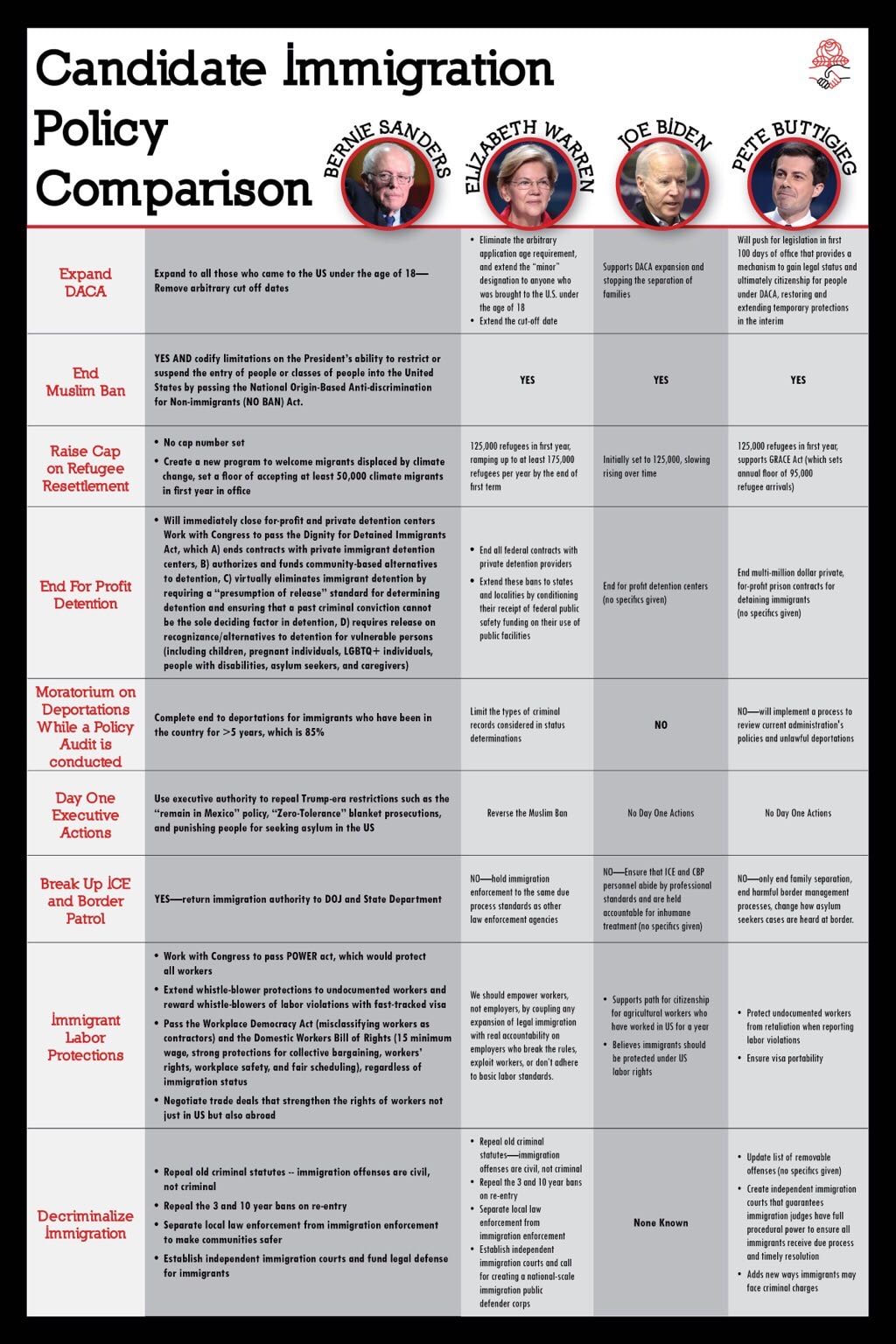
Candidate immigration policy comparison chart for Bernie Sanders, Elizabeth Warren, Joe Biden and Pete Buttigieg. The same information follows as a table.
Candidate immigration policy comparison
PolicyBernie SandersElizabeth WarrenJoe BidenPete Buttigieg
Expand DACAExpand to all those who came to the US under the age of 18. Remove arbitrary cut-off dates.Eliminate the arbitrary application age requirement, and extend the “minor” designation to anyone who was brought to the U.S. under the age of 18. Extend the cut-off date.Supports DACA expansion and stopping the separation of families.Will push for legislation in first 100 days of office that provides a mechanism to gain legal status and ultimately citizenship for people under DACA, restoring and extending temporary protections in the interim.
End Muslim banYes, and codify limitations on the President’s ability to restrict or suspend the entry of people or classes of people into the United States by passing the National Origin-Based Anti-discrimination for Non-immigrants (NO BAN) Act.YesYesYes
Raise cap on refugee resettlementNo cap number set. Create a new program to welcome migrants displaced by climate change; set a floor of accepting at least 50,000 climate migrants in first year in office.125,000 refugees in first year, ramping up to at least 175,000 refugees per year by the end of first term.Initially set to 125,000, slowly rising over time.125,000 refugees in first year; supports GRACE Act (which sets annual floor of 95,000 refugee arrivals).
End for-profit detentionWill immediately close for-profit and private detention centers. Work with Congress to pass the Dignity for Detained Immigrants Act, which (A) ends contracts with private immigrant detention centers, (B) authorizes and funds community-based alternatives to detention, (C) virtually eliminates immigrant detention by requiring a “presumption of release” standard for determining detention and ensuring that a past criminal conviction cannot be the sole deciding factor in detention, (D) requires release on recognizance or alternatives to detention for vulnerable persons (including children, pregnant individuals, LGBTQ+ individuals, people with disabilities, asylum seekers, and caregivers).End all federal contracts with private detention providers. Extend these bans to states and localities by conditioning their receipt of federal public safety funding on their use of public facilities.End for-profit detention centers (no specifics given).End multi-million dollar private, for-profit prison contracts for detaining immigrants (no specifics given).
Moratorium on deportations while a policy audit is conductedComplete end to deportations for immigrants who have been in the country for more than 5 years, which is 85%.Limit the types of criminal records considered in status determinations.NoNo. Will implement a process to review current administration’s policies and unlawful deportations.
Day one executive actionsUse executive authority to repeal Trump-era restrictions such as the “remain in Mexico” policy, “zero-tolerance” blanket prosecutions, and punishing people for seeking asylum in the US.Reverse the Muslim ban.No day one actions.No day one actions.
Break up ICE and Border PatrolYes. Return immigration authority to DOJ and State Department.No. Hold immigration enforcement to the same due process standards as other law enforcement agencies.No. Ensure that ICE and CBP personnel abide by professional standards and are held accountable for inhumane treatment (no specifics given).No. Only end family separation, end harmful border management processes, change how asylum seekers’ cases are heard at border.
Immigrant labor protectionsWork with Congress to pass the POWER Act, which would protect all workers. Extend whistle-blower protections to undocumented workers and reward whistle-blowers of labor violations with fast-tracked visas. Pass the Workplace Democracy Act (misclassifying workers as contractors) and the Domestic Workers Bill of Rights ($15 minimum wage, strong protections for collective bargaining, workers’ rights, workplace safety, and fair scheduling), regardless of immigration status. Negotiate trade deals that strengthen the rights of workers not just in the US but also abroad.We should empower workers, not employers, by coupling any expansion of legal immigration with real accountability on employers who break the rules, exploit workers, or don’t adhere to basic labor standards.Supports path to citizenship for agricultural workers who have worked in the US for a year. Believes immigrants should be protected under US labor rights.Protect undocumented workers from retaliation when reporting labor violations. Ensure visa portability.
Decriminalize immigrationRepeal old criminal statutes: immigration offenses are civil, not criminal. Repeal the 3 and 10 year bans on re-entry. Separate local law enforcement from immigration enforcement to make communities safer. Establish independent immigration courts and fund legal defense for immigrants.Repeal old criminal statutes: immigration offenses are civil, not criminal. Repeal the 3 and 10 year bans on re-entry. Separate local law enforcement from immigration enforcement. Establish independent immigration courts and call for creating a national-scale immigration public defender corps.None known.Update list of removable offenses (no specifics given). Create independent immigration courts that guarantee immigration judges have full procedural power to ensure all immigrants receive due process and timely resolution. Adds new ways immigrants may face criminal charges.
A product of the Immigrant Rights Working Group of DSA.
Please share widely. 

0 Comments on Comparison of the Candidates on Immigration Policies - Vote Smart

Bernie Sanders: The Democrats' Dilemma

2/25/2020

Bernie Sanders on a campaign plane

BY PETER OLNEY AND RAND WILSON

The American presidential primaries began in earnest on February 3, 2020, with the now infamous Iowa caucuses.[1] Iowa is a small mid-western state with a population of 3,155,070. Almost 85% of its residents are white – hardly representative of the U.S. as a whole, yet this is where the voting begins every four years to nominate candidates to the Democratic and Republican parties.

It is a process of thousands of local meetings held across the state where voters come together to “caucus” for their chosen candidates. While most American states have simple ballot voting for candidates, the Iowa system choses its delegates based on a complicated formula “initial alignment votes” and “final alignment votes” that are used to determine the statewide number of “state delegate equivalents” for Iowa’s 41 delegates to the Democrats nominating convention.

One thing is clear: democratic socialist Bernie Sanders won the popular vote with 42,672 first choice votes, about 6,000 votes more than former South Bend Indiana Mayor Pete Buttigieg. However, the byzantine caucus system apportioned 13 delegates to Buttigieg and only 12 to Sanders.

Sanders’ strong showing in Iowa was followed by a narrow victory on February 11 in the New Hampshire primary — another small and racially unrepresentative state — but an important bellwether of voter sentiment on the road to the nomination. Sanders won with 25.7% of the vote, Pete Buttigieg came in second at 24.4%, followed by a surprising strong third place finish for Minnesota Senator Amy Klobuchar at 19.8%.[2] The dismal fourth place finish for Senator Elizabeth Warren of neighboring Massachusetts at 9.2% is of concern to the left because she and Sanders represent the anti-corporate wing of the electoral field.

Support for Sanders’ is surging with a strong base of young people and working-class voters. Amazingly, more than 1.5 million people have donated to his campaign with an average contribution of only $18. Unlike other candidates, who rely on major donors from Wall Street and corporate America, Sanders’ grass roots effort has shattered all previous records by raising over $121 million dollars — $25 million in January 2020 alone.[3]

Despite Bernie’s initial successes, many Democrats have raised concerns about whether Bernie is the best candidate to beat Republican President Donald Trump on November 3, 2020. Beating Trump will require a “united front” of voters who may not be ready to support Bernie’s more radical “social democratic” proposals. For example, Sanders has championed Medicare for All and free college tuition for all, policies that are long established in Europe but viewed as very radical in the United States.

The U.S. “winner-take-all” Electoral College system does not lend itself to building electoral support with your preferred candidate in the election and then making parliamentary alliances after the election to form a government. In the case of the U.S., it will require broad unity behind one candidate for the Democrats to defeat Trump. 

While the corporate-controlled news media is constantly degrading Bernie’s chances, there is a strong argument that he is the best candidate to form the broad coalition needed to beat Trump. In a head-to-head match-up with Trump, Bernie Sanders is the best candidate to:
  • Peel off white, working-class voters who helped elect Trump in 2016 out of disgust with neo-liberal Hillary Clinton;
  • Inspire a grassroots movement for social and economic justice along with the passion and energy of millennials that is essential for the on-the-ground, door-to-door mobilization needed to beat Trump;
  • Perform especially well in Wisconsin, Pennsylvania and Michigan – the three states that went to Trump by a margin of only a little more than 80,000 votes in 2016.

The Sanders’ candidacy — and his prospect of becoming president — seriously threaten the neo-liberal Wall Street regime and the military industrial complex that have so richly profited from America’s unbridled “frontier capitalism.” For that reason, the Democratic Party establishment will stop at nothing to prevent his nomination.  


After the 2016 Democratic Convention debacle, where unelected “super delegates” carried the vote for Clinton in the first round of delegate votes, the Democratic Party was forced to prevent them from voting in the first round in 2020.  However, party officials will still allow these unelected delegates to vote in the second and any additional rounds in a “brokered” convention, where these delegates would likely tip the nomination away from a progressive candidate.

The nominating process is still in its very early stages and a lot can happen before the July 13-16 convention in Milwaukee, Wisconsin. The biggest day of the primary process is “Super Tuesday,” March 3 when 14 states vote including California with 400 delegates.[4]

Bernie Sanders will likely maintain 20-30 percent support because of his long history of principled stands on the issues that matter most to working class families. With many candidates in the field, he may have the most delegates, but not enough for a first ballot majority at the convention. A first ballot victory requires 1990 pledged delegates – elected in primaries and caucuses – for victory.  If the delegate vote goes to a second round, Sanders is likely to lose to a more moderate candidate because of the votes from 771 unelected super delegates. That would rekindle charges of the party once again rigging the nomination — and it could destroy the unity needed post-convention to defeat Trump. What a depressing scenario!

That is the Democrats dilemma: Unless there is a first ballot consensus, the party could suffer a deep and ugly split. With the pro-corporate Democratic establishment so determined to stop Sanders and the transformation of the party by any means, this might result in defeat in November and the nightmare of four more years of Trump.

That’s an unacceptable outcome. In the remaining months, we must build a determined mass movement of progressive Democrats, independents (unenrolled voters) and the emerging socialist tendency to help Bernie win on the first ballot or find a consensus candidate who unites Americans of good will who want to save democracy and defeat Donald Trump. This is a not an election to allow self-righteous ideological purity to obfuscate the need for a huge political uprising to block Trump from securing a potentially disastrous second term.

After the 2016 Democratic Convention debacle, where unelected “super delegates” carried the vote for Clinton in the first round of delegate votes, the Democratic Party was forced to prevent them from voting in the first round in 2020.  However, party officials will still allow these unelected delegates to vote in the second and any additional rounds in a “brokered” convention, where these delegates would likely tip the nomination away from a progressive candidate.

The nominating process is still in its very early stages and a lot can happen before the July 13-16 convention in Milwaukee, Wisconsin. The biggest day of the primary process is “Super Tuesday,” March 3 when 14 states vote including California with 400 delegates.[4]

Bernie Sanders will likely maintain 20-30 percent support because of his long history of principled stands on the issues that matter most to working class families. With many candidates in the field, he may have the most delegates, but not enough for a first ballot majority at the convention. A first ballot victory requires 1990 pledged delegates – elected in primaries and caucuses – for victory.  If the delegate vote goes to a second round, Sanders is likely to lose to a more moderate candidate because of the votes from 771 unelected super delegates. That would rekindle charges of the party once again rigging the nomination — and it could destroy the unity needed post-convention to defeat Trump. What a depressing scenario!

That is the Democrats dilemma: Unless there is a first ballot consensus, the party could suffer a deep and ugly split. With the pro-corporate Democratic establishment so determined to stop Sanders and the transformation of the party by any means, this might result in defeat in November and the nightmare of four more years of Trump.

That’s an unacceptable outcome. In the remaining months, we must build a determined mass movement of progressive Democrats, independents (unenrolled voters) and the emerging socialist tendency to help Bernie win on the first ballot or find a consensus candidate who unites Americans of good will who want to save democracy and defeat Donald Trump. This is a not an election to allow self-righteous ideological purity to obfuscate the need for a huge political uprising to block Trump from securing a potentially disastrous second term. 
…

[1] 2020 Iowa Democratic caucuses, https://en.wikipedia.org/wiki/2020_Iowa_Democratic_caucuses

[2] Jonathan Martin and Alexander Burns, “Bernie Sanders Scores Narrow Victory in New Hampshire Primary,” New York Times, February 11, 2020, at https://www.nytimes.com/2020/02/11/us/politics/bernie-sanders-new-hampshire-primary.html?action=click&module=Top%20Stories&pgtype=Homepage. 

[3] Eliza Collins and Chad Day, “Bernie Sanders Raised $25 Million in January,” Wall Street Journal, February 6, 2020, at https://www.wsj.com/articles/bernie-sanders-raised-25-million-in-january-11580986800; K.K. Rebecca Lai, Josh Katz, Rachel Shorey, Thomas Kaplan and Derek Watkins, “The Donors Powering the Campaign of Bernie Sanders,” New York Times, February 1, 2020, at https://www.nytimes.com/interactive/2020/02/01/us/politics/democratic-presidential-campaign-donors.html.

[4] “Super Tuesday,” from Wikipedia, https://en.wikipedia.org/wiki/Super_Tuesday#2020

ABOUT THE AUTHORS

Peter Olney is retired Organizing Director of the ILWU. He has been a labor organizer for 40 years in Massachusetts and California. He has worked for multiple unions before landing at the ILWU in 1997. For three years he was the Associate Director of the Institute for Labor and Employment at the University of California. View all posts by Peter Olney

Rand Wilson has worked as a union organizer and labor communicator for more than twenty five years and is  currently an organizer with SEIU Local 888 in Boston. Wilson was the founding director of Massachusetts Jobs with Justice.  Active in electoral politics, he ran for state Auditor in a campaign to win cross-endorsement (or fusion) voting reform and establish a Massachusetts Working Families Party.  He is President of the Center for Labor Education and Research, and is on the board of directors of the ICA Group, the Local Enterprise Assistance Fund and the Center for the Study of Public Policy. 


0 Comments on Bernie Sanders: The Democrats' Dilemma

Is Bernie Really a Socialist ? Does it Matter ?

2/17/2020

Is Bernie Really a Socialist? Does It Matter?
Peter Dreier
 In 2016, few thought Bernie Sanders had a chance to win the nomination, much less the presidency, so they didn’t take his identity as a socialist as seriously. Now that Bernie has a good chance of winning the nomination, we are clearly in a whole new territory that we don’t understand and can’t predict, which makes all of us jittery.
The primary goal is to defeat Trump. But can we do that AND elect a democratic socialist at the same time – one who pledges to transform America’s hyper-capitalism into something that more closely resembles European social democracies like Denmark and Sweden? And can Bernie win the White House and also help the Democratic Party maintain its majority in the House and perhaps even win a majority in the Senate?
For a course I’m teaching, I’ve been accumulating articles and columns that address these matters, pasted below.
Republicans are saying that he’s a dangerous socialist and lots of liberals and progressives are saying that he’s not really a socialist, but a social democrat, assuming that people know the difference. Many Democrats, fearful of the word “socialist,” but predicting that Bernie will get the nomination, hope to redefine Bernie’s views as a modern version of the New Deal. That’s essentially what Paul Krugman did in his column this week. He wonders why Bernie insists on calling himself a democratic socialist when he’s, in fact, a Denmark-style social democrat, and concludes that its mostly Bernie’s nostalgia for Debsian ideas and his curmudgeon personality.
Some Democrats and liberals, assuming Bernie will get the nomination, are urging him to soften his use of “socialism” and even say that he’s already started pivoting by downplaying Medicare for All (although it didn’t help with the Nevada Culinary Workers union), while others argue that he’ll lose his loyal base of supporters if they think he’s just another politician pandering to polls and undermining his authenticity.
Bernie's 2016 and current campaigns, along with the upsurge of activism since Occupy Wall Street, has moved the Democratic Party and the national debate to the left, which is good public policy, but folks disagree on whether that’s good politics. Klobuchar is to the left today of where Obama was in 2008 and 2012, but she (along with Biden and Mayor Pete) are distancing themselves from Sanders, concerned that they will all be painted with the “socialist” brush. The Republicans are already engaged in weaponizing the word “socialism,” painting all the Democrats as wanting to turn the US into Venezuela or Cuba.
My friend Michael Kazin (and coeditor of the new book, "We Own the Future: Democratic Socialism - American Style") argued in the New York Times yesterday that, whether or not Sanders wins the nomination or beats Trump, Bernie has “already won” because he’s transformed the debate. To many that is the definition of a Pyrrhic victory.
Republican anti-Trumpers like David Frum, Charlie Sykes, and Max Boot, along with many Democrats (including Michelle Goldberg, writing in 2016, and Eric Alterman, writing a year ago), worry that Bernie can’t win with the socialist label, but others, like Russell Berman in The Atlantic this week, say that Bernie has normalized the idea of socialism, so that it has gone mainstream, despite the Gallup polls showing that most Americans say they wouldn’t vote for a socialist for president. I was one of those who sought to mainsteam/normalize Bernie’s socialism, in several articles in 2015 and 2016, by making the case that, according to polls, most Americans agreed with his policy agenda, even if they didn’t think of themselves as socialists.  


So far, neither Sanders’ Democratic rivals nor the Trumpites have revealed the opposition research they have about Bernie. The rival Democrats don’t want to alienate Bernie’s supporters. The Republicans are, for the most part, holding their fire. They want Bernie to win the nomination because they think he’s beatable and vulnerable to the attacks they’ll unveil once he gets the nomination, about his days in Moscow and Nicaragua, his ties to the SWP, and his decades-ago ideas about nutjob psychologist Wilhelm Reich, among other subjects.
But a number of liberal journalists have begun writing about these allegedly vulnerable aspects of Bernie’s past as a warning, such as Jonathan Chait’s recent article saying that nominating Bernie would be insane. Similarly, some in the right-wing media have already been attacking Bernie as a socialist and a communist, and of course Trump has done this in his last two SOTU speeches and at every campaign rally. Kevin Williams wrote this in the right-wing magazine, National Review: "It would take a lot to make President Trump seem like the 'normal' candidate in a general election. But Sanders might just pull it off."
I’m teaching a new course on democratic socialism and we’re discussing these questions, like:
• Is Sanders a socialist or a social democrat? Does it matter?
• Can a self-proclaimed democratic socialist be elected president this year?
• How do we interpret polls showing that a growing number of Americans say the prefer socialism to capitalism?
• How do we interpret polls showing that a majority of Americans say they wouldn’t vote for a socialist for president?
• How did Sanders, AOC, and progressive activists move the Democratic Party to the left?
• Will having a socialist had the head of the ticket doom many Democrats running for Congress, state legislatures, and other offices?
• What will corporate/Wall Street Democrats do if Sanders gets the nomination? Does it matter?
• If there’s a brokered convention, and Sanders isn’t the nominee, will his supporters embrace the Democratic candidate?
• Can Sanders be an effective president (or more or less effective than another Democrat), even if the Democrats controlled both houses of Congress? Can he be effective (or more or less effective than another Democrat), if the Republicans control at least one house of Congress?
• Are Sanders’ ideas acceptable to a majority of Americans, even if he’s not the right messenger? Would another candidate with similar ideas (i.e. Warren) be able to turn those radical ideas into acceptable ideas?
• What is it about the structure and/or culture of the Democratic Party that it is so divided? (Of course, one could ask the same question about the Republicans in 2016).
• What lessons should liberals and progressives learn from the experiences of 2016, 2018, 2020?
Here’s a short reading list.
 
  • Waldman, “Is it really a risk for Democrats to nominate a socialist?” (Washington Post, Feb. 12, 2020) https://www.washingtonpost.com/opinions/2020/02/12/is-it-really-risk-democrats-nominate-socialist/ (opens in a new tab)
  • Chait, “Running Bernie Sanders Against Trump Would Be an Act of Insanity” (New York, Jan. 28, 2020) https://nymag.com/intelligencer/2020/01/bernie-sanders-electable-trump-2020-nomination-popular-socialism.html (opens in a new tab)
  • Berman, “The Night Socialism Went Mainstream” (The Atlantic, Feb. 11, 2020) https://www.theatlantic.com/politics/archive/2020/02/bernie-sanders-wins-new-hampshire/606022/ (opens in a new tab)
  • Krugman, “Bernie Sanders Isn’t a Socialist” (NYT, February 13, 2020)  
  • https://www.nytimes.com/2020/02/13/opinion/bernie-sanders-socialism.html (opens in a new tab)
·        Edsall, “If Bernie Wins, Where Will He Take the Democratic Party?” (NYT, Feb. 5, 2020) https://www.nytimes.com/2020/02/05/opinion/sanders-2020-election.html (opens in a new tab)
·        Bouie, “Why Bernie Sanders Isn’t Afraid of ‘Socialism’” (NYT, June 17, 2019) https://www.nytimes.com/2019/06/17/opinion/bernie-sanders-socialism.html (opens in a new tab)
·        Starr, “Why Liberals Should Beware Sanders’ Socialism” (Politico, February 22, 2016) https://www.politico.com/magazine/story/2016/02/bernie-sanders-2016-socialism-213667 (opens in a new tab)
·        Cox, “Social Programs Are Not Socialism” (Public Seminar, February 9, 2020) https://publicseminar.org/essays/social-programs-are-not-socialism/ (opens in a new tab)
·        Boot, “Bernie Sanders is a risk we can’t run at this moment of national peril” (Washington Post, Feb. 12, 2020) https://www.washingtonpost.com/opinions/2020/02/12/bernie-sanders-is-risk-we-cant-run-this-moment-national-peril/ (opens in a new tab)
 
Message received on North Star with the note: Feel free to share. 

0 Comments on Is Bernie Really a Socialist ? Does it Matter ?

Socialism and Power

2/11/2020

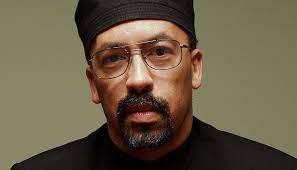
Portrait of Bill Fletcher Jr. in a black cap and glasses

How Socialists Can Govern

Bill Fletcher Jr. 
February 1, 2020
Dissent Magazine (opens in a new tab)

Many on the U.S. left fear governing power, in part because it has been so difficult to achieve. More recent optimism among socialists is a welcome development—but we need a middle ground between being cynical and naive.


Bernie Sanders’s presidential primary run in 2016 saw 13 million people vote for a democratic socialist. Two years later, Alexandria Ocasio-Cortez’s underdog, grassroots-driven victory against one of Congress’s most powerful Democrats shook the political establishment. Combined with the election of Donald Trump, these two campaigns reignited interest in something many on the left had shied away from for the better part of a century: electoral power.

But what is electoral power? Many political theorists distinguish between “state power” and “governing power.” The “state”—as described here—is not simply a series of apparatuses but instead the representation of the balance of class forces, with a hegemonic bloc—made up of institutions like the police, Congress, and the Federal Reserve—looking out for the long-term interests of the dominant class—in our case, the 1 percent. There are different fractions in the 1 percent with interests that sometimes diverge. They might receive differing degrees of support from the state and sometimes have stronger relationships with one party over another. Overall, the capitalist state looks out for the long-term interests of capital rather than the particular interests of any one capitalist.

“Seizing state power” is therefore a process of fundamentally altering the balance of class forces and creating a new hegemonic bloc that moves us away from capitalism. Winning state power involves the domination and, over time, deconstruction and replacement of capitalist institutions.

“Governing power” is something altogether different—effectively, progressives or leftists winning political office within the context of a capitalist state. They may be elected to positions of leadership, but they do not control the state apparatuses and do not have the mandate or strength to carry out a full and thoroughgoing process of social transformation.

This might look like winning a mayor’s or governor’s office. This is also the situation Sanders or any other left-leaning candidate is likely to walk into should they make it to the White House. More crucially, this is the situation that has faced countless left-leaning politicians in the United States and abroad who have tried to make inroads toward a consistent democracy, let alone democratic socialism, at the local, state, and even federal level.

That governing power has been so difficult to achieve and exercise has led many on the left in United States to fear it, and not without reason. Domestically and internationally, there have been many examples of significant challenges faced by a left that has gained governing power only to become corrupted or checkmated. But too many have taken the wrong lesson from this history and fallen back on empty rhetoric to articulate a path to power: first, describe a list of capitalism’s atrocities; second, say that socialism will resolve said atrocities—no intermediary steps required.

read more. https://www.dissentmagazine.org/article/how-socialists-can-govern (opens in a new tab)


0 Comments on Socialism and Power

The DNC Can't Steal This Election From Sanders

2/7/2020

Bernie Sanders gesturing with both hands as he speaks
By Bhaskar Sunkara
The Guardian.


T
his has been a confusing 24 hours, to say the least. The Iowa caucus appeared to go fine, but then a tabulating fiasco delayed official results. We’re still waiting on them.

The problem, in part, was rooted in a “Shadow Inc” application used to help tally the votes. The app had gotten attention in the weeks before the caucus, with experts worrying that it could be vulnerable to hacking.

There’s no indication that happened, and since the results were also all recorded manually, we should have confidence in their integrity (if not the byzantine caucus system itself). But it’s just another reason why some voters might not trust election results. Liberals have at times made hysterical claims that Russia “hacked” the election results in 2016. Keith Olbermann even went as far as to say that the United States was the victim of a “Russian coup”.

On the right, Donald Trump pushed the idea that illegal voting could swing elections in 2016, paving the way for him to contest a potential Hillary Clinton victory that year. And he’s renewed those claims recently, stating last July that “You’ve got people voting that shouldn’t be voting. They vote many times. Not just two times, not just three times … It’s a rigged deal.” Of course, the widespread problem is not illegal voting, but voter suppression – the systematic effort by Republican officials to make it harder for poor people, particularly people of color, to participate in elections.

On the left, Bernie Sanders supporters have a more reasonable beef. The Democratic National Committee pushed its preferred candidate in 2016, helping the Hillary Clinton team beat Bernie Sanders through measures such as limiting the number of debates (25 in 2008, but down to six in 2016). But these actions have been inflated into a narrative that the DNC “rigged” an election that Sanders would have otherwise won.

The key reason why Sanders fell short by several million votes in the primaries – that he was a relatively unknown candidate who ran out of time as he was gaining momentum – doesn’t have the same visceral appeal as a “stolen” race.

With Iowa, these claims will only get more attention. With 62% of the vote released as of Tuesday night, it appears that Sanders won the first and second rounds of the popular vote, but is slightly behind Pete Buttigieg in the delegate count. But on Monday night Buttigieg was able to take the stage and prematurely claim victory, and more importantly Sanders’ main rival, Joe Biden, was able to escape to New Hampshire without having the media reckon with the fact that the presumptive national frontrunner probably placed fourth in Iowa.
 
Saying that elections are all 'hacked' or manipulated nowadays is a great way to encourage working people not to come out and vote.
It’s all quite convenient. And the name of the tech company that made the dubious app that caused much of the trouble is Shadow Inc!

But fellow Bernie Sanders supporters hear my plea – we gain nothing by playing into the idea that the process is so stacked against us that we can’t win. For one, saying that elections are all “hacked” or manipulated nowadays is a great way to encourage working people not to come out and vote. Why bother supporting an insurgent candidate, if the outcome is already assured?

Beyond that, this emphasis is a distraction from both the economic concerns that Bernie Sanders excels at talking about and the grassroots organizing that’s propelling him so far this campaign. Sanders placed well in Iowa, not because his Twitter warriors memed the DNC hard enough, but because his volunteers knocked on 500,000 doors in the state inJanuary alone. Despite only 4% of caucus attendees being Latino, they poured $1.5m into bilingual mailers. The campaign made so many phone calls (more than 7m) that they had to tell volunteers to stop – they had virtually no one left to call.

This unprecedented ground game was all in the service of a popular candidate running on a popular set of issues. There’s a reason why Democratic party elites like John Podesta are worried about the Sanders campaign – Bernie could very well win. With a dedicated base of supporters and turnout from lower-propensity voters, like working-class Latinos, Sanders has reliable votes and volunteers. And by the time the establishment coheres around Biden or some other candidate it will be too late.

We need to be vigilant for dirty tricks and rule changes meant to undermine us, but we should feel confident that victory is possible. And that means letting people know that their vote will be counted, and that even the flawed institutions of American democracy can sometimes deliver progress.

1 Comment on The DNC Can't Steal This Election From Sanders

Thirty years of sophisticated attacks on runaway corporate power show that Elizabeth Warren would be a radical president

2/1/2020

By Nathan Newman
January 30, 2020  

Capitalism dumps its financial dead in corporate bankruptcy courts–-and Elizabeth Warren knows where the bodies are buried.

Over thirty years ago, Warren made it her academic mission to understand the intricacies of how companies die, how the law decides who inherits the assets of the corpse and how that process drives rising inequality in the economy.

There is a trope that Warren was a late convert to progressivism – itself a bit debunked (opens in a new tab) since she voted against Reagan in 1980. But dismissing her as a “technocratic” proponent of “good capitalism,” (opens in a new tab) as Jacobin’s editors do, misses the deep radicalism of her legal and economic analysis.  If you really want to place the candidate on the political spectrum, you need to understand the critique of corporate bankruptcy she made over 30 years ago when she argued that government, not some objective “market,” decides who wins and who loses and detailed how the rules shape our broader economic system.

One key divide between liberalism and radicalism is whether politicians let the market produce inequality in the economy and then use taxation and public spending to clean up the mess afterwards–the paradigmatic liberal approach. This contrasts with the more radical approach of actively shaping the rules of the economy up front to prevent the wildly unequal distribution of wealth in the first place.

Warren’s writings and her stump speech advocacy for “big structural change” place her decidedly in the second camp. That is reflected in her policy proposals —from remaking the financial system to calling for putting workers on boards of directors to promoting the break-up of monopolies to reshaping housing markets to arguing for redistributing wealth itself through a tax on the net worths of the richest Americans rather than just raising taxes on high-earners’ incomes.

Over thirty years ago, Warren was arguing (opens in a new tab) that economic redistribution should not be left to budget politics but that policymakers need to be “dealing with the distributive issues that bankruptcy policy implicates”—the issues that create lopsided distributions to begin with.

As early as 1987, Warren was trashing (opens in a new tab) the economic models of law and economics with their “simple answers” where “economic analysis is utterly self-referential…within a confined, abstract scheme” with no empirical basis in reality.

Conservatives, she wrote, must assume a sufficiently imperfect market for businesses to fail, but a sufficiently perfect market for their “version of a ‘market based’ solution’ to be effective in dealing with those failures. I have difficulty envisioning that market.”

Warren’s diagnosis of the problem of inequality dates back thirty years in her writing and is remarkably similar to what she says on the campaign trail now: the solution is not just getting better technocrats running the system but reducing the power of financial interests and increasing the voice and organizing power of average workers and consumers to control what laws get written in the first place.

Why Bankruptcy Laws Matter

Your eyes may glaze over hearing the words “corporate bankruptcy” – and that’s the point. The media tell endless stories of the winners of capitalist competition – the Apples, the Googles, the Exxons – but most firms, especially smaller firms that are never listed on the stock market, don’t survive and the distribution of their assets in bankruptcy court matters. But that process is arcane and meant to be that way to the advantage of those who benefit from it.

Donald Trump epitomizes this reality since several firms that he has owned have gone through bankruptcy, stiffing creditors and contractors (opens in a new tab), even as Trump himself leveraged the legal system to shield most of his own personal assets.  As Trump himself acknowledged when asked about his many bankruptcies, “I’ve taken advantage of the laws of this country.”

Documenting how wealthy operators like Trump take advantage of the bankruptcy laws to increase economic inequality and figuring out how to design the law to promote greater equity has been much of Warren’s life work.

Bankruptcy is actually at the center of our economy. as Warren wrote back in 1992 (opens in a new tab), “The most difficult social problems get dumped into bankruptcy– mass torts, environmental disasters, the dashed expectations of retired employees.” The failures of capitalism have to be managed by bankruptcy court judges. That’s where, for example, kids in chemotherapy, union workers with empty pensions and bankers square off to divvy up the assets of a belly-up chemical company that poisoned the groundwater in multiple communities.

Economists and legal writers like to pretend that the economy is made up just of markets and contracts, but Warren dismisses this as a “fiction” which lasts until one party or the other no longer has the money to make good on those promises. At that point, bankruptcy courts navigate all the “normative issues of fairness ignored in contract law,” which Warren argues (opens in a new tab) the business class pretends has no place in economic thinking.

Bankruptcy exists not to further markets but to correct the mistakes (opens in a new tab) that led to bankruptcy happening in the first place – and brings active government concerns for distributional fairness into play. “It provides a forum for negotiating deals, and, ultimately, it allocates the value of a firm to all claimants, making difficult distributional decisions among competing parties.” Pension holders owed money long into the future get into the same court proceeding with the banks holding immediate debt–“both present and future claims at once (opens in a new tab),” as Warren highlights.

How Bankruptcy Law Shapes Markets and Economic Inequality

Every legal rule in bankruptcy, Warren argues, reverberates in the broader economy to shape market outcomes, sometimes to the good, more often to the advantage of the wealthy, but never in some “natural” way as conservative economic thinkers would have it.

Warren writes (opens in a new tab): “Any legal rule will cause some redistribution of wealth.”
This may be obvious to many progressives, but it challenges the core capitalist legal ideology that law can stand outside the market and be a neutral arbiter of contractual relationships.  Instead, Warren sees legal rules as inherently favoring one group over another at every economic point of negotiation: “A rule of ownership, a rule of liability, or a rule of priority will relatively advantage or disadvantage competing parties.”
Stakeholders with explicit debt-based contracts with a firm, so-called “secured creditors”, consistently get priority by bankruptcy judges because, as Warren argues (opens in a new tab), they helped write most of the rules: “The group that profits from priority is well-funded and active…Their representatives are present at every drafting committee meeting and debate on the subject.”

Consumer debtors “have a perpetual problem” in Warren’s words (opens in a new tab): “they do not have money and they do not organize.”  For more organized labor and civil rights groups “bankruptcy was never a top priority,” so, she argues, the monied interests with their singular focus and far deeper pockets dominate the process far more of the time- one reason Warren makes strengthening the organizing power of workers and consumers a priority to alter that dynamic in the setting of legal rules across the economy.

Bankruptcy as Backdoor Industrial Planning

Warren focuses relentlessly in her work on the role of firms not just as profit-maximizing machines for shareholders – the conservative ideal – but as institutions serving the broader economy, the perpetual focus of progressives who promote industrial planning.

Industrial planning by the government is usually talked about on the left only after firms have shut down in a community, but Warren focuses on why bankruptcy law brings the broader social values of industrial planning to bear before companies disappear, and argues that it must go further in this area.

One key goal in bankruptcy is keeping the firm going. Partly, this enhances the value of its assets to pay off its obligations, but it also (opens in a new tab) serves broader political interests of those outside contract relationships in the market. As Warren wrote, “the revival of an otherwise failing business also serves the distributional interests of many who are not technically ‘creditors’ but who have an interest in a business’s continued existence.”Those interests include older employees who can’t be retrained for other jobs, customers losing key suppliers of goods and services, suppliers losing current customers, property owners suffering declining property values, and states or municipalities facing shrinking tax bases.”

While corporate law and general contract law studiously exclude those broader community stakeholders from legal consideration, federal bankruptcy statutes create a real role for those interests – and Warren makes clear that expanding the law’s focus on those broader community interests should be a priority.

Creditors may want to dismantle a firm so they can get paid quickly but bankruptcy court, Warren argues, is where government is mandated to step in to protect the social values the market ignores.

Warren’s Ideological Challenge to Market Economics

Warren’s focus on community interests beyond the narrow confines of the market reflects her deeper ideological challenge to traditional legal economics. Warren argues (opens in a new tab) that markets ignores ”parties without legal rights” and that we need a legal system to “protect these parties [and] more than the goods that are traded by private contract.”

Thirty years ago, Warren was a very public combatant with conservative “law and economics” legal writers, quoting Duncan Kennedy of the quasi-Marxist Critical Legal Studies movement that “the insulation from value judgments that economic analysis offers is illusory.”

Warren openly mocked the idea that there was any “real” market that law was supposed to try to drive the economy towards.  Any attempt to discuss policy “in a perfect market is a Zenlike exercise, much like imagining one hand clasping,” so attempts to imagine a “perfect market” were “worth little (opens in a new tab).”

Warren’s was an empirical critique of how markets function, but it was also a values-based statement that recognizing just the interests of those with property rights in the market would fundamentally be unjust.  She rejected (opens in a new tab) market-based bankruptcy schemes as one where those without direct contracts with a firm, including “tort victims, discrimination and harassment complainants, or antitrust plaintiffs, would be left out.” A market approach “is overtly distributional in a regressive sense” in moving wealth from those with weak or no property rights claims in the market to those with enough political power to shape the rules.

At the heart of Warren’s ideological vision is a clear demand that the market and property rights be subordinate to the human needs and democratic will of the community.

Warren as a Radical Leader

Even as the corporate Right has been determined to conquer the courts in order to shape the law to further corporate interests, the liberal movement has been remarkably unfocused on the role of law in promoting economic inequality through the rules of the market.
Liberals have tended to treat battles in the courts as the place where social issues like abortion and gay marriage play out, while reserving their energy fighting economic inequality for tax and budget battles.  Based on her corporate bankruptcy writings and current proposals, a Warren Presidency, probably even more than a Sanders Presidency, would refocus the liberal-left on how legal rules decide winners and losers in the economy before a widget is produced or a line of code is written.

All her skepticism of markets is reflected in Warren’s array of economic plans in her Presidential run which systematically subordinates every market and property rights claim to regulatory supervision. Most on point is her proposed “Accountable Capitalism Act (opens in a new tab),” which would take supervision of large corporations away from the states and put them under federal regulation- and require them to “consider the interests of all corporate stakeholders – including employees, customers, shareholders, and the communities in which the company operates”– exactly the broader stakeholder interests usually considered only once companies have failed and gone into bankruptcy court.

Warren may call herself a “capitalist to my bones” but it is a “capitalism” in opposition to the systematic valorization of property rights and market solutions that is currently embedded in our economic and legal system.
Warren has spent decades arguing markets are the legal creation of government rules- and argues for far-reaching changes in how that government should design those rules.  Whatever you call it, Warren’s analysis dating back thirty years, and the proposals she now promotes, reflect an ideology that would make her orders of magnitude more radical than any President in our history.

A lawyer, policy advocate and writer, Nathan Newman also teaches sociology and criminal justice at CUNY.


0 Comments on Thirty years of sophisticated attacks on runaway corporate power show that Elizabeth Warren would be a radical president

Year Three of the Trump Economy-The U.S. Economy in 2019

1/27/2020

By Bill Barclay
CPEG,  and Ventura DSA

Last year was the tenth since the end of the Great Financial Crisis (GFC) and the third of trump’s presidency. 
 
Trump came into office promising increased rate of growth – 4% maybe even 5 or 6% – an end to trade deficits and more jobs, including a revival of manufacturing.  
 
So, where so we stand?
 
On the question of growth there is no doubt: although the numbers for the 4th quarter GDP growth are not in yet, it is clear that 2019 will be the 13th consecutive year of real GDP growth below 3%, probably around 2.3%.  This number is in contrast to the 3% annual real GDP growth that occurred between during early 1987-2007 neoliberal decades, and even further below the 3.7% average for the first three plus decades (1948-1980) following World War II.  The U.S. economy is stuck in low gear. And, the usual policy response of the neoliberal era – cut corporate tax rates in the hopes that more investment will occur – is not working.  The “Tax Cuts and Jobs Act” (TCJA), Trump’s major tax cut enacted in 2017, has not moved us off the launching pad.  
 
The Stock Market

Or at least not most of us.  After a down year in 2018, the stock market raced to quite a few records in 2019, rising 30%.  A major driver of this gain was the use of the increased cash in the hands of corporations to purchase their own stocks.  While 2018 will probably remain the record year for such stock buybacks, 2019 will be a close second.  (Among the chief beneficiaries of stock buybacks are the company executives who are offered stock options as part of their benefits.)
 
But the interesting, although often neglected, fact about stock buybacks is how they have been financed.  More than half of all buybacks are paid for by the purchasing company taking on more debt.  It is sort of like mortgaging your house so you throw a big party.  The result was a ramping up of non-financial corporate debt in 2019 that now exceeds 75% of GDP, above the previous record peak in the midst of the GFC.  And, half or more of this debt is rated BBB, the lowest grade above junk bond status.  The risks for your pension fund – yes, it is probably buying this stuff to get higher yields – is that, if a downgrade to junk status occurs (as happened to Ford in late 2019), your fund will have to sell – pension funds can’t own junk bonds.  
 
The use of corporate cash to buy back stocks was accompanied by a failure of the TCJA to achieve its stated goal of increasing the rate of investment, by providing “rocket fuel for the economy.”  Business investment has declined throughout 2019 and now is at a level similar to that of the 2000-01 recession, although well above the trough during the recession that followed the GFC.  Of course, Trump blamed others for the failure of the U.S. economy to achieve a 4% (or even 3%) growth rate – in particular the Federal Reserve – in his January 2020 Davos rant.
 
Trade

During his campaign, Trump repeatedly attacked existing trade agreements, labeling NAFTA as “perhaps the worst deal ever made.” He also vowed to end the “cheating” by China in trade practices, although he blamed previous U.S. leaders for letting China do so.  
 
At the end of 2019, Trump got a new NAFTA, “The U.S./Mexico/Canada Agreement (USMCA) through Congress.  The USMCA does have some improvements over the old NAFTA but is very weak on environmental issues – climate change is never mentioned – and will likely have limited impact on the economic geography of automotive jobs.  
 
What about the big trade picture?  In December 2019 there was much made of the quarterly decline in the U.S. trade deficit.  But missing from the self-congratulatory posturing was the fact the 2018 trade deficit was a record, eclipsing even those just prior to the GFC.  The year 2019 will likely see a smaller trade deficit – but still much larger than the early 2000s. 
 
Read more:  https://www.cpegonline.org/post/year-three-of-the-trump-economy-the-us-economy-in-2019 (opens in a new tab)
 

0 Comments on Year Three of the Trump Economy-The U.S. Economy in 2019

A Clean Slate for Worker Power: Building a Just Economy and Democracy

1/23/2020

By Benjamin Sachs 
January 23rd, 2020

After eighteen months of highly collaborative work involving over seventy academics, organizers, lawyers, and students from around the world, we released this morning the report and recommendations of the Clean Slate for Worker Power project. You can learn all about the project at cleanslateworkerpower.org. Our full Report is available here, and the Executive Summary here. The Introduction, which outlines the theory and ambition of the project, is below:

A Clean Slate for Worker Power:
Building a Just Economy and Democracy

Introduction

Since the founding of the country, concentration of power in the hands of a small minority has been recognized as a threat—perhaps the primary threat—to the viability of American democracy. This threat of concentrated power motivated the drafters of the U.S. Constitution to advocate for a system of checks and balances and a division of authority between state and federal governments. Concern over concentrated power explains the founders’ desire to ensure that a “multiplicity of interests” would be represented in the decisions of the national government. This aspiration finds expression in core principles of our democratic system: in the idea that every person should have one vote, no more and no fewer; in the idea that we are to have a republican form of government, not an oligarchy or an aristocracy; in the idea that we are all equal before the law.

But, since the founding of the country, the struggle to uphold these constitutional principles against the threat of concentrated wealth has been a continual one. This struggle was central to the story of the New Deal. Thus, President Franklin Delano Roosevelt critiqued wealthy business and financial elites by naming them “economic royalists,” thereby invoking the American revolutionary struggle against political royalism. As FDR put it in 1936: “For too many of us the political equality we once had won was meaningless in the face of economic inequality.” 1 This democratic struggle against concentrated economic power has also been core to the highest aspirations of the labor movement. Dolores Huerta, leader of the United Farm Workers’ historic organizing effort, put it this way: “Organized labor is a necessary part of democracy, [because o]rganized labor is the only way to have fair distribution of wealth.”

The struggle to preserve democracy in the face of extreme wealth concentration is a defining feature of our current historical moment because we live in a time of radical economic inequality. The point can be illustrated with any number of statistics, and it is worth reviewing a few of them:

  • The average Amazon worker makes $29,000 per year, while Jeff Bezos, the CEO of Amazon, has a net worth of $110 billion. This means it would take an Amazon worker 3.8 million years, working full time, to earn what Bezos now possesses. It would take an Uber driver, driving full time, nearly 150,000 years to earn what Uber co-founder Travis Kalanick made on the Uber IPO.
  • The country’s wealthiest 20 people own more wealth than half of the nation combined—20 people with more wealth than 152 million others.

read more. https://onlabor.org/a-clean-slate-for-worker-power-building-a-just-economy-and-democracy/
onlabor.org/a-clean-slate-for-worker-power-building-a-just-economy-and-democracy/ (opens in a new tab)


0 Comments on A Clean Slate for Worker Power: Building a Just Economy and Democracy

​Bernie-and-Elizabeth Matters More Than Bernie-vs.-Elizabeth

1/16/2020

Elizabeth Warren and Bernie Sanders talking on stage at a presidential debate
(Ed.: recommended. History will remember both Sanders and Warren for taking on American capitalism. Their differences won’t loom that large.)

By Harold Meyerson

LINK (opens in a new tab)

0 Comments on ​Bernie-and-Elizabeth Matters More Than Bernie-vs.-Elizabeth

Thoughts on Building a New Anti War Movement

1/10/2020

By Joe Allen
January 9, 2020

(Ed.: We haven’t had an antiwar movement in the U.S. for a long time. So, when Iranian General Qassem Suleimani was assassinated on orders from President Donald Trump on January 3rd, it immediately raised the prospect of a real shooting war between the U.S. and Iran. It also caught many of us flat-footed and scrambling to respond.)
 
LINK (opens in a new tab)

Also see: Article on unions in In These Times.
 
LINK (opens in a new tab)

0 Comments on Thoughts on Building a New Anti War Movement

DSA Mobilizes To Oppose War

1/7/2020

#NoWarWithIran: What You Can Do NowJANUARY 7, 2020People across the globe are reeling from the U.S. military’s escalation towards war. Just weeks after anti-government protests in Iran about rising fuel prices, these attacks on Iraqi soil bring us dangerously close to never-ending U.S. led war with catastrophic consequences for millions of Iranians, Iraqis, and people across the Middle East.
Join our national organizing call this Thursday, 1/9 at 8pm ET/7pm CT/6pm CT/5pm PT. (opens in a new tab)
War would also immediately put at risk our own domestic fights for Medicare for All, a Green New Deal, and other programs. It would bring thousands more working-class people from the U.S. into the war zone. And it would lead to increased racial and religious profiling in our communities and suppression of dissent. Democratic socialists understand that working class people in the U.S. have nothing to gain from war in the Middle East and we must do everything in our power to stop further U.S. military intervention in the region.
Already, DSA chapters all over the country are organizing demonstrations demanding an end to the escalation, but it will take sustained pressure from a mass movement to stop U.S. imperialism.
Join us for an emergency national strategy call THIS THURSDAY NIGHT, January 9th, 8pm ET/7pm CT/6pm MT/5pm PT on how we can help reignite a mass anti-war movement to stop a war with Iran. (opens in a new tab)
On the call, we’ll be joined by:
  • Azadeh Shahshahani, a distinguished Iranian legal scholar who worked formerly for the ACLU and now Project South to defend Muslims and immigrants from state repression in the U.S. Azadeh will be talking about the complex political situation in Iran and how democratic socialists can build solidarity with the millions of Iranians and Iraqis whose lives are threatened by war with the U.S.
  • We’ll also hear from leaders in our Veterans Working Group and from our National Political Committee with information on specific actions your chapter can take within the week to stop a war.
In the meantime, we urge you to call or visit your representatives’ offices in groups or as individuals, or if they are supporting the drive to war, organize protests on their doorsteps.
Demand they support:
  • The Barbara Lee and Ilhan Omar War Powers House resolution (opens in a new tab)
  • Ro Khanna re-introduced House bill blocking war funding and Bernie Sanders’s companion bill in the Senate (opens in a new tab)
You can find your House representative’s contact information here. (opens in a new tab) For the Senate, you can use the directory here. (opens in a new tab) State that you are a constituent, that you are against war with Iran, why you personally are for the bills, and then ask “Will you/will the Congresswo/man or Senator support these bills?”
You can read our DSA National Political Committee statement for more information. (opens in a new tab) And if your chapter is having a #NoWarWithIran action, or you’d like rally posters for friends and neighbors, you can order union-printed posters through our swag store. (opens in a new tab) Overnight shipping is available.
We will update this page as the situation unfolds.

0 Comments on DSA Mobilizes To Oppose War

Bernie on the War Crisis With Iran

1/4/2020

Start at 46 Minutes.  Jan. 3, 2020.

0 Comments on Bernie on the War Crisis With Iran

DSA FOR BERNIE

1/2/2020

DSA for Bernie montage from Democratic Socialists of America on Vimeo.

0 Comments on DSA FOR BERNIE

Don’t Think Sanders Can Win? You Don’t Understand His Campaign

12/30/2019

Bernie Sanders gesturing with both hands as he speaks
There was a time in America when being called a socialist could end a political career. Not anymore.
By Keeanga-Yamahtta Taylor
Dr. Taylor is the author of “From #BlackLivesMatter to Black Liberation.”
·       Dec. 10, 2019
·       https://www.nytimes.com/2019/12/10/opinion/bernie-sanders-multiracial-workers.html (opens in a new tab)


…Adding to that, Mr. Sanders is the top recipient for donations by teachers, farmers, servers, social workers, retail workers, construction workers, truckers, nurses and drivers (opens in a new tab) as of September. He claims that his donors’ most common employers are Starbucks, Amazon and Walmart, and the most common profession is teaching. Mr. Sanders is also the leading recipient of donations from Latinos as well as the most popular Democrat among registered Latinos who plan to vote in the Nevada and California primaries. According to Essence magazine (opens in a new tab), Mr. Sanders is the favorite candidate among black women aged 18 to 34. Only 49 percent of his supporters are white, compared with 71 percent of Warren supporters. Perhaps most surprising, more women under 45 support him than men under 45.
Mr. Sanders’s popularity among these voters may be what alienates him within the political establishment and mainstream media. The leadership of the Democratic Party regularly preaches that moderation and pragmatism can appeal to “centrist” Democrats as well as Republicans skeptical of Mr. Trump. It is remarkable that this strategy still has legs after its spectacular failure for Hillary Clinton in 2016. 
In many respects, Bernie Sanders’s standing in the Democratic Party field is shocking. After all, the United States government spent more than half of the 20th century locked in a Cold War against Soviet Communism. That an open and proud socialist is tied with Ms. Warren for second place in the race speaks to the mounting failures of free market capitalism to produce a decent life for a growing number of people. There was a time in America when being called a socialist could end a political career, but Bernie Sanders may ride that label all the way to the White House.
This essay has been updated to reflect news developments. 
From the New York Times


0 Comments on Don’t Think Sanders Can Win? You Don’t Understand His Campaign

Meyerson, On the UK Elections- And Ours

12/13/2019

All unhappy social democratic parties are alike: They’ve lost the white working class.
Britain’s Labour Party was decimated in its working-class home last night, when Boris Johnson’s nativist Tories ousted one Labour MP after another in England’s North, once the U.K.’s industrial heartland, today its rust belt. The migration of Britain’s abandoned workers to the anti-immigrant nationalism at the root of Brexit closely tracks the pattern we’ve seen in France, where the longtime proletarian strongholds of the French Communist Party have turned to the insular nationalism of two generations of Le Pens in recent elections. And in the historic home of European social democracy, Germany, the world’s oldest social democratic party is polling close to single digits.
Last night’s election in the U.K. marks the worst performance by Labour since 1935—just as the most recent elections in Germany and France also marked the low points for the Social Democrats and Socialists, respectively. Socialists do govern in Spain, Portugal, Denmark, and Sweden (though the Swedish Social Democrats also experienced their worst election in 2018 and govern now in coalition with that nation’s Greens), but these are exceptions to the painful decline of European social democracy.
Four kinds of fragmentation have vexed the parties of the European left over the past 20 years, as they’ve vexed the Democratic Party in the United States as well. The first stems from the growing presence in those parties of urban upper-middle-class professionals, who are often at odds on cultural questions, broadly defined, with the parties’ more traditional and patriarchal working classes. The second is no stranger to the United States but is only now impacting Europe with the diminution (not sudden, but perceived as such) of many nations’ relative racial and religious homogeneity—defections from the left due to racism and nativism. The shift last night of England’s North from Labour to the Tories summoned memories of George Wallace’s surprising successes in Northern states in the Democratic primaries of 1964, heralding the end of the New Deal coalition and the subsequent electoral victories of Richard Nixon and Ronald Reagan. The third fragmentation results from geographic divergence—with minorities and the culturally liberal young and professionals clustering in cities with large service sectors, while formerly industrial and rural areas, increasingly poor and elderly, experience both the reality and the sense of abandonment.
Underlying all three of these fragmentations is the de-linking of class interests: As globalization and financialization (the latter particularly pronounced in the U.K. and U.S.) have undermined the egalitarian achievements of the postwar era, parties of the center-left have been stretched ideologically, often to the breaking point. The ’90s saw Britain’s New Labour under Tony Blair, America’s Democrats under Bill Clinton, and Germany’s Social Democrats under Gerhard Schröder all move to globalize and deregulate their economies, to the benefit of those nations’ banking and corporate sectors and the detriment of their working-class voters. The collapse of 2008 and the hugely unequal recovery that followed has led to battles between the center-left and a more militant left in virtually every industrialized nation.
Harold Meyers.

0 Comments on Meyerson, On the UK Elections- And Ours

A left Unity Plan to Defeat Trump

12/12/2019

Introduction to Seed the Vote
Jason Negrón-Gonzales, Organizing Upgrade
The Trump era has been all about the naked aggression of the far right, but cracks are appearing. Trump is battling impeachment, a result not only of his criminality but of the changes that the blue wave brought to Congress. Last month we saw further losses for the right in Virginia, Kentucky and Pennsylvania – the result of sustained organizing by hundreds if not thousands. That work didn’t start this year; it’s the culmination of many years of work.  None of this was spontaneous. When we organize, we can win. When we step up to fight, we can win. 
… The possibility of Trump’s re-election in 2020 is a real one. And it’s one we are determined to stop. When we – a group of left activists rooted in community and labor organizing in the San Francisco Bay Area – gathered this spring, it was with the urgency that came from seeing our communities under relentless assault from a white nationalist, authoritarian administration. But we also knew that 2020 – with the size, energy, and leftward shift among the opposition to Trumpism – would give us an opportunity: if we plan carefully and think big, we can make a difference at the ballot box in 2020, the kind of difference the Left failed to make in 2016. And we thought we could do this while building a stronger and more cohesive Left.

  1. Background to Trumpism’s Ascent to Power:

  1. The Right-Wing/Trumpist Goal: A Racialized Authoritarian State:
  2. A Broad but Politically Diverse Opposition, and Tensions Within It.
Since 2016, a growing number of people have thrown themselves into efforts to defeat Trumpism by advocating a broadly left politics. What does this opposition look like?
Social justice efforts have been able to activate significant mass actions in opposition to Trump and right-wing policies, from the Women’s March to airport protests to the more recent teacher strikes. Mass mobilization played a particularly important role through 2018, in stalling or rolling back many of Trump’s assaults on communities of color and democratic rights. Alongside the energy in the streets, progressive institutions have gotten renewed energy.
  1. Vulnerabilities and Challenges
Then there are specific challenges facing the social justice wing of the opposition:
The Democratic establishment makes consistent efforts to squelch progressive electoral insurgencies, for example proposing bans on consultants who work with radicals challenging incumbents in the primaries. And the ‘moderate’ forces use their command of the media to undermine or even smear left candidates and grassroots non-electoral organizations. 

  1. Key Take-Aways:
**The majority of the country is opposed to Trumpism, but this opposition is much more heterogeneous sociologically and politically than the Trumpist bloc. This reality poses big challenges to a Left that is challenged to both build and maintain the broad unity necessary to defeat the Trumpist-GOP in the 2020 election AND build the independent strength of the social justice forces.
**The influence of progressive ideas and the reach of organizations espousing a social justice agenda have grown substantially since 2016, but a realistic assessment of the balance of forces tells us that the progressives remain fragmented in many ways and, even if we were more united, remain weaker and far less resourced than the long-established centrist and corporate forces in the opposition to Trump and, specifically, within the Democratic Party.
Read more: 
Organizing Upgrade (opens in a new tab)


0 Comments on A left Unity Plan to Defeat Trump

No One Is ILLegal- Webinar

12/9/2019

 
The Democratic Socialists of America’s Immigrant Rights Working Group organized a very successful webinar on the topic, No One Is Illegal! Capitalism, Imperialism and Borders on November 21. Hundreds of people registered and about eighty participated.  We were assisted by the national office of DSA. 
 
For those that missed the webinar live, find the link to the recording here.
https://drive.google.com/a/dsausa.org/file/d/1klH099AlL9hst23I0rDKyUW_vA8jISWI/view?usp=sharing
 
 
 We encourage immigrant rights groups and activists  to share it and also organize discussions around it. The speakers explained the roots and nature of the attack on immigrants and presented a working class strategy for resistance and liberation.
 
This webinar is the first of several that we will be organizing. The next one will be a version of this one in Spanish. Please stay tuned for details on that one. We are also going to be putting together a webinar on practical tips and models for immigrant rights organizing. 
 
Many on the first webinar asked for more information from the panelists who joined us. See below for both their bios and publications. Also, to supplement these, we encourage everyone to read, share and discuss the many excellent articles in the DSA’s Fall 2019 Socialist Forum. 
 
Harsha Walia is a community organizer and cofounder of No One Is Illegal. She is the author of Undoing Border Imperialism. She’s based in Vancouver, British Columbia in Canada.
 
Todd Miller is the author of Empire of Borders, Border Patrol Nation. You can read an interview that summarizes his argument on Jacobin. He writes for NACLA among other publications. He’s based in Tucson, Arizona. 
 
Justin Akers Chacon is the author of No One is Illegal and Radicals in the Barrio. He wrote a recent article on Punto Rojo entitled The Anti-Migrant International. He is an immigrant rights activist in San Diego, California and a co-founder of the Coalition to Close the Concentration Camps.
 
Jorge Mújica is author of Voces Migrantes: Movimiento 10 de Marzo, a member of DSA, an Organizer with Arise Chicago, and a National Council member of the National Writers Union. He is based in Chicago, Illinois. 


0 Comments on No One Is ILLegal- Webinar

DSA Labor Commission

12/6/2019

I'm sending this for our Democratic Socialist Labor Commission (DSLC). The DSLC includes DSAers active across the labor movement — union members and retirees, workers center activists, journalists, students in labor solidarity groups, DSA Labor Branch members, and more. Help DSA support the rank and file labor movement — join the DSLC today! (opens in a new tab)
The DSLC strengthens our intersectional, worker-led struggle by:
  • providing labor-related organizing resources
  • advising the NPC on labor-related matters
  • building channels within DSA for labor activist networking and discussions
  • helping socialists tackle challenges in their workplaces
You can be a part of the DSLC's organizing and labor solidarity work — apply today! (opens in a new tab)
In solidarity,
Maria Svart
DSA National Director
PS: Nominations for the DSLC Steering Committee Election will be accepted starting 12/9/2019. As soon as nominations open, the form will be available here. (opens in a new tab)
 

0 Comments on DSA Labor Commission

Democrats and Labor on NAFTA 2.o

12/3/2019


HOUSE SPEAKER NANCY PELOSI has made no secret of her desire to pass the U.S.-Mexico-Canada Agreement by the end of the year, telling reporters recently that it would be her goal for the House to vote on it before Christmas. Centrist Democrats have been insisting privately that a quick passage for the trade deal is necessary for moderate members of Congress to win their competitive reelections in 2020, to show they can “do something.” Unions have made clear, though, that from their perspective, USMCA lacks real labor enforcement mechanisms, which could undermine the whole deal, further drag down wages, and eliminate more jobs.
Meanwhile, a top priority for labor has been sitting quietly on Pelosi’s desk and, unlike USMCA, already commands enough support to get it over the House finish line. The Protecting the Right to Organize Act would be the most comprehensive rewrite of U.S. labor law in decades. It would eliminate right-to-work laws, impose new penalties on employers who retaliate against union organizing, crack down on worker misclassification, and establish new rules so that employers cannot delay negotiating collective bargaining contracts. Introduced by Rep. Bobby Scott, D-Va., in May, it already has 215 co-sponsors in the House and 40 in the Senate.
 
https://theintercept.com/2019/12/02/nancy-pelosi-usmca-pro-act-unions/ (opens in a new tab)
 
Meanwhile. The NYT reports all is going well with Democrats and Nafta.  The Democratic Leadership expects some 100 Democrats to vote yes in the House.  This is how the original Nafta was passed in 1994.  Some  102  Democrats and the remainder Republicans made it a majority.
 
https://www.nytimes.com/2019/11/21/business/usmca-trade-democrats.html?
(opens in a new tab)

0 Comments on Democrats and Labor on NAFTA 2.o

Sanders Releases a Real Immigration Plan !

11/29/2019

Bernie Sanders and Alexandria Ocasio-Cortez waving on stage
Sanders on Immigration

By far the most progressive plan of any of the candidates.


Key Points
  • Institute a moratorium on deportations until a thorough audit of past practices and policies is complete.
  • Reinstate and expand DACA and develop a humane policy for those seeking asylum.
  • Completely reshape and reform our immigration enforcement system, including breaking up ICE and CBP and redistributing their functions to their proper authorities.
  • Dismantle cruel and inhumane deportation programs and detention centers and reunite families who have been separated.
  • Live up to our ideals as a nation and welcome refugees and those seeking asylum, including those displaced by climate change.
Details
This country is a nation of immigrants. Other than the native peoples of the Americas, every one of our families came here from somewhere else. Some came by choice, some by necessity, and others in chains. As we have developed as a nation, each of us has contributed to the growth and prosperity of America in our own way. And our nation has been most successful and most true to its ideals when that prosperity has been shared among all of us. In many ways, that is what this campaign is about: building a movement to create an America where everyone shares in the prosperity that they and their ancestors helped create.
 
Read the plan
https://berniesanders.com/issues/welcoming-and-safe-america-all/ (opens in a new tab)

0 Comments on Sanders Releases a Real Immigration Plan !

Newer posts >>
<< Older posts

Principles (opens in a new tab)
Join Us (opens in a new tab)

Our Strategy (opens in a new tab)
Blog (opens in a new tab)
Twitter (opens in a new tab)
Facebook (opens in a new tab)

The opinions expressed here are those of members and allies of DSA North Star Caucus meant to educate, inspire discussion and encourage comradely debate.


RSS Feed


North Star caucus members

antiracismdsa (opens in a new tab) (blog of Duane Campbell)

Authory (opens in a new tab) and Substack (opens in a new tab) of Max Sawicky

Socialist Education

Online University of the Left (opens in a new tab)

Left Periodicals

Democratic Left (opens in a new tab)
Socialist Forum (opens in a new tab)
Washington Socialist (opens in a new tab)
Jacobin (opens in a new tab)
In These Times (opens in a new tab)
Dissent (opens in a new tab)
Current Affairs (opens in a new tab)
Portside (opens in a new tab)
Convergence (opens in a new tab)


The Nation (opens in a new tab)
The American Prospect (opens in a new tab)
Jewish Currents (opens in a new tab)
Mother Jones (opens in a new tab)
The Intercept (opens in a new tab)
New Politics (opens in a new tab)
Monthly Review (opens in a new tab)
n+1 (opens in a new tab)
+972 (opens in a new tab)
The Baffler (opens in a new tab)
Counterpunch (opens in a new tab)
Black Agenda Report (opens in a new tab)
Dollars and Sense (opens in a new tab)

Comrades

Organizing Upgrade (opens in a new tab)
Justice Democrats (opens in a new tab)
Working Families Party (opens in a new tab)
Poor People's Campaign (opens in a new tab)
Committees of Correspondence for Democracy and Socialism (opens in a new tab)
Progressive Democrats of America (opens in a new tab)
Our Revolution (opens in a new tab)
Democracy for America (opens in a new tab)
MoveOn (opens in a new tab)
Black Lives Matter (opens in a new tab)
Movement for Black Lives (opens in a new tab)
The Women's March (opens in a new tab)
Jewish Voice for Peace (opens in a new tab)
J Street (opens in a new tab)
National Abortion Rights Action League (opens in a new tab)
ACT UP (opens in a new tab)
National Organization for Women (opens in a new tab)
Sunrise (opens in a new tab)
People's Action (opens in a new tab)
National Network for Immigrant and Refugee Rights (opens in a new tab)
Dream Defenders (opens in a new tab)


  • Home
  • Principles
  • Join Us
  • About
  • About DSA
  • Our Strategy
  • Blog
  • Contact

© COPYRIGHT 2019 - 2026. ALL RIGHTS RESERVED.