DSA NORTH STAR
  • Welcome
  • Principles
  • Join Us
  • Our Strategy
  • Blog
  • About
    • About North Star
    • About DSA
    • Contact
  • Welcome
  • Principles
  • Join Us
  • Our Strategy
  • Blog
  • About
    • About North Star
    • About DSA
    • Contact

Blog, page 23 of 25

​Statement on Human Rights Violations in Bolivia

11/22/2019

Statement on Human Rights Violations in Bolivia

// WE ARE CURRENTLY COMPILING A LIST OF SIGNERS FOR PUBLICATION AND HAVE TAKEN THIS FORM OFFLINE. 
// PLEASE E-MAIL gabriel.hetland@gmail.com IF YOU WISH TO BE INCLUDED IN THE PUBLISHED VERSION.

Evo Morales – the democratically elected President of Bolivia from the MAS party (Movimiento al Socialismo, Movement Towards Socialism) – was forced to resign on November 10, in what many observers view as a coup. In the wake of Morales’ resignation, there has been mounting chaos and violence. What is happening in Bolivia is highly undemocratic and we are witnessing some of the worst human rights violations at the hands of the military and the police since the transition to civilian government in the early 1980s. We condemn the violence in the strongest terms, and call on the US and other foreign governments to immediately cease to recognize and provide any support to this regime. We urge the media to do more to document the mounting human rights abuses being committed by the Bolivian state.

On November 10, Morales’ vice president and the heads of both chambers of Congress also resigned in the face of threats of violence against top MAS officials unless they left office. The pressure campaign included the burning of MAS officials’ houses and kidnapping of relatives. This paved the way for the ascension to the presidency of Jeanine Áñez (a conservative Roman Catholic opposition leader from northeastern Bolivia, widely accused of holding racist views) on Tuesday November 12.

The circumstances surrounding the rapid-fire resignations makes Áñez’s assumption of power highly questionable. There are serious doubts about the constitutional legitimacy of her succession. Without the forced resignations by MAS officials, Áñez would not have had even a minimally plausible constitutional path to the presidency, as she was serving as Vice-President of the Senate, a position that is not in the line of presidential succession within the constitution. Additionally, Áñez, whose party received only 4% of the vote in the most recent October 20 election, declared herself President in a Senate session lacking quorum, with MAS senators who make up the legislature’s majority boycotting partly due to fears for their physical safety.

Áñez represents the radical-right sector of the Bolivian opposition, which has taken advantage of the power vacuum created by Morales’ ouster to consolidate control over the state. Áñez appears to have full support of Bolivia’s military and police. Over the course of the last week the military and police have engaged in significant and increasing repression against protests, which have been largely, though not entirely, peaceful. By the night of November 13, La Paz and Cochabamba city center streets were empty of anyone but the police, military, and self-appointed neighborhood militias. There has been ongoing looting, burning of buildings, and violence on the streets and protesters have been met with much repression. In a highly disturbing move, Áñez issued an executive order on November 15 exempting the military from criminal responsibilities related to the use of force. Áñez has said Morales will face prosecution if he returns to Bolivia. sh has also floated the idea of banning the MAS party – which is undoubtedly still Bolivia’s largest and most popular political force – from participation in future elections.

Equally disturbing has been a resurgence of public anti-Indigenous racism over the course of the last week. Shortly after Áñez was declared President, she thrust a massive Bible into the air and proclaimed “The Bible has returned to the palace!” Three days earlier on the day of Morales’ ouster, Luis Fernando Camacho, a far-right Santa Cruz businessman and ally of Áñez, went to the presidential palace and knelt before a Bible placed on top of the Bolivian flag. A pastor accompanying him announced to the press, “The Pachamama will never return to the palace.” Opposition activists burned the wiphala flag (an important symbol of Indigenous identity) on various occasions. These are extremist views that threaten to reverse decades of gains in ethnic and cultural inclusion in Bolivia.

Despite increasing violence and repression, diverse social forces have been demonstrating around the country to condemn the government of Áñez. It is important to note that they include not only MAS supporters but also a broad swath of popular sectors that repudiate the rightwing seizure of the state. Thousands of largely unarmed protesters, mostly coca-leaf growers, gathered peacefully in Sacaba, a town in the department of Cochabamba, on the morning of November 15. After unsuccessful negotiations to march to the town square, protesters tried to cross a bridge into the city of Cochabamba, heavily guarded by police and military troops. Soldiers and police fired tear gas canisters and live bullets into the crowd. During the two-hour confrontation, nine protesters were shot dead, and at least 122 were wounded. Most of the dead and injured in Sacaba suffered bullet wounds. Guadalberto Lara, the director of the town’s Mexico Hospital, told the Associated Press it is the worst violence he has seen in his 30-year career. Families of the victims held a candlelight vigil late Friday in Sacaba. A tearful woman put her hand on a casket and asked, “Is this what you call democracy? Killing us as if we counted for nothing?”

We denounce the repressive state violence unfolding in Bolivia. We also voice our concern that the international media have not been able to effectively cover the human rights violations in Bolivia as they too have been met by the violence of the military. On November 15, an Al Jazeera journalist covering protests in La Paz was gassed by the police in the streets and could no longer hold her microphone or camera. Although she later backed down, Áñez’s new minister of communications told the press that the government will not tolerate “seditious” media. This environment, in which freedom of the press is not only not guaranteed, but threatened by the government, has resulted in an alarming lack of coverage of the gross human rights violations being committed by the armed forces against civilian unarmed protesters.

We are outraged by the Áñez regime’s violations of Bolivians’ political, civil, and human rights, and by the deplorable use of deadly violence that has led to a mounting death toll of protesters and countless serious injuries. We call upon the international community to immediately and publicly condemn these acts of violence. We ask international human rights bodies and organizations to impartially investigate and document the acts of violence committed by government agents. We demand that the international community ensure that this de facto regime, which is at best highly suspect and viewed by many as lacking any legitimacy, protect the lives of peaceful protesters, respect the rights of all to freedom of assembly and speech, and strictly abide by international norms on the use of force in situations of civilian violence. We demand that the US and other foreign governments cease all support to this regime and withhold international recognition until free and fair elections – including all political parties – are held, repressive violence ceases, and the fundamental human rights of all Bolivians are respected.

Signatory
Angela Davis, University of California Santa Cruz
Greg Grandin, Yale University
Molly Crabapple, Author and Artist
Javier Auyero, University of Texas, Austin
Sinclair Thomson, NYU
Brooke Larson, University of Stony Brook
Forrest Hylton, Universidad Nacional de Colombia-Medellín
William Robinson, University of California-Santa Barbara
Sujatha Fernandes, University of Sydney (Australia)
Gianpaolo Baiocchi, NYU
Steve Ellner, Universidad de Oriente (Venezuela)
Micah Uetricht, Jacobin
Shawn Gude, Jacobin
Alex Main, Center for Economic and Policy Research in Washington, DC.
John L. Hammond, Hunter College and Graduate Center, CUNY
Marc Edelman, Hunter College and Graduate Center, CUNY
Deborah Poole: Johns Hopkins University (Baltimore)
Judy Helmand, York University, Toronto, Canada
Susan Spronk, University of Ottawa
Mark Healey, University of Connecticut
Laura Enriquez, University of California, Berkeley
Daniel Aldana Cohen, University of Pennsylvania 
John Lindsay-Poland, Global Exchange
Ben Dangl, University of Vermont
Nicole Fabricant, Towson University
Carwil Bjork-James, Vanderbilt University
Santiago Anria, Dickinson College
Gabriel Hetland, University at Albany, SUNY
Samuel Handlin, Swarthmore College
Christy Thornton, Johns Hopkins University 
Thea Riofrancos, Providence College
 
See the full list:
https://docs.google.com/spreadsheets/d/1p6Zm0e1P0SGYqFlD_N7UKAYVfJB4UwFHIAsHyq6qqlU/edit?usp=sharing

0 Comments on ​Statement on Human Rights Violations in Bolivia

WEBINAR : No ONe is Illegal

11/12/2019

A man carrying a young girl as they wade across a river with other migrants
No One Is Illegal! 
A Webinar on Capitalism, Imperialism and BordersWhen:             November 21st, 2019, 8:30pm EST, 7:30pm CST; 5:30pm PST
Register:          https://act.dsausa.org/signup/no-one-illegal-webinar-capitalism-imperialism-and-borders/
Sponsor:          Immigrant Rights Working Group – Democratic Socialists of America (DSA)
 
Borders throughout the world have become sites of state violence, racist discrimination, and policing of workers freedom of movement. Governments from the US to Mexico, the EU and Israel to name just a few have militarized their boundaries, policed them with guards, forced migrants to take dangerous routes where they are losing their lives in record numbers, jailed those that survive in concentration camps, and exploited others as cheap labor denied the rights of workers with citizenship. On this webinar, experts on capitalism, climate change, imperialism and migration will explain the systemic roots of population displacement, the nature and function of the new border regime and present a case for working class unity against the oppression and scapegoating of migrants in the U.S. and throughout the world. 
 
Speakers:
 
Justin Akers Chacon, author of No One is Illegal and Radicals in the Barrio.
 
Todd Miller, author of Empire of Borders, Border Patrol Nation, and Storming the Wall.
 
Harsha Walia, author of Undoing Border Imperialism, cofounder of No One Is Illegal.
 
Jorge Mújica, author of Voces Migrantes: Movimiento 10 de Marzo, DSA member and Organizer with Arise Chicago, National Council member of the National Writers Union.
 
To get involved in DSA, become a member, join the Immigrant Rights Working Group, and find out more about activist campaigns. 

0 Comments on WEBINAR : No ONe is Illegal

DSA for Bernie Campaign

11/6/2019

Democratic Socialists for Bernie poster: Education for all. A raised fist holds up an open book, surrounded by students and teachers.

0 Comments on DSA for Bernie Campaign

Open Borders is not the Issue

11/4/2019

Ten Arguments for Open Borders, the Abolition of ICE, and an Internationalist Labor Movement (Fall 2019) ResponsesOCTOBER 31, 2019“Open Borders” is Not the Issue: A Reply to Dan La Botz
Dan La Botz has written an extensive piece on open borders in Socialist Forum. I want to critique some parts of his arguments.
La Botz is well informed in this field and makes the best case for open borders. However, the conclusions do not necessarily follow from his arguments. In my view, he is about 80% correct. At the same time, we should not assume that open borders is the only correct position for the left, nor that it is feasible. We need clarity on these issues in order to build our movement.
At the same time, most of organized labor, most of the major civil rights organizations, and the Bernie Sanders campaign do not support open borders. We should understand why.
La Botz’s descriptions of the economy and the political forces, and his analysis are very well informed. The conclusions he draws from this work go beyond the arguments he makes. I do not have the time to go through each of the arguments in detail, so I want to highlight what I see as the major problem areas.
While it is true that delegates at the 2019 DSA national convention endorsed open borders an open borders policy of DSA, not all DSA members agree with that position.
In 2018 I described some of these contradictions in a piece called “Steps Toward a Labor Informed Perspective on Immigration” on the DSA North Star caucus’s blog. Here’s a brief excerpt from that piece:
In the article, “The Left Case against Open Borders”, writer Angela Nagle gets some of the economic conditions correct, but like Trump, she argues without evidence that the problem is that unions, the Left and immigrants’ rights activists support “open borders”.  Her writing follows from the position in Melting Pot or Civil War? A Son of Immigrants Makes the Case Against Open Borders by Reihan Salam.
Developing a policy on migration for labor and the left is far more complex than presented by Nagle and other writers.
First we must deal with some of the false accusations about the role of unions in the immigration policy debates.
Writer Nagle is wrong in asserting that the left and labor favor open borders. This is accepting the false narrative of Trump and the anti- immigrant forces.
There has been a long and well developed movement for immigration reform, along with connected policy proposals – few of which argue for open borders. Progressive policies and practices have emerged from within U.S. communities and the labor movement.
I agree with La Botz that “We are in a struggle for hearts and minds on the question of immigration, a key issue in U.S. politics today.” He then locates the problems in the crisis of 9/11 and austerity policies following the economic crisis of 2008.
Those issues were important, but anti-immigrant hostility was rampant as early as 1994, when Republican governor Pete Wilson won re-election while supporting the successful Proposition 187 ballot initiative. Proposition 187 established a citizenship screening system and attempted to cut undocumented immigrants off from health care, education, and other public services. Over five million voters – 60% of Californians who voted on the initiative – cast their ballots for this harshly anti-immigrant measure. Republicans have since been repudiated in California, and it is now a sanctuary state. However, at the federal level congressional Republicans passed and Bill Clinton signed the Immigration Reform and Immigrant Responsibility Act of 1996, a repressive bill that provided for the construction of fencing along the border and criminalized many aspects of immigrant life. Over the decades there have been numerous appropriation bills to provide increased funding for the Border Patrol as well as militarization and fencing of the border. Many of the current repressive actions at the border were made possible by the Trump administration’s use of this 1996 legislation. For more on this history, see Sand and Blood: America’s Deadly Stealth War on the Mexican Border by John Carlos Frey.
While I agree with La Botz that the anti-immigrant campaigns contribute to capitalist exploitation, I do not agree that open borders campaigns will advance the rights of immigrant workers. The DSA International Committee has a number of pieces supporting the position of open borders as put forward by La Botz and this position is supported by Alexandria Ocassio-Cortez, among others. However the U.S. organized labor movement is not there, nor are major political movements such as the civil rights organizations and the Sanders campaign.  We should try to understand why these groups, our usual allies, are not arguing for open borders.
La Botz argues that organized labor does not currently support an internationalist position due in some part to the shortcomings of union leadership, an analysis linked to his support for the rank-and-file strategy regarding the labor movement. This may certainly be part of the story, and the rank-and-file strategy is well worth debating. But we should be cautious in incorporating the assumptions of the rank-and-file campaign approach as a part of a strategy for responding to migration.  It is only one idea, and there is only scattered evidence to support it. We need strategies based upon really existing conditions, not wished for new unions.
Instead of open borders, most progressive unions have been arguing for revised immigration and labor policies that protect the rights of migrant workers, including their right to form unions. We should work with labor unions and workers centers. But we cannot assume that the unions support the rank-and-file strategy. Instead, we should seek migration policies that are possible within the present political reality.
La Botz, in his piece, argues for an internationalist labor position. That is fine. I am all for internationalism. I hope we get there someday. While supporting internationalism, we do not all support the abolition of nation-states. That is an extreme position. We should note that this argument has been active since at least 1914 and it has not yet made significant progress.  I wish the internationalists well, but I also favor working in the real world, as it is.
When La Botz proposes the abolition of borders, we have to consider what would take their place. My view of history is that nation-states, with all of their problems, have been the only instrument that has limited the exploitation of the working class. That is why working people’s movement seek to gain control of governments. They hope to use their control of governments to protect their lives, their families. Since the new deal, national governments have imposed some limits on corporations.
I accept as accurate La Botz’s descriptions of the multinational corporations. The question is, what are we going to do about it. La Botz is certainly correct that in this neoliberal era workers are losing ground. However, tell me where corporations have been limited by any power other than a nation-state.
Without national and state governments, working people would be even more exposed to abuse by the multinational ruling class – the party of Davos. For example, it is states and nations that are now suing Facebook and Google. If we no longer have nation-states, who will sue them? And, who will establish the courts in which to sue?
In his piece La Botz asserts as urgent that we overcome the divisions within the U.S. working class, and he correctly describes the important role of migrant labor within that working class. We should be opposing these divisions in the working class. This includes actions of solidarity with migrant workers, which are essential. But simply adopting an open borders policy does not overcome the divisions. Why do you think organized labor, including the sections of organized labor led by immigrants, is not pursuing open borders?  It is because open borders is in part a neoliberal capitalist utopian dream or nightmare.
The Trump administration and the Republican Party want the election campaign to be about “open borders” because it mobilizes their nativist, reactionary base. The nationalist right wing will accuse those of us on the left of being in favor or open borders because that helps them to win the public debate against immigration. It fosters fear and anxiety, and places difficulties in the way of both migration and unionization.
In my decades of activist experience, few migrants have advocated for open borders. This is not a campaign emerging from the ranks of immigrant workers. Rather, migrants are seeking a way to work and feed their families and to keep them safe from violence.
Dan La Botz has done a great service by laying out the arguments for open borders. And he is correct in proposing that migration and borders are critical emerging issues facing the environmental justice movements. But instead of arguments for open borders, I urge a perspective on organizing that begins the conversation within the experience and common sense of working people. That is an argument we can win.
Duane Campbell, Sacramento DSA
La Botz responds:
In his response to my arguments for open borders, Duane Campbell writes, “open borders is in part a neoliberal capitalist utopian dream or nightmare.” He supports the efforts by the AFL-CIO and other U.S. unions to pressure the U.S. government to protect workers in this country by regulating immigration. He is correct that this has been the position of U.S. unions practically since they were founded and generally remains so today. To influence the government, the unions have allied with the Democratic Party, relying on it to propose legislation. In the last couple of decades this proposed legislation has been called “comprehensive immigration reform,” which is intended to strengthen the borders, to regulate the flow of immigrants into the United States, and which proposes an onerous process for reaching U.S. citizenship.
One has to ask, how has the labor bureaucracy that leads the unions been doing with this strategy? After the Immigration Reform and Control Act of 1986 gave “amnesty” to a couple of million undocumented immigrants, other millions of migrants continued to enter the United States without documents. The number of undocumented immigrants rose from 5 million to 11 million. Nor did the harsher and more punitive Illegal Immigration Reform and Immigrant Responsibility Act of 1996 have the desired effect, and undocumented immigrants continued to come into the country. At the same time, the percentage of workers in the unions fell from 20.1% to 10.7% today.
Many workers, seeing the immigrants continued to come and that their unions continued to decline, and having bought the unions’ argument that the government could protect them, turned to Donald Trump who promised to do exactly what the unions had promised: use the government to protect them. Their votes helped elect Trump to the presidency. And he did what he promised, tightening up the border and rounding up undocumented immigrants. And union membership continued to fall. And, of course, the AFL-CIO’s alliance with the Democratic Party not only failed to protect U.S. workers, but it led to the abuse and exploitation of immigrant workers.
What is the alternative? To be more successful, U.S. unions must turn from relying on the Democratic Party and the government to protect them and engage instead in an economic and political struggle against the corporations. The unions will have to break from their “partnership” with the employers, which is generally the rule. To carry this out, the unions will need to organize not only the unorganized but also the undocumented. To do that they will have to carry out a political fight within the unions against the racism that is still prevalent in many. They must provide convincing demonstrations of the ability of workers to unite, to fight, and to win not only strikes but also the fight for pro-labor legislation. Socialists are key to raising these ideas in the workers’ movement.
Can anyone seriously think that the current top-level leadership of the unions is capable of carrying out such a transformation of the labor movement? There is little if any evidence for it. So, then, how will the union movement become capable of breaking with its past and its futile dependence on the Democratic Party? The only possibilities are these: First, either the rank-and-file movements in the unions informed by a pro-immigrant and internationalist policy raised within by democratic socialists will transform the exiting unions into organizations fighting for the working class as whole; or, second, the continued deterioration of working-class power and the decline of the workers’ standard of living, together the rising sense of indignation among working people because their needs and desires are ignored, will lead to some national uprising such as we see today in France, Chile, Lebanon, and several other nations. At such moments, nationalist sentiment sometimes comes to predominate, though strong international feelings also often develop, though the outcome is always unclear.
Open borders does not mean the abolition of the nation-state, but rather a change in the practices of the nation-state. The very word internationalism suggests that there are many nations and there will continue to be even if we win the battle for socialism in one place or another. Only on the distant horizon of the abolition of capitalism and worldwide socialism can one contemplate the abolition of the nation-state.
The only way to move toward an open borders and internationalist policy such as presented in my original article, is through a rank-and-file movement imbued with pro-immigrant and internationalist sentiments that understand the enemy is the domestic employer, not the immigrant worker. The only way that such ideas will be raised is through the active intervention of socialists in the unions, defending both workers’ immediate interests and their long-term interests around issues such as immigration and climate change.
Share This

0 Comments on Open Borders is not the Issue

NAFTA Is An Accomplice to Murder

10/31/2019

NAFTA Is An Accomplice  To Murder

Oscar Hernández Romero’s friends searched for him in garbage dumps, ravines and all the other places that could hide what they feared to find—the bullet-riddled body of a Mexican labor activist. But they’ve turned up no trace of Oscar, who disappeared near the open-pit gold mine in southwestern Mexico where workers went on strike two years ago demanding to join the independent labor union Los Mineros. Anti-union thugs murdered three other men involved in the organizing effort by workers at the Media Luna mine, and Oscar is feared dead, too. NAFTA, which siphoned a million jobs from America and mired Mexican workers in poverty, is an accomplice to murder because it incentivized the killing of labor activists like Oscar. Corporations in Mexico exploit workers and pollute the environment to slash costs, which enables them to undercut U.S. and Canadian competitors. They aggressively thwart unions because their business model requires cheap labor. That puts targets on the backs of labor organizers who work to improve conditions in Mexican factories, mills and mines. If this situation is going to change, NAFTA must change. Strong labor standards and enforcement provisions must be written into the text of the proposed new NAFTA, including an ironclad right to organize and protection for activists, so Mexican workers can join real labor unions like Los Mineros, throw out company-controlled imposter unions like the one at Media Luna and get better wages and working conditions. Without these safeguards in the new NAFTA, formally known as the United States-Mexico-Canada Agreement, Mexican labor activists will risk death. And corporations will continue to fire American and Canadian workers and move operations to Mexico.


Tom Conway is president of USW, the United Steelworkers (opens in a new tab)

0 Comments on NAFTA Is An Accomplice to Murder

Sanders and AOC- Left Electoral Activism

10/24/2019

0 Comments on Sanders and AOC- Left Electoral Activism

Sanders: “I Won’t Make the Mistake Obama Did of Shutting Down Grass Roots Pressure on Washington”

10/21/2019

Bernie Sanders speaking with reporters in a Capitol hallway
In contrast with Obama’s strategy, Sanders said that he met with the former president and shared his thoughts directly. 
“I’m a great fan of Barack Obama, who’s a friend of mine. He and I have actually discussed this very issue. His view is, it’s hard to do it,” said Sanders. “I understand that. But the essence of my politics, and I think Alexandria’s as well, is that we need an ongoing grassroots movement of millions of people to pressure Congress, to pressure the corporate establishment, so that we can bring about the changes that this country desperately needs. So that’s why I have said that I will not only be commander-in-chief, I’m going to be organizer-in-chief.” (An aide to Sanders said the meeting with Obama took place in the spring of 2018.)
The full conversation will be posted on Monday. Sanders and Ocasio-Cortez discussed the Espionage Act, Syria, Joe Biden, monopoly politics, and why Ocasio-Cortez endorsed Sanders over Elizabeth Warren. To get an early look, sign up for The Intercept’s newsletter.
Ryan Grim is the author of “We’ve Got People: From Jesse Jackson to Alexandria Ocasio-Cortez, the End of Big Money and the Rise of a Movement

0 Comments on Sanders: “I Won’t Make the Mistake Obama Did of Shutting Down Grass Roots Pressure on Washington”

The Great REcession Ten Years On

10/19/2019

The Great Recession Ten Years On 
William J. Barclay,  2019 
June 2019 marked ten years since the official end of the Great Recession. Of course, declaring the ends (and beginnings) of recessions is rather arbitrary and always done in retrospect. It was not until September 2010 that the National Bureau of Economic Research (NBER) declared that what became known as the Great Recession had ended in June 2009. The same body determined the Great Recession began in December 2007, but did not make that call until a year later, in December 2008. 
The Great Recession was the deepest and longest since the Great Depression of the 1930s, and books and papers analyzing the event are legion. Ushered in by the financial crisis of 200-2007, the Great Recession featured high unemployment, housing foreclosures, GDP downturns, government interventions aimed at countering the downward spiral, and more. However, less attention has been paid to the structure and functioning of the economy in the years that followed, and the long shadow of the Great Recession is still with us a decade later—particularly in the ways that the crisis changed, or failed to change, the U.S. economy. 
There are three striking features of the American economy that have emerged in the past decade—two that are new and one that is a reincarnation of an already established trend: 
  • ·  The United States is in a prolonged period of slow growth that was triggered by the financial crisis and the Great Recession. 
  • ·  There is an ongoing decline in labor force participation—especially among males— alongside an official declining and now low unemployment rate. 
  • ·  Lastly, despite its role in triggering the Great Recession, finance has returned to its position as the dominant sector in the U.S. economy, with the associated process of financialization. 
See more in  post on Chicago Political Economy Group
 
https://www.cpegonline.org/post/the-great-recession-ten-years-on

0 Comments on The Great REcession Ten Years On

Trump is Destroying the Rojava Project

10/17/2019


Trump destroyed the Rojava project
By Dave Anderson - October 17, 2019
When Turkey invaded Syria, there was almost universal condemnation
across the political spectrum. But the most unique protesters are the
anarchists all over the planet who say that a new egalitarian society
is being created in Rojava, the semi-autonomous Kurdish region in
northeast Syria.

Shortly after the invasion, an international campaign called “Rise Up
For Rojava’” was formed (riseup4rojava.org/). The campaign declares:

“Seven years ago a revolution began in Rojava that was to radically
change the lives of millions of people. The Kurds liberated themselves
from the dictatorship of the Assad regime and began to organize
themselves in self-governed councils, communes and cooperatives. In
particular, the autonomous organization of women became the driving
force behind the social revolution. Over the course of the struggle
against the Islamic state, a unique multi-ethnic and multi-religious
project developed, which today guarantees the peaceful coexistence of
millions of Kurds, Arabs and Christians. The Democratic Federation of
Northeast Syria is a unique example of the vision of a peaceful and
democratic Middle East and has therefore always been a thorn in the
side of both regional powers and imperialist states.”

The Rojava project is the brainchild of Abdullah Öcalan, the founder
of the Kurdistan Workers’ Party (PKK). The Turkish based party adopted
authoritarian Marxist Leninist politics and initiated a campaign of
armed conflict against the Turkish government in 1984 in order to
create an independent Kurdish state. The PKK attacked government
forces as well as civilians.


In 1980, Öcalan fled his home in Turkey and turned up in Syria. The
regime of Hafez al-Assad allowed him to set up guerrilla training
camps. The PKK directed attacks on Turkey from Syrian soil. In 1997,
the U.S. declared the PKK a terrorist organization and the next year
Assad kicked Öcalan out and he went to various countries until Turkish
intelligence, with the help of the CIA, captured him in Kenya.

Öcalan was sentenced to death for treason and separatism. The sentence
was commuted to life imprisonment. Turkey had to do that since it
wants to enter the European Union. In order for a nation to become an
EU member, it has to abolish the death penalty.

In prison, Öcalan has been an insatiable reader and has been inspired
by social theorists such as Michel Foucault and Immanuel Wallerstein.
But he has been particularly influenced by a little known anarchist
philosopher in Vermont named Murray Bookchin. Öcalan liked Bookchin’s
ideology of “communalism” which proposed a social order where central
governments would be replaced by loose federations of autonomous
communities. Öcalan’s manifesto of “Democratic Confederalism” merged
Bookchin’s ideas with the emerging Kurdish feminist movement.

Mother Jones reporter Shane Bauer describes what this looks like in practice:

“It’s difficult to overstate how radically politics have been
transformed in Rojava since its ‘self-administration’ was formed in
2013. Rather than revolving around a single strongman or a central
authority, the territory is organized into cantons, largely
self-governing regions with their own decision-making councils and
institutions…

“Each canton is split into neighborhood or village communes. …One that
I visited encompassed 257 homes. Every two years, its residents elect
a man and a woman who manage neighborhood concerns and meet with the
co-chairs of other communes to address community issues. The commune
sold gas for heating and cooking, managed health care, developed local
economic projects, and helped reconcile neighborhood disputes. One
commune I visited had recently helped reconcile a marital dispute and
set up nighttime patrols to improve safety. Another was planning to
install streetlights.”

Bauer says there has been a feminist social transformation:

“Probably the most dramatic effect of the Rojava revolution has been
its impact on women. Every public institution, from communes to courts
to canton ministries, is chaired by a man and a woman. The cantons
require that at least 40 percent of all political positions are held
by women. While Syrian law is based on Shariah, Rojava’s ‘social
contract’ separates religion and state. It has abolished forced
marriage, polygamy, and child marriage…”

But this utopia was built in hell. The Kurds remembered that they had
been betrayed many times by the U.S. in the past but hoped that this
time would be different. They were appreciated by the U.S. troops who
worked with them. The U.S. military concluded that the Syrian Kurds
were the most reliable and toughest fighters in the battle against
ISIS. The Kurds, backed by U.S. air power, took back nearly all the
land seized by Islamic State fighters since 2014. They lost 11,000
troops in the fighting and have seen another 20,000 wounded.

We have to get out of the endless wars but we need to seek peaceful
diplomatic solutions with other nations. Trump’s sudden and brazen
green-lighting of Turkey’s invasion was immoral, idiotic and
dangerous.


0 Comments on Trump is Destroying the Rojava Project

Discussion of DSA Strategy and Labor

10/16/2019

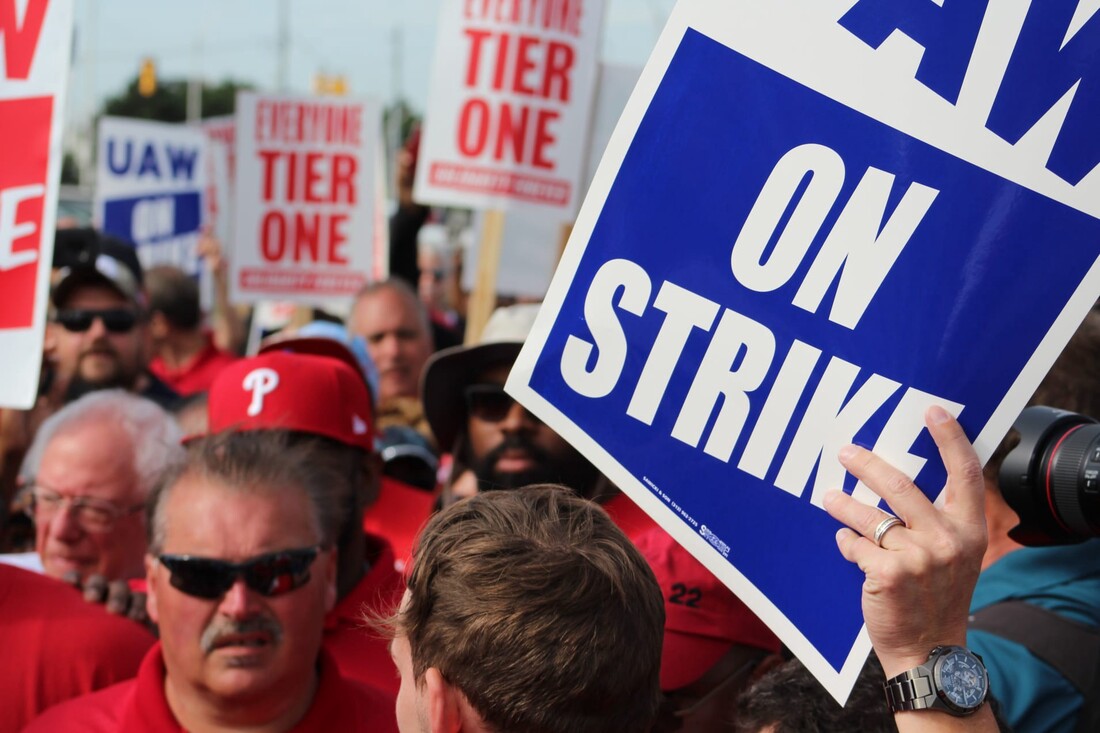
UAW members on a picket line holding “On strike” and “Everyone tier one” signs

A contribution to the discussion of the role of labor and the participation of DSA in labor. 
Without a Clear Strategy for Labor, Socialists are Falling Behind Workers,  Ryan Mosgrove, 
 
https://medium.com/@rwmosgrove/without-a-clear-strategy-for-labor-socialists-are-falling-behind-workers-ed40656930c2
 
Also; In These Times has 3 articles by DSA members on union organizing.
IN the November issue.  Will be on line in November.  One is by Bill Fletcher Jr.


0 Comments on Discussion of DSA Strategy and Labor

Sanders Condemns Trump for Encouraging Turkey's Invasion of Kurdish Areas in Syria

10/13/2019

Kurdish women and children fleeing on foot, carrying their belongings
Amid Reports of Civilian Deaths, Sanders Condemns Trump for 'Giving Turkish Army Permission' to Slaughter Kurds in Syria
"I strongly condemn Trump's reckless decision to abandon our Kurdish allies to their fate at the hands of Turkish President Erdoğan."
by Jake Johnson, staff writer (opens in a new tab)

Syrian Arab and Kurdish civilians flee amid Turkish bombardment on Syria's northeastern town of Ras al-Ain in the Hasakeh province along the Turkish border on October 9, 2019. (Photo: Delil Souleiman/AFP/Getty Images)

As Turkish troops invaded northeastern Syria and launched airstrikes that reportedly killed at least seven civilians, Sen. Bernie Sanders issued a statement late Wednesday condemning U.S. President Donald Trump's decision to abandon Kurdish forces and pave the way for Turkey's military assault.
"I strongly condemn Trump's reckless decision to abandon our Kurdish allies to their fate at the hands of Turkish President Erdoğan," said Sanders, a 2020 Democratic presidential candidate. "This is not a case of sending American troops there. They are already there and Trump is withdrawing them, giving the Turkish army permission to invade."
"This is not a case of sending American troops there. They are already there and Trump is withdrawing them, giving the Turkish army permission to invade." 
—Sen. Bernie Sanders

Trump on Sunday abruptly announced the withdrawal of U.S. forces from northeastern Syria, a decision that was met with outrage and warnings of a deadly Turkish invasion.
On Wednesday, that invasion began as Turkey began bombarding Kurdish targets in Syria, forcing civilians to flee in panic.
The Kurdish-led Syrian Democratic Forces (SDF) warned in a statement Wednesday that Turkey's assault "will spill the blood of thousands of innocent civilians because our border areas are overcrowded."
Sanders said the U.S. president "should not make significant national security decisions impulsively, by tweets after a single phone call," and urged Congress to assert its constitutional authority over foreign policy.
"Kurdish fighters have fought and died in our joint effort to eliminate ISIS," said the Vermont senator. "They should not be abandoned in this way. Congress must assert its important responsibility over foreign policy and serve as a check on our unstable president."
After Turkey launched its assault on Wednesday, Trump issued a tepid statement denouncing the invasion as a "bad idea."
As The Guardian reported late Wednesday, "activists and observers said at least seven civilians had been killed so far."
"There were also early reports of civilian casualties in border towns hit by shelling," according to The Guardian. "Pictures and video shared on social media showed wrecked buildings and bodies in the rubble."
Reposted from Common Dreams. 
Our work is licensed under a Creative Commons Attribution-Share Alike 3.0 License. Feel free to republish and share widely.
This is the world we live in. This is the world we cover.


0 Comments on Sanders Condemns Trump for Encouraging Turkey's Invasion of Kurdish Areas in Syria

Why the Left Needs To Stop Worrying and Learn To Love Impeachment

10/8/2019

The fight for democracy can’t be left to the centrists.
Reprinted from In These Times. 

BY Max B. Sawicky
Democracy is not merely an identifier or assertion of bona fides for socialists. It is an operational requirement, both to attain power and to employ it.
If you’re trying to build a mass political organization while ignoring the political issue everybody in the country is talking about, you’re doing it wrong.
Why in the world not impeach Donald Trump? You’re a socialist and you don’t want to see him impeached? Really? Back in April—admittedly, before the latest Biden-Ukraine revelations—my friend Bhaskar Sunkara (opens in a new tab), editor of the socialist magazine Jacobin, made the case against impeachment. He acknowledged that Trump is reprehensible in the extreme, yet dismissed impeachment as “squandering a historic opening to advocate for social reforms in exchange for some political theater.”
I disagree. This career draft dodger, tax evader, adulterer, debt-defaulter, chiseler, four-flusher and all-around gonif —Donald Trump, our fucking president—is the poster boy for everything we despise. And the entire Republican Party has stood foursquare behind him from the beginning.
Impeachment formalizes and emphasizes that the current administration and all its works—its legislation, its deregulation, its judicial appointments—are fundamentally illegitimate. Impeachment does not only challenge current authority; it challenges its genesis.
A distinction between the current priorities of the Left—Medicare For All, the Green New Deal, etc.—and impeachment is illogical. For the foreseeable future, if not indefinitely, democratic socialists will have to work within the framework of the U.S. state. For this to be feasible, the State’s democratic processes need to be preserved, if not strengthened. We need to attack the legitimacy of the administration in order to defend our increasingly embattled democratic institutions. We need democracy to pursue all our priorities in social reform.
Democracy is not merely an identifier or assertion of bona fides for socialists. It is an operational requirement, both to attain power and to employ it. 
Impeachment is not a substitute for a social justice agenda, or a positive electoral outcome in 2020. It is a facilitator. Immediately, it preoccupies the Trump administration and limits the damage it would do on other fronts. It dramatizes a wealth of detail on the administration’s malfeasance. It strengthens the case for whoever opposes Trump, against any Republicans who support him, and against any Democrats who fail to prosecute the case against him energetically.
There is a risk that the impeachment proceedings will be narrow and legalistic, and even worse, that they will feature neoconservative attacks on Trump for failing to support Ukraine against Russia. As with every other issue, the debate within the Democratic caucus in Congress on how to do impeachment will be ideological.
It is up to the Left to promote a progressive frame for impeachment. The chief prospective victim in the Ukraine affair was not Ukraine—it was our own democracy. The degradation of our democratic institutions, from voter suppression to gerrymandering to the stonewalling of Merrick Garland, is the source of Republicans’ current political advantage and prevents urgent reforms supported by strong majorities of the public.
A leading objection offered by Sunkara and others is that “no one thinks that this can happen given the current composition of Congress.” Everyone is aware that there are not enough Republican votes in the Senate to remove Trump from office. But the politics of impeachment lie more in the process than in the conclusion. And incidentally, if there is no chance of a Senate vote to remove Trump, there is nothing to fear in a President Pence. In any case, one useful way to broaden the impeachment inquiry is to rope Pence into it, not to mention the Secretary of State and the Attorney General. Trump has been helpful in this regard, in effect threatening to take his cronies down with him. This is a good thing!
In April, Sunkara dismissed the prospect of impeachment hearings as “theater,” but politics substantially is theater. Picket lines and marches are theater. There is bad theater, and there is constructive theater. Impeachment can be constructive. Sunkara imagined the hearings will be boring. Tastes may differ on this, but watching guilty miscreants—and rest assured, they are all guilty—be abused by Members of Congress could prove to be very entertaining. For Members with a killer instinct, impeachment can be blood sport. Must-see TV.
Impeachment is a political weapon. The meticulous elaboration of charges and evidence in a due-process setting is the education that the country needs. Knowing something in general is never as compelling as learning all the gory details. If you think such a process would fall on deaf ears, you have to think there is no good case to make against Trump—a strange conclusion for any reader of In These Times.
Another reservation on the Left is that impeachment lets Democrats off the hook for their numerous deficiencies. Professor Samuel Moyn would like the Left to use impeachment (opens in a new tab) to indict both parties, as well as their roles in the growth of the “imperial presidency,” a growth which certainly raises the likelihood of misbegotten military adventurism. But such a posture would surely render the Left irrelevant to this debate, which is grounded in partisan party conflict.
As noted at the outset, when the nation’s attention is focused on a thing, it does little good to say you really should be listening to me talk about something entirely different. A failure of the Left to take up impeachment leaves the field to lowest-common-denominator neocon/neoliberal politics, with which after all we are competing. Every presidential candidate with a lick of sense understands they can’t let the likes of Joe Biden monopolize the anti-Trump franchise.
The root of the case against Trump is the struggle for democracy. As Leigh Phillips and Michal Rozworski say in The People’s Republic of Walmart (opens in a new tab), “Democracy is the beating heart of socialism.” Democratic socialists must become serious about democracy: It should be more than merely a means of distinguishing ourselves from some other dudes.
In political competition with craven Republicans and assorted weak-kneed Democrats, democracy is our super-power.

ABOUT THIS AUTHOR

Max B. Sawicky is an economist and writer based in Virginia. He previously worked for 18 years at the Economic Policy Institute in Washington, D.C. 
Reprinted with permission from In These Times,
http://inthesetimes.com/article/22087/why-the-left-needs-to-stop-worrying-and-learn-to-love-impeachment (opens in a new tab)

0 Comments on Why the Left Needs To Stop Worrying and Learn To Love Impeachment

A Race-Class Narrative About Immigration

10/2/2019

A Race-Class Narrative About Immigration 
Encouraging people to see their fates as linked across color lines is critical to defeating dog whistling and its mass violence. The race-class research suggests that efforts to broaden the “we” will be most successful when those not at risk of deportation come to see how fearmongering imperils their own well-being. When people perceive that messages of racial threat are strategic lies that harm them and their families, they’re more likely to reject these fear stories entirely and to recognize their shared humanity with those they’re told menace them. The following box offers a race- class narrative on immigration.26 The one after that dissects the message into its component parts, offering a pocket summary of a typical race-class message. 

The Narrative About Immigration

Regardless of where we come from, what our color is, or how we worship, every family wants the best for their children. But today, certain politicians and their greedy lobbyists are putting  our families at risk. They rig the rules to enrich them- selves and avoid paying their fair share of taxes, while they defund our schools and threaten seniors with cuts to Medicare and Social Security. Then they turn around and point the fin- ger for our hard times at new immigrants—even tearing families apart and losing children. When we reject their scapegoating and come together across racial differences, we can make this a nation we’re proud to leave all of our kids—whether we’re white, Black, or brown, from down the street or across the globe. 

Anatomy of a Race-Class Narrative

Regardless of where we come from, what our color is, or how we worship, every family wants the best for their children. 
Discuss race overtly and as including everyone. Beyond physical features, this can be done by invoking the differences the Right seeks to racialize, including national origin and religion. As a matter of general messaging advice, start with an affirmative value statement rather than a problem. 
But today, certain politicians and their greedy lobbyists are putting all of our families at risk. 
identify the actual source of threat to working families, taking care to explain motives, even through simple terms like “greedy.” 
They rig the rules to enrich themselves and avoid paying their fair share of taxes, while they defund our schools and threaten seniors with cuts to Medicare and Social Security. 
Excerpts from Merge Left: Fusing Race and Class, Winning Elections, and Saving America.
Ian Haney López.  2019.   See post below and opportunity to download the chapter. 
CAN PROGRESSIVES BEAT TRUMP'S WAR ON IMMIGRANTS IN 2020 ?


0 Comments on A Race-Class Narrative About Immigration

AOC Proposes a Just Society

9/28/2019

Alexandria Ocasio-Cortez in a dark blazer
  'A Just Society': Ocasio-Cortez Unveils Legislative Package to Tackle American Poverty and Inequality"It's a visionary plan that makes moral and economic sense, and most importantly, is informed by what's moving in communities all around the nation."
by
Jessica Corbett, staff writer (opens in a new tab)

https://www.commondreams.org/news/2019/09/25/just-society-ocasio-cortez-unveils-legislative-package-tackle-american-poverty-and

0 Comments on AOC Proposes a Just Society

Can Progressives Beat Trump's War on Immigrants in 2020 ?

9/24/2019

A road map to neutralizing the role of racism as a divide-and-conquer political weapon
Ian Haney López believes that Trump wants 2020 voters debating whether he is a "racist" — it's his strategy for winning.
 
In 2014, he published Dog Whistle Politics: How Coded Racial Appeals Have Reinvented Racism and Wrecked the Middle Class (opens in a new tab). In the book, he named and explained how politicians used coded racial appeals as part of a strategy of racial divide-and-conquer to help the 1% get even more powerful.
 
His new book, Merge Left: Fusing Race and Class, Winning Elections, and Saving America (opens in a new tab), explains how the political exploitation of coded racism has evolved under Trump — and suggests an evidence-based approach on how to beat it. 

The evidence comes from the two-year race-class narrative research project involving focus groups and national polling (opens in a new tab). 

The takeaway is that naming racism as a weapon of the rich and calling for coming together across racial lines proved to be the most effective way to defang the Right’s racial fear narratives and to build broad cross-racial support for racial justice as well as for economic populism.
 
Download Chapter 10: 20/20 Vision: Comparing the Left’s Possible Responses to Anti-Immigrant Dog Whistling here (opens in a new tab).

0 Comments on Can Progressives Beat Trump's War on Immigrants in 2020 ?

U.S. Sanctions - Designed to Kill

9/24/2019

US Sanctions Are Designed to Kill
BY KEVIN CASHMAN ,CAVAN KHARRAZIAN,
US sanctions are killing ordinary Iranians by the thousands. Through its control over the world banking system, America’s sanctioning power flouts international human rights law and poses a threat to the world. Jacobin. 
https://jacobinmag.com/2019/09/us-iran-sanctions-donald-trump-iran-deal-oil-banks?
(opens in a new tab)


0 Comments on U.S. Sanctions - Designed to Kill

Labor and the American Prospect

9/23/2019

prospect.org/labor (opens in a new tab)The American Prospect has a new website. They have a specific link for labor issues.
Here. https://prospect.org/labor

0 Comments on Labor and the American Prospect

Debate Over Endorsing Warren or Sanders

9/19/2019

An interesting series of articles in Jacobin.,
https://jacobinmag.com/2019/09/working-families-party-endorsement-elizabeth-warren-bernie-sanders

0 Comments on Debate Over Endorsing Warren or Sanders

Trump Nomination for Secretary of Labor

9/19/2019

The AFL-CIO this week launched a website (opens in a new tab) parodying Scalia's resume. "After years of quashing and eroding the rights and safety of working people, never in my wildest dreams did I think I would be nominated to lead the Department of Labor,"

0 Comments on Trump Nomination for Secretary of Labor

Support the UAW Strike

9/18/2019

Right now, nearly 50,000 UAW workers in 19 states are striking against General Motors. I’m sending this statement and support suggestions from our DSA Democratic Socialist Labor Commission. Read on for more about the strike and how you can help!
In solidarity,
Maria Svart
DSA National Director

Statement from the DSA Democratic Socialist Labor Commission:
DSA stands with the United Auto Workers on strike against General Motors


Our union brothers and sisters at GM are the poster children of the slogan “They got bailed out, we got sold out.” While GM has enjoyed record profits, $11.8 billion last year,  the company continues to squeeze concessions from workers. As socialists we know that the employer’s profits come from our labor.
That is why we are heartened to see UAW workers declaring that they are ready to fight back. We stand in solidarity with them until they are victorious. We stand with them in their fight to beat back healthcare takeaways, end the two-tier wage system, and secure real wage increases.
This strike connects deeply to two of DSA’s major campaigns: Medicare For All and building a democratic, militant union movement. One of the major proposed takeaways is around healthcare. Medicare For All is vital not only because healthcare is a human right but because Medicare for All would eliminate one of the major burdens in contract negotiations. GM is wielding health insurance as a cudgel to scare workers to accept concessions and the two-tier status quo. Winning M4A will strip such power from the capitalist class.
The reports about the preparation for the strike are a textbook example of why we need democratic unions. In the lead-up to the strike members were not included in decisions; there were no informational pickets, no open bargaining, and no community outreach. We hope that this strike will help workers build a vibrant reform movement in the UAW and rebuild a union that is able to fight against the corporations.
Any problems with the UAW officialdom do not diminish the importance of this strike, though. Members are standing strong. DSA will stand in solidarity with the workers until they win!Here is how you can help:
  • Go to the picket lines with signs of solidarity; click here for locations. (opens in a new tab) Ask what picketers need. Listen to their stories and publicize them. Arrange for a community support day when organizations and locals will swell the picket lines. You can find a downloadable sign here. (opens in a new tab)
  • Post about your support and share on social media #dsasupportsUAWstrike. Solidarity pictures will make it to many UAW strikers who will be heartened and energized to know we’re all paying attention.
  • Publicize Bernie Sanders’ statement of support (opens in a new tab) (and his visit to the lines when that happens). Talk with the strikers about Bernie’s Workplace Democracy Plan. (opens in a new tab) Let the DSLC know (dslc@dsausa.org) (opens in a new tab) if they are interested in joining Labor 4 Bernie. (opens in a new tab)

 See also:  What’s at Stake in the General Motors Strike 
Only a strong movement can put the management of capitalism on the political agenda.
Nelson Lichtenstein  September 20, 2019, Dissent. 
https://www.dissentmagazine.org/online_articles/whats-at-stake-in-the-general-motors-strike

0 Comments on Support the UAW Strike

The Important GM Strike

9/17/2019

Meyerson on TAPWhy the Striking Autoworkers Need to Win Big. Anyone who understands the need for the United States to reduce its stratospheric levels of economic inequality and to give its workers a boost into the middle class has to be rooting for the United Auto Workers members on strike now at General Motors. Those workers sacrificed a good share of their incomes to help GM weather the 2008 financial collapse, as Mike Elk reported yesterday at prospect.org, and now that the company has record profits, totaling more than $30 billion during the past three years, their demands—to reopen factories whose work GM has offshored; to provide full pay, hours, and benefits to the workers whom GM has relegated to a second tier or to the status of temp—are more than just.
Perhaps even more important to the nation at large, though, a successful strike at GM would continue to signal the return of the most important income equalization tool in American history: the strike. Over the past 18 months, teachers, hotel workers, and telephone company workers have waged and won major strikes, after decades in which the strike had almost disappeared from the nation’s economic landscape. Low unemployment rates embolden workers, but there’s nothing like a string of successful strikes to embolden them more. (And all praise to the telecom workers’ union—the Communications Workers of America—for persisting in waging, and winning, strikes over the past decades when most other unions hadn’t done the work required to strike and win.)
When GM was the nation’s largest employer, and when unionization rates were so high that even non-union workers got raises so their employers could keep them from defecting to unionized firms, the UAW’s strikes at GM had far greater impact on the nation’s economy than today’s strike can have. America’s mid-20th-century middle-class majority was largely the creation of the more than 300 major strikes the nation experienced every year during the 1950s. We’re a long way from that level of broadly shared prosperity now, but one indispensable way to begin to re-create it is to roll the union on. Ergo: Go, UAW! ~ HAROLD MEYERSON

0 Comments on The Important GM Strike

A Strategy to Buiild Labor Power

8/29/2019


LUKE ELLIOTT-NEGRI
PUBLISHED IN JACOBIN.  Aug.26, 2019
If we're going to revive the labor movement, we need a strategy that's rooted in socialist principles but flexible enough to adjust to changing conditions in the US workforce…
 
DSA is perhaps the only organization on the US left right now that could imagine supporting its members to take on such work in a systematic way. The organization could even, for example, explore purchasing or renting homes near targeted facilities and providing free or subsidized rent for salts. I have very modestly supported DSA salts to buy a car that they share, but we can be much more thorough in our support of people willing to take on this grueling, vital work.
We should also be actively assessing the willingness of existing left-led unions — even ones where the target industry or company is not a perfect fit — in their willingness to support such efforts. That is, we don’t just need to wait until new activists who are targeting unions for takeover have success — there are already unions that have a vibrant, left-wing, democratic culture.
Leftists can build relationships with left-led unions. To the point above, some unions already experience the vibrant and militant internal life that is the goal for many on the Left to achieve when they get jobs on the shop floor of existing bargaining units. We could be building relationships with such unions to assess opportunities for collaboration — on new organizing, working-class legislative goals (like the new rent laws in New York), solidarity in the midst of pitched industrial battles, and much more.
Leftists can support or build workers centers. Workers centers are one of the more creative organizational forms generated in the recent decades of general labor movement decline. At their inception, they did not aim to negotiate collective bargaining agreements like traditional unions, but rather they organized low-wage workers to fight the boss, often using wage-and-hour violations as leverage...
This is especially important with respect to the looming environmental crisis — if we cannot pivot the bulk of the existing labor movement to a coordinated approach to transitioning to a sustainable economy, there will be no labor movement because there will be no humans to populate it.
Leftists can run campaigns and win elections. If it weren’t for Bernie Sanders bringing democratic socialism to the millions through a Democratic Party presidential primary, we would not have the current scale of organized left to even host the discussion we’re having right now about labor strategy. There are stakes to this debate in part because there is an organization with nearly sixty thousand members that could really take a crack at deep and serious involvement in the labor movement. At this level alone, elections matter and should be understood as an essential tactical element of left labor strategy.
Projects like Labor for Bernie suggest further possibilities — leverage high-profile elections to build connections with and among regular workers who have politics to the left of their unions. Such projects are another potential path to identifying and cohering shop floor leaders, even if they don’t fit the typical mold.
Read the entire piece on Jacobin (opens in a new tab).
https://jacobinmag.com/2019/08/rank-and-file-strategy-dsa-labor (opens in a new tab)
reposted with permission, 

0 Comments on A Strategy to Buiild Labor Power

Why Socialism Is Gaining in the US

8/20/2019

https://youtu.be/BlrDpTGRREA

0 Comments on Why Socialism Is Gaining in the US

What Socialists Just Did and Why

8/12/2019


Harold Meyerson, The American Prospect 
At its biennial convention last weekend in Atlanta, DSA (which, with 56,000 members, is now the largest American socialist organization in the memory of anyone under 80) passed a headline-grabbing resolution declaring that it would not endorse any Democrat save Bernie Sanders in next year’s November presidential runoff.
The vote on the resolution was actually fairly close, though support for Sanders in the primaries is overwhelming within the organization. And its proponents provided a number of qualifications and caveats, making clear that DSA members are free to campaign for the eventual Democratic nominee if they so choose, and that in 2016, DSA locals did campaign against Trump (and members for Hillary) in swing states.
Still, inasmuch as DSA locals work closely with immigrant-protection groups, and the national organization has called for the abolition of ICE, it could be difficult to explain to undocumented immigrants and asylum seekers, facing deportation and family separation, why the group won’t join its allies in a forthright fight to dump Trump.
However, I find myself of two minds in assessing DSA’s position. As a member of the organization and one of its predecessors (the Democratic Socialist Organizing Committee) for the past 44 years, I’m embarrassed and regretful that my organization hasn’t grasped the primacy and urgency of joining, in a public and full-blown way, the battle to rid the world of Trump. In 1944, the U.S. Communist Party effectively, if temporarily, self-abolished so its members could support Franklin Roosevelt’s re-election bid, as part of the fight against fascism. To be sure, that move came at the behest of Joseph Stalin, whose nation was allied with ours in the existential battle against Hitler. But for all its myriad and ultimately fatal flaws, and granting that its self-abolition was a typical CP overreaction, the U.S. Communist Party understood the gravity of the fascist threat. Why not DSA?
That’s the reaction of my DSA mind. But partly through my long-ago work with DSOC, which led to my political work for some left-wing unions, which led to my own work for left-wing candidates and causes, I also seem to have a political-consultant mind. And that mind tells me that the eventual Democratic presidential nominee needs the formal endorsement of DSA like a hole in the head. Where DSA is strong and where socialist and progressive candidates can win—generally, in cities with substantial populations of millennials, immigrants, and minorities—a DSA endorsement can make all the difference, producing scads of the most tireless precinct walkers and dedicated phone-bankers. It has made that difference in New York, Chicago, and any number of smaller cities. In nearly every state, and certainly in the nation at large, however, a DSA endorsement would be one more item on the bill of particulars the Republicans would hurl at the Democratic nominee in hopes of revving up more of their right-wing base. In every encounter with reporters, the nominee would be pressed about DSA’s endorsement. Just as well, says my consultant mind, that DSA takes a pass—particularly since I have no doubt most of my fellow members will end up helping that Democratic nominee in states where that help matters.
 
Read the essay
https://prospect.org/article/what-socialists-just-did-and-why
  (opens in a new tab)


1 Comment on What Socialists Just Did and Why

Media Coverage of the DSA Convention

8/6/2019

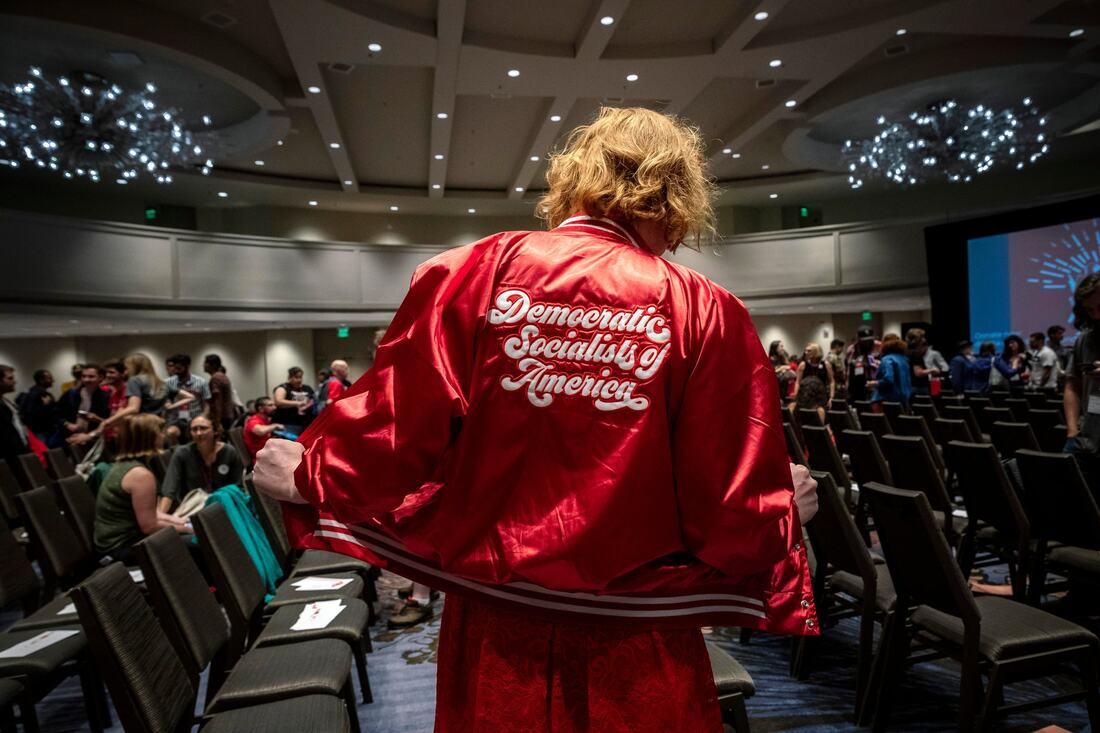
A delegate in a red satin “Democratic Socialists of America” jacket in a convention hall
 
Media coverage of the DSA convention.
 
The Guardian https://www.theguardian.com/politics/2019/aug/06/democratic-socialists-us-alexandria-ocasio-cortez-bernie-sanders
 
 
WaPo https://www.washingtonpost.com/politics/paloma/the-trailer/2019/08/06/the-trailer-they-re-open-to-candidates-other-than-bernie-sanders/5d484b6288e0fa1454f8014e/
 
 
 DSA convention and North Star made the New York Times. 

https://www.nytimes.com/2019/08/06/us/politics/bernie-sanders-democratic-socialists-america.html#click=https://t.co/gEt9EpBBJn (opens in a new tab) 

-- 


0 Comments on Media Coverage of the DSA Convention

Newer posts >>
<< Older posts

Principles (opens in a new tab)
Join Us (opens in a new tab)

Our Strategy (opens in a new tab)
Blog (opens in a new tab)
Twitter (opens in a new tab)
Facebook (opens in a new tab)

The opinions expressed here are those of members and allies of DSA North Star Caucus meant to educate, inspire discussion and encourage comradely debate.


RSS Feed


North Star caucus members

antiracismdsa (opens in a new tab) (blog of Duane Campbell)

Authory (opens in a new tab) and Substack (opens in a new tab) of Max Sawicky

Socialist Education

Online University of the Left (opens in a new tab)

Left Periodicals

Democratic Left (opens in a new tab)
Socialist Forum (opens in a new tab)
Washington Socialist (opens in a new tab)
Jacobin (opens in a new tab)
In These Times (opens in a new tab)
Dissent (opens in a new tab)
Current Affairs (opens in a new tab)
Portside (opens in a new tab)
Convergence (opens in a new tab)


The Nation (opens in a new tab)
The American Prospect (opens in a new tab)
Jewish Currents (opens in a new tab)
Mother Jones (opens in a new tab)
The Intercept (opens in a new tab)
New Politics (opens in a new tab)
Monthly Review (opens in a new tab)
n+1 (opens in a new tab)
+972 (opens in a new tab)
The Baffler (opens in a new tab)
Counterpunch (opens in a new tab)
Black Agenda Report (opens in a new tab)
Dollars and Sense (opens in a new tab)

Comrades

Organizing Upgrade (opens in a new tab)
Justice Democrats (opens in a new tab)
Working Families Party (opens in a new tab)
Poor People's Campaign (opens in a new tab)
Committees of Correspondence for Democracy and Socialism (opens in a new tab)
Progressive Democrats of America (opens in a new tab)
Our Revolution (opens in a new tab)
Democracy for America (opens in a new tab)
MoveOn (opens in a new tab)
Black Lives Matter (opens in a new tab)
Movement for Black Lives (opens in a new tab)
The Women's March (opens in a new tab)
Jewish Voice for Peace (opens in a new tab)
J Street (opens in a new tab)
National Abortion Rights Action League (opens in a new tab)
ACT UP (opens in a new tab)
National Organization for Women (opens in a new tab)
Sunrise (opens in a new tab)
People's Action (opens in a new tab)
National Network for Immigrant and Refugee Rights (opens in a new tab)
Dream Defenders (opens in a new tab)


  • Home
  • Principles
  • Join Us
  • About
  • About DSA
  • Our Strategy
  • Blog
  • Contact

© COPYRIGHT 2019 - 2026. ALL RIGHTS RESERVED.