DSA NORTH STAR
  • Welcome
  • Principles
  • Join Us
  • Our Strategy
  • Blog
  • About
    • About North Star
    • About DSA
    • Contact
  • Welcome
  • Principles
  • Join Us
  • Our Strategy
  • Blog
  • About
    • About North Star
    • About DSA
    • Contact

Blog, page 25 of 25

Welcome to the Socialist Majority Caucus

2/4/2019


North Star  welcomes  DSA’s new caucus, Socialist Majority. We agree with you on many issues and look forward to working with you to discover new strengths and then build a diverse, democratic, DSA. 
Yours in Solidarity,
DSA North Star
The caucus for Socialism and Democracy

0 Comments on Welcome to the Socialist Majority Caucus

Standing Up for Congresswoman Alexandria Ocasio-Cortez

1/26/2019

Alexandria Ocasio-Cortez smiling at a microphoneAlexandria Ocasio-Cortez

AOC’s Achievement: Making Americans’ Progressive Beliefs Politically Acceptable. Of all the reasons that Representative Alexandria Ocasio-Cortez is driving the right crazy, one of the most important is this: She’s advancing presumably radical ideas (by the right’s standards, anyway) that actually have massive public support.
Green New Deal? Fuzzy though its meanings may be, it brings together regional development policies for the huge region of the country that private capital has long since abandoned, climate change policies in a nation where climate-change apprehension is at an all-time high, full employment and decent wage policies for a nation where even voters in Republican states are casting ballots for higher wages and better jobs. Before AOC, whose radar was a Green New Deal even on? Since she joined the protestors in Nancy Pelosi’s office, a far-flung majority of Americans now see it as a way to address all manner of problems.
Likewise with taxing the rich. When AOC made the case for a 70 percent tax rate on annual income over the $10 million threshold, CNN’s Anderson Cooper responded as if she’d just called for collective farms. Now that Senator Elizabeth Warren is proposing a wealth tax that would compel the rich to pay an even fairer share of their bounty to support the common good, pundits are beginning to notice that the public has been supporting much higher taxes on the rich for a very long time. Since 2003, Gallup has annually asked the public whether they believe the level of taxes the rich pay is too high, too low or just right. The percentage saying “too low” has been in the 60-percent-to-70-percent range every year.
So it’s not hard to see why AOC is driving the right crazy. Forget the dancing, not to mention the racism and sexism that underpins many of the right’s complaints. It’s that she’s giving voice to progressive ideas that the public actually supports but that have long gone unvoiced by nearly everyone in power who has a megaphone they could use. She’s game-changingly brilliant at promoting progressive public policy. To the right, if I may steal from the Bard, such women are dangerous. ~ HAROLD MEYERSON


0 Comments on Standing Up for Congresswoman Alexandria Ocasio-Cortez

Mike Harrington and His Legacy

1/23/2019

Black-and-white photo of Michael Harrington


Michael Harrington     
 Photo Credit: Gretchen Dohart

If there is a heaven, and it reserves a place for virtuous skeptics, I imagine the late Michael Harrington looking down with celestial satisfaction at the recent growth of Democratic Socialists of America, having played such an essential role in its founding 35 years before.
Harrington, who would have turned 90 in February 2018 but who died too young at age 61, was born in St. Louis and moved to New York City in 1949 to become a writer. In 1951, he began a life-long commitment to radical politics when he joined Dorothy Day’s anarchist-pacifist Catholic Worker movement.
Mike soon shed his anarchism as well as his parents’ Catholicism, and in 1952 left Day’s community for the Young People’s Socialist League (YPSL), youth affiliate of the battered remnant of the Socialist Party (SP). YPSL counted 134 members nationwide that year. And it was about to get smaller, because Mike joined a faction that split away to form an even fringier group, the Young Socialist League (YSL), whose adult mentor, Max Shachtman, had a long history of radical in-fighting. 
In the late 1950s, the Shachtmanites rejoined the SP. As newly appointed YPSL national organizer, Mike hitch-hiked across the country, visiting campuses from Brandeis to Berkeley to recruit young socialists (among those who joined in those days was an undergraduate at the University of Chicago named Bernie Sanders). Tom Hayden and other campus activists, in the process of creating Students for a Democratic Society (SDS), were among those Harrington influenced. Mike famously wound up quarreling with Hayden and other SDSers at their founding convention in Port Huron, Michigan, in 1962, over some serious issues (the Cold War, the Soviet Union, anticommunism), but also over unspoken generational tensions. It was a rift he later deeply regretted.
In the mid-1960s, following the publication of his book The Other America, Mike became famous as “the man who discovered poverty.” He was invited to take part in planning sessions for President Lyndon B. Johnson’s War on Poverty in 1964 and advised Martin Luther King Jr. on the civil rights leader’s plans for a Poor People’s Campaign in 1968. Like King, Mike wrestled with the political and moral dilemma posed by LBJ’s escalation of the Vietnam War, reluctant to sever ties with an administration that, domestically, had been so committed to a progressive agenda. King’s breaking point came in 1967, when he publicly denounced and marched against the war. Mike, for complicated reasons including ties to the comrades of his youth, the increasingly right-leaning Shachtmanites, took much longer to do so. It was probably the costliest political mistake of his life, among other results undermining any remaining influence he had over the New Left in the later 1960s. Mike never abandoned his opposition to communism as the antithesis of his own democratic socialist beliefs. But, through painful experience, he learned from King’s example that a morally consistent politics also proved, in the long run, a pragmatically sound politics. 
By the early 1970s, the old SP was hopelessly divided over the war in Vietnam and other issues, and in 1973, Mike and others, breaking with the right-wing Shachtmanites, created the Democratic Socialist Organizing Committee (DSOC), which grew to several thousand members. Nine years later, in 1982, DSOC merged with the New American Movement (NAM), which had been founded some years earlier by former New Leftists. The new Democratic Socialists of America (DSA) represented a partial healing of old generational/political divisions. 


The greatest challenge the U.S. left has faced over the years is organizational discontinuity. As once-promising movements collapse (see 1919, 1956, 1969), new generations of activists must reinvent the wheel. DSA’s major achievement has been to preserve some organizational coherence and continuity on the democratic left.DSA, it’s worth noting, was never entirely or exactly a “Harringtonite” group, and no one in the organization during Mike’s lifetime ever so described themselves. Mike did not seek nor did anyone in DSA cede him the cultish authority implied by the label. In both DSOC and DSA, robust internal debate was the norm, resulting in many of Mike’s proposals being voted down or revamped by his comrades. 
But if DSA had no “Harringtonites,” Mike’s leadership is still worth remembering for three reasons: (1) Mike’s commitment to building a socialist organization; (2) his commitment to creating broad independent coalitions; and (3) his commitment to communicating socialist values and proposals in accessible terms.
Commitment #1: The socialist movement, Mike wrote, “is itself the embryo of socialism.” The movement has had a long history of nurturing talented speakers, writers, and organizers who sooner or later departed its ranks to achieve individual celebrity in post-socialist careers (see, for example, newspaper columnist Walter Lippmann, labor leader Walter Reuther, and sociologist Daniel Bell). After the success of The Other America, Mike could have done the same. Instead, he doubled down on his commitment to building the movement. He spoke at hundreds of gatherings every year, for free at socialist gatherings, and, when paid, often donated his speaker’s fees to the organization. Nor did he shrink from the scut-work of organization-tending, including hours and hours of not always exciting meetings. 
Mike was not a martyr. He enjoyed the camaraderie that came with hanging out with old comrades and new recruits. But there was a moral seriousness at the core of his lifelong devotion to the day-to-day labor of building durable and effective organizations.
Commitment #2: By the 1970s, Mike identified his politics as “the left-wing of the possible.” Successful social movements, as measured in durability and influence, were those capable of winning real gains for their followers (see the labor movement of the 1930s and the civil rights movement of the 1960s). To be relevant to the everyday and pressing concerns of ordinary people, socialists had to work with those with whom they shared some common goals, but not necessarily a common vision of social transformation. For Mike, that meant building strong coalitions with the labor movement; the civil rights movement; church groups; campus groups; and the liberal wing of the Democratic Party, which (worth remembering) in the 1970s and early 1980s was still largely defined by its New Deal heritage.
What this did not mean was surrendering an independent socialist perspective. Mike worked with many leading Democrats, but he was not part of or subservient to the party establishment. He criticized Democratic leaders who retreated from social justice principles when they were in power (playing a leading role in mobilizing opposition to the conservative drift of Jimmy Carter’s administration) and when they were not. In the early Reagan years, he condemned the “Democratic collapse” in the face of the right-wing Republican agenda. With the exception of the Congressional Black Caucus, he wrote in Democratic Left in the fall of 1981, “the Democratic party either stood idly by while reactionaries mounted their savage attack on social programs…or worse, joined in the destruction of gains they themselves had pioneered.” Being the left wing of the possible did not mean ceasing to be left wing.
Commitment #3: In writing and speaking, Mike developed a voice that was at once passionate and persuasive. The Other America, one of the most influential works of social criticism in the 20th century, contains no overheated rhetoric, no disdainful posturing, no sanctimonious bullying of the privileged. Mike could convey moral seriousness without lapsing into moralism. His tone suggested that the reader was a reasonable person, and reasonable people, once apprised of the plight of the “Other America,” would agree on the need to find solutions. 
In 1989, five months before his death from cancer, Mike spoke to a February conference of the DSA Youth Section. He noted that some in the crowd would pay their dues for a year or so (“God bless you”) then move on to other things, and “probably remain, at least, a good liberal.” But to those who wound up staying for the long term, he had special words of encouragement, words as relevant today as they were then: “This movement should enrich you. This movement should allow you to lead a different kind of life. This is not a burden. At its best this is a movement of joy.” For Mike, democratic socialism was a generous, positive, and affirmative movement. May it always continue to be so.
Maurice Isserman—a charter member of DSA—teaches history at Hamilton College, and is the author of The Other American: The Life of Michael Harrington (2000). 
This article originally appeared in the Winter 2017 issue of Democratic Left magazine.
Individually signed posts do not necessarily reflect the views of North Star, of DSA as an organization or its leadership. 

0 Comments on Mike Harrington and His Legacy

DSA Members in Congress

1/20/2019

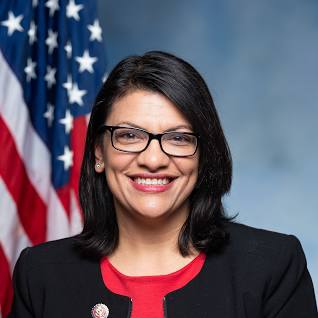
Portrait of Rashida Tlaib in front of an American flagRashida Tlaib

Now that they are in Congress, both Tlaib and Ocasio-Cortez will almost certainly develop broadened political bases largely independent of DSA. Organized labor and liberal advocacy groups will be in their camp now. The Congresswomen may, out of conviction or good will, continue to pay DSA dues, and show up for rallies, fundraisers or other socialist gatherings, as Dellums and Owens did. But it’s unlikely they’ll have the time or inclination to devote much more in terms of direct involvement. If they are going to do their jobs right, serve their constituents—and get re-elected—they are going to be very busy and in a much bigger arena.

Volunteer power from DSA, however, did help both Tlaib and, perhaps more so, Ocasio-Cortez, win their contested primaries. That involvement shows what kind of an impact the organization can have on electoral races, and will likely inspire other insurgent candidates to seek DSA’s endorsement in future races. And as more politicians begin to adopt the label of “democratic socialist”—while advancing the values and policy priorities of the group, DSA will continue to grow in power as a player in American politics.
It is this growth that is more important for the organization’s continued success than discussions of strict accountability to DSA. After all, as elected representatives, Tlaib and Ocasio-Cortez are accountable to a number of different groups that helped elect them, and first and foremost—and rightly so in a democratic system—to the voters of the districts they represent. And as a matter of practicality, DSA currently needs Tlaib and Ocasio-Cortez more than either of them need DSA. 
This reality is worth remembering if the newly reenergized DSA is to help expand the socialist caucus in the House of Representatives beyond the two it currently counts.
Maurice Isserman
 
Maurice Isserman, a charter member of Democratic Socialists of America, is the author of The Other American: The Life of Michael Harrington (2000)
This post is dated. We intended to post it back in November, however our blog was not functioning at that time.
 
https://inthesetimes.com/article/21570/socialists-house-midterms-victor-berger-ocasio-cortez-tlaib (opens in a new tab)


0 Comments on DSA Members in Congress

MICHAEL HARRINGTON AND HARRINGTONISM:A CRITICAL APPRECIATION

1/17/2019

George Fish
“Michael Harrington.” It’s a name that gets tossed around by members of DSA, sometimes in negative and derogatory ways.  But simply put, DSA, as an organization advocating democratic (as opposed to authoritarian) socialism, that fights for free, honest and open elections for achieving socialism based on democratic self-determination and for transformative change for the here and now, is Harringtonist to its core.   Harringtonism is the guiding ideology of democratic socialism in the US, and the basic set of political principles that separates DSA from the authoritarian, totalizing, and revolution-fantasy nostrums of anarchism and Marxism-Leninism. 
Not that Michael Harrington was perfect.  Certainly his red-baiting attack on the young radicals who were involved in the founding of Students for a Democratic Society (SDS, itself established as the youth group of the old-line social-democratic League for Industrial Democracy in 1962) was terribly flawed, and is well documented as such in Kirkpatrick Sale’s 1973 history, SDS, pp. 60-68.  For them, Harrington’s harsh critique of them as being allegedly “soft on communism” smacked both of redbaiting (when they were also quite critical of Soviet-style “socialism”), as well as being hectored and lectured to as naïve children by one of their supposedly older, and thus naturally more experienced and aware, “betters.”  For these young SDSers, Harrington’s direct attack was both hostile and condescending, and clearly the account given by Sale bears this out.
   Also flawed was his reluctant understanding that the anti-Vietnam War Movement was not some sort of “communist front” but a popular resistance:  both as a Vietnamese response driven more by nationalism than Stalinism, and as a deep revulsion among the US and Western young, moved by conscience to see it as a fruitless, endlessly brutal, war against a non-Western population.  Yet, Michael Harrington saw neither of this for a long while, though he later changed his mind, at least in part; his cherished ties to the centrist hawks of the then-US labor movement blinded him to this, and caused his abstention from the broad-based antiwar movement.  Also erroneous was his confusing the old-line centrist union leaders of the AFL-CIO labor movement with the union rank-and-file. (Which was organized labor of the 1950s and 1960s except for the exiled Teamsters, kicked out of the AFL-CIO for corruption and criminal activities; and a handful of independent labor unions, notably the International Longshore Workers Union [ILWU] and the United Electrical Workers [UEW], which were labor pariahs regarded as “pro-communist.”)  The AFL-CIO was then tightly under the autocratic rule George Meany, who’d been in power since 1955, brooked no dissent, and was a fierce foreign policy hawk. (Harrington later changed his mind on this also, and, admirably, later corrected this by helping many young activists get jobs in unions.) 
To be fair and honest to Michael Harrington, though, we must also acknowledge that he did come to oppose the war in Vietnam.  Harrington was no knee-jerk Cold Warrior “liberal,” he was always a principled anti-Stalinist horrified at how the word “socialism” had become identified with Soviet-style authoritarianism, and knew better than to conflate anti-Stalinism with a simplistic anticommunism.  This goes back to Harrington’s early days in the Independent Socialist Club under his mentor, Max Shachtman, which sided neither with the Soviet-led “peace camp” nor the US-led “democratic” camp, but always understood that Stalinist “socialism” was neither democratic nor socialist.  
On the issue of war and peace, had he lived Harrington would certainly have opposed US wars in Iraq and Afghanistan; and stood with Bernie Sanders in calling for a “level playing field” on the issue of Israel vis-à-vis the Palestinians.  But also, he would’ve opposed both Netanyahu’s chauvinism and the settlements on the West Bank as well as Hamas’s call to “drive the Jews into the sea.”  He certainly also would’ve been neither naïvely pro-Assad or pro-Putin, and articulated that a mere “anti-imperialism” that translates into a knee-jerk anti-Americanism is not a principled socialist foreign policy.  
During the time of Michael Harington’s greatest political influence, the mid-to-late 1960s, George Meany and his acolytes controlled the AFL-CIO with an iron fist, tolerated no dissent, and even went so far as to brand delegates to the 1972 Democratic Convention who’d been elected instead of those the AFL-CIO supported as “faggots”!  Openly opposing (or even subtly criticizing) hawkish, hidebound Meany and Meany-ish politics could well be a political death sentence.  But Michael Harrington would’ve been proud to see the leadership of the AFL-CIO move from a Meany acolyte, Lane Kirkland, to, first, a John Sweeny, then a Richard Trumka, which moved labor politics to a more open embrace of the poor, African American and other racial minorities, women, immigrants, and others marginalized from “mainstream society;” to see rank-and-file union locals and even some national unions endorse Bernie Sanders for President; to see the emergence of dissident union caucuses such as Teamsters for a Democratic Union, the continued publication of such as In These Times,Labor Notes, and nowJacobin and a revampedDissent; and the emergence of Our Revolution, its sister affiliate Labor for Our Revolution, and the Sanders Institute.  Not to mention the nationwide wave of teachers’ strikes!  
On the other hand, despite a noble impulse to break from the stifling “moderation” of the Eisenhower years and the confrontational Cold War politics of the post-World War II era, the young 1960s New Left’s understanding of the Cold War and the “irrelevance” of “anti-communism” certainly was naïve, and created all sorts of problems for its flagship group, SDS, in the future.  When Marxist-Leninist groups actively entered it, most notably the Maoist-Stalinist Progressive Labor Party, with its student activist cadres all voting as a bloc and giving not an inch on  opposing positions within SDS, SDS’s response to such “Marxism-Leninism” was for its leadership to try and prove itself more Marxist-Leninist than the Marxist-Leninists—which led the New Left of the late 1960s to not only organizationally fall apart with the demise of SDS as a mass-based movement of politically left youth in 1969, but also degenerate into Weatherman, a neo-anarchist grouping with Maoist trappings that overtly practiced confrontational violence and strategic bombing of public buildings in order to “spark the revolution;” then, in response, to the proliferation of impotent anti-Weatherman Maoist sects in the 1970s.  But the better strains of the “far left,” such as some Trotskyists and the dissident Trotskyist offshoot founded by Max Shachtman (as mentioned, a direct political mentor of Michael Harrington), understood well the basic difference between socialism with democracy, and Stalinist “socialism” without it.  
So, despite these significant misunderstandings on the part of Harrington, later history does partially absolve him; and the founding of DSOC, and later, DSA, by Mike Harrington, and his active role in them until his death in 1989, certainly vindicates his ideas in many key ways. But one can’t say the same for the young acolytes of Weatherman and Maoism that grew out of this New Left, who not only enabled both Richard Nixon and Ronald Reagan to successfully run for President by opposing what remained of the New Left, but also succeeded in defanging organized leftism in the US from the early 1970s until the early anti-globalization protests of 1999 and the early 21stCentury, leaving the political landscape without any kind of significant left presence except for one hopelessly out-of-touch, sectarian, beleaguered and marginalized.  
There is, indeed, an honorable socialist tradition that opposes both unregulated and repressive capitalism andthe authoritarian degeneration of “socialism” USSR-style, which made socialism synonymous with Gulag in the eyes of many people.  This socialism, democratic yet positively transformative, was the acme of Michael Harrington’s socialism—and, though he’s never been a member of DSA, also informs the positive and aggressive “democratic socialism” of Bernie Sanders. Had he lived, I’m certain, Michael Harrington would’ve been proud of Bernie.
Further, Michael Harrington would’ve certainly been proud that DSA has become the political home now of vital, exciting young people galvanized by Bernie Sanders and new to left politics, such as 29-year-old Alexandria Ocasio-Cortez, who are infusing new life into our venerable organization!  
Also, in articulating his political vision that led to establishing DSOC and later DSA, Harrington found himself in a minority within the Socialist Party, which not only voted against him, but changed its name to Social Democrats USA (and became defunct a few years after that), while DSOC, later DSA, continued, and now thrives since 2016.  For the old Socialist Party had become a place where a hidebound, right-wing form of anticommunism had taken over in place of a principled anti-Stalinism; where once self-professed socialists were often to the right of liberals and the Democratic Party on even domestic issues; and where members of the Socialist Party then, such as Jeanne Kirkpatrick, former Ambassador to the UN under Reagan, became neoconservative hawks echoing Republican talking points on the Cold War, even in the face of Gorbachev.
Also, Michael Harrington made all the “right” (in both meanings of the word) enemies—from William F. Buckley, Jr. to Irving Kristol, former anticommunist right-wing social-democrat editor of the New Leader“moderate” political magazine turned self-professed “neoconservative,” who had trouble precisely with the status quo because it had become “liberal”! And to having his politics disavowed by such as the “Senator from Boeing,” Henry “Scoop” Jackson, arch-Cold Warrior Senator from the State of Washington, where Boeing was a major employer!  This, too, is part of the legacy of Michael Harrington and Harringtonism. 
Michael Harrington was also correct in seeing the locus for socialist struggle within the Democratic Party, and constituting DSA as the left wing of the Democratic Party, rather than chasing the political will-o’-the-wisp through “anti-capitalist” third parties, which have proved themselves electorally irrelevant, and sometimes even bizarre. (Consider the Green Party candidate in the 2018 Ohio election who claimed to be descended from space aliens!) Bernie Sanders’s successful campaign for President in 2015 and 2016 running as a Democrat certainly vindicates Harrington on this. 
Michael Harrington was, furthermore, a prolific writer who had direct impact on progressive US domestic policy (e.g., Lyndon Johnson’s War on Poverty), and through many books, starting with 1962’s The Other America--whichexposed the vast extent of poverty still prevalent in the US’s “affluent society”—thus laid out a compelling vision for an up-to-date democratic socialism; in terms of practical politics, Harrington’s vision directly inspired aspects of both Kennedy’s New Frontier and Johnson’s Great Society .  While we who are veterans of DSA may agree or disagree with parts of it, such as his knee-jerk (but understandable for the time) anticommunism, or for his lack of perception in how limited the results of the New Frontier or the Great Society would be (again, understandable for the times he was in), there is no questioning that, as DSA members, we still follow in the vein he laid out:  we seriously engage in electoral politics, we wish to transform the US in the here and now, and we wish to reach out to ordinary working people, not just preach to the already-converted left choir.  As DSAers and North Star caucus members, we are all united on these three essential points—which is integral to Michael Harrington’s understanding of the tasks of the US left to above all, “speak American” and be “the left wing of the feasible.”  
While DSA members do have differing assessments of Michael Harrington and what constitutes Harringtonism, we should certainly agree that what Harrington promulgated in the name of socialism differs fundamentally from both Marxism-Leninism and anarchism.  But DSA does have a specific understanding of socialism that is not only rooted in the political vision of Michael Harrington, it also separates DSA organizationally from the Marxist-Leninist (or Leninist-Trotskyist) or anarchist tendencies that have shaped left politics in very sectarian and unattractive ways.
Such is the legacy of Michael Harrington and Harringtonism, a legacy that, despite its faults and shortcomings, has also demonstrated its positive, constructive side.
 
Biographical note:  George Fish is an At-Large member of DSA living in Indianapolis, Indiana, an extensively-published left/socialist writer and poet, and a rank-and-file member of UFCW Local 700.                    
  Ed. note.
Here is Michael Harrington describing his views in 1978.

https://www.dissentmagazine.org/article/what-socialists-would-do-in-america-if-they-could (opens in a new tab)


 The views and opinions presented in the North Star blog reflect those of the individual authors, and do not necessarily reflect the opinions of the North Star Caucus nor of DSA. 

1 Comment on MICHAEL HARRINGTON AND HARRINGTONISM:A CRITICAL APPRECIATION

12 Theses on The Election

1/7/2019

by Leo Casey

1) How should the left approach the 2020 elections? Here are my thoughts. The paramount objective must be the defeat of Trump & the retaking of the Senate from GOP. This is the ‘prize’ on which we must keep our eyes. 

2) If we do not win this ‘prize,’ the elections will be catastrophic for American democracy, those targeted by Trump’s authoritarian populism & the left. But much of the discussion on left twitter and facebook takes place within a political vacuum, as if context was irrelevant. 

3) There will be a vigorous campaign over which presidential candidate would be the best standard bearer in that all important battle. But the very breadth of the current field means that there are many authentic progressives who are credible prospects.

4) Rather than rush to anoint a particular candidate as the one and only prospect, it makes much more sense for the left, at this early point in the campaign for an election two years down the road, to be focused on promoting issues that it wants the Democratic Party and whomever is the candidate to embrace. 

5) Alexandra Ocasio Cortez’s ability to put the #GreenNewDeal (opens in a new tab) on the agenda before she was even sworn in illustrates what the democratic left can – and should be – doing to advance an agenda that will address critical issues such as climate change and economic inequality & set the stage for 2020.
6) By contrast, the rush to focus on a particular candidate plays into narrow conception of elections, focused on personalities to the exclusion of program. And insofar as it takes the form of insisting that the personality can only be a self-avowed democratic socialist, it becomes an exercise in sectarian purity. 

7) Nothing would be more damaging to the development of democratic socialism as a political force that can seriously contest for political power in the US than the loss of 2020 elections, with the sense that democratic socialists harmed Trump’s opponent and sat on the sidelines in a critical struggle. 

8) Insofar as some on the left feel that it is absolutely essential to weigh in behind a particular candidate, it is critical that this intervention take a positive form, providing reasons to support their preferred choice, and not a negative campaign against others. 

9) Negative campaigns against progressive candidates are worse than a zero sum game: they damage both the target and the intended beneficiary. If a candidate wins by such means, it becomes all that more difficult to unify the supporters of others for the critical general election. 

10) The consequence of negative campaigns among progressives, based on dubious logic that they are competing for same votes, is that pro-business ‘moderates’ would be advantaged in campaign to win the nomination. 

11) Attacks on Elizabeth Warren in the name of support for Bernie Sanders, such as that conducted by Jacobin editor Bhaskar Sunkara, are illustrative of precisely what those of the left should NOT be doing. Such tactics will hurt both Warren and Sanders, to the benefit of those to their right. 

12) Above all else, a left approach to the 2020 elections must never lose sight of the ‘prize’: the defeat of Trump, the GOP and the racist, authoritarian populism they have brought into the mainstream of American politics. 

3 Comments on 12 Theses on The Election

Democratic Leadership and Pay-Go

1/5/2019

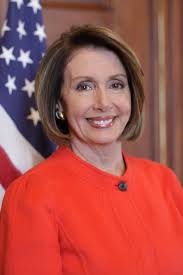
Portrait of Nancy PelosiNancy Pelosi
By Max Sawicky 
Ferment inspired by the execrable Trump presidency and Republican Congress has returned Democrats to a majority in the House of Representatives, but their incoming leader, Rep. Nancy Pelosi (D-CA), is maneuvering to squelch that ferment with a new “rules package” that will discourage progressive legislation.
The two moves in question are reinstituting a “PAY-GO” restriction on legislation, and neutering a new committee dedicated to advancing the Green New Deal (GND).
PAY-GO, short for “pay-as-you-go,” requires any proposal for new spending or tax cuts to be accompanied by offsetting measures that preclude any increase in the federal budget deficit over the ensuing decade. Under this rule, a bill violating this requirement is subject to a “point of order” on the House floor. That immediately interrupts consideration of the bill, which can then be killed absent consent by the Democratic leadership, meaning Nancy. It is possible for the restriction to be waived, but that would require buy-in from you guessed it, Nancy, so it will be her way or no way.
In practice, of course, a speaker who has the support of her caucus has dictatorial control over the House. She or her can block any bill at any time. What PAY-GO does is give Pelosi an excuse for letting something die before it has a chance to get a vote by the full House. Her fingerprints on the blockage are not as obvious. Instead of the headline being, “Nancy says she doesn’t like this bill,” it will be, “Green New Deal falls afoul of PAY-GO rules.” Meanwhile, the new committee dedicated to advancing the GND, besides being hampered by PAY-GO, would lack subpoena power. So compared to other Congressional committees, it will be like the kids’ table at Thanksgiving.
Why, oh why, would the great San Francisco liberal be doing this? A few possibilities come to mind.
The worst is that she is committed to the same nostrums of fiscal responsibility that have helped the Democrats lose political battles since Walter Mondale in 1984. If you’re old, you may remember Mondale’s bold announcement in his presidential campaign that he would raise taxes to fix the deficit. That November, he lost 49 states to the addled Ronald Reagan. In 1993, new president Bill Clinton rammed through a deficit-reduction-minded budget deal that was followed in 1994 by Democrats losing both the Senate and the House, the latter for the first time in forty years. In 2010, Barack Obama promoted a health care reform that, out of deficit concerns, was insufficiently funded, among other deficiencies, resulting in a plethora of difficulties in operation of the new law, and some impact on flipping the Congress to the Republicans. There’s a pattern here.
The wonder about mainstream Democratic affection for PAY-GO is that the deficit fears upon which it is premised are no longer subscribed to by Democratic economists, even relatively moderate ones such as Larry Summers, Obama’s chief economic adviser, or Jason Furman, head of Obama’s Council of Economic Advisers. Summers has written of his worries that the economy is in a long-term rut of “secular stagnation.” Furman recently acknowledged in the Wall Street Journal that deficits resulting from Trump’s tax cut had a positive boost for the economy, albeit limited and temporary.
There is a reasonable case for higher deficits even now with a low unemployment rate (and many remaining labor market drop-outs). Moreover, there is no reason to expect current conditions to persist for a full decade. In particular, policies that strengthen the “automatic stabilizers” in the budget (i.e., those that automatically increase spending and cut taxes when the economy slows down) would be beneficial for the long term.
As a general matter, it makes sense to finance infrastructure — investments that provided benefits over an extended period of time — with borrowed money, as business firms often do. Defraying the interest on such debt is the real pay-as-you-go. Denying such investment is just cutting your nose to spite your face.
We might also linger on the thought that a reduced national debt would not be much consolation after the advent of irreversible, catastrophic climate change. Investment will be one of the pillars of addressing this threat.
Deficit reduction politics by now should be recognized as a gigantic loser for Democrats. Republicans are never constrained by deficit impacts in any of their proposals. Either they are ignored, or measures like the Trump tax cut are magically transformed into deficit-reducing miracles.
On the Democratic side, any “fully-funded” spending bill provides opponents of the bill with a nice array of groups negatively affected by the offsets upon which to base a counter-mobilization. Knowledge of the PAY-GO obstacle will strangle potential progressive initiatives in the crib.
Nancy’s rules are probably designed to restrain the energized progressive contingent of House Democrats. She’s smart, after all; she can’t be unaware of the impact of her rules. However effective she was in mobilizing her caucus behind Obama’s initiatives in 2008 and 2009, her vision of political possibilities does not seemed to have evolved with the times. She reminds us of defeated Senator Claire McCaskill, who wondered how someone like Alexandra Ocasio-Cortez had become “the new, shiny object.” Something is happening and she don’t know what it is.
One rationale for stifling discussion of social legislation is to keep the spotlight on toppling Trump. While there is no reason not to unleash the full fire and fury of the House majority on our vicious, kleptocratic administration, there is a pragmatic reason to maintain attention on the issues that arguably flipped the House: meat and potatoes stuff like health care, the minimum wage, etc.
It is true that no progressive initiative is likely to make it through the Republican Senate, much less Trump’s White House, but that’s the cynic’s view. Proposing hopeless initiatives is the beginning of providing some hope for them. Republicans seem to understand that better than Democrats.
It’s always possible that the commitment to PAY-GO, like most other decisions, is more an artifact of what wealthy donors have indicated they prefer, rather than ordinary voters. Or as Nancy says, “We’re capitalists, and that’s just the way it is.”

Reposted from Jacobin blog with the permission of the author. 
Max B. Sawicky is an economist and writer living in Virginia. He has worked at the Government Accountability Office and the Economic Policy Institute.
Ed note;  Congresswoman Alexandria Acosio-Cortez was one of 3 Democrats to vote to oppose the Pay-Go rule. 


0 Comments on Democratic Leadership and Pay-Go

Building a global progressive network to combat fascism

12/20/2018

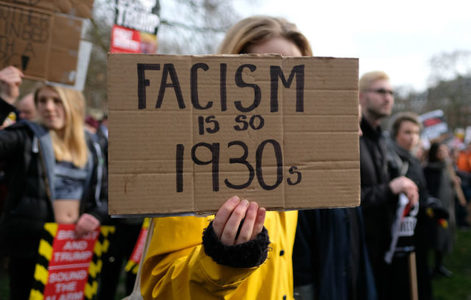
A protester holds a cardboard sign reading “Facism is so 1930s”
Media credit. Alisdare Hickson via flickr. Creative Commons.

David Anderson
We are witnessing an explosive revival of the far right across the globe. It is happening in Europe, Latin America, Russia, the Middle East and Asia. But it is particularly ominous that it is also happening in the United States, the dominant and oldest democracy, after the election of  Donald Trump.
Last month, U.S. Senator Bernie Sanders and Yanis Varoufakis, the former finance minister of Greece, launched Progressive International, which hopes to create a united front against the far right by mobilizing “a global network of individuals and organizations that will fight together for dignity, peace, prosperity and the future of our planet.” They issued a call to action:
“There is a global war being waged against workers, against our environment, against democracy, against decency.
“A network of right-wing factions is collaborating across borders to erode human rights, silence dissent, and promote intolerance. Not since the 1930s has humanity faced such an existential threat.
“To defeat them, we cannot simply go back to the failed status quo of the last few decades. Unfettered globalization promised peace and prosperity. But it delivered financial crisis, needless war, and disastrous climate change, instead.”
The announcement was delivered at an inaugural three-day event in Burlington, Vermont, by a new think-tank called the Sanders Institute, which is led by the senator’s wife, Jane O’Meara Sanders. She said that the Institute was founded in 2017 but the gathering was deliberately held after the midterm elections:
“The Democrats took back the House, so the ideas that we’re coming up with have more of a shot of being brought forward in the House and even possibly pass depending on how strong the progressives are and that will help us in terms of moving the principles and the values and ideas that we have forward.”
The gathering brought together some 250 progressive thinkers, politicians and activists. The attendees included Cornel West, Bill McKibben, Naomi Klein, Danny Glover, Our Revolution president Nina Turner, The Young Turks founder Cenk Uyger, labor leaders Roseann DeMoro (National Nurses United) and Peter Knowlton (United Electrical Workers), and Carmen Yulin Cruz, the mayor of San Juan, Puerto Rico.
Speeches and panel discussions dealt with winning Medicare for All, solving the climate crisis with a Green New Deal, reforming the criminal justice system and creating affordable housing.
Shortly after the gathering, Katrín Jakobsdóttir, Iceland’s Prime Minister, announced on Facebook her support for Progressive International because it represents “the struggle for general welfare, security, and dignity for all people,” and that a trans-border network of those on the left would help “alleviate social and economic inequality, make changes to the global financial system, turn away from the arms race, and stop climate change.”
Jakobsdóttir, who’s been described as “the anti-Trump,” is the leader of Iceland’s Left-Green Movement, which is in a coalition government with two more conservative parties. John Nichols of The Nation notes that she is “the first elected head of state who comes from a new breed of Nordic left-wing parties that link democratic socialism, environmentalism, feminism, and anti-militarism. She is, as well, one of a number of young left-leaning women who have emerged as prime ministers and party leaders in countries around the world at the same time that the United States has been coming to grips with the defeat of Hillary Clinton and the election of Donald Trump.”
In 2018, a record number of women were elected to office in the U.S. But we still have a lot of catching up to do. Americans have a problem hearing that we can learn from the experiences of other countries. Politicians are always telling us that we are the greatest and most wonderful country on the planet. This arrogant notion that we are an isolated shining city on a hill is a dangerous delusion. We are not immune from the forces of history.
It can happen here. America can become fascist. 
In September, Bernie Sanders and Yanis Varoufakis wrote a pair of op-eds in the Guardian about the need for a Progressive International. Sanders asked:
“Three years ago, who would have imagined that the United States would stay neutral between Canada, our democratic neighbor and second largest trading partner, and Saudi Arabia, a monarchic, client state that treats women as third-class citizens? It’s also hard to imagine that Israel’s Netanyahu government would have moved to pass the recent ‘nation state law’, which essentially codifies the second-class status of Israel’s non-Jewish citizens, if Benjamin Netanyahu didn’t know Trump would have his back.
“All of this is not exactly a secret. As the U.S. continues to grow further and further apart from our longtime democratic allies, the U.S. ambassador to Germany recently made clear the Trump administration’s support for rightwing extremist parties across Europe.”
Varoufakis said that fascism can become attractive to desperate people:
“Our task is not unprecedented. Fascists did not come to power in the mid-war period by promising violence, war or concentration camps. They came to power by addressing good people who, following a severe capitalist crisis, had been treated for too long like livestock that had lost its market value. Instead of treating them like ‘deplorables,’ fascists looked at them in the eye and promised to restore their pride, offered their friendship, gave them a sense that they belonged to a larger ideal, allowed them to think of themselves as something more than sovereign consumers.”
But he says, “That injection of self-esteem was accompanied by warnings against the lurking ‘alien’ who threatened their revived hope.” Progressives can offer a positive alternative to both the fascists and the establishment — a global Green New Deal. 
 
Reposted from the Boulder Weekly. Dec.13,2018.  https://www.boulderweekly.com/opinion/the-anderson-file/building-a-global-progressive-network-to-combat-fascism/ 

Dave Anderson is a long time member of NAM and DSA. He was a
paralibrarian at the University of Colorado Boulder for 30 years and
has been a free lance writer. He was the president of the university's
AFSCME Local 3592. He has been an activist in the labor, single payer,
peace and environmental movements.


0 Comments on Building a global progressive network to combat fascism

Steps Toward a Labor Informed Position on Immigration

12/17/2018

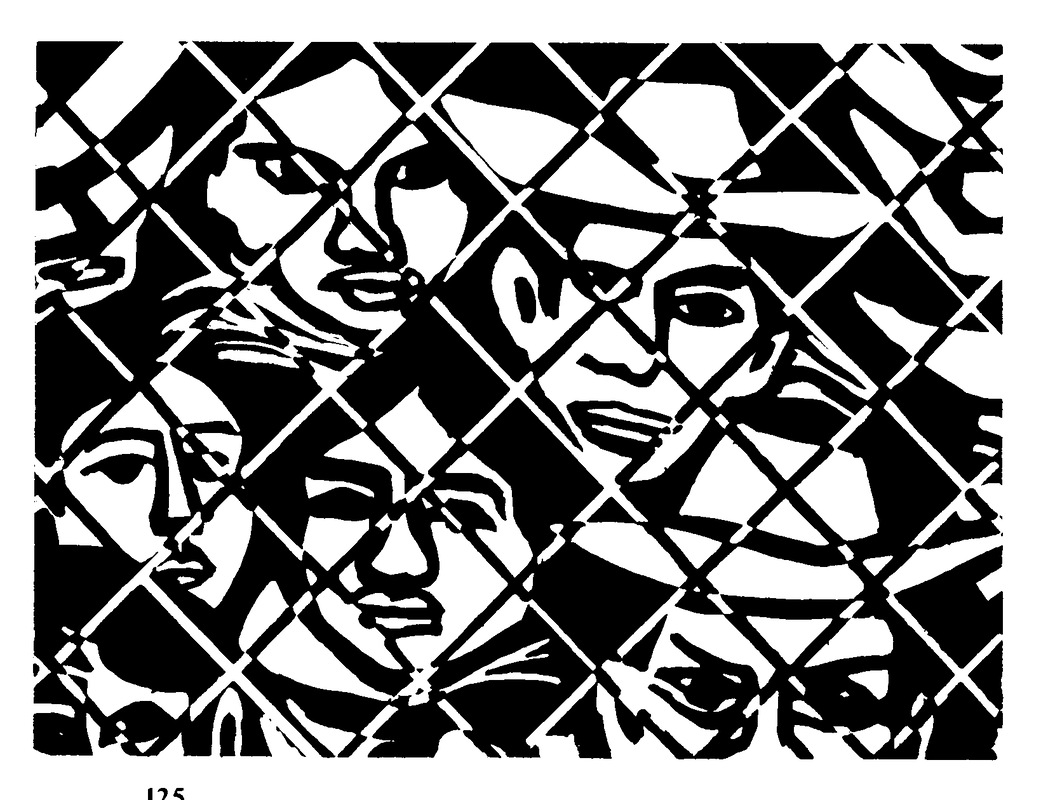
Rini Templeton drawing of migrants’ faces behind a chain-link fence
Rini Templeton
Steps Toward a Labor Informed Position on Immigration
 by Duane Campbell
( a prior version of this paper appeared on Portside with the title: The Left Case Against Open Borders-by Angela Nagle:  a Review) 
 
Tens of thousands of Hondurans, El Salvadorans and Guatemalans are fleeing  hunger and death.  Usually they do not flee in caravans but alone or with their immediate families. Caravans are formed for protection from crimes, assault, rape and extortion. As the Exodus Caravan from Honduras has reached our borders, there is a heightened sense of fear in the nation promoted by Donald Trump and his administration.
 
To  begin with, the caravan of poor people at our border should not be stopped.  Instead, those eligible for refugee status should be admitted required by the 1951 UN Convention on the Status of Refugees, the Universal Declaration of Human Rights (1946) and current U.S. law.  DSA’s Immigrants’ Rights Committee is actively involved with several local chapters in support of the migrants in the caravan in Tijuana, Mexico. 
 
When writers  propose an immigration policy and a critique of a movement, it is important to get the story right. People’s lives depend upon it.

It Is Not About Open Borders

In the article, “The Left Case against Open Borders”, writer Angela Nagle  gets some  of the economic conditions correct, but like Trump, she argues without evidence that the problem is that  unions, the Left  and immigrants’ rights activists support  “open borders”.   Her writing  follows from the position in Melting Pot or Civil War? A Son of Immigrants Makes the Case Against Open Borders – (2018) by Reihan Salam
 Developing a policy on migration for labor and the left is far more complex than presented by  these writers.  
 
First we must  deal with some of  the false accusations about the role of unions in the immigration policy  debates.  
 
Writer Nagle is wrong  in asserting that the left and labor favor open borders. This is accepting the false narrative of Trump and the anti- immigrant forces. 
 
There has been a long and well developed movement for immigration reform, along with connected policy proposals – few of which argue for open borders. Progressive policies and practices have emerged from within U.S. communities and the labor movement.  The writer seems to not be aware of this history. Instead she describes critics of the current attacks on immigrants as “Useful Idiots.”
 
She notes the Reagan Administration policy  known by Republicans  as amnesty without noting that the  Simpson- Mazolli Act was the consequence of a multi- year struggle for immigration reform by both corporate forces and community groups. 
This  Immigration Reform and Control Act of 1986 bill permitted the legalization of some 2 million farmworkers and over 4 million others already living in the U.S.  This program was a hard fought product of years of struggle by immigrants’ rights activists and their allies.
 
In addition to providing a path to legalization for many already here, the act required employers to attest to their employees immigration status  and made it illegal for hire or recruit undocumented workers.  These provisions were known as employer sanctions.  The act also contained the program known as H2A which provides a system of temporary, controlled farm labor “guest workers” with very limited ability to organize, to have a union,  and to demand improved wages or working conditions. The law further  includes H1B temporary workers in high skilled technical fields.  By 2017, some 40,000  agricultural “guest workers” were employed in the fields  and some 419,000 mostly high tech H2B workers were employed in the U.S. 
 
Immigrant rights groups opposed employer sanctions arguing that they would provide the employer with yet another way to exploit and intimidate immigrant workers.  Now, the Nagle article argues for E verify system, which is the current digital process of employer sanctions, without noting that employer sanctions were opposed by the AFL-CIO in their  landmark 1999 resolution on organizing immigrant workers.   

In 1994, a Republican led Congress, with the support of 102  Democrats, passed the North American Free Trade Act, the economic construction that provides for free trade of goods and services but did not change immigration law. The promise made by NAFTA supporters was that the new trade regime would significantly reduce immigration.  Instead, NAFTA impoverished millions of small farmers in Mexico and drove many of these workers to migrate to the U.S.
In 1996 the Republicans passed and Bill Clinton signed theIllegal Immigration Reform and Immigrant Responsibility Act of 1996, a repressive bill that  provided for the construction of fencing along the border and criminalized many factors of immigrant life. Over the decade there were numerous appropriation bills to provide increased funding for the Border Patrol,  militarization and fencing of the border.

It Is Not About Mass Migration

In 2005 when Republicans pushed the Sensenbrenner bill , theBorder Protection, Antiterrorism and Illegal Immigration Control Act of 2005 , unions with significant immigrant membership worked with immigrants rights groups to muster over 1 million into the streets in protest around the country on May 1, 2006, to kill the bill. They did demand a new amnesty for workers already here, this is what the Republican nationalists call a demand for open borders and mass migration. 
 
Nagle argues: “There is no getting around the fact that the power of unions relies by definition on their ability to restrict and withdraw the supply of labor, which becomes impossible if an entire workforce can be easily and cheaply replaced. Open borders and mass immigration are a victory for the bosses.”
 
While this is  partially true, neither unions nor the left have been arguing for open borders nor mass immigration.  They have been arguing for revised policies that protect the rights of migrant workers including their right to form unions. 
Nagle argues that support for restriction of immigration  can be found in labor history.   Yes, organized labor has long had two traditions on immigration; one urged restriction of immigration, the second urged recognizing that immigrants were here and sought to organize  them into unions.    Certainly there are instances of  organized labor being anti immigrant, such as in the Chinese Exclusion Act.   However she uses her history very selectively for example ignoring the unionization of the Industrial Workers of the World , the CIO and  Packinghouse Workers among many.   BTW. the socialists in labor were almost always on the side of supporting unionizing immigrant workers- not of building walls. 
 Seeking to support her claim, Nagle cites as evidence references to the UFW strike in 1969 ( I think she means 1973).  In the strike mass Immigration was not the issue confronted by the UFW, it was strike breaking. The author, an Irish writer, may not know that the UFW has organized undocumented labor, has helped tens of thousands to  achieve their  legalization papers and has proposed more immigration and the protection of farm worker rights. The actual history of the UFW contradicts her thesis and the photo of Cesar Chavez used to promote the essay is -at best- a deception. 
 
 It would help for the writer  to be better informed on the immigrants’ rights movement and the labor movement.  If you are going to describe union’s approaches to immigration, you should deal with union sources, not the Koch Foundation funded think tanks she currently relies upon.  

It Is About Workers’ Rights

In 1999 and 2000 The AFL-CIO changed its policy and no longer supported efforts prior efforts that blamed workers for migration.   Since the 2000 change  of federation policy several unions have changed their stance and work to  organize immigrant workers rather than trying  to keep them out of the country, but these unions have not argued for open borders.
See, Illegal People: How Globalization Creates Migration and Criminalizes Immigrants,  Bacon (2008)
 
Nagle describes  the neoliberal corporate opinion campaign in support of more immigration. These are corporate campaigns, not union campaigns. 
The left and unions are not promoting open borders, they are defending workers- some of who are undocumented.  Workers without  legal status are a product of the biases in current immigration law including per country caps on granting visas.  
Angela Nagle is the author of a prior book Kill All Normies.  Her criticism of immigration politics  seems , like her book, to be informed by  a class of pundits and hash tag politics  rather than a  working knowledge of U.S.  labor unions and their history in dealing with immigration. 
 In her essay Nagle  describes well several  aspects of global finance and NAFTA.  Yes, there are real problems with NAFTA.  But, NAFTA was and is a neoliberal project, not a left project nor a union project.   Rather than accepting the  neoliberal argument that the U.S. has benefitted from migration, it would be more accurate to argue that certain corporations and industries and their owners  have benefitted in the U.S., Canada and Mexico. The lobbyists from these industries dominate finance and  the foreign policy establishment and they  promote the  reconsideration of NAFTA.  Other corporations and most workers are harmed by the  current exploitation of illegal migration- such as in farm labor and construction.  The winning corporations externalize their own costs to the entire society and take little responsibility for their actions including the destructions of entire communities.  Under CAFTA, (Central America Free Trade Agreement) for example, the U.S. military is active in Honduras and other parts of Central America paid for by us all for the benefit of specific corporations not to the benefit of the people of the U.S.

Addressing Root Causes of Migration- The Economy

Angela Nagle makes her most useful point when she argues in her conclusion,   “The proper response, therefore, is not abstract moralism about welcoming all migrants as an imagined act of charity, but rather addressing the root causes of migration in the relationship between large and powerful economies and the smaller or developing economies from which people migrate. “
 
Most labor and left advocates of immigration reform would agree with her assessment of the need to address the root causes of migration.   See for example,  Bacon,  The Right to Stay Home: How U.S. Policy Drives Mexican Migration (2013) 
There were 27.4 million foreign born persons working in the U.S. labor force in 2017- 17.1 percent of the total labor force.  Latinos accounted for 47.9 percent of the total and Asians 25.2 percent, As of 2016, roughly 10.6 million of  all the 16.3 million workers covered by a union contract were women and/or people of color. More than a third (35.8 percent) are black, Latino or Asian.  
 These are the workers discussing the future of immigration and how it will affect their work lives, their unions, and their families.  
 
The growth of neoliberal corporate capitalism and the global markets produce a few winners and millions of losers including millions of migrants.
The actual alternative to the current existing  immigration policy is  not “ open borders”- it  is enforcement of existing employment laws as a first step, followed by the development of new employment and immigration laws, leading to a fair, pro worker  system of immigration. 
 
The U.S. does need to develop a new immigration policy. Note- asylum policy is different than immigration policy.  
In the last 50 years immigration policy was shaped by what could be passed through Congress, not what ought to be policy.  A policy that the left might favor such as the control of capital is not likely to pass the Congress.
We should try something different.  We should try consulting working people.  An enlightened policy on immigration is more likely to emerge from  including leaders and activists from the multi-racial (and significantly immigrant) working class in conversations and  cooperation with labor and  left forces in other countries.  
One  example, in July 2018  Mexico elected a new left president, Manuel Lopez Obrador.  After the vote, and prior to his inauguration on Dec.1, progressive independent labor unions have emerged after decades of repression.  These unions will represent Mexican workers. 
 
Trump, in his arrogance, has told Mexico to enforce U.S. immigration and asylum policy at the border in Tijuana and  on November 24, he claimed that he had an agreement with the new Obrador government.  He did not. Readers should understand that current U.S. immigration policy and drug policy is  significantly dependent upon the continuing  cooperation of the Mexican Army.  The Obrador government  responded  to Trump’s demand by offering to cooperate if the U.S. provided $20 billion in development aid to Honduras, El Salvador and Guatemala. We have not heard of a response. 
 
We on the left  should engage with the newly insurgent labor movement and the new government of Mexico and the peoples of Central America in designing  an immigration policy that serves working people on both sides of the border.  
 
 
David Bacon describes  the issues well, 
Without changing U.S. trade policy and ending structural adjustment programs and neoliberal economic reforms, millions of displaced people will continue to migrate, no matter how many walls are built on the border.

Changing corporate trade policy and stopping neoliberal reforms is as central to immigration reform as gaining legal status for undocumented immigrants.  There is a fundamental contradiction in the bipartisan policies in Congress that promote more free trade agreements, and then criminalize the migration of the people they displace.  Instead, Congress could end the use of the free trade system as a mechanism for producing displaced workers.  That would mean delinking immigration status and employment.  If employers are allowed to recruit contract labor abroad, and those workers can only stay if they are continuously employed (the two essential characteristics of guest worker programs), then they will never have enforceable rights.

 
THE RIGHT TO MIGRATE, THE RIGHT TO STAY HOME
By David Bacon  NACLA Report on the Americas
Volume 50, 2018 - Issue 3: NACLA at 50: 
https://www.tandfonline.com/doi/abs/10.1080/10714839.2018.1525078 (opens in a new tab)
 
The DSA Immigrants’ Rights Committee has worked toward defining a socialist approach to immigration that respects working people. Working with the national office we are actively engaged in supporting efforts by several DSA chapters and individuals to provide support for the migrants in Tijuana, Mexico.
 
We oppose the efforts of both Trump nationalists and neoliberal advocates to  avoid discussion of  the neoliberal economic system we currently have that produces migration.  
 
 
Duane Campbell has over thirty years of experience working with unions and immigrants’ rights organizations.  He is currently a co-chair of DSA’s Immigrants” Rights Committee. The committee can be contacted at
Dsa.immigration@gmail.com  


 Another version of this piece, with an excellent edit and some differences in emphasis has been posted on the DSAWeekly blog site. 

https://www.dsausa.org/weekly/toward-a-left-position-on-immigration/
We thank the editors  for their interest and  are pleased to work in cooperation with DSAWeekly.

2 Comments on Steps Toward a Labor Informed Position on Immigration

Join the North Star discussion of electoral Strategy

12/4/2018

Portrait of Bill Fletcher Jr.Bill Fletcher

In the face of an openly racist campaign by Trump and the Republicans in the November 2018 elections, voters opted for Democrats by 9 percentage points in a record turnout, resulting in the largest Democratic gains in the House in a half-century. Two of the those Democrats, Alexandria Ocasio Cortez and Rashida Tliab, were women of color who ran and were elected as open members of DSA. The mid-terms resulted in the largest number of women ever elected to the US Congress, in eight African-American Congresspersons elected from majority white districts, and in the passage of several progressive referenda, such as the Florida vote to restore voting rights to ex-felons. On the other hand, the Republicans strengthened their hold on the Senate, and widespread voter suppression in Georgia, Florida and Texas brought narrow GOP victories over the historic progressive campaigns of Stacey Abrams, Andrew Gillum and Beto O’Rourke.
 
What does all this mean for the political terrain on which DSA and the broader progressive movement fight going forward?
 
North Star DSA invites all members and friends to participate in a discussion of these questions, with a panel led by People for Bernie founder Winnie Wong, American Prospect Executive Editor Harold Meyerson and long time union organizer and writer Bill Fletcher,  (above) followed by questions and answers.
 
Dec.2, 2018. 
 
Here is the discussion. We encourage further discussion on the North Star discussion board. For those who couldn't make the call for any reason, here is the recorded video of the call.
 
https://zoom.us/recording/share/Q006Fnw3rhyY22DC2SW7Jm1Xwkl6-XXkrGf-nlzgpamwIumekTziMw?startTime=1543791857000 (opens in a new tab)


0 Comments on Join the North Star discussion of electoral Strategy

Interim Committee Statement on Role of Caucuses iN DSA

11/19/2018

The North Star interim steering committee met by Zoom call on November 12, 2018 and resolved to continue building the North Star caucus. As several of our members have pointed out, our political project is just beginning.

During the midterm elections, many leaders and members of North Star dedicated their energies towards campaigning for a better future. Around the country, socialists and other progressives were elected into office at every level of government. Alexandria Ocasio-Cortez became the youngest woman elected to the United State Congress. Rashida Tlaib became one of the first two Muslim women elected to Congress. Marc Elrich was elected to become the chief executive of a jurisdiction with over one million residents. Several of our candidates to state legislatures also won elections or re-election. The broader progressive movement had many more historic victories with both elected officials and ballot measures.

We look forward to getting back to strengthening and growing North Star.

The toxicity in DSA has not dissipated. Electoral engagement is still criticized by some members as a waste of time. There remains a tendency to deny political participation to the broader, less active DSA membership. DSA is currently not doing enough to engage with our natural allies in coalition work or movement building. Political purism continues to distract from socialist organizing, even as some members openly reject the principles and tradition of democratic socialism. North Star exists to challenge these tendencies and make DSA a better organization.

We dismiss the notion that DSA should exist without caucuses.

In an organization of 50,000 members, many if not most new to democratic socialism, the old DSA without caucuses is no longer viable. The organization needs organized factions – caucuses – that put DSAers who think alike and do similar work in touch with each other, allowing members to develop and present their political views and strategies to the organization as a whole. Interaction among such caucuses is the essence of democracy in any large organization. Without public caucuses, cliques will still form underground to deliberate, organize and push their politics. However, the great preponderance of the membership will be left with no access to this decision-making. Insiders ‘in the know’ should not be allowed to make all the important decisions without real accountability in the form of organized dissent.

The idea that DSA can do without caucuses is not all that different from the idea of our country’s founders that the republic could do without political parties. The principle is bound to fail because it is based on a fundamental misunderstanding of how politics works in large organizations.

What does need to be addressed is how caucuses conduct themselves: do they operate in a factional way, putting the interest of the caucus above the interest of DSA as a whole, and even more importantly, above the interest of the movement as a whole? North Star has never played that game and never will

0 Comments on Interim Committee Statement on Role of Caucuses iN DSA

Join DSA North Star Online Video Conference Call - Sep 16 at 1pm EDT

9/13/2018

Join us for our Zoom video teleconference where we will have a national discussion led by leaders in DSA about electoral politics, movements, and organizing.
Everyone is Welcome! Invite other DSA members!  

Register for call and specific breakout sessions here (see call-in information for call at bottom of email)
https://docs.google.com/forms/d/1cISajYdggj9OpUSwp84cDnBoUnc_tkYtiW7C0XFParw  (opens in a new tab)

DSA North Star Online Conference 
Sunday September 16, 2018
1:00pm to 3:00pm EDT
(12:00pm to 2:00pm CDT, 11:00am to 1:00PM MDT, 10:00am to 12:00pm PDT)

Part 1. Introduction and National Perspectives 40 minutes
Introduction. What is North Star about? What do we wish to accomplish? How do we do it?
We’ll begin this meet up by hearing from DSA members active in governing, electoral politics, and organizing. How have DSA members successfully organized around electoral politics?

Speakers:
  • Miriam Bensman - NYC DSA involvement in Alexandria Ocasio-Cortez campaign & Cynthia Nixon-Jumaane Williams endorsements
  • Natasha Fernandez-Silber and Tony Eggert - Detrioit DSA and Rashida Tlieb campaign
  • Mike Sylvester - Maine State House Rep since 2016 on being DSA member in office
  • Eric Robertson - Atlanta Metro DSA and Stacey Abrams for GA gov campaign & other southern campaigns
 
Part 2.  Breakout Sessions. 40 minutes. Choose a break-out session that interests you.
    Please sign up on this form to register for the conference and signup for the break-out session that interests you.  These break-out sessions are designed to become ongoing working groups for work by DSA North Star members and allies
     https://docs.google.com/forms/d/1cISajYdggj9OpUSwp84cDnBoUnc_tkYtiW7C0XFParw (opens in a new tab)

* Outreach and Recruitment; Building a North Star chapter locally:  What has been the experiences in building North Star groups within local DSA chapters and what kinds of activities have such chapters engaged in. How to increase membership in DSA and North Star and deepen involvement by existing members. Learn how chapters increase involvement.

* Anti-racism Coalitions. Ideas and discussions on how to increase racial, religious, and ethnic diversity in DSA and North Star and build real and lasting coalitions in movements and elections in defeating racism and unifying diverse populations.
 
* Media and Social Media: How can North Star best get our core ideas out to the general DSA population.   How to use blogs, social media, online publications or other means to get our ideas discussed in DSA internal media and reach as large and diverse audience as possible.

* Building External Alliances with Labor and other Progressive Organizations:  How can North Star strengthen alliances with left-oriented alliances in labor and other progressive movements, and progressive communities of color.

Part 3. Debriefing, Conclusion, and Momentum Building! 20 minutes
Report backs from Breakout Sessions and Next Steps 
  • Revising DSA North Star's Statement of Principles
  • Electing a Steering Committee to take North Star to June DSA Convention
  • Future work of breakout sessions and online Zoom meetings

On Day of the Call, to Join the Video Conference, set up your webcam and computer audio and log on to this URL
      https://zoom.us/meeting/register/b010eb9fa7872468dc2040ba88984b7b (opens in a new tab)

To Join by Phone Only
        Call +1 669 900 6833  or +1 408 638 0968  or +1 646 876 9923 
        Meeting ID: 825 657 640 

For more information about DSA North Star, visit:
DSA North Star (opens in a new tab)


0 Comments on Join DSA North Star Online Video Conference Call - Sep 16 at 1pm EDT

We Stand With Alexandria Ocasio-Cortez- SIGN BELOW

8/31/2018

0 Comments on We Stand With Alexandria Ocasio-Cortez- SIGN BELOW

Why DSA Should Support the Nixon/Williams Campaigns against Andrew Cuomo

7/12/2018

Cynthia Nixon and Alexandria Ocasio-Cortez flexing their arms in front of an Ocasio-Cortez campaign truck
Written by Nathan Newman (Bronx/Upper Manhattan DSA)
Co-signed by
Ted Auerbach (S. Brooklyn), Steve Max (At-Large), Rafael Noboa y Rivera (Queens), Jay Shaffner (Lower Manhattan)
To co-sign, add your name at this link (opens in a new tab).


New York City DSA should endorse and organize to help Cynthia Nixon win the Democratic nomination for Governor against Andrew Cuomo. 
 
To many of us, this should be one of the most obvious endorsement possible for DSA, given you have a candidate promoting one of the most progressive statewide platforms in modern New York history facing off against the most conservative Democrat in modern New York history.
 
Supporting her and Jumaane Williams running for Lieutenant Governor is a critical campaign for socialists in New York.
 
Cynthia Nixon Would Improve the Lives and Strengthen the Political Power of Working People in New York

That Nixon now defines herself as a democratic socialist is nice but largely irrelevant, since the goal of DSA’s electoral work should not be building its own version of Tammany Hall where only its own clubhouse of candidates can be endorsed. We don’t have the power or even the ideological commitment of the majority of the population to vote directly for socialism at the ballot box across the nation or state, but we can help elect candidates who move us in that direction. The goal of our electoral work should be results-oriented, namely which candidate if elected will lead to policies that strengthen the power of the working class and oppressed communities to take on capitalist power in all aspects of their lives.
 
On that score, Cynthia Nixon is a clear choice.
  • DSA promotes Medicare for All not just because it will improve peoples lives but because it will weaken the power of capitalist institutions to control our lives and health.  Cynthia Nixon is a strong proponent  while Andrew Cuomo has clearly stood against raising the revenue needed for such a program.
  • DSA promotes rent control to strengthen the power of tenants against landlord capitalists- and Nixon has the most expansive agenda for rent control in recent history while Cuomo has been firmly in the pocket of the real estate industry.
  • Cuomo has also promoted the privatization of public schools to enrich his hedge fund donors milking public dollars in charter schools.  Nixon, on the other hand, has spent literally decades fighting for educational equity and against the charter school movement.
  • And working people can’t have real power as long as corporations have unlimited ability to fund state campaigns and suppress the vote through New York’s anachronistic voting rules – and Nixon is campaigning on one of the strongest platforms to rein in corporate influence on elections and ease registration of all New Yorkers.
Combined with the upsurge against the formerly GOP-aligned “Independent Democratic Conference” Democrats and the likely ouster of GOP control of the State Senate, a Nixon Governorship would be a chance to enact those and a wide range of other progressive policies to empower working people in electoral and non-electoral fights as well.
 
DSA should want to associate its organization in voters’ minds with enacting policies that concretely improve their lives.  At this juncture in history, that can’t be done just by supporting members of its own organization but requires support and alliances with progressive candidates to build a working majority to enact those changes. Democratic primaries are a key tool for showing that we can replace a Democrat like Andrew Cuomo who blocks real change with someone like Nixon who will help move policy forward.
 
Supporting Nixon and Removing Cuomo Will Strengthen DSA Political Power and Alliances at the Grassroots

Andrew Cuomo is a problem not just because he promotes austerity economics and has blocked a wide range of progressive policies in alliance with the IDC-GOP-controlled state senate.  His dominance of state politics restricts political support for progressive candidates around the state.  The upsurge of activity challenging IDC Democrats, Julia Salazar’s campaign, the successful campaign of Alexandria Ocasio-Cortez against Rep. Joseph Crowley – these are all part of a broad rebellion against Cuomo and the conservative New York political status quo.
 
Ocasio-Cortez’s defeat of Crowley will not just add a socialist voice in Congress; it removed the head of the Queens Democratic machine which had undercut more progressive candidates for decades. It is no coincidence that in the wake of Crowley’s defeat, Democratic politicians like New York City Speaker Corey Johnson rushed out to endorse insurgent candidates against the IDC, including the launch of a new challenge by John Liu to IDC Senator Tony Avella in Queens itself, while it seemed to embolden local politicians and Representative Nydia Velasquez to endorse Julia Salazar. 
 
Removing Cuomo would have a similar thunderclap impact on politics throughout New York State, opening space for progressive candidates to run with the support of other local leaders without fear of retribution to from the vindictive Andrew Cuomo.  If electing Cynthia Nixon did nothing but remove that ongoing assault on local progressives driven by Andrew Cuomo, it would be a tremendous gain for progressive power and will open up spaces for DSA to organize that had not been as possible before.  DSA should concentrate resources on supporting our friends, but punishing our enemies, which means supporting non-socialists in many cases to defeat those enemies, should be a part of our strategy as well. Nixon happily identifies with DSA politics but even if she didn’t, she’s a weapon to take out Cuomo, which should be a key socialist goal in New York.
 
More broadly, this upsurge against Cuomo and the IDC is part of the broader mobilization of womens, people of color, LGBTQ, environmentalist, worker, community and immigrant rights organizations activated by the threat of the Trump administration.  The broad base of the Democratic Party is demanding change and is receptive to socialist ideas but the best way to reach them is by working side-by-side with them in shared campaigns. DSA’s own growth has been tied to that energy and the Nixon campaign is one vehicle to build further alliances that will strengthen our non-electoral campaigns and recruit new members.
 
Having members working in the name of DSA with those other organizations supporting Nixon throughout the New York City region is a tremendous opportunity to deepen relationships with activists in other social movements energized by the current environment. That relationship-building will also strengthen DSA’s ability to hold candidates accountable AFTER the election as well. 
 
Supporting Nixon Will Build DSA Activism, Not Detract from Other Campaigns Such As Julia Salazar’s

Some opponents of a Nixon or Williams endorsements act like DSA activism is a zero-sum game, where any hour done in the name of DSA for Cynthia Nixon or Jumaane Williams will mean an hour less canvassing for Julia Salazar.  But activist energy doesn’t work that way, especially in a broad tent organization like DSA. 
 
Those excited by Julia Salazar’s campaign will still travel from around the City to support her because she is an outstanding candidate and they are excited to support a fellow DSA member gain political office.  Endorsing Nixon won’t make them drop that enthusiasm.
 
But thousands of other NYC DSA members are grounded in local politics and/or have limited time, so will welcome having a way to incorporate DSA work and messaging into neighborhood electoral work they would likely be doing in any case.  
 
There is zero reason for anyone involved in the Julia Salazar campaign to divert time to the Cynthia Nixon and/or Jumaane Williams campaigns.  If DSA endorses them, there will be plenty of other DSA members who will undoubtably step up to help organize DSA work on the campaigns in their neighborhoods and to help coordinate around the City.  Some may be currently inactive DSA members who are already strongly excited about the Nixon/Williams campaigns and will happily work on developing DSA literature and organize DSA-organized events and outreach working with the campaigns.
 
And here’s the thing- by talking to other activists around the City about DSA’s work on behalf of Nixon and Williams, we can also talk about other work such as Julia Salazar’s campaign, which may excite new activists not currently connected to DSA at all to go support her campaign.  Endorsing Nixon and Williams would very likely end up increasing the number of activists supporting the Salazar campaign.
 
Because that’s what happens when you build broad alliances—the energy you put out supporting others leads many of them to support your work.
 
There is a reason why Ocasio-Cortez and Salazar have endorsed and been endorsed by Cynthia Nixon; they recognize political activism is not a zero-sum game but one where we are collectively more than the sum of our parts.
 
Or as Alexandria Ocasio-Cortez said when she endorsed Cynthia Nixon, “The only way you counter a machine is with a movement.  Movements are not done alone…and they are only powerful when they come together.” 
 
Democratic Socialists of America as an organization should be part of the movement to overthrow the Cuomo machine in New York State.

Go to this link to add your name as co-signer (opens in a new tab), 

0 Comments on Why DSA Should Support the Nixon/Williams Campaigns against Andrew Cuomo

Adding DSA North Star Icons to Your Social Media Accounts

5/1/2018

DSA North Star @DSANorthStar, with a star and a red rose


This space will have a wide range of debate in coming weeks but for today please head over to our Statement of Principles and join if you agree.

In the meantime, just a quick way to show support is to add DSA North Star icons to your twitter and Facebook profiles.

For Twitter
For adding a DSA NorthStar emoji to your Twitter handle, use a combo of the Eight Pointed Star available in twitter with a red rose.  You can copy from each of these URLs directly into your twitter profile next to your name when you edit your profile:
https://emojipedia.org/eight-pointed-black-star/
https://emojipedia.org/rose/
 
 For Facebook
Add a DSA Northstar Frame/Icon to your Facebook profile picture
  • In your Facebook Feed, click on your name in the upper left to open your profile page
  • Hover your mouse on your profile picture and click on it to “Update your Profile Picture”
  • Click on where it says “Add Frame”
  • You will see a list of frames, but in the box labelled “Search for themes, owner names and more”, search for “DSA Northstar.”
  • You have the option to change back to your plain profile in an hour, a day, a week or never (meaning keep Northstar icon in your profile picture indefinitely).  In the bottom right, click on the time period to keep the “Northstar” frame on your profile picture.

0 Comments on Adding DSA North Star Icons to Your Social Media Accounts

May Day 2018 Letter to DSA Comrades

5/1/2018

Dear Comrades,

We invite you to join us as founding members of a new caucus within Democratic Socialists of America (DSA).  For now, we are calling ourselves DSA North Star: The Caucus for Socialism and Democracy.  You can find our provisional statement of principles here.  We are going public on May Day in honor of International Workers’ Day.

We are reaching out to DSA and YDSA members in all geographic regions of the country, and we are asking those of you receiving this statement to help with that outreach.  Our movement right now in 2018 must focus on defeating as many of Trump’s allies in the Republican Congress as possible.  To do that, we must ally with a broad array of forces in the resistance to the Trump Administration and its enablers.

The provisional statement of principles expands on our purposes for organizing.  Suffice it to say here that all of us are committed to democracy as both a means and an end.  Socialism cannot be achieved except through democratic struggle.  “Come the revolution,” a society shaped by that struggle would be profoundly democratic and egalitarian.  In advancing that struggle now, we all believe that socialists need to engage in the fights people are already waging for immediate demands.  Most immediately, we define ourselves as loyal participants in the resistance to the Trump Administration and its allies in the Republican Congressional majority.  Defeating Republicans in the 2018 election and removing Trump from office are minimal conditions to restore decency and democracy right now.  We’ll work with lots of non-socialists to achieve those ends.  And we will be clear that those minimal conditions are just that—minimal.  In the broad majoritarian struggle, we will work alongside our allies while seeking to educate them and the broader US public about the need for fundamental changes in our economic, political and social life.

It’s an exciting time to belong to DSA.  The most recent elections in Virginia, Montana and elsewhere demonstrate the great potential for democratic socialists to engage in and begin to transform US politics.  We’re still living off some of the fantastic momentum of the 2016 Bernie Sanders campaign, where Senator Sanders forced his opponents and the media to deal with his self-identification as a democratic socialist.  DSA has grown to more than 30,000 national members, with organized groups in nearly every state in the union.  In many locations, DSA chapters have developed great programs of activity, ranging from Medicare for All advocacy, to electoral engagement, to defense of immigrant communities, tenant organizing and more.

So why organize a caucus at all and why now?

As stated above, socialists are starting to enter and to transform US politics.  Keeping an eye on the prize of transforming US politics is what all of us signing this statement of principles think DSA is about.  Unfortunately, we’ve seen some less healthy developments in the organization.  Nearly 40 percent of the delegates to the recent national convention voted to reject any joint work with Our Revolution, the group explicitly organized by Senator Sanders’s supporters to carry on the work begun in the 2016 campaign.  What was the objection to Our Revolution?  It’s not pure enough.  It doesn’t support only explicitly socialist candidates.  That stance of political purism has a long and not a very proud tradition in US left politics.  Those holding it end up isolating themselves—and DSA—from the very people we need to reach.

Even more disturbing, we’ve seen a trend of people, often operating through anonymous social media but sometimes identifying themselves openly, behaving in a manner that can be only described as toxic.  They demonstrate a willingness to scrap any hint of due process or democratic deliberation and to organize digital mobs to enforce some sort of orthodoxy.  If DSA heads down that path, the best outcomes would be driving good people away from DSA and a descent into irrelevance; a much worse outcome would be that an organization with a toxic internal culture infects the larger liberal left.

DSA can and must do better.

We hope you can and will choose to join the caucus by signing our provisional statement of principles.

Here’s our plan:
  • Saturday, June 16: We will be hosting a national, virtual meeting for interested caucus members to officially launch the caucus, elect new leadership, refine and ratify our statement of principles, and vote on our caucus name (currently “North Star”).  Details on how to participate will be sent to signatories of the provisional statement of principles.
  • September 15–16: We’re working on plans for an in-person national weekend conference with virtual participation to further democratize our caucus and prepare organizers to spark regional collaboration.  The host city is yet to be determined.

We’d appreciate your response to this letter and to our statement of principles.  If you support the statement of principles, please sign on as a founding member of our caucus.  If you disagree, we’d welcome further discussion.

In solidarity,

DSA North Star: The Caucus for Socialism and Democracy

See who we are: DSA North Star

0 Comments on May Day 2018 Letter to DSA Comrades

Newer posts >>

Principles (opens in a new tab)
Join Us (opens in a new tab)

Our Strategy (opens in a new tab)
Blog (opens in a new tab)
Twitter (opens in a new tab)
Facebook (opens in a new tab)

The opinions expressed here are those of members and allies of DSA North Star Caucus meant to educate, inspire discussion and encourage comradely debate.


RSS Feed


North Star caucus members

antiracismdsa (opens in a new tab) (blog of Duane Campbell)

Authory (opens in a new tab) and Substack (opens in a new tab) of Max Sawicky

Socialist Education

Online University of the Left (opens in a new tab)

Left Periodicals

Democratic Left (opens in a new tab)
Socialist Forum (opens in a new tab)
Washington Socialist (opens in a new tab)
Jacobin (opens in a new tab)
In These Times (opens in a new tab)
Dissent (opens in a new tab)
Current Affairs (opens in a new tab)
Portside (opens in a new tab)
Convergence (opens in a new tab)


The Nation (opens in a new tab)
The American Prospect (opens in a new tab)
Jewish Currents (opens in a new tab)
Mother Jones (opens in a new tab)
The Intercept (opens in a new tab)
New Politics (opens in a new tab)
Monthly Review (opens in a new tab)
n+1 (opens in a new tab)
+972 (opens in a new tab)
The Baffler (opens in a new tab)
Counterpunch (opens in a new tab)
Black Agenda Report (opens in a new tab)
Dollars and Sense (opens in a new tab)

Comrades

Organizing Upgrade (opens in a new tab)
Justice Democrats (opens in a new tab)
Working Families Party (opens in a new tab)
Poor People's Campaign (opens in a new tab)
Committees of Correspondence for Democracy and Socialism (opens in a new tab)
Progressive Democrats of America (opens in a new tab)
Our Revolution (opens in a new tab)
Democracy for America (opens in a new tab)
MoveOn (opens in a new tab)
Black Lives Matter (opens in a new tab)
Movement for Black Lives (opens in a new tab)
The Women's March (opens in a new tab)
Jewish Voice for Peace (opens in a new tab)
J Street (opens in a new tab)
National Abortion Rights Action League (opens in a new tab)
ACT UP (opens in a new tab)
National Organization for Women (opens in a new tab)
Sunrise (opens in a new tab)
People's Action (opens in a new tab)
National Network for Immigrant and Refugee Rights (opens in a new tab)
Dream Defenders (opens in a new tab)


  • Home
  • Principles
  • Join Us
  • About
  • About DSA
  • Our Strategy
  • Blog
  • Contact

© COPYRIGHT 2019 - 2026. ALL RIGHTS RESERVED.