DSA NORTH STAR
  • Welcome
  • Principles
  • Join Us
  • Our Strategy
  • Blog
  • About
    • About North Star
    • About DSA
    • Contact
  • Welcome
  • Principles
  • Join Us
  • Our Strategy
  • Blog
  • About
    • About North Star
    • About DSA
    • Contact

Blog, page 19 of 25

Post Election Reckoning: A North Star Web Call

11/29/2020

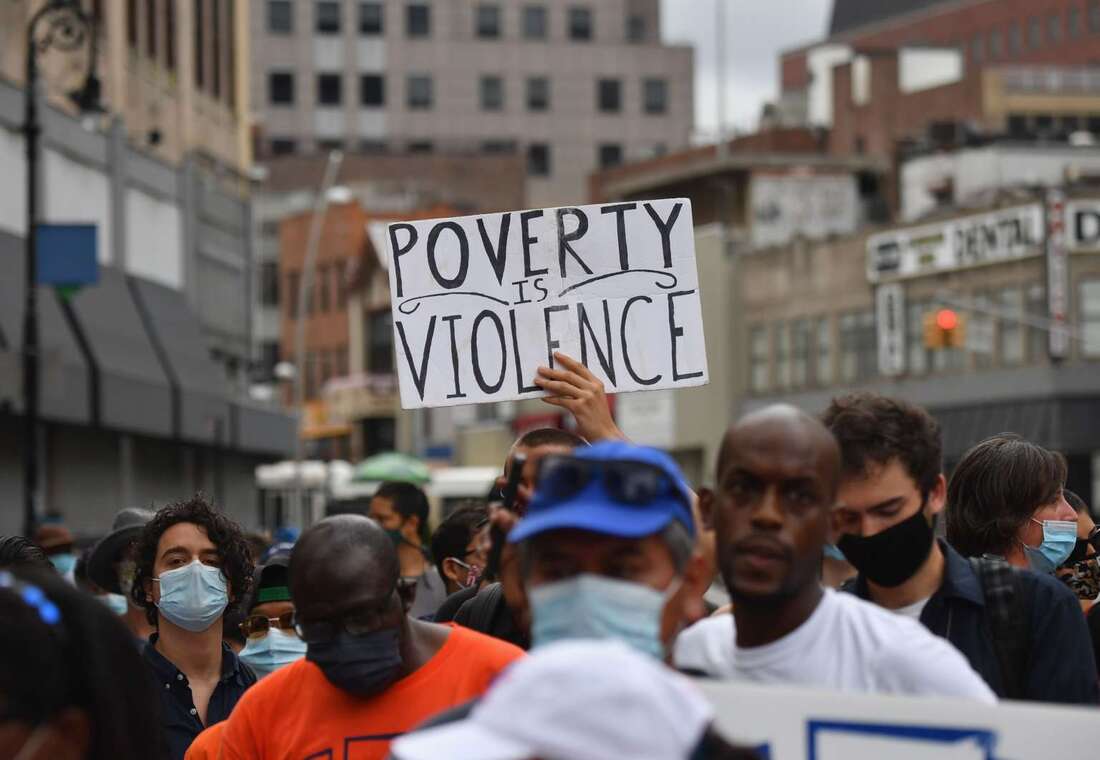
Masked marchers in a city street, one holding a sign reading “Poverty is violence”Protestors demonstrate during a ‘No Evictions, No Police’ national day of action protest against law enforcement who forcibly remove people from homes on September 1, 2020, in New York City. ANGELA WEISS / AFP VIA GETTY IMAGES


Web call for  DSA North Star members.

You are invited to join us for a  Zoom web call with Carl Davidson and Bill Fletcher Jr. to discuss their summing up of the election and the road ahead. 
 
Post Election  Reckoning: New Hypotheses for the Road Ahead.  
Carl Davidson and Bill Fletcher, Jr. 
November 7, 2020
Organizing Upgrade (opens in a new tab)
 
 Call.     
 Dec. 6., 2020.  3 PM Pacific.  6 pm Eastern.
 
      Please read the piece on the NS blog, or on Organizing Upgrade and prepare to discuss the ideas.
    Please read the piece and prepare to discuss it,
After the Election: The Road Ahead

there is a link at the end of the post to continue with the remainder of the piece on Organizing Upgrade. 
 
Also read the statement of the NS Steering Committee.
DSA North Star Steering Committee Statement on the Election and Our Tasks (opens in a new tab). 
 
 
Zoom call in information will be shared 1 day before the webinar - here. 
 
The webinar will include time for discussion and dialogue.  Here are some guides to dialogue when conversing with allies and building an organization.
Dialogue was the heart of the organizing effort of Paulo Freire and others to build a left in Latin America.
 
Dialogue: 

I search for basic agreements.
I search for strengths in your position.
I reflect on my position.
I consider the possibility of finding a better solution than mine or yours.
I assume that many people have a piece of the answer.
I want to find common ground.
I submit my best thinking hoping your reflection will improve it.
I remain open to talk about the subject later on.

Anti-dialogue:
I search for glaring differences.
I search for weaknesses in your position.
I attack your position.
I denigrate you and your position. 
I defend my solution and exclude yours.
I am invested wholeheartedly in my beliefs.
I assume there is one right answer, and that I have it.
I want to win.
I submit my best thinking and defend it to show it is right.
I expect to settle this here and now.
I seek to silence those who disagree with my position. 

Adapted from, Choosing Democracy: a practical guide to multicultural education.  4th. edition. Duane Campbell.  2010.  Allyn and Bacon. 


0 Comments on Post Election Reckoning: A North Star Web Call
It's Over: Democracy Won- This Round !

11/28/2020

 We want to thank the many people who helped us avoid a catastrophic coup !

It looks like the worst may be over. Monday likely was decisive. Trump was handed another legal slapdown in his effort to disenfranchise millions of confirmed voters with evidence-free claims. Local organizing in Michigan pushed-back against wayward electorates — ending with Michigan officially certifying election results. And the General Services Administration officially announced its transition to President-elect Biden.

On that last point, many news sources missed the critical timing. Emily Murphy, the administrator, made the announcement first. She explicitly said she made it without input from the White House. Only after the GSA made its announcement, Trump tweeted that "I am recommending that Emily and her team do what needs to be done." It's the closest to a concession we may ever get.

We started Choose Democracy to be prepared if it was necessary for a national resistance to a coup. As an effort, we're not anti-Trump or pro-Biden. We teamed up across political spectrums to be pro-Democracy and stop a coup. Democracy has been severely tested, and is the worse for wear, but it never reached a breaking point that required a large-scale national mobilization.

We are thankful for the fast-paced local resistance to initial coup efforts. The most dramatic was the organizing work in Michigan after the biggest post-election scandal erupted: two Michigan electorates attempted to thieve millions of votes from majority Black Detroit. Hours of heated testimony organized by mostly black organizers in Wayne County made them switch back (well, before they unsuccessfully tried to switch back again, again).

Michigan's win by organizers was public, but it wasn't alone. From our perspective, one of the biggest stories only got glancing attention: PA's Election Integrity Commission. Before the election, a nebulous commission was proposed by the GOP. It claimed to be prepared to root out fraud. As a GOP-led commission it held the right to subpoena anyone, would start before the election, and, arguably, had the ability to seize uncounted ballots. Organizers on-the-ground — including progressive leftists and moderate Republicans — defeated this effort quietly and quickly. (We look forward to telling more details of these stories!) These and other on-the-ground efforts ahead of time may have proven decisive. Thank you for all the work you did pressuring your own local politicians before the election.

We also want to thank all the groups and people who prepared for severe escalation. We believe these efforts made an impact. As any union organizer will tell you, bosses know when a union is ready for a strike and it is added into the calculation. The hundreds of news articles showing our collective preparation to resist helped — even if we didn't have to follow through this time.

Stopping a coup by a one-off rally is like stopping an army with a pea-shooter. We are thankful to folks who strategized and prepared for more than the same-old tactics. We applaud youth who prepared for a national strike, unions prepping for rolling and general strikes, and those who prepared consumer boycotts to shut down the country.

If we are feeling charitable (and today we are), we might even be thankful that we didn't have a more effective coup effort. The fact Trump was meeting with Michigan Republican leaders this late was a sign of incompetent planning. One reason we maintained such optimism was the coup plotters failed to put together and carry out any organized plan. Jared Kushner was scrounging for a legal team on election night and its legal team never put forward a cogent argument. The political strategy of telling lies didn't translate to political organizing of any coherent approach that would result in Trump staying in office. Ultimately, Trump never seizedpower; he just said he'd stay in power.

This is consistent with Trump's ability to control narrative. He's good at claiming dramatic headlines, poor at the detailed follow-through. A coup in the US is made much harder because political power is widely distributed in local and state governments and courts — and those systems showed their independence from Presidential sway. We want to thank people in those systems who defended that independence — poll workers, election officials, electorates, and all those who kept our election system trustworthy.

We are thankful for those that stood against party line to do the right thing. Despite a polarized climate, a slew of Republicans slapped down Trump's plans. It was a Republican PA judge Matthew Brann who slammed Guliani's legal strategy, rejecting every aspect of their claim. GOP leaders in the state houses of PA and MI explicitly rejected Trump's strategy to endorse alternate state electors — and were true to their word on that. Republican leadershelped kill PA's Election Integrity Commission. Despite pressure, threats to his family, and perhaps a career-ending move, Van Langevelde, a member of Michigan's board of state canvassers and who works for Republicans in the Statehouse, followed the law and voted to certify Michigan's results. And election officials on both sides of the aisles have made clear this was a clean election.

We note this because the polarized rhetoric rarely notes how many people "from the other side" played their role appropriately. Whereas Democratic actors faced no push-back from their base for not supporting the coup, Republicans were tested and faced repercussions.

We will keep being vigilant until this election is over. We are confident Trump will continue with outrageous headline-grabbing behavior (as we drafted this letter Trump grabbed headlines for his tweet to pardon Michael Flynn and a call-in to a PA GOP event doubling down on his claims the election was rigged). We encourage people to reclaim the space Trump has occupied in their heads and not be click-baited by the outgoing commander-in-chief.

We will be offering one more webinar to celebrate and share what we've learned about protecting and strengthening our democracy going forward. Please stay tuned.

There are fundamental issues that need addressing. We witnessed a scorched-earth policy, a mass refusal to push-back on falsehoods, and a withering attack on democracy. It is not going away. The distrust and distortions have taken root in much of the country's psyche. So we thank all of you who are preparing for the fights ahead (even as Choose Democracy fully expects to close shop on January 21st, having done our job on helping stop a coup).

For this weekend, it's okay to exhale.

And so we thank you — supporters, friends, colleagues. Those of you who signed the pledge and did your part to be brave enough to prepare for the worst. This was a big lift held by many people.

Choose Democracy

0 Comments on It's Over: Democracy Won- This Round !

DSA North Star  Steering Committee Statement on the Election and Our Tasks

11/20/2020


North Star Steering Committee Statement on the Election and Our Tasks

A.    Five Takeaways from the 2020 U.S. Election

1.    Increased Turnout

Voter turnout was the highest in more than a century.  About two-thirds of registered voters cast ballots. Despite concerns expressed in the run up to the election that Republicans were registering more new voters, first time voters, almost 1 in 7 of all voters, split for Biden 2:1.  As a result, Biden’s strongest age demographic was voters 18-29 who gave him 60% of their votes.  Overall, Biden lost male voters but more than made up for that by winning female voters.

2.    Who Turned Out to Vote

Black, Latino, Asian American and Native American as well as young voters of all races were mobilized at record levels by volunteer field organizing efforts and energy of grassroots organizations, particularly in swing states.  These groups, with many first time voters, provided the margins of victory for the Democratic candidates in Pennsylvania, Michigan, Georgia, Arizona and Wisconsin, states that supported Trump in 2016. Although Trump kept much of his base of rural, non-college educated white voters, his margins among this group were smaller than in 2016.  In Georgia, progressive Black-led organizations like Black Voters Matter, New Georgia Project and Fair Fight had registered 800,000 new voters, mainly younger voters and people of color. Groups associated with the Georgia Latino Alliance for Human Rights (GLAHR) and the Arizona LUCHA delivered record turnouts of Latino voters.

Progressive often speak of “the Latino vote” or the “POC vote” but this does not reflect on-the-ground realities. This is particularly true for Latinos, who are very diverse and whose voting power is undermined by the archaic Electoral College system that is the U.S. presidential election.  Almost one-third of Latino voters live in California, a (today) reliably Democratic state and have been strongly Democratic for some time.  However, Biden was unable to take Texas, where another one quarter of Latino voters reside as Trump maintained his (minority but still significant) Latino vote share.  And Trump won Florida, whose very diverse Latino vote is divided among immigrants and communities with roots in the Caribbean (including Puerto Rico, Cuba and other), Latin America and Central American.

3.    The Squad Triumphant – and Helping Biden Win Swing States

Two members of the Squad of Left Congressional Democrats were instrumental in driving Democratic voter turnout in the key states of Minnesota and Michigan. Congresswoman Ilhan Omar overcame Trump’s personal Twitter hate vendetta against her as a Muslim born in Somalia and the $10 million campaign funding for her Republican opponent, to win almost 65% of the vote in her race along with an incredible 88% turnout in Minneapolis that helped provided Biden’s margin of victory in Minnesota.  Omar’s campaign featured in-person door-to-door canvassing that the Biden campaign did not do. Congresswoman Rashida Tlaib,  also a Muslim and a DSA member,  focused in Detroit/Wayne County on engaging some 200,000 voters who had not voted in 2016 to ensure her own re-election and help deliver Michigan to Biden.
     
4.    The Campaign Messaging and the Vote Counting

During the Democratic primaries, the (seemingly endless) number of debates had focused on the policy differences and convergences among the large number of candidates. But the presidential election saw very little policy focus—by either party. As many commentators noted, this election was largely a referendum on Trump.  

The national Democratic Party focused its efforts on massive TV advertising trying to persuade suburban swing voters who had voted for Trump in 2016 to vote for Biden and moderate Democratic Senate and House Democratic candidates in 2020.  Biden’s messaging was that he would restore normalcy and decency to the White House and undo the harm wreaked by the Trump administration, which, probably because of the experience of Trump’s four years, made more sense for his own candidacy than Hillary Clinton’s failed “I’m not Trump” campaign did in 2016.  

However, it did not much help down-ballot Democratic candidates, since it failed to deliver a positive or inspiring message to economically distressed former Democratic or independent voters.  Democrats both failed to flip the 10 CDs they  had targeted and lost a few net House seats, mainly of more conservative Democrats; two of the House losses were to Cuban American Republicans in Florida. More importantly and problematic for both the incoming Biden administration and the ability of the Left to win progressive policies, they failed to gain a majority in the Senate.

As noted above, much of Trump’s base support of rural voters, evangelical Christians and traditional Catholics, along with white men in general with less formal education, remained intact.  He campaigned vigorously, ignoring corona virus precautions, and the Republican Party may have done a better job of turning out its voters through social media and direct canvassing than the Democratic Party did.  But, as was the case for Biden, there was little if any policy message, reflecting the frequent cult-like nature of Trump’s support and a sobering reminder of where we find ourselves politically.  He lost the popular vote by more than 6 million and the Electoral College vote by the same margin he won it in 2016. 

Mail in and early in-person voting exploded in 2020 as the pandemic worried many, especially Democratic and independent voters.  For states on the West Coast with long experience of these voting methods, there were very few problems or concerns. That was not the case in many other, especially swing, states and contributed to the drawn-out nature of the final decision.  

The main television media did a fairly credible job of patiently waiting for all the votes to be counted, but Trump and the Republicans are still using right-wing and social media to spread disinformation and discredit the vote count where the final tallies narrowly favor Democrats.  These efforts appear to be foundering. 

5. The Election Heroes

Just as “essential workers” are the real heroes and heroines of the pandemic, postal workers, local and state election officials and volunteers may be the saviors of the tattered framework of American democracy.  Whether Republicans or Democrats, they toiled for many days to ensure that every vote was counted as thoroughly and accurately as possible.   Tens of thousands of Americans rallied throughout the country the day after Election Day to demand that every vote be counted, and a broad coalition of organizations remains on alert to mobilize millions more if Trump and his Republican enablers continue to try to thwart the will of the electorate.

B. The Tasks Ahead of Us

The dancing in the streets, the ringing of the church bells in France and other celebrations after Biden’s victory demonstrate the widespread disgust with Trump and his politics.  But remember that 73 million of our citizens voted for him.  

Today, every responsible organization of the broad American Left is preparing its members and supporters not only to defend democratic rights, but to mobilize to push for a broad progressive agenda, including racial justice, environmental justice, universal health care, immigration reform, and a just and equitable recovery from the pandemic.

Although progressives helped Obama to victory in 2008, the Left was not strong enough to drive an agenda that was other than a return to pre-Great Recession “normality,” and Obama’s vision was limited to that goal.  This was a crisis that went to waste.  

Because of the 2016 and 2020 campaigns of Sanders and the growth of POC (People of color organizations), we are stronger now, although we also face a more mobilized, self-conscious neo-fascist right.   If the Biden presidency is unable to deliver more than some better, and less venal, appointed officials and executive orders reversing some of Trump’s mayhem against immigrants and the environment, it will lose credibility with its supporters.  Substantive improvement is particularly important to retain the commitment of the large segment of voters who turned out for the first time.  We must do all we can to insure that the midterm elections in 2022 do not result in a revival of Trumpist Republican reaction in an even more virulent form.

1. Three Immediate Tasks

The first immediate priority has to be remaining vigilant against a “soft coup” aimed at keeping Trump in the White House. The second, a definite long-shot, has to be a last-ditch attempt to block a Republican majority in the Senate.  With two Senate seats at stake in January 2021 run-off elections in Georgia, victories of the two Democratic candidates would knot the Senate at 50 Republicans/50 Democrats, with Vice-President Kamala Harris breaking the ties.  That result would not only ease the stranglehold on the legislative process currently exerted by Mitch McConnell’s Republican majority, it also would make it more difficult for the Democratic Party to claim it is not responsible for failing to enact progressive reform legislation.

An equally important task is to combat the right-wing effort, led by Trump and his GOP minions, to delegitimize the election results.  They may not be successful in reversing the outcome, but their goal is also to constrain or even eliminate the ability of Biden and Harris to govern.  They seek to do this both institutionally by making obstruction the primary function of the senate and culturally by casting doubts in any way shape and form possible on the reality of the election outcome.  This despite the growing gap in the popular vote where Biden’s lead has grown to more than 6 million votes and may approach 7.5 million by the end of the vote count.

2. The Intermediate Term Tasks

As we argued above, the Left must work harder than we ever have before, to avoid another crisis going to waste.  And, surprisingly enough, Biden’s first post-election policy speech has told us exactly where to focus our time and energies.  He articulated four priorities for the incoming administration: economic recovery, combatting COVID-19, racial justice and climate change.  

Importantly, Biden’s economic and health advisors understand that numbers one and two are not either/or; they are possible only as both. No success against COVID-19 = no economic recovery for the majority of our people.  We must pressure—whether by contacting our legislators, organizing in our communities or agitating in the streets—for an economic package that includes direct payments to working people, a national testing and tracking regime, a coherent plan for distributing whatever vaccine(s) become available and funding for state and local governments. A major reason for the very slow recovery from the Great Recession was the failure to provide the last piece in this legislation.  And the resulting slow return of jobs and public services in part nourished Trump and Trumpism.  

The Left must play a key role in demanding that a Covid-19/economic recovery plan prioritizes the needs of the most vulnerable communities and persons, especially African-Americans, Latino/a, Native Americans and immigrants.  

In the next period it may be the area of climate change where there are the most openings for the Left.  Although Trump and his minions have clung to the “climate change is a hoax” meme, that has lost ground, even among self-identified Republicans.  It has also lost ground among members of our economic elite, and there are state governors and legislatures that now take climate change seriously. Late and too little, but the ground is being laid for an energy regime transition.

Although the Biden administration will be able to use executive orders to undo some of the worst regulatory damages done by the Trump administration, it is not likely to advocate or enact a sweeping Green New Deal program adequate to the scale of the emergency. We will fight for a major national  infrastructure program that creates millions of good unionized jobs through renewable energy and retrofitting public and private housing.  However expanding the positive and exemplary role of state and local governments  will be a crucial arena for the struggle for environmental justice that prioritizes vulnerable communities.

3.    A Final Consideration

We didn’t fall over the precipice as a victorious re-election of Trump would have represented, but we remain too close to the rim of destruction for U.S. democracy.   Democratic socialists defend democracy in order to deepen and extend it further so that the broad working class has more decision-making power.  It is sobering to note that a majority of white voters still voted for an incompetent, egocentric demagogue who demonized immigrants and Blacks to try to maintain power.  If Trump had not blundered so egregiously by denying the pandemic, he might have been re-elected despite his low approval ratings.

Democratic primary voters and Democratic Party leaders played it safe with Joe Biden, with the resulting lack of any ambitious reform program articulated during the campaign.  The restoration of the Obama era message worked—just.

At best, with the 2020 election we barely escaped from the beaches of Dunkirk.  We remain too distant from D-Day.

Statement authored by members Paul Garver and Bill Barclay at the invitation of the NS Steering Committee. Statement is by the NS Steering Committee.

Comments are welcome.


6 Comments on DSA North Star  Steering Committee Statement on the Election and Our Tasks

Trump Defeated- But Trumpism Rages On

11/17/2020

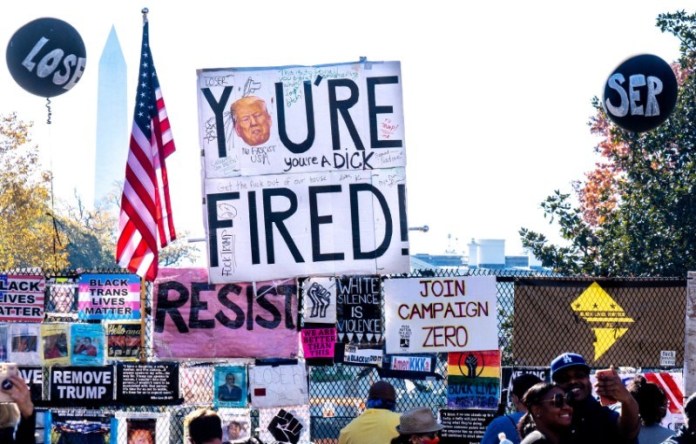
Protest signs on the fence outside the White House, including “You’re fired!”, “Resist” and “Remove Trump”Victoria Pickering

While Trump plots, Democrat Joe Biden looks set to take over in the White House. How did the Democrats win the poll and how influential will the socialist left be? 

Paul Garver on the takeaways from the US elections

At about 70%, the overall voter turnout was higher than the normally miserably low US standard. Black, Latino, Native American and young voters of all races were mobilised at record levels by volunteer field organising efforts and the energy of grassroots organisations in the key battleground states, providing the margins of victory for the Democratic candidates in Pennsylvania, Michigan, Georgia, Arizona and Wisconsin, all of which had supported Trump in 2016. In Georgia, progressive Black-led organisations like Black Voters Matter and the New Georgia Project had registered 800,000 new voters, mainly younger voters and people of colour. Groups associated with the Georgia Latino Alliance for Human Rights (GLAHR) and the Arizona LUCHA delivered record turnouts of Latino voters.

Two members of the ‘Squad’ of left Congressional Democrats were instrumental in driving Democratic voter turnout in the key states of Minnesota and Michigan. Congresswoman Ilhan Omar overcame Trump’s personal Twitter hate vendetta against her, as a Muslim born in Somalia, and the $10 million campaign funding for her Republican opponent, to easily win her own re-election in Minneapolis with an incredible 88% voter turnout that helped provide Biden’s margin of victory in Minnesota. Omar’s campaign featured person door-to-door canvassing that the Biden campaign did not do. Congresswoman Rashida Tlaib (also a Muslim and a DSA member) focused in Detroit/Wayne County on engaging some 200,000 voters who had not voted in 2016 to ensure her own re-election and help deliver Michigan to Biden.

The national Democratic Party focused its efforts on massive TV advertising, trying to persuade suburban swing voters who had voted for Trump in 2016 to vote for Biden and moderate Democratic Senate and House candidates. Biden’s messaging was that he would restore normalcy and decency to the White House and undo the harm wreaked by the Trump administration. This message made more sense for his own candidacy than Hillary Clinton’s failed “I’m not Trump” campaign did in 2016. However, it did not much help down-ballot Democratic candidates, since it failed to deliver a positive or inspiring message to economically distressed former Democratic or independent voters. Democrats lost a few net House seats, mainly of more conservative Democrats, and failed to win a majority in the Senate.

Trump’s base support of rural voters, evangelical Christians and traditional Catholics, along with white men in general with less formal education, remained substantially intact. He campaigned vigorously, ignoring coronavirus precautions, and the Republican Party did a better job of turning out its voters through social media and direct canvassing than the Democratic Party did. By the time all the votes are counted, the Republican vote count will exceed that of 2016. However, Trump still lost the popular vote by a large margin and the electoral vote more narrowly, due to the unusually large turnout of Black, Latino, young and big city voters.

The widespread use of mail-in ballots and early voting due to the pandemic encouraged overall voting turnout, probably helping Democrats, but confused the counting of the votes themselves. More Republicans voted on election day itself, suggesting that Trump would win key states like Pennsylvania, before the mail-in ballots were counted. The main television media did a fairly credible job of patiently waiting for all the votes to be counted, but Trump and the Republicans are still using right-wing and social media to spread disinformation and discredit the vote count where the final tallies narrowly favour the Democrats.

Just as “essential workers” are the real heroes and heroines of the pandemic, postal workers, local and state election officials and volunteers may be the saviours of the tattered framework of American democracy. Whether Republicans or Democrats, they toiled for many days to ensure that every vote was counted as thoroughly and accurately as possible. Tens of thousands of Americans rallied throughout the country the day after Election Day to demand that every vote be counted, and a broad coalition of organisations remain on alert to mobilise millions more if Trump and his Republican enablers continue to try to thwart the will of the electorate.

The dancing in the streets after Biden’s victory became evident was justified. However, every responsible organisation of the broad American Left is preparing its members and supporters not only to defend democratic rights, but to mobilise for a broad progressive agenda, including racial justice, environmental justice, universal healthcare and a just and equitable recovery from the pandemic. We do not intend to repeat the demobilisation of the progressive movements that occurred after Obama won the presidency in 2008. If the Biden presidency is unable to deliver more than some better or less venal appointed officials, and executive orders reversing some of Trump’s mayhem against immigrants and the environment, it will lose credibility with its own base supporters. The midterm elections in 2022 might then result in a revival of Trumpist Republican reaction in an even more virulent neo-Fascist form.

If one immediate priority has to be remaining vigilant against a ‘soft coup’ aimed at keeping Trump in the White House, the second has to be a last-ditch attempt to block a Republican majority in the Senate. With two Senate seats at stake in the January 2021 run-off elections in Georgia, a Democratic double victory would knot the Senate at 50 Republicans/50 Democrats, with Vice-President Kamala Harris breaking the ties. That result would not only ease the stranglehold on the legislative process currently exerted by Mitch McConnell’s Republican majority – it would make it more difficult for the Democratic Party led by Biden to claim a lack of responsibility for advancing progressive reform legislation.

Within days after the election, conservative Democrats were blaming their losses in the House of Representatives on advocacy of “socialist” issues like the Green New Deal and Medicare for all, and on advocacy for defunding the police and Black Lives Matter. Members of the Squad, and their supporters like the Justice Democrats, blamed the losses on the Democrats’ lack of a compelling progressive economic message like a Green New Deal jobs programme, and on the failure of some Democratic candidates to make effective use of social media and direct contact with voters. That debate will continue within the Democratic Party for years to come. In the long run, even if it wins some elections, a weak, centrist and vacillating, Republican-lite Democratic Party cannot compete ideologically with a virulently right-wing Republican Party that rejects any reasonable compromises to further a multiracial, working class agenda that is favoured by the base supporters of the Democratic coalition.

A final consideration: whereas we did not fall over the precipice that a victorious re-election of Trump would have represented, we still remain too close to the rim of destruction for US democracy. Democratic socialists defend democracy in order to deepen and extend it further so that the broad working class has more decision-making power. It is sobering to note that a majority of white voters still voted for an incompetent, egocentric demagogue who demonised immigrants and blacks to try to maintain power. If Trump had not blundered so egregiously by denying the pandemic, he would likely have been re-elected.

The Democratic Party played it safe with Joe Biden by running away from any ambitious reform program other than restoration of the Obama era. Biden eschewed any commitment to pursue fundamental reforms. Yet the threats posed by climate catastrophe, growing economic inequality and racial injustice are growing not diminishing in scale and urgency, and call for decisive actions.

At best, with the 2020 election we barely escaped from the beaches of Dunkirk. We remain too distant from D-Day.

reposted from
https://www.chartist.org.uk/trump-defeated-but-trumpism-rages-on/

Note; British spelling of terms like Organize, mobilize, are not corrected.

0 Comments on Trump Defeated- But Trumpism Rages On

After the Election: The Road Ahead

11/14/2020

Post-Election Reckoning: New Hypotheses for the Road Ahead
By Carl Davidson and Bill Fletcher, Jr.

Hypothesis No. 1. One cannot understand this election unless one begins with a recognition of voter suppression:  Since 2008, the Republican strategy has increasingly focused on voter suppression.  The weakening, if not evisceration, of the Voting Rights Act was one significant piece of that. In the lead up to 2020 the Republicans, under Trump, have pushed this further by undermining the basic right to vote; making it more difficult; encouraging intimidation; undermining the U.S. Postal Service, long voting lines, fewer polls in Black neighborhoods, and so on.
 1.1 Thus this election was about racism and revanchism:  The politics of this race do not make any sense unless one factors in racism and revanchism, the seeking of revenge. The Trump message of allegedly keeping America great, was a message against traditionally marginalized populations, including but not limited to African Americans, non-immigrant Latin@s, women, and immigrants from the global South.  Trump continued to stoke fear among whites, while also playing to “colonial mentality” among some populations of color. His message to Latin@ immigrants seemed to imply that a vote for him was a vote for them having the chance of becoming ‘white.’ But the election was about a broader sense of revanchism. There was anti-communism aimed at Cuba and Venezuela.  It was also a revanchism aimed at shifting gender roles.

THERE IS A RIGHT WING MOVEMENT

Hypothesis No. 2. There is no doubt that there is a right-wing mass movement:  Much of the U.S. Left has attempted to deny or equivocate on the existence and strength of the right-wing populist movement.  One can no longer debate this. This movement exists and it has an armed wing. Along with overtly fascist groups in its core. It is a movement against the 20th century victories of progress. The fact that anyone could be convinced that Biden was a socialist not only illustrates the irrationality of the movement, but also should remind us that Sanders would not have had it any easier had he been the nominee. The right-wing movement sees any progressive reforms as equaling socialism. While many on the Left have fallen into the trap of thinking or wishing that were true, we must be in touch with reality and recognize that reforms under democratic capitalism do not equal socialism.

2.1 The Trump vote was a vote against reality:  This is one of the most difficult conclusions from this election. In the face of the worst global pandemic since 1918-1919; one in which the total incompetence of the Trump administration has been on display, millions were willing to live in absolute denial, many of them continuing to believe that COVID-19 is nothing more than a bad flu. This rejection of reality translates into other areas including, but not limited to, racial relations, foreign policy, and the environmental catastrophe. This is a movement whose slogan really should be the closing line of the comedian George Wallace who would say:  “That’s the way I see it, and that’s the way that it ought to be.”

2.2 Every vote must be counted: In the context of massive voter suppression, every vote must be counted, whether the vote was offered in person, through the mail or in drop-boxes. There is no Constitutional reason that a vote count should be stopped.

2.3 There is no monolithic Latin@ vote; there are Latin@ voters: The election results illustrate that there is no cohesive Latin@ vote. The Puerto Rican vote in Florida, for instance, bore absolutely no resemblance to the Cuban or Venezuelan vote. The reasons that various populations have come to the U.S.A. and the class character of many of those who have arrived here, have helped to shape their politics. Trump played to the fear among many Floridian Latin@ immigrants regarding socialism and communism. That did not work so well with Puerto Ricans. They also played to social conservatism among Chican@ voters in Texas. Though this was shrewd politics on Trump’s part, we on the Left must not fall into the trap of believing that there is a monolithic population out there. That said, the Democrats made a significant error in their work in Florida and Texas in not putting greater resources into reaching and mobilizing Latin@ voters.

ASSESSING THE DEMOCRATIC PARTY CAMPAIGN

Hypothesis No. 3. The main problem in this election was not the Democratic Party leadership; the strategic situation has become far more complicated:  There are already those on the Left who believe that the main problem in this election was the leadership by the Democratic Party establishment. While there were many errors made, including the matter of polling (which needs to be studied in order to understand the errors), and insufficient support and vetting of statehouse candidates, (no gains were made) to a broader array of mass initiatives, the explanation for why there were not greater victories in the election cannot be dropped simply on the D.P. The factors noted above are far more significant, especially the power of right-wing populism at the base.  That said, there must be major changes made, including a DP rural organizing project, continuous outreach, stronger organization at the county level, and support of electoral efforts among traditionally marginalized groups (including but not limited to African Americans and Latin@s). Though the D.P. platform was probably among the most progressive in D.P. history, the party must champion a progressive, populist message that is both anti-neo-liberal but also anti-right-wing populist. This is a critical fight to wage within the D.P., and it’s one that will strengthen the Bernie-inspired forces at the base over the Third Wave centrists.

3.1 This is a moment where we must initiate a mass campaign of “one person, one vote”:  The Electoral College was created in order to support the slave-owning states and to limit the strength of the nation-state. It is an archaic institution that must be brought to an end. In almost any other country on this planet, the person who receives the most votes wins…period. Our reliance on the Electoral College means that, in effect, only certain states really matter. The struggle for “one person, one vote” needs to be a national campaign for the expansion of democracy. This includes alternative methods for allocating votes, e.g., proportional delegates rather than a state committing all of its delegates to the top vote getter, as well as new and concrete efforts to undermine voter suppression.

“MOVEMENT BUILDING”?

Hypothesis No. 4. We need to think through this election in a wider context of ideas related to strategy and tactics. We can start with ‘movement-building.’

4.1 ‘Building a Movement’ is a flawed concept. But you can find it at the end of nearly every article or speech. It appears so often that it has more uses than aspirin as a cure for our ills. But we need to set it aside, or get a deeper understanding. Why? Because we don’t build them. Mass movements are largely built by capitalist outrages inflicted upon us, and capitalism will continue to do so, whether it’s another police murder, and invasion abroad, or a poisoning of a city water system. At most, we can fan the flames, which is fine but secondary. Our real task is to build organizations and campaigns within mass movements.

Read more. (opens in a new tab)
https://organizingupgrade.com/the-post-election-reckoning-new-hypotheses-for-the-road-ahead/?

0 Comments on After the Election: The Road Ahead

North Star  Caucus Strategy Worked Well in the Election

11/12/2020

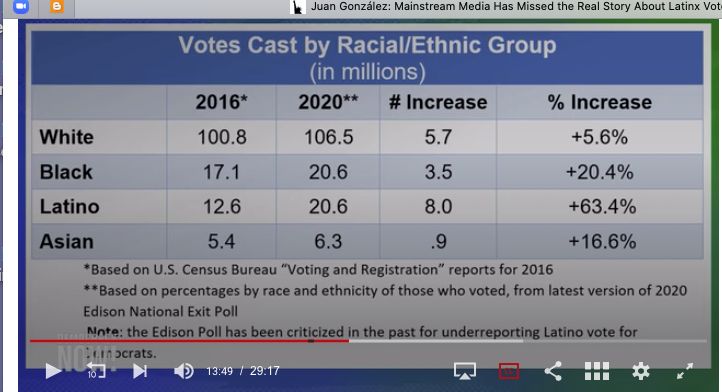
Table: votes cast by racial and ethnic group, in millions. White: 100.8 in 2016, 106.5 in 2020, an increase of 5.7 (5.6%). Black: 17.1 and 20.6, an increase of 3.5 (20.4%). Latino: 12.6 and 20.6, an increase of 8.0 (63.4%). Asian: 5.4 and 6.3, an increase of 0.9 (16.6%). 2016 figures are based on U.S. Census Bureau voting and registration reports; 2020 figures on the latest Edison National Exit Poll, which has been criticized in the past for underreporting the Latino vote for Democrats.
The North Star Caucus came into existence to advance a practical democratic socialist politics within DSA. The 2020 election clearly revealed the value of this approach and the caucus.

We first advanced a position on voting to defeat Trump and Trumpism in one of our resolutions to the 2019 DSA convention.
 
"Whereas, our first priority is the electoral and political defeat of Donald Trump, the Trumpist Republican Party and all of the authoritarian forces aligned with them. The white nationalist authoritarianism of Trumpism poses a ‘clear and present danger’ to working people and their unions, to people of color, to women, to LGBTQIA people, to immigrants, to members of minority religious faiths and to democracy itself. Trumpist victories in the 2020 elections would mean the consolidation of an authoritarian state with the most reactionary politics, the expansion of imperial aggression abroad and the collapse of the political space for democratic and left forces at home. The defeat of Trumpism is thus a strategic imperative, the most important political task of our time."
 
Our position did not get consideration at the convention, competing views won out.
 
We then developed an effort to advance this position as an educational and activist campaign within the broad left.  We organized this petition that was published in the Nation and circulated broadly.
To Defeat Trump (opens in a new tab)
 
“We, the undersigned democratic socialists, want to make clear that the priority for the left in 2020 should be the electoral defeat of Donald Trump and the Trumpist Republican Party in November. At present, the only way to accomplish that will be to vote for his Democratic opponent.
The racist, xenophobic, misogynist authoritarianism of Trumpism poses an immediate existential danger to people of color, to immigrants, to reproductive rights, to trade unions, to LGBTQIA people, to Muslims, to Jews, to members of other religions, and to democracy itself. A Trump victory would fortify our authoritarian State, expand imperial aggression, and collapse the political space for democratic and left forces at home. Reversing the creeping neo-fascism at play in our country is a strategic imperative, the most urgent political task before us.”
 
The obvious facts  in the nation, on the  electoral ground, led thousands of left organizers, union leaders, political activists and citizens to adopt similar emphases.

My conclusion is that the effort of North Star Caucus provided leadership in developing a democratic socialist position in the election.  Good work to all.

Additional notes.  Newsperson Juan Gonzalez provides an important critique of main stream media’s coverage of the Latino Vote.
https://www.youtube.com/watch?v=tIrr4Ka6KAg&feature=emb_logo


and provides this graphic.


Duane Campbell,
North Star Caucus.  DSA. 


0 Comments on North Star  Caucus Strategy Worked Well in the Election

Georgia's Blue?  Understanding the vote is Critical.

11/11/2020

Jose Perez,

A lot of people are scratching their heads and wondering, how did Georgia wind up Blue in the electoral college maps while Texas, North Carolina and even Florida remained red?

There are undoubtedly many factors to take into account, but at least in Georgia, I believe the difference came from two extraordinary women political leaders who inspired the sort of grass-roots, from below organizing work that leads to permanent change.

One is Stacey Abrams, who everyone has heard of, the Democratic candidate for governor in 2018 who established the New Georgia Project (in its various incarnations).
 
The other is Adelina Nicholls, who almost no one has heard of, and is the founder and executive director of the Georgia Latino Alliance for Human Rights (GLAHR). 
 
Yes, Stacey Abrams is, in a sense, more significant, for her ties are to the much larger Black community. But as we say in GLAHR, "Aquí estamos y nos nos vamos," we're here and we're not leaving, and this year, we Latinos have made ourselves felt. 
 
I have not an ounce of doubt: we pushed Biden over the top. Yes, we stood on the shoulders of a giant, the Black community, and proudly so, and so we flipped the state from red to blue. 

It is not a question of who deserves more credit, but of what together we can accomplish.
 
The activist movement associated with GLAHR (GLAHR itself is a 501c(3) non-profit and was not directly involved in many phases of this) targeted suburban Atlanta's two main (until now) Republican-dominated counties for a sustained campaign beginning with voter registration and culminating with dozens of election defender teams at polling places on  November 3. 
 
For the Latino movement, the central objective of the overall campaign was NOT electing Biden but knocking out the 287G "polimigra" programs which are authorized by the elected sheriffs of the two counties. 
 
Key in that was defeating the Republican candidates for Sheriff, one an incumbent, the other the chief deputy of the retiring office holder.

In that, GLAHR made an alliance with activists from SONG (Southerners on New Ground), and people activated by the BLM upsurge this summer. 

Because of Covid-19 and my age (I'm 69), my participation has been limited to the streaming show GLAHR folks do every day, otherwise. I've been mostly observing from the sidelines while this has been going on But these activists conducted a year long campaign and in the decisive phase this fall, knocked on 120,000 doors in Cobb and Gwinnett. If you want to see the biggest vote total shifts in Georgia, go look at those two counties and compare them to 2016.
 
But of tremendous importance to the Latino community, both counties elected candidates for sheriffs that are pledged to stop 287G, the program that creates a direct pipeline to deportation from a county jail where people can be booked for nothing more than a traffic ticket.

Although various Latino groups are claiming they did all sorts of things in Georgia, so many thousands of phone calls and tens of thousands of texts, that  I know of, no one else was on the ground in Georgia knocking on doors and talking to people apart from Stacey Abrams' and Adelina's movements. And if you're questioning the reality of what I'm saying about the Latino activist side of this, on this facebook page you can examine the receipts (opens in a new tab).

And as for South Georgia, the only group that I know of who also did door-knocking GOTV there were the activists from GLAHR's local "Comités Populares." 

Various reports have highlighted the role played by the campaign against Sheriff Joe Arpaio in Maricopa County (Phoenix & metro area) in leading to this year that state going blue.
 
But people are not aware that the same idea has been followed in Georgia. Which is, of course, no coincidence. Because many leaders of both the Georgia movement and the Arizona movement are part of Mijente, which grew out of the "not one more" campaign aimed at deporter-in-chief Barack Obama in the last years of his administration. 

Some people say that we in Georgia followed AOC's call for "deep canvassing," going out and actually talking to people, and not just buying ads on TV and sending mailings. Others noted that we've been following what Brazilian Paulo Freire taught more than a half century ago in his book, Pedagogy of the Oppressed.

I hope some day soon some progressive national media will come down to Georgia and present to the country a more complete picture of this extraordinary victory.

Bernie Sanders: Why Is Georgia So Important?

In battlegrounds like Wisconsin, Michigan and Georgia young voters very strongly supported Biden and other Democrats. In Georgia, for example, 90% of young black voters and 62% of young white voters chose Biden over Trump. And that made all the difference not only in winning that state for Biden, but forcing two Republican senators into runoff elections that will determine which party controls the U.S. Senate. One of the candidates in that runoff election is Reverend Raphael Warnock, whom we strongly supported.

Bernie Sanders 
Turning Arizona Blue: On the Ground in Maricopa CountyThe heroes of this election season are the millions of citizen volunteers who texted, phoned and post carded, but perhaps the biggest contribution nationally was the work of the beleaguered HERE which lost 80% of its members due to COVID impacts. 

portside.org/2020-11-09/turning-arizona-blue-ground-maricopa-county (opens in a new tab)https://portside.org/2020-11-09/turning-arizona-blue-ground-maricopa-county
 
Georgia on My Mind:
Next stop is Georgia. Let’s make sure that Biden is not tempted to “Reach Across the Aisle” to make deals with Mitch McConnell. January 5th in Georgia we will have the chance to flip two Senate seats and create a 50-50 Senate with Kamala Harris casting the deciding ballot! All eyes are on Georgia, and all hands need to be on deck to flip both those seats. Georgia activists may not want Yankee carpetbaggers, but they will want texting, phoning, post carding and money. And hopefully this time labor unions will all unite to bang the doors. If volunteers for the doors are needed, my bags are already packed!
Peter Olney is retired Organizing Director of the ILWU. He has been a labor organizer for 40 years in Massachusetts and California. He has worked for multiple unions before landing at the ILWU in 1997. For three years he was the Associate Director of the Institute for Labor and Employment at the University of California.


1 Comment on Georgia's Blue?  Understanding the vote is Critical.

Welcoming president biden

11/8/2020

By Max B. Sawicky

MetroDC DSA

I’m seeing a bunch of lefty “O.K., now let’s go after Joe Biden.” I expect to be in that game myself, but some preliminary cautions are appropriate. At the very least, shouldn’t we hold back criticism until some proposals are rolled out? Some of them will be in the form of trial balloons, which can be shot down as needed. Others will be more forthright. In either case, our brickbats should be substantive.

The fate of Senate races in Georgia will of course be enormously consequential, but they don’t make as much difference when it comes to our longer-term aspirations. Whether or not the Senate ends up even (with Vice President Kamala Harris holding the tie-breaking vote), our vision for social transformation is the same. What is different will be the short-term bargaining situation.

One thing to avoid is binary, all-or-nothing responses. For instance, Biden will propose to expand coverage under the Affordable Care Act. Rejecting any such proposals because they are not “Medicare For All” would be unwise. The convenient and inconvenient thing about health care is that it is infinitely divisible along a continuum. There are always ways to get a bit more, or a bit less. Of course we should demand more than what we expect to get in the end. On the surface, there is nothing wrong with the M4A slogan.

Even so, Medicare For All is an empty box. I’m on Medicare, and I can assure you that in its present form, by itself, it is woefully inadequate as health insurance. M4A proposals in Congress substantially expand Medicare benefits and coverage. With a hostile Senate, expansion of Medicare will be daunting. It will also be a potent political demand. M4A will come to signify universal coverage, something hard to reject for Republicans who are up for election in 2022.

The Biden plan will put a ceiling, at least in the short term, over what is possible. Any such cap is — should be — vulnerable to criticism. Ironically, the more intransigent a Republican Senate could prove to be, the more flexibility it lends to the side of full-blown M4A. If McConnell refuses to deal and keeps his people in line, then there is no incentive to noodle with compromises. If the Senate isn’t blue by January, M4A can make it so in two years.

Aside from genuinely popular initiatives of the sort introduced by Bernie Sanders, Biden has another source of leverage: executive decisions that do not require legislation. Threats on this front might motivate some stray Republican votes on measures that do require legislation. We have every right to expect a blizzard of executive orders that fill the hopper and will be ready to go, the day after the inauguration. The other immediate priority is another Covid/recession relief measure, since anything negotiated with Mitch McConnell and Trump prior to January 20th is likely to be inadequate.

Two things worry me the most.

One is a return to the old-time religion of deficit reduction. Most Democrats have wised up to the political chicanery embodied in this issue. Republicans care about deficits when it comes to Democratic proposals, never when it comes to their own. The problem is, some Democrats, including some liberal economists, still think the national debt is a Problem. Like Obama, Biden might be gulled into some kind of ‘grand bargain’ that entails cuts in Social Security and Medicare and tax increases. It will be marketed as “Saving Social Security.” Such a decision would certainly lead to disaster in the next midterm elections, as did similar decisions by Bill Clinton in 1994 and Barack Obama in 2010. It would also pave the way for Trump: The Sequel in 2024.

The other thing that bothers me is the prospect of Biden returning to the traditional, bipartisan posture of U.S. world policeman hegemony that leads to debacles in Libya and Iraq. The flashpoints include North Korea and Iran. I count the latter as less likely since Biden would probably resurrect the agreement with Iran made by Obama. But by and large, this is an appetite that is never satiated. Ironically, Trump’s signal contribution to the national well-being lay in his aversion to any such grand-scale projects. His violence was focused on defenseless drone victims in the Middle East and desperate asylum seekers at the U.S. southern border.

One tip-off will be the new administration’s plans for the military budget. The need for the “empire of bases” or the ability to fight a couple of ground wars has never seemed less persuasive. The most evident threats to U.S. national security would seem to be in cyberspace, where meddlesome state actors and potential terrorists communicate.

0 Comments on Welcoming president biden

Dealing With Fear and Trump

11/2/2020

Many of us are finding ourselves quite apprehensive, even fearful, because of what is happening with the 2020 elections and in American political life. There is value, I want to argue, in taking a moment to analyze those feelings, the role they play in the elections and what we can do about them. I will offer some practical recommendations on that front at the conclusion of this post.
 
We generally find it difficult to talk about our feelings in public forums, but they are far from a purely private matter: they are a vital element of politics, because they influence in powerful ways what is important to us and how we act on what is important. To the extent that we are self-aware of the political sources and political impact of our feelings, we are more effective political actors. A sound political strategy accounts for the emotional dimension of politics, and chooses political interventions with them in mind.
 
So let us start with this public acknowledgement: we – those of us on the broad progressive left – are terribly anxious, and we are deeply fearful. We hear it in each other’s voices when we speak, we see it in each other’s faces on Zoom and when we meet in person, and we read it in each other’s words on social media.
 
There are good reasons why we have these feelings. You don’t need me to recite the ways in which Donald Trump has undermined democratic institutions and norms and promoted racial hate and division over the past four years. Today, it is painfully obvious that in his bid to hold on to power, Trump is prepared to violate the most fundamental principle of democracy – that the people chose who will govern through free and fair elections. The stakes in the election are nothing less than the survival of American democracy. That has to be worrisome.
 
Let’s delve into the emotional dimensions of this Trumpian moment. Like other demagogues of the authoritarian right, Trump trades primarily in two political emotions – fear and ressentiment. The latter term is drawn from social science and philosophy, where it is used to describe resentment and hostility directed toward marginalized ‘outgroups’ that are scapegoated as the cause of various economic and social ills. In his appeals to his base, Trump weaves these two emotions together in the form of fear and ressentiment directed at the ‘other,’ with the most frequent targets being along the lines of race – Latinos, African Americans, Muslims, immigrants and refugees. During the election campaign, these emotions have become the foundation of increasingly unhinged conspiracy theories that the Democrats are controlled by violent radicals looking to overturn the entire social order. In this Trumpian narrative, Democrats are forcing these ‘others’ on the America of “Make America Great Again,” that old world in which marginalized outgroups knew their ‘proper place’ as subordinates. Trump’s embrace of the Proud Boys and the QAnon conspiracy theorists is only the clearest manifestation of this approach.
 
Progressive appeals to solidarity and the common good are based on contrary emotions, hope and empathy instead of fear and ressentiment. Trump is not going to convince us that we should be fearful of racial ‘others.’ But that does not mean that we are unaffected by Trump’s manipulation of emotions. Trumpian discourse is designed to stoke fear amongst us – a different fear than that fueled by Trump in his base, but a real fear nonetheless. Trump knows full well, for example, that his support of white supremacists and neo-Nazis, his incitement of the Proud Boys and the QAnon crowd, makes us fearful of what they will do. He wants us to be fearful, because stoking fear in one’s democratic opponents can produce a number of political effects. If we allow it, fear can demoralize and even intimidate us. Fear can paralyze us. When we act out of our fears, we don’t think as clearly and logically as we might. Fear can induce the ‘flight or fight’ response, in which our body’s physiology seizes control of us.
 
But when we understand that our fears are being stoked for political purposes, there are ways to counter it. Here are the three practical ways.
 
First, constructive action directed at the source of our fears is central to overcoming the sense of being overwhelmed by them. Our task through Tuesday, November 3 is clear: get as large a vote for Biden-Harris as possible. The bigger and more decisive vote, the more total and decisive the political defeat of Trump and Trumpism, and the more diminished the room of maneuverability in attempts to overturn the election results. YOU can be involved. I am heading up to Philadelphia for the next two days, but the upside of an election in a pandemic is that you don’t need to do that: you can play a positive role from your living room, making calls and texts. My union, the American Federation of Teachers, has an app (AFT Votes) you can download or a website you can go to (https://www.aftvotes.org/) that provides a number of ways you can volunteer to win this election. Other unions provide the same opportunities. There are a multitude of organizations out there – Working Families Party, Our Revolution, Indivisible, Move On, Warren Democrats – that will happily involve you in this work. (I know because they all text me several times a day asking me to volunteer. {-;) Doing this will make you feel better, and it is the best way to stop Trump in his tracks.
 
Second, DO.NOT.PANIC. Understand what will happen the evening of election day. There has been a massive, entirely unprecedented early vote in this election. For example, the number of Texans voting early has surpassed the entire number of 2016 votes in that state by 700,000. This early vote has been strongest among the solid majority of the population which is supporting Biden-Harris. This means that the election day vote may be more favorable to Trump. Since the election day vote is counted first, Trump could well have an early lead on election night expect that in battleground states such as Pennsylvania. But as the early votes are counted, that lead will disappear and Biden-Harris will win handily. Trump’s strategy will be to announce victory based on these early results, and then create chaos and call upon the courts to stop the counting of the rest of the votes. If we react to his announcements out of fear, we will be biting on his bait. We must win the narrative on Tuesday night and for the remainder of the count, which will take days at a minimum. #COUNTEVERYVOTE must be our mantra until every vote is counted.
 
Third, there is a very real possibility that Trump and his enablers will attempt to overturn the results of the popular vote, by one means or another. If that is the case, we will need to defend the popular vote and American democracy in the streets with non-violent, mass protests. Trump and his neo-fascist supporters will attempt to use fear to intimidate us from protesting. But we can do what we must while taking sensible precautions for our safety. First, the best way to make protesting safe is to put millions of Americans into the streets: the greater our numbers, the harder it will be to suppress a democracy movement. Second, we need to organize our protests in ways that make it possible to look out for each other. We should not be going to protests as individuals, but in organized groups, with those we know and trust – family members; our unions; our churches, synagogues and mosques; our neighborhoods; and so on. Teachers should create affinity groups with those you know and trust in your schools; health care professionals with those in your hospitals and clinics; state and local government workers with those in your workplaces. Plan to meet up in advance and stay together throughout the entire protest. When protests are organized internally in this way, it is much easier to maintain discipline and keep the focus on their purpose, and to isolate individuals who come to disrupt. Democracy movements that succeed take this organic form, building on the relationships of trust ordinary people have with each other.
 
Only “we the people” can save American democracy. And to do so, we must  overcome the efforts to use our fears against us. Franklin Roosevelt may have indulged hyperbole when he said that “the only thing we have to fear is fear itself,” but he was certainly right that our refusal to respond to attempts to instill fear in us is the foundation of a democratic politics.
 
 
Leo Casey
Executive Director
Albert Shanker Institute
555 New Jersey Avenue N.W.
Washington, D.C. 20001
 
See post below.

1 Comment on Dealing With Fear and Trump

Finding Courage - AOC

10/31/2020

0 Comments on Finding Courage - AOC

Our Demand - Count Every Vote

10/31/2020

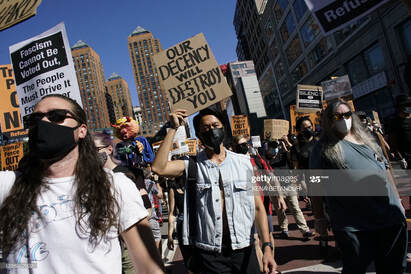
Masked protesters marching with signs reading “Fascism cannot be voted out, the people must drive it out” and “Our decency will destroy you”


Listen to what Trump says.  He plans to steal the election!
It is hard to believe that it has come to this. We have to defend democracy itself.
 
We must plan to stop him ! 


Step #1.  Defeat him at the polls.
It is time to plan for steps 2-10.
  
 
How would you like a strategy that does all of the following?

Enables you and your friends to act close to home.

Gives you some “wins” on the way to the big goal of defeating a power grab.

Is easy to explain to your friends.

Allows any number of people to participate because it will all add up.

Reduces the risk of violent confrontations.

Can be calibrated to the amount of risk of arrest that you can handle.

Can be done in-person in a way that keeps the pandemic at bay.

Targets a set of people who especially have a personal stake in the elective process.

Takes on the politically powerful who are hesitating to commit, pressuring them to do the right thing.

Draws on the strengths that already exist in our political system.

Puts us on the offensive instead of merely protesting.

Maximizes the number of people who participate in the movement.

Doesn’t have to be the only strategy being carried out in order to be successful.

OK, here’s the idea: Go to people who hold elective political power near you, in your town, county, city, state. Urge them to “Join us in demanding every vote be counted.”
Continue with this plan here.  George Lakey. 
https://wagingnonviolence.org/2020/09/what-will-it-take-to-defend-the-election-heres-one-winning-strategy/  

Here is a detailed plan for another series of strategies.
Hold the Line. A Guide to Defending Democracy
 
http://holdthelineguide.com

We should begin planning now. There is work to be done for all who are willing.


Share the pledge to resist . The only way to maintain momentum is to continue sharing information, resources, and actions with our friends and family. Sign the pledge and share it with everyone you know. If you tag us in a tweet or on your stories, we will share!

Additional resources

What If Trump Won’t Leave ?
Francis Fox Piven & Deepak Bhargava
 
https://theintercept.com/2020/08/11/trump-november-2020-election/
 
Video talk;  Strike- 
"Social Self Defense Against the Impending Trump Coup"

Jeremy Brecher
 
https://www.youtube.com/watch?v=zBFn120hmI0&feature=youtu.be (opens in a new tab)

https://organizingupgrade.com/strike-for-democracy/
(opens in a new tab)

https://protecttheresults.com/ (opens in a new tab)


Blurred photo of a crowd

0 Comments on Our Demand - Count Every Vote

Trump's Immigration Policy

10/29/2020

0 Comments on Trump's Immigration Policy

Teachers' Union Pledges Protect the Vote !

10/28/2020

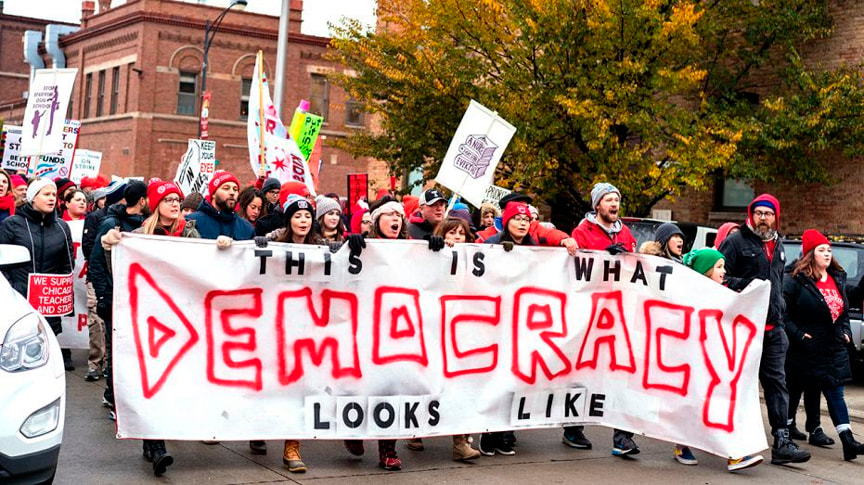
Striking Chicago teachers marching behind a banner reading “This is what democracy looks like”
PROTECTING AMERICAN DEMOCRACY
The 2020 election is a test of who we are as Americans and what we will do to preserve our democracy when it is in mortal peril.
Throughout our history, Americans have risen to the moment to extend and defend democracy. From the abolitionists and suffragists who risked their freedom in the fights against slavery and to secure the vote, to the working people who faced violence and repression when they organized unions and defended free speech, and from the armed forces who defeated fascism in a world war, to the civil rights activists who fought the Jim Crow South, Americans have made immense sacrifices and put our lives on the line to make the democratic promise of “liberty and justice for all” a reality. The American Federation of Teachers—our members, our locals, our state federations and our national organization—has been part of that democratic quest: We fought against fascism here and abroad, including our participation in the great battles of all of our civil rights movements.
Today, we in the AFT face a historic challenge. Donald Trump’s presidency has been marked by a series of attacks on the democratic institutions and norms of our government and civil society: assaults on the rule of law; an independent judiciary; a free press; the separation of governmental powers; the right to protest; equality under the law; the rights of people of color, believers in minority religious faiths and immigrants; the freedom of association of working people; and more. This endless barrage has taken a deep and destructive toll on our political life, our national psyche and our national identity, threatening to lay waste to our country’s motto: E pluribus unum—out of many, one.
Now, in the final week leading up to the 2020 election, in the midst of a surging coronavirus pandemic and as Americans are voting, Trump and his supporters have mounted an offensive on the very foundation of democracy—the power of the people to choose their government through free and fair elections.
The AFT is unequivocal and unwavering in our response: We stand for American democracy. Democracy is a defining principle of our work as educators, healthcare professionals and state and local government workers, and a core value of who we are as unionists and citizens. Our vote is our voice and a sacred right upon which freedom depends. We see no choice: To be true to ourselves and the values we hold dear, we must rise to the defense of democracy.
While our opposition to Trump is clear, our defense of the right to vote, the requirement to count every vote and the assurance that the will of the voters must determine who is president must not depend on a presidential preference.
In the coming days, we will do everything in our power to support our fellow citizens in the effort to exercise their democratic franchise and cast their votes. We will remain engaged with fellow democracy defenders to see that those votes are counted and that the will of the people is reflected in the peaceful transition of power to the legitimate winners of our free and fair elections.
To ensure that the will of the people is respected in the 2020 elections, we dedicate ourselves to the following four propositions:
  • •    Every American citizen registered to vote must be able to vote. In the context of the current pandemic, voters must have the ability to cast their ballot in ways that do not endanger their health, such as mail ballots and early voting, as well as have sufficient ways to vote on Nov. 3. There must be sufficient numbers of polling stations and election officials for all voters to vote. Intimidation of voters must not be allowed to stand.
  • •    Every vote must be counted. Given the unprecedented numbers of votes that have been cast early and by mail, the final tally will not be known on election night. Indeed, there may not be enough of a vote count available on Nov. 3 to project who has won. Counting must continue until all votes have been counted.
  • •    The electoral verdict of “we the people” must be respected. It is not the right of those in power—whether they be in the White House, Congress and the Supreme Court, or in state capitols and local governments—to decide who governs us. It is the right of the people, and the people alone. The reins (or leadership) of government must be transferred peacefully to the choice of the people.
  • •    We will not be intimidated. AFT members have a proud tradition of engaging in the peaceful struggle for American democracy. In the tradition of our teachers, Martin Luther King Jr. and A. Philip Randolph, we will organize and participate in peaceful, nonviolent mass protests against any efforts to thwart free and fair elections and to undermine American democracy. When democracy is in danger, we will be in the streets and in our workplaces with our colleagues in the labor movement and allies in the community, defending it against its enemies—foreign and domestic.
Make no mistake, the AFT believes that the American people should freely elect this country’s next leader, and we will accept the legitimate outcome of the election regardless of the victor. However, as a union deeply rooted in democratic principles, we will do whatever it takes to stand by our commitment to reject election interference, threats, tampering, stealing, acts of violence or other actions that undermine the will of the people in this exercise of Americans’ democracy. We, the people, must decide.
AFT Executive Council  http://www.aft.org (opens in a new tab)


0 Comments on Teachers' Union Pledges Protect the Vote !

Can Biden Be Pushed Left?

10/26/2020

Joe Biden speaking at a podium in front of an American flag in Valley Forge, Pennsylvania, on C-SPAN


History suggests that what you see on the campaign trail, or even in a candidate’s past legislative record, is not necessarily what you get from a president once in power.


Bob Master ▪ October 14, Dissent Magazine

…Transformational leadership is determined not only by the character, or even by the ideology of a particular leader, but by a complex interplay of social forces and historical circumstance. Perhaps most importantly, mass popular mobilizations can shift the frame of debate and push leaders beyond where anyone expected them to go. History demonstrates that this dynamic can produce surprising breakthroughs, even when activists may least expect them…


…Then the pandemic hit, casting an unsparing light on the catastrophic inability of our society to meet the nation’s needs—and the profound racial and class inequities that determined who suffered the greatest impact of the crisis. It is a poignant historical irony that at the very moment when the candidacy of the candidate who did more to advance a social democratic program in U.S. politics than perhaps any politician in U.S. history was collapsing, an unprecedented social crisis erupted that made plain the need for an invigorated American social democracy informed by a deep commitment to racial justice: one with truly universal health care, a robust public health system, strengthened workers’ rights, massive investments in reversing climate change, universal child care, expanded paid family leave, and a stronger safety net for the unemployed.

But Bernie’s ideas have outlived his campaign; coupled with the deeply disruptive impact of the pandemic, they have pushed candidate Biden further to the left than any of us might have thought possible, on issues of climate, racial justice, and an expanded social safety net. And the magnificent impact of the Black Lives Matter upsurge over the last several months demonstrates the remarkable power of social movements to reshape public opinion and policy discourse in what seems like an instant. These conditions have set the table for an historic era of reform if we do our work over the next few months….

…Our first imperative in 2020 is a massive repudiation of Donald Trump. There is only one way to do that. A vote for Joe Biden will deal the deadliest blow against Trumpism, authoritarianism, racism, and reaction. Our second obligation is to organize social movements that will force President Biden and a Democratic Congress to take long overdue steps toward fundamental social and economic reform. We must be sharply focused on both tasks over the coming weeks and months.
Read the entire article.
https://www.dissentmagazine.org/online_articles/can-biden-be-pushed-left


Bob Master has worked in the labor movement for forty-three years. He currently serves as Assistant to the Vice President for Political and Mobilization Activities in District One of the Communications Workers of America. He was a co-founder of the New York Working Families Party and is a member of the WFP National Executive Committee.


1 Comment on Can Biden Be Pushed Left?

The Socialist Awakening : What Is Different Now About the Left?

10/20/2020


Above is a very interesting, thoughtful discussion of The Socialist Awakening, a new book by John Judis, a leftwing jounalist, at right in the video. It’s well worth spending an hour to watch. Judis and Peter Dreier, at left, make great points about socialist history and theory, the weaknessss of the New Left generation they were part of, and some of the strengths of the new generation of leftists. Judis offers important advice about the importance of reaching out beyond the East and West Coasts, major cities and college towns, and of finding a way to talk to more Americans in ways that aren’t alienating.

Yet I was dismayed by the sharp difference between this discussion and The Struggle or the Sidelines: DSA and the 2020 Elections, a webinar that DSA’s Socialist Majority Caucus hosted Sunday night.


The Struggle or the Sidelines was an interview with historian Barbara Ransby and labor movement veteran Jose La Luz. Like Judis and Dreier, both are what MC Abdullah Younnous called “OG,” or older generation. But Ransby is African American, La Luz is Puerto Rican and a long-time DSA leader. Dreier and John Judis are both white Jewish men; Dreier a long-time DSA member; Judis I think is a former member.
The Struggle or the Sidelines discussion is here.

https://www.facebook.com/watch/live/?v=801755180659062&ref=watch_permalink (opens in a new tab)

Theories of racial capitalism and colonialism are central to Ransby and La Luz’s talks on why it’s crucial reasons to be engaged in the struggle against Trump and Trumpism and for socialism. They called for a multiracial movement that is antiracist and anticolonial. Deier and Judis barely mentioned racism and colonialism, and then onliquely in discussing immigration and protests against racist policing.

Dreier, a professor of Politics and Urban Policy, notes that while his own generation read Marcuse, his students read Michelle Alexander’s The New Jim Crow. Neither he nor Judis noted that their generation included SNCC, not just SDS; neither noted, as Ransby and La Luz did, that the recent protests sparked by the police killings of George Floyd and Breonna Taylor and others were the largest protest in American history—and remarkable for the large share of young whites participating.

I firmly believe that Peter Dreier and John Judis are anti racist and anti imperialist, AND  I think their virtually omitting racism and colonialism from the discussion is typical of white leftists of their generation, who I grew up with. I sometimes make the same omissions myself.

The younger Socialists I know, white, black, Latinx and Asian, seldom do. They clearly prefer the vision and and analysis that Ransby and La Luz articulated. I do, too. Many of us old white leftists haven't listened enough, or absorbed deeply enough, the perspectives of our comrades of color. I’m glad the younger generation, whites as well as POC, seems to be doing better.


Miriam Jean Bensman
NYC

0 Comments on The Socialist Awakening : What Is Different Now About the Left?

Democracy Groups Plan to protect the Vote

10/16/2020

Seed the Vote logo


With 170+ 'Protect the Results' Events Planned for Nov. 4, Pro-Democracy Groups Vow to 'Ensure Voters Have the Last Word'


"We will honor the valid results of the 2020 election, ensure that every vote is counted, and show up to demand that the losing candidate put their ego aside and concede for the good of our country."
by

Julia Conley, staff writer, Common Dreams.

https://www.commondreams.org/news/2020/10/16/170-protect-results-events-planned-nov-4-pro-democracy-groups-vow-ensure-voters-have (opens in a new tab)

Projecting the 78 Harrowing Days After the Election.  David Dayen.
https://prospect.org/politics/winter-of-our-discontent-trump-2020-election/ (opens in a new tab)


0 Comments on Democracy Groups Plan to protect the Vote

The Socialist Moment, and How to Extend It

10/10/2020

A new book and a new film speak to different audiences about the movement’s revival and prospects.
BY HAROLD MEYERSON
 
OCTOBER 9, 2020
 

While Joe Biden has been making it unmistakably clear that he’s nobody’s socialist tool, the American socialist movement—most of whose adherents will be voting for Biden—has continued to expand. The Democratic Socialists of America (to which I’ve belonged since the Neolithic Age) now has more than 70,000 members and has launched a campaign to raise that number to 100,000. At its current rate of growth, its membership rolls may well surpass that of the Debs-era Socialist Party, which claimed 118,000 dues-payers at its early-20th-century zenith.

The rebirth of American socialism has come complete with any number of explanatory and exhortatory books, the best of which was published late last month: The Socialist Awakening: What’s Different Now About the Left (opens in a new tab), a brief, incisive volume by veteran political journalist, longtime democratic socialist, and sometime American Prospect contributor John B. Judis. The book is Judis’s third in a series published by Columbia Global Reports. In it, as in its two predecessors The Populist Explosion and The Nationalist Revival, Judis tracks the consequences of the failures of globalized capitalism to sustain working- and middle-class prosperity and stability since the 2008 collapse, and the concomitant rise of both left and right in the wake of those failures. As is not the case in the other two volumes, however, Judis writes not merely as an analyst of an ideology’s return but as an advocate for its necessity, with particularly shrewd assessments of how the new American socialism can advance, and, alternatively, how it may marginalize itself into irrelevance.

Judis focuses on two periods in American socialism’s long history: the Debs Era of 1900 through 1920, and the Bernie Sanders Surge, which began to incubate with the Occupy movement of 2011 but didn’t really take off until Sanders began running for president in 2015. Both were periods in which capital concentrated wealth and power, in which little of either trickled down to most Americans, in which the New Deal’s semi–social democratic reforms had either not yet been enacted or had been discarded in the post-1970 turn toward laissez-faire.

Sanders has always made it plain that socialist leader Eugene V. Debs was his hero, but in Judis’s telling, the key to Sanders’s zeitgeist-changing success was his move away from the socialist insularity that Debs espoused. While nominally remaining a political independent, Sanders won election to Congress on a social democratic platform of greater regulation of capital, greater power for workers, an expansion of social welfare and economic rights, and a pledge that he’d caucus with the Democrats.

When he began running for president in 2015, Sanders made clear his model of socialism was the Scandinavian mixed economy. But as Judis recounts, after Columbia University historian Eric Foner sent him an open letter that emphasized a more American pedigree for socialist initiatives, Sanders took the hint. As I recounted in the Prospect, in Sanders’s two speeches that he billed as his definition of socialism—one given at Georgetown University in 2015, the second at George Washington University in 2019—he cited Franklin Roosevelt and Martin Luther King as his forebears in the struggle for socialist reforms.


In keeping with that expansive definition, Judis emphasizes the broad socialist “network” that’s emerged today, which extends well beyond DSA card-carriers. It includes a range of progressive think tanks (like the Economic Policy Institute and the Roosevelt Institute) and magazines; most importantly, it includes not just the avowed socialists in elected office but a host of progressives whose politics are indistinguishable from the socialists’ politics, as Elizabeth Warren’s were from Sanders’s.

Expanding that network, as socialists like union leaders Sidney Hillman, A. Philip Randolph, and Walter Reuther did during the New Deal and the postwar period, will be as important, if not more important, to the social democratization of today’s United States than the growth of DSA per se, Judis contends. What could retard that growth, he continues, would be continuing the hold that a relatively small group of orthodox Trotskyists now have over DSA’s leadership. The majority of DSA members, he argues, are Berniecrats, happy to work for socialist and other progressive candidates seeking office as Democrats. (I believe he’s right about this.)

They understand, as Sanders does and as DSA founder Michael Harrington did, that third-party politics are a dead end in the current configuration of the American electoral system, and that socialists have won power in democracies only when allied with other progressives on behalf of social democratic programs. Such an approach is anathema to the neo-Trotskyist cadres in DSA, for whom a kind of socialist identity politics eclipses both class politics and that of a 21st-century popular front.

Judis also makes the case for a socialist version of nationalism, at which many in today’s socialist movement will look askance. So long as democratic nations offer the one kind of government where majority rule holds sway, though, I think Judis has a point. While capitalism has had no trouble going global (in part to escape the regulations enacted by democratic nations), socialism cannot yet call on any planetary democratic body to reform the global economy. Moreover, people’s support for welfare states funded with their taxes, Judis points out, seldom extends beyond their nation’s borders. To advance a slightly different viewpoint, it’s worth noting that the nation that has given the highest share of its GDP in foreign aid—sometimes to insurgent movements, like the African National Congress—was Sweden under the Social Democrats. Of course, that was when Sweden also had the world’s most expansive welfare state for its own citizens.

Judis writes not merely as an analyst of an ideology’s return but as an advocate for its necessity.

As events would have it, the publication of Judis’s book coincides with the premiere of a film that seeks to introduce and normalize socialism to American viewers. Indeed, The Big Scary ‘S’ Word (opens in a new tab), a film by documentarian Yael Bridge, will have its first festival screening later today.

In Judis’s terminology, The Big Scary ‘S’ Word is a film about the broad socialist network, and broad left history, rather than a look at, say, the American Socialist and Communist Parties, or at DSA today. The focus is on progressives in motion, then and now, and their connection, explicit or implicit, to socialists and socialism, as distinct from the substance of their involvement in the socialist movement as such. Rather than disentangle the socialist and nonsocialist threads that came together to make the civil rights movement, for instance, the picture simply documents the socialism of Martin Luther King. Some of the environmental protests it shows may not have been populated by socialists, but they’re juxtaposed with interviews with Naomi Klein in which she connects a socialist perspective to any serious effort to save the planet.

There’s a marvelous segment, replete with old films and photos, on the socialists’ 40-year control of Milwaukee’s city government, but no discussion of the social democratic meliorism of Victor Berger, the Milwaukee socialist leader and a contemporary of Debs who did not share Debs’s antipathy to reformist socialism. For that, you need to consult Judis’s book, which is pitched at a narrower audience than Bridge’s film.

Just as Eric Foner plays a key role in Judis’s account of the Americanization of Bernie Sanders’s socialism, so Foner plays a key role in explaining the contributions of socialists to American struggles for justice in Bridge’s picture. In this task, he is joined by Klein, Cornel West, The Nation’s John Nichols, and a host of others. In documenting the rise of socialism today, the picture focuses on Lee Carter, a DSA member and the one socialist in the Virginia legislature, as well as on a teacher who assumed a leadership role during the Oklahoma teachers strike and became a socialist in the process.

As its title suggests, The Big Scary ‘S’ Word makes a broad and pointedly reassuring case for socialism as the remedy to our towering inequities. Judis’s book makes a compelling case for what it will take to roll the revived socialist movement on, and offers a pointed critique of how sectarianism could derail it. The former is essential viewing for a broad audience; the latter essential reading for progressives and socialists.
Harold Meyerson 

0 Comments on The Socialist Moment, and How to Extend It

Our Struggle - Vote

10/7/2020

0 Comments on Our Struggle - Vote

SANDERS: LET'S STAND TOGETHER

10/7/2020

Joe Biden and Bernie Sanders bumping elbows at a CNN Democratic debate
Let me begin by wishing the president and the First Lady a full and speedy recovery from the COVID-19 illness they are now dealing with. And I, of course, wish the same for my colleagues in the Congress who have also been infected with the virus, as well as the many, many other Americans who are struggling with this terrible disease.

What the last few days have told us is that, if there was ever any doubt, it should now be clear now that no one, no one, is safe from this pandemic. It doesn't matter if you are a front line worker in a hospital - and we thank our medical personnel for the extraordinary sacrifices they have made for us during this pandemic. It doesn't matter if you are an essential worker at a supermarket, a packing house worker, or a bus driver. And it doesn't matter if you are president of the United States. Each and every one of us is vulnerable. And we will remain vulnerable until there is a vaccine or a perfected cure. That's the reality, and there is no getting away from that.

There are some who say that we have to make a choice between having a strong economy and protecting the American people from this terrible disease. I disagree. The truth is that we will never have a strong economy so long as this pandemic continues to surge — as it is today. We will never have a strong economy if people are afraid to go to work, afraid to go to school, afraid to shop, afraid to go to a restaurant or afraid to do all of the things that we have always done. We will never have a strong economy unless we get this pandemic under control.

Is the solution to this crisis to shut down the economy and lock everyone in their homes? No it is not. We can keep our country moving forward if we do so in a way that is disciplined, not dangerous — that is responsible, not reckless.
 
And now I want you to ask yourselves some very simple questions. Which candidate for president has shown that he will be disciplined, that he will be responsible, in dealing with this pandemic? Which candidate for president has made it clear that he will develop policies based on the advice of the best scientists in our country and the world? Which candidate for president will develop national protocols and guidelines, and model the behaviors we all need to engage in to keep our families and our neighbors safe? Which candidate has the temperament to see us through this difficult crisis? Let me repeat. Which candidate has the temperament to see us through this difficult crisis? I don't think there is any doubt that the answer to those questions is, that in the worst public health crisis in 100 years, we need Joe Biden as our president.

And now let me say a word about the economy.

Let’s be clear: The working class of America is in more desperation today than at any time since the Great Depression of the 1930s.
Tens of millions of our fellow citizens have lost their jobs as a result of the pandemic. They have lost their incomes. They have lost their health insurance. They have depleted their life savings. They cannot afford to pay rent or mortgages. They cannot afford to put food on the table. And they are going deeper and deeper into debt.

Today, the percentage of Americans who don’t have jobs is at its highest level in 45 years — while tens of millions of Americans who do have jobs are often working part-time for starvation wages.

And as bad as the economy has been in general it has been far, far worse for African Americans and Latinos. During the pandemic, nearly 60% of Latino families and 55% of African American families have either experienced a job loss or a pay cut.

Meanwhile, not everyone is hurting in America. While the middle class is being devastated and poverty is growing, we are witnessing a massive increase in income and wealth inequality. Over the past 6 months, and I want you to hear this, 643 billionaires have seen their wealth go up by $845 billion.

Let me repeat. While 30 million Americans have lost their jobs, while 12 million Americans have lost their health insurance, while 29 million Americans do not have enough food to eat, while 40 million Americans face eviction, 643 billionaires increased their wealth by $845 billion over the past 6 months alone.

That is the state of the economy in America today. The very rich get much, much richer, while nearly everyone else gets poorer and poorer.
And let’s be clear: Despite what you may have heard, over the past 4 years the economy has not been good for the working class — not before the pandemic, not during the pandemic.

No. It was not a good economy when over half of the American people were living paycheck to paycheck, as was the case before the pandemic, with no ability to put a nickel in the bank.

It was not a good economy when 87 million people were uninsured or underinsured and 68,000 Americans were dying each year because they could not afford to go to a doctor.

It was not a good economy when over 40 million workers in America were earning starvation wages of less than $15 an hour.

It was not a good economy when half of older Americans had no retirement savings and no idea how they would be able to retire with any shred of dignity.

It was not a good economy when over half a million Americans were homeless and 18 million families were spending more than half of their incomes on housing.

Yes, it was a great economy for the billionaire class, and it has become even better for them during this horrific pandemic, but it has been an absolute disaster for working families.

But, truth be told, the economy has not been good for the working class for decades.

Over the past 45 years, there has been a massive redistribution of wealth in America, but it has gone in the wrong direction — from the working class and the poor to the very richest people in our country.

Since 1990, while the top 1% saw their wealth go up by $22 trillion, the bottom 50% of Americans saw their wealth go down by $776 billion. 
Incredibly, if income inequality had remained the same as it was in 1975, the average worker in America would be making $42,000 more today.
Instead, the average worker in America is now making $34 bucks a week less than he or she made 47 years ago — after adjusting for inflation.

Corporate Greed

Brothers and sisters: What I understand and what you understand is that the American people are getting more and more disgusted with the corporate greed they experience every single day.

They are sick and tired of large, profitable corporations shutting down in the United States, throwing American workers out on the streets as they move their factories to low-wage countries. 

They are sick and tired of corporate CEOs who now make 300 times more than their average employees, while they give themselves huge bonuses and cut back on the health care benefits of their employees.
They are sick and tired of paying, by far, the highest prices in the world for prescription drugs while the largest drug companies in America make tens of billions in profits year after year after year.

In my view, we can no longer tolerate a rigged system that allows the three wealthiest people in our country to own more wealth than the bottom 50%.

We can no longer tolerate a rigged tax code that allows billionaires to pay a lower tax rate than nurses, teachers and truck drivers while we have the highest rate of childhood poverty of almost any major country on earth.

We need to create an economy and a government that works for all of us, not just the top 1%.

Joe Biden will improve the economy

Now, it is no great secret that Joe Biden and I disagree on a number of issues.

But there is no question that the economic proposals that Joe Biden is supporting are strong and will go a long, long way in improving life for working families. 

Let me tell you about just some of those proposals.

Minimum Wage – When Joe Biden is president he will increase the federal minimum wage from a starvation wage of $7.25 an hour to a living wage of $15 an hour. What Joe understands is that if you work 40 hours a week you should not be living in poverty. A job in America should lift you out of poverty, not keep you in it. And let’s be clear: When we increase that minimum wage to $15 an hour we will be raising the wages of more than 40 million workers. 

And Joe Biden also understands that we have to guarantee that every woman in America gets equal pay for equal work. Women in America don’t deserve to be making just 80 cents on the dollar compared to men. They deserve the whole damn dollar.

Joe Biden also knows that if we are going to expand the middle class in this country, we must make it easier for workers to join unions, engage in collective bargaining and end the heavy-handed corporate tactics that make it hard for workers to unionize in America.

And Joe Biden also understands that we have got to stop providing corporate welfare to companies that are throwing American workers out on the street and moving abroad.
 
It is absolutely unacceptable that more than 300,000 American jobs have been shipped overseas over the past 4 years, while some of the biggest corporate outsourcers in America have received over $400 billion in government contracts. When Joe Biden is president he will sign an executive order to prevent companies that ship American jobs abroad from receiving corporate welfare.

Infrastructure – Here's something else that Joe Biden understands. And that is that, in the midst of the worst economic crisis in our lifetimes, we need to create millions of good paying jobs through a massive investment in rebuilding our crumbling infrastructure — our roads, bridges, sidewalks, schools, water systems and affordable housing.

Paid Family and Medical Leave – I'll tell you what else Joe understands. Like most of us, he is embarrassed that the United States is the only major nation on earth not to guarantee paid medical and family leave. When a woman in this country gives birth, she should not be forced to go back to work after one or two weeks. When a kid gets sick, mom or dad should be able to stay home and not lose a day's pay. That’s why Joe has proposed at least 12 weeks of paid family and medical leave for working families.

Childcare – When we talk about babies and young children, we all know that our current childcare system is totally inadequate. Our children and their parents deserve high quality, reliable and affordable childcare. That’s why Joe has proposed universal pre-K education for every 3 and 4 year old in the country. 

Colleges – When we talk about making sure that we have the best educated workforce in the world, Joe understands that we have got to make public colleges, universities and trade schools tuition free for working families and substantially reduce student debt in America.
 
Tax Reform – At a time of massive income and wealth inequality, Joe Biden understands that we must demand that the wealthiest people and most profitable corporations in America pay their fair share of taxes. No more tax breaks for billionaires while veterans sleep out on the street and children go hungry. No more tax breaks for companies that ship jobs overseas or shift their profits to the Cayman Islands.

Prescription Drugs – As some of you may recall, last year I traveled to Canada with a group of diabetics to buy insulin, a life and death drug for more than 30 million Americans. And here's what we found. You can buy insulin in Canada, a few miles from our border, for one-tenth the price that it is sold here. No. You didn't mishear me. The same product, made by the same company, is sold for one-tenth the price that it's sold here. But it's not just Canada and it’s not just insulin. While the drug companies, through their collusion, price fixing and greed, make obscene profits, we pay by far the highest prices in the world for prescription drugs. Joe Biden understands that we must take on the pharmaceutical industry and significantly lower drug prices in this country.

Health Care – As many of you know the United States is the only major country not to guarantee health care for all people. Meanwhile, despite paying almost twice as much per capita for health care as the people of other countries, over 90 million Americans are uninsured or underinsured and over half a million Americans go bankrupt because they cannot afford to pay their medical bills.

While Joe and I disagree on the best path to get to universal coverage, his proposal will greatly expand access to health care and make it more affordable for tens of millions across this country. He will lower the eligibility age of Medicare from 65 to 60. He will expand Medicare to cover dental care, eyeglasses and hearing aids. And he will substantially increase funding for community health centers to make sure that millions of Americans get the primary health care and mental health care that they desperately need.

Conclusion

My friends: 

In the wealthiest country in the history of the world, we need an economy that works for all of us and not just the 1% and large corporations. 

There is no excuse for millions of workers in our country being unemployed, and for tens of millions lacking health insurance. There is no excuse for America having the highest rate of childhood poverty of almost any major country on earth, for starvation wages, for a dysfunctional child care system, for homelessness and for massive student debt.

Let us stand together — Black and white, Latino, Asian American, Native American, gay and straight and elect Joe Biden as the next president of the United States.

Thank you all very much.

Bernie Sanders


0 Comments on SANDERS: LET'S STAND TOGETHER

Trump Plans to Steal the Election - We plan to Stop Him!

10/3/2020

Listen to what Trump says.  He plans to steal the election!
It is hard to believe that it has come to this. We have to defend democracy itself.
 
We must plan to stop him ! 


Blurred photo of a crowd
Step #1.  Defeat him at the polls.
 
Here are some strategic  steps 2-10. 
 
How would you like a strategy that does all of the following?

Enables you and your friends to act close to home.

Gives you some “wins” on the way to the big goal of defeating a power grab.

Is easy to explain to your friends.

Allows any number of people to participate because it will all add up.

Reduces the risk of violent confrontations.

Can be calibrated to the amount of risk of arrest that you can handle.

Can be done in-person in a way that keeps the pandemic at bay.

Targets a set of people who especially have a personal stake in the elective process.

Takes on the politically powerful who are hesitating to commit, pressuring them to do the right thing.

Draws on the strengths that already exist in our political system.

Puts us on the offensive instead of merely protesting.

Maximizes the number of people who participate in the movement.

Doesn’t have to be the only strategy being carried out in order to be successful.

OK, here’s the idea: Go to people who hold elective political power near you, in your town, county, city, state. Urge them to “Join us in demanding every vote be counted.”
Continue with this plan here.  George Lakey. 
https://wagingnonviolence.org/2020/09/what-will-it-take-to-defend-the-election-heres-one-winning-strategy/  

Here is a detailed plan for another series of strategies.
Hold the Line. A Guide to Defending Democracy
 
http://holdthelineguide.com

We should begin planning now. There is work to be done for all who are willing.


Share the pledge to resist . The only way to maintain momentum is to continue sharing information, resources, and actions with our friends and family. Sign the pledge and share it with everyone you know. If you tag us in a tweet or on your stories, we will share!

Additional resources

What If Trump Won’t Leave ?
Francis Fox Piven & Deepak Bhargava
 
https://theintercept.com/2020/08/11/trump-november-2020-election/
 
Video talk;  Strike- 
"Social Self Defense Against the Impending Trump Coup"

Jeremy Brecher
 
https://www.youtube.com/watch?v=zBFn120hmI0&feature=youtu.be (opens in a new tab)


1 Comment on Trump Plans to Steal the Election - We plan to Stop Him!

What Is Freedom ?

10/3/2020

0 Comments on What Is Freedom ?

Building on black lives movement

9/23/2020

By Paul Garver

Since my last article on U.S. politics in The Chartist (opens in a new tab) was printed [#302, Feb. 2020], the coronavirus pandemic followed by the Black Lives Matter protests has been reshaping the political terrain.

The ongoing pandemic is damaging Trump. His bumbling ineptitude and narcissistic callousness are on full display every day. The societal consequences of the economic crisis triggered by attempts to control the pandemic are devastating with no end in sight. Trump’s chief argument for reelection had been the relatively strong economy, and Trump is now promoting over-hasty measures to revive the economy by relaxing safety precautions. The pandemic is therefore raging out of control in those rural and small-town areas controlled by Republican politicians too much in thrall to Trump’s willful ignorance and denial of science. 

The widespread and persistent Black Lives demonstrations throughout the country, led by young people of all races, are showing the power of the streets to shift popular attitudes on race and force politicians at all levels to promise reforms in policing.  Progressive insurgents have been defeating middle-of-the-road Democratic incumbents in recent Congressional primaries.  In a New York district, African-American educator Jamaal Bowman decisively defeated Eliot Engel, a darling of the Democratic establishment, who was endorsed by Hilary Clinton and heavily funded by pro-Israel and both Democratic and Republican political action committees. Another African-American progressive insurgent Mondaire Jones won a primary election for an open seat in a predominantly White New York suburban district, while Black Lives Matter insurgent Cori Bush defeated an entrenched Democratic incumbent in Missouri.

“Squad Members” and DSA members Alexandria Ocasio-Cortez and Rashida Tlaib easily won their reelection primaries.  It is now likely that the current Squad of four in the House of Representatives will be expanded to at least ten members after the 2020 elections. Despite the panicked negative responses from the institutional Democratic Party, the balance of power is clearly shifting towards the Left in the U.S. House, which is likely to have an expanded Democratic majority.

The fundamental tenet of Sanders campaign was that millions of new, marginalized and younger voters would be drawn into the electoral process, which did not happen. However It now appears that the massive and sustained Back Lives Matter Protests are being accompanied by a strong Left electoral surge, at least in major metropolitan areas.  It remains unclear whether Biden can harness that surge. In general, younger and poorer people do not vote in the same proportion as older and wealthier persons. This partly explains why Biden defeated Bernie Sanders in the Democratic primaries. 

Sanders may have withdrawn prematurely from the Presidential race.  The pandemic is dramatically demonstrating the defects of employer-based insurance by threatening tens of millions of newly unemployed with loss of their health coverage. The costs of Medicare for All and a Green New Deal jobs program pale in comparison with the huge sums of money now being poured into financial and fossil fuels corporations as temporary bailouts. By withdrawing from the Presidential race, Sanders failed to accumulate enough committed Democratic delegates to ensure that the positions of his supporters would have direct influence on the Democratic Party 2020 platform. 
 
Sanders quid pro quo was to enter into negotiations with Joe Biden to create “unity” task forces to shape the Democratic Party’s platform.    The six task forces were Climate Crisis/Environmental Justice, Criminal Justice, Education, Economy, Health Care and Immigration. The Sanders and Biden campaigns each appointed a co-chair plus four additional members {Biden] and two [Sanders] for each task force. The recommendations of those unity task forces were made public in early July. In general, they would provide a comprehensive domestic framework for a decent social democratic party, although compromised short of more ambitious progressive goals like Medicare for All, Green New Deal or free higher education. 

However, the Democratic Party policy committee is already watering down these task force recommendations. In any event few people actually read long form party platforms. What the electorate will be made aware of is how the candidate and the campaign present their proposals. Left to his own advisors and devices, Joe Biden is likely to follow the Hilary Clinton model by lying low and stressing the defects of Trump rather than propose any sweeping or comprehensive alternatives.  As in 2016 this is thought by Democratic pols to be the “safe” strategy for defeating Trump in 2020.

Most leaders of progressive movements and unions, following Sanders, are endorsing Biden. Less from enthusiasm but as the only available alternative to Trump’s re-election. However, we cannot know yet whether sufficient numbers of their members and followers can be motivated to overcome the twinned difficulties of the pandemic and voter suppression hurdles to actually register and vote in November. 
Most of the voting is likely to be through absentee mail-in ballots because of the pandemic.  Physical polling places, particularly in African-American neighborhoods, have been closed down, forcing long lines at those still open. We do not know the full impact of a shift to mail-in voting.  Trump is opposed to its widespread use even though he and most of his advisers vote absentee themselves. But in general, poorer people still face more difficulties in voting by mail as well as in person.

In any event the most potent electoral tool of the Left had become door-to-door canvassing in lower-income neighborhoods and communities.  This has become almost impossible due to the pandemic. But that has not hindered good performances by progressive insurgents in Democratic congressional primaries. Effective use of social media helped bring out tens of millions to the Black Lives Matter protests throughout the country, where tables were set up to register and inform voters. It could encourage voting as well by young people as well.

Defeating Trump electorally is a necessary, but not a sufficient condition for preserving democracy and advancing democratic socialist ideas. It is even possible that Trump will not willingly vacate the White House following a narrow defeat. He has dozens of ways to discredit and contest the vote, by claiming fraud and by plying upon the slow process of counting challenged and absentee ballots. Trump also has a Supreme Court majority that could award him a dubious electoral victory in a close election as it did for George Bush in 2000.

Even if Joe Biden wins the Presidential race, Republicans will continue to block any serious progressive legislation if they continue to control the U.S. Senate. A Democratic majority in the Senate is needed to block Trump if he is reelected and to pass any vitally needed legislation if he is not.

There are only marginal indications that Trump’s core support bases are crumbling.  He is still supported by a plurality of White male voters, by most Evangelical voters and by virtually all Republicans. The Trump administration is doubling down on those repressive and regressive measures designed to fire up that base – anti-immigrant and refugee, militarization of police forces, restricting reproductive freedom, encouragement of religious-based bigotry, destruction of environmental protections, etc. 
 
Trump’s re-election remains possible. The arcane rules of the U.S. electoral system permit an electoral victory by a popular minority, like Trump won in 2016. Republican legislatures and politicians at the state level are enacting targeted measures to discourage and deny voter participation, particularly by persons of color and younger persons.  The Supreme Court continues to tolerate these anti-democratic practices.

Elections of course matter mostly because they register ideological and political trends in the electorate. The defeat of Sanders in the primaries, countered in part by a growing number of state and local electoral victories by the Left, suggests that, while the democratic socialist movement is increasingly relevant to U.S. politics, it is relatively strong only among younger people [of all races], those with some higher education, and concentrated in larger cities and university towns.  To become a major force in national politics the democratic socialist left has to become convincing and credible to other broader constituencies as well.

This poses a major challenge to the democratic socialist movement in the USA, and in particular to the Democratic Socialists of America [DSA], its largest and fastest growing organization. As a “big tent” organization that every month takes in hundreds of young people from all socialist backgrounds and none, DSA can do little more than provide a political education framework for local DSA groupings that vary widely from place to place. DSA does not have a single strategic direction or mandate as clear as [for example] the small but admirably focused Justice Democrats. However, DSA is alive and energetic, and its members are learning to organize at the grassroots in hundreds of local chapters.

I became politically active in the late 1960s and early 1970s through the civil rights and anti-Vietnam War movements. We never managed to align our immediate demands with a long-term strategy for achieving political power.  Part of our problem was that we young people felt isolated and alienated from most existing authorities, including the Communist and Socialist parties. Today we are working that this tragic failure to connect between Left generations is not going to happen this time. The wonderfully sustained and widespread multi-racial Black Lives Matter demonstrations build about the achievements of the civil rights movement, and give us hope that together with a sustainable Left electoral and organizational building strategy we can build a political movement capable of contesting for power.

0 Comments on Building on black lives movement

Organized labor and the “cold civil war”

9/19/2020

Portrait of Bill Fletcher Jr. resting his chin on his fist
Bill Fletcher


We may not get a second chance !

By Bill Fletcher, Jr. & Jose Alejandro La Luz

            The eruption of protests and rebellions following the murder of Minneapolis resident George Floyd sent shockwaves across the country; indeed, around the world.  Suddenly, in the context of a pandemic unlike anything that we in the USA have witnessed since 1918-1919 and an economic collapse worse than the Great Recession, masses of people were on the move challenging the profound racial injustice demonstrated by law enforcement abuse against racialized populations and, specifically, against African Americans.  “Black Lives Matter” became the renewed battle cry and, when it met with the response that “All Lives Matter,” the correct refrain was, all lives should matter, but the reality of the USA is that Black lives don’t matter.  And, as we swept away the racial fog that surrounds so much in the USA, we discovered that other racialized populations were also regular targets of extrajudicial violence, including Native Americans, Chicanos, Puerto Ricans, and Asian Americans.
      
      The moment in which we live is explosive because of the fusion of crises, including but not limited to the Covid19 pandemic, the economic collapse, the environmental catastrophe, extrajudicial violence targeting racialized populations, and a growing right-wing populist movement with a crypto-fascist President as its main spokesperson.  In this situation, organized labor—the trade union movement—has been inconsistent; sometimes paralyzed; and at other moments outspoken.  What it fails to acknowledge, let alone address, is that the political polarization of the USA has placed us in a situation that some commentators have described as a “cold civil war.”
          
  How should we understand the term “cold civil war”?  It means that the social, economic, and political contradictions in the USA have been brewing in such a way that there is a polarization undermining a so-called mainstream consensus within the democratic capitalist framework.  It does not necessarily mean that we are in pre-civil war situation, i.e., it does not necessarily mean that we are on the verge of a military conflict, but it does mean that the antagonisms have bubbled to the surface and have moved outside of the generally accepted bounds of democratic capitalist politics.  This includes the increased use of extrajudicial violence by the authorities as well as by paramilitaries.  To be clear, the polarization that has emerged is between forces that are advancing right-wing, irrationalist authoritarianism, on the one hand, and those who favor democracy (subject, of course, to wide interpretations).
      
      None of this should surprise us since the Republican Party has shifted dramatically, since the late 1960s, in a rightward direction and, particularly beginning in the 1990s, flirted more and more with right-wing populist movements as a means of driving forward their neo-liberal economic agenda and their anti-20th century social and political agenda.
          
  Though the Republican establishment seems to have thought that they could control the right-wing populist forces, much like Dr. Frankenstein thought that he could control the monster, it has largely lost sway.  The complete collapse of the traditional Republican establishment in 2016 in the face of the Trump juggernaut illustrates this point.
           
We now have an Administration that flirts with open fascists; articulates lies and other forms of irrationalism; and has threatened to ignore the results of the November 2020 election should they lose.  All of this lays the foundation for, quite possibly, a series of confrontations between pro-democracy forces, on the one hand, and on the other, both pro-Trump forces of the State as well as pro-Trump mass movements and militias.
          
  What must be done?
(1) Organized labor must pull its collective head out of the sand:  Most immediately there must be a recognition of the toxic danger contained in the growing right-wing populist threat.  While it is clear that the majority of the USA, including the majority of the US working class, has no interest in right-wing populism, it is also the case that right-wing populism represents a major threat to the working class movement specifically, and the USA more generally.  Organized labor needs to speak openly about this threat and not act as if this is not a “labor issue”.

(2) Organized labor must advance a mobilization process that engages its members in supporting efforts to rethink, restructure, reallocate, and demilitarize law enforcement:  This is not just a matter of transforming local police departments but also must include addressing the barbaric treatment of documented and undocumented immigrants and refugees by ICE and the Border Patrol.  US authorities are treating migrants as cattle, completely ignoring the fact that many of these migrants are at our borders precisely because of the role of the USA in undermining the economies, environments, and sovereignty of their respective countries of origin.  Contrary to the right-wing myth that these migrants are coming to the USA in order to have so-called anchor babies—as opposed to the industry created to facilitate just this for many East Europeans—migrants from the global South are arriving at our borders largely because of the damage done to their homelands.

(3) Organized labor must put into place pro-democracy volunteer brigades in preparation for the November election:  We need volunteers who will assist with voter registration; mobilize in large numbers should law enforcement and right-wing militias show up at polling places in order to intimidate voters; block the right-wing from challenging legitimate voters and ballots; and lay the groundwork for massive civil disobedience should the Trump administration attempt to forestall the elections and/or refuse to recognize the results.

(4) Organized labor must join hands with other social movements in creating a broad front for democracy and against repression:  Organized labor cannot do any of this work alone.  It must reach out to potential allies with a focus on opposing the growth of authoritarianism.  The ‘price of admission’ to this front or coalition must be low, i.e., we need to recognize that there are many things around which we shall disagree, but the time has come to join hands in the name of defending AND expanding democracy.

            We may not get a second chance.
——————————————————————-
José La Luz speaking into a microphone at a Bernie Sanders campaign event
Jose La Luz

0 Comments on Organized labor and the “cold civil war”

TRUMP INTENDS TO STEAL THE ELECTION. HERE’S HOW TO STOP HIM

9/15/2020

BILL MOSLEY (opens in a new tab)
Washington Socialist

Donald Trump’s intent to steal this November’s election has long since moved out of the realm of paranoia and conspiracy theory and into ho-hum conventional wisdom.
 
One didn’t have to do much digging to come to that conclusion – he as much said so himself in a July 19 interview with Chris Wallace, his least-favorite journalist on his house organ Fox News, in which he declined to guarantee that he would accept the results of the election. He had said much the same thing in 2016, launching a bit of asymmetric warfare with his opponent Hillary Clinton who respected the result at the polls which awarded Trump the Electoral College victory even though he lost the popular vote. No one has asked Joe Biden whether he would accept the results, as it’s assumed he would be too decent a human being not to.  No one, not even Fox, assumes decency of Trump.

Thus Trump continues to lay the groundwork for a 2020 election in which he is defeated at the polls but nevertheless somehow manages to upend democracy and retain control of the White House. As they say, it’s crazy but it just might work.

Trump realizes he could not win a free and fair election in which all eligible voters who wanted to participate could vote easily without standing in long lines, traveling long distances or jeopardizing their health. At the beginning of 2020 it was at least plausible that the enthusiasm of his white working-class base coupled with general apathy among much of the rest of the electorate could carry the day for him. But with the advent of the COVID-19 pandemic, nearly 6 million Americans infected and over 170,000 dead, the collapse of the economy accompanied by mass unemployment, the explosion of outrage over police violence against African Americans, and the president’s incompetent, uncaring and frequently destructive leadership in the crises, more and more voters have become motivated to ensure that Trump is a one-term president.

Part of Trump’s strategy involves the old ploy of the pot calling the kettle black – claiming without evidence that it’s the Democrats that are plotting to steal the election from him. “Fraud. That’s what they want: fraud. They want to try and steal this election because, frankly, it’s the only way they can win the election,” Trump charged in an interview from the links in Bedminster, taking a golf break since he was handling the national crises so well.

It’s odd that a sitting president would charge the opposition of trying to steal an election, since in most countries it’s the incumbent head of government who uses the powers of their office to do the stealing – as just recently happened in Belarus. For a strongman, Trump seems to consider himself a laughably weak one. He could correctly assert that in this country the states largely control voting, and that each of the nation’s 24 Democratic governors would like to see him gone. Those governors, however, all want to bring about that result by making it easier for their citizens to vote – to expand democracy, not overturn it.

Trump is not as feckless as he sometimes claims to be. He does have levers to use in his favor and plans to employ them. He once proposed delaying the election, although he has no legal authority to do so and gained little mainstream traction for the proposal, even among leading Republicans. Trump’s real scheme always has been to make it harder to vote. And with the pandemic raging, he knows that many Americans will be reluctant to vote by any method other than the mail. Therefore, he has attacked mail voting as insecure and subject to fraud. But since many state governments, and not only those dominated by Democrats, are expanding mail voting anyway. Trump moved to step B of his plan: to undermine the institution without which mail voting would be impossible – the U.S. Postal Service.

The efforts of Louis DeJoy, Trump’s hand-picked Postmaster General, to “reorganize” the Postal Service have been well-documented in the press. The effect of his “reform” effort has been to slow down the mail and make delivery more unreliable. And this is exactly what Trump wants, for it sets the stage for him to delegitimize an election in which he loses but manages to retain power anyway. Once again, Trump made his intentions plain in an interview with the Fox Business Network in which he stated baldly that he didn’t want emergency funding for the Postal Service because “they need that money to have the Post Office work, so it can take all of these millions and millions of ballots.” Once his plot to sabotage his own agency was revealed and both Congress and citizens fought back, DeJoy promised during a Senate hearing to delay any further overhaul of the Postal Service until after the election. That could be believed as much as the fox in the henhouse solemnly promising to eat no more chickens.

One nightmare scenario is as follows, similar to speculations reported by the Post’s Robert McCartney: Election-night news coverage shows a close election, especially in crucial swing states, with Trump holding a slight lead. Even well past midnight the networks can’t call the election because an unprecedented number of ballots has been submitted by mail and much of it is yet to be counted. Election night passes into the morning with no declared winner as election boards all over the country are sifting through millions of uncounted ballots. Since Trump condemns mail-in voting and the Democrats have embraced it, Biden is likely to gain in this late count. This gives Trump the opening to claim unfriendly state governments are trying to use “fraudulent” mail voting to steal the election from him, especially those in swing states with Democratic governors such as Michigan, Pennsylvania, Nevada and North Carolina.  Republican governors try to halt the count in their states.  Amidst the chaos, Trump’s Second Amendment boys descend on election boards with their hardware, while Biden futilely pleads for calm while the votes are counted.  It’s unclear where this story would end, but it would make the 2000 debacle look like a picnic.

In fact, many of those mailed-in ballots might not get counted at all. DeJoy’s Postal Service has bluntly warned 46 states and DC that it can’t guarantee delivery of all their mailed ballots in time to be counted according to the states’ rules.  In response some states have pushed up their deadlines for voters to mail ballots, or extend the time after election night for tabulating them. But the former disenfranchises voters by forcing them to vote before the official day of the election; the latter drags out the count and further allows Trump to claim the election is being stolen from him.

--
How do we fight back?
First of all, all states should institute universal, no-excuse voting by mail, and their citizens should lobby for it as vigorously as possible.  Here in the Washington region, DC already plans to mail a ballot to all registered voters; Maryland is mailing an application for a mail ballot to all its registered voters while in Virginia one can vote by mail without an excuse, although voters have to ask for a ballot. It’s very late in the election calendar for states to institute new election procedures, but these are unprecedented times. States must ensure ramped-up security at locations where votes are being counted to guard against intimidation or violent attempts to disrupt the tallies (this being distinct from a heavy security presence during actual voting which may be used for voter intimidation).

There seems to be no way to oust DeJoy before the election, but Democrats in Congress and state government as well as citizen watchdogs must continue to keep an eye out for further shenanigans intended to hold up the mail or, worse, lose some of it. It’s a sad statement that we have come to this pass, but this is only the latest in a slow slide to dictatorship that will steepen if Trump is re-elected.

And everyone concerned about what a second Trump term would bring must vote – for Biden. Not Howie Hawkins or Kanye West or others in the grab-bag of spoiler candidates. Biden is not the candidate we wanted – I hardly need to catalog his flaws and his past failings – but he is all that is standing between us and the destruction of democracy.
A second Trump term would be too awful to contemplate. Should he somehow emerge victorious, even by questionable means, he would feel unleashed. After the Senate voted against removing him from office he sacked administration officials who courageously testified about his hijacking of aid to Ukraine for naked political purposes: Ambassador to Ukraine Marie Yovanovitch, national security staff member Lt. Col. Alexander Vindman, and Ambassador to the European Union Gordon Sondland. He subsequently canned the supposedly independent inspectors general across the government who were poking into areas that inconvenienced him.

What would a newly re-elected (even in a stolen vote) Trump be like? He would respect no restraints on his power. He would employ the full strength of the executive branch as he willed. Border Patrol agents kidnapping demonstrators in Portland? That was only a warmup. He’s the commander in chief of all the armed forces and has the Insurrection Act at his disposal; he could send the military to crush dissent. He would raid the Treasury for his pet projects and laugh at the Constitution’s Appropriations Clause, as he already has to fund his Mexican border wall. What recourse would Congress or the courts have? Impeachment? He already beat that one. Congressional oversight?  Don’t make him laugh. As for the courts, he would be Andrew Jackson writ large – who, after Chief Justice John Marshall penned the Supreme Court decision against his plan to force the Cherokees to move to Oklahoma from their ancestral home in the Southeast, allegedly said, “Let him enforce it.” That quote would become Trump’s mantra. It’s the executive branch that does the enforcing.

Following the destruction of our democratic institutions comes the full force of his toxic policies. Environmental destruction that pushes us over the cliff into full-blown and irreversible climate change. Militarized policing. Massive tax cuts for the rich and austerity for everyone else. Evisceration of safety, environmental and consumer-protection regulations. A stream of right-wing judges pledging to undo Roe v. Wade, for starters. And if you like the way he’s handling the pandemic, we’ll get more of the same.

So as not to shy away from the obvious conclusion, a re-elected Trump could lead us into strongman dictatorship along the lines of Russia or the Philippines, if not full-blown fascism. The Constitution’s protections against a president with no regard for it are shaky at best.

Four years ago I wrote an article for the Washington Socialist in which I argued that in noncompetitive states, those who opposed Trump but couldn’t bear to support Hillary Clinton could safely vote for third-party candidates – while still, I added, helping to elect Clinton through phone banking, canvassing, contributions and other efforts. A similar argument has been made for 2020 by, among others, DSA member Mike Hirsh in New Politics who urged leftists in noncompetitive states to vote Green.

Today I say that argument might have been fine for 2016, but in 2020 we live in a different world. Perhaps the only thing that will force Trump to back down from an attempted overthrow of the election results is an overwhelming popular vote against him on Election Day, notwithstanding how many mail ballots have yet to be counted. Losing in a landslide vote wouldn’t shame him enough to abandon claims that voter fraud was the reason for his losing – shame is not in his makeup – but it would lead the bulk of Republican governors and members of Congress, whose support he has needed and still would need to advance his schemes, to abandon him. They know how to read the election results and when to retreat. They were Trump’s toadies when he was winning, but once the stink of defeat is on him they won’t be able to run away fast enough.

Therefore, in 2020 every vote counts – in California and Massachusetts, in Wyoming and Mississippi -- and in DC, Maryland and Virginia.  If we want Trump out, there can be no protest voting – every vote for the Democratic ticket is a vote for a democracy. All others are votes for Trump and tyranny.

So vote – and donate, and join a phone bank, and do whatever you can to elect Biden and Harris. Then once democracy is preserved, we can become the opposition again.
I realize this article might rub some readers the wrong way. If so, good. I welcome your comments.
 

1 Comment on TRUMP INTENDS TO STEAL THE ELECTION. HERE’S HOW TO STOP HIM

Joe Biden’s Tax Proposals: Not Sanders or Warren But Going in the Right Direction

9/14/2020

 
  • Bill Barclay, Chicago Political Economy Group 
 
There are many bad things that flow from the highly unequal distribution of income in the United States but there is one positive: you know where to look for tax revenue to fund our depleted social support system.  Or if you want to address some of the inequality itself.
 
Both Bernie Sanders and Elizabeth Warren made proposals during their presidential campaigns that built on this reality.  Warren’s best-known proposal was her wealth tax, while Sanders attacked the intergenerational transmission of inequality by proposing a much more robust estate tax than currently exists.  During the Democratic primaries, Joe Biden did not support either of these proposals.  But as a candidate of a party that has moved to the left over the last decade or more, he has put forth several tax proposals that speak, at least in part, to the problem of economic inequality in the United States.  His proposals address both the current level of inequality as well as the intergenerational transmission of economic privilege.
 
  1. Taxing for Our Retirement Years – Social Security (FICA)
 
It has been widely recognized that the FICA, the payroll tax that funds Social Security as it is currently structured, is outdated.  FICA is not raising enough revenue to insure that, over the long term, Social Security will continue to be fully funded.  And this is, in large part, because of increased income inequality.  In 2020 FICA applies to only the first $137,700 of income received. Here is the problem.  Although the annual FICA cap rises with inflation, it doesn’t rise fast enough to keep up with increasing income concentration.  Thus, while the 1980 FICA cap of $25,900 captured over 90% of all income received, the 2020 cap captures less than 83% – over $1.2 trillion of income escapes the FICA tax – and that threatens the system.  
 
Biden is proposing to tax all income received above $400,000 (in addition, of course to the current first $137,700).  This would raise between $800 billion to $1 trillion new revenue over a decade. While it obviously creates a doughnut hole between the current cap and $400,000, it would significantly increase FICA coverage. 
 
  1. Capital Gains
 
Capital gains, the amount above your cost that you sell an asset such as stocks for, have been taxed at a lower rate than income for many decades in the Unites States.  The argument has been that investors should be rewarded for deferring consumption and taking on risks, that lower capital gains taxes would generate faster economic growth and ultimately benefit everyone.  However, the primary beneficiaries have been the top 1-5% of households by income. 
 
This is true on two counts. First, the vast bulk of capital gains, about 70%, goes to the top 1% of households by income while less than 10% goes to the bottom 80% of households by income.  Second, since the highest income households in the United States receive a large share of their total income in the form of capital gains (and pass-through income, taxed at the capital gains rate), many in the very top income level pay a lower effective income tax rate than households lower down the income hierarchy.  Finally, the low capital gains tax rates that benefits primarily high-income households leads to a further concentration of wealth and greater wealth inequality.  
 
Biden proposes to tax capital gains at the same level as income for all households with total income in excess of $1 million (households below this level would still benefit from the lower capital gains tax rate).  This proposal would raise $400-550 billion in new revenue over a decade.  It is also smart politics, since households with small amounts of capital gains often value that small income and its lower tax rate – and they would still have that benefit.  The constituency for resisting this proposal would be limited to a relative few, the roughly 500,000 households with income in excess of $1 million out of a total number of tax filing household of more than 150,000,000.  Of course, these households have a lot of money to lobby against such a proposal.
 
  1. Stepped Up Basis 
 
Stepped up basis is an often overlooked piece of the tax code that provides huge benefits to the heirs of the very, very wealthy. In terms of the intergenerational transmission of wealth and the creation of a hereditary plutocratic aristocracy, it is probably more important than our weak estate tax. 
 
It works like this.  Suppose someone buys stocks valued at $10,000 when they are young and, because they are either very lucky or very good at stock picking, upon their death, the stocks are now valued at $1 million. There is no tax owed on the huge gain in value and their heirs now have an effective purchase price of $1 million. Under current law, the heir(s) would only pay capital gains tax on and additional gains beyond the “stepped up basis” of $1 million. And, of course this process could continue across generations.  For the huge fortunes of families like the Waltons and the Gates, or heirs of wealthy individuals such as Jeff Bezos or Elon Musk, this is a completely unearned windfall.
 
Biden proposes to end stepped up basis across the board.  Passing such legislation is going to be a very heavy lift, but one that we all should support.  This measure would raise $40 billion annually – and maybe more if the increased concentration of wealth grows.
 
  1. Corporate Income Tax Rate – Not Quite to the Status Quo Ante
 
A very large portion of the money that Biden’s tax proposals would raise comes from raising the corporate income tax rate to 28%.  OK, but it was 35% just 10 years ago.  This is a partial reversal of the Trump reduction in corporate tax rates but we can and should go further.  
 
In 1952, corporate income taxes generated almost 1/3 of total federal revenue; today they account for less than 10%.  And there are large and profitable corporations – such as GE, Boeing and Verizon – that have gone for many consecutive years without paying ANY tax at all to the federal government.  Biden would also eliminate the loss-carry-forward provision that, among other outrageous things, allowed Amazon to pay NO federal taxes in 2018 – a year in which they netted $11.2 billion.
 
  1. Raising the Top Rate – But Keeping It Below 40%.
 
Biden proposes a top rate of 38.6%.  Well, this is a step – but only a small step – in the right direction.  From 1930 when Hoover raised the top individual income tax rate to 63% until 1986, the top rate was never below 50% and, until 1981, never below 70%.  With these “confiscatory” rates we recovered from the Great Depression and successfully fought WWII.  We also had a real GDP growth rate above that of the last two decades, when neoliberals claimed the wealthy needed the incentive of keeping more of their ill-got gains to induce them to invest.  
 
Just as is the case in taxing high income receivers more to support Social Security, so here there is solid evidence that higher top rates would not constrain growth.  In fact, with more resources to invest in education, health care and the necessary transition out of a fossil-fuel-based political economy, our GDP growth rate would, in all likelihood, be higher than the last 13 years of below 3% annual real GDP growth and would certainly be more equitably distributed.
 
  1. Summary – Where We Would Be and What We Must Do if Biden Is Elected
 
The good principle underlying Biden’s tax proposals is the recognition that the tax system is unjust and needs to be corrected.  That will give progressives of various stripes a base from which to build. I think the key tax policy building block should be a wealth tax to counter the creation of enormous fortunes in the hands of one individual or family.  These fortunes are the roots of growing inequality and the rise of a plutocratic oligarchy.  The exact level can be debated, but the principle should be that articulated by Teddy Roosevelt in support of the estate tax but this time applied during the lifetime of the wealthy rather than only at their deaths.
 
The really big fortune, the swollen fortune, by the mere fact of its size, acquires qualities which differentiate it in kind as well as in degree from what is possessed by men of relatively small means. Therefore, I believe in a graduated income tax on big fortunes, and … a graduated inheritance tax on big fortunes…
            Theodore Roosevelt, 1910


1 Comment on Joe Biden’s Tax Proposals: Not Sanders or Warren But Going in the Right Direction

Newer posts >>
<< Older posts

Principles (opens in a new tab)
Join Us (opens in a new tab)

Our Strategy (opens in a new tab)
Blog (opens in a new tab)
Twitter (opens in a new tab)
Facebook (opens in a new tab)

The opinions expressed here are those of members and allies of DSA North Star Caucus meant to educate, inspire discussion and encourage comradely debate.


RSS Feed


North Star caucus members

antiracismdsa (opens in a new tab) (blog of Duane Campbell)

Authory (opens in a new tab) and Substack (opens in a new tab) of Max Sawicky

Socialist Education

Online University of the Left (opens in a new tab)

Left Periodicals

Democratic Left (opens in a new tab)
Socialist Forum (opens in a new tab)
Washington Socialist (opens in a new tab)
Jacobin (opens in a new tab)
In These Times (opens in a new tab)
Dissent (opens in a new tab)
Current Affairs (opens in a new tab)
Portside (opens in a new tab)
Convergence (opens in a new tab)


The Nation (opens in a new tab)
The American Prospect (opens in a new tab)
Jewish Currents (opens in a new tab)
Mother Jones (opens in a new tab)
The Intercept (opens in a new tab)
New Politics (opens in a new tab)
Monthly Review (opens in a new tab)
n+1 (opens in a new tab)
+972 (opens in a new tab)
The Baffler (opens in a new tab)
Counterpunch (opens in a new tab)
Black Agenda Report (opens in a new tab)
Dollars and Sense (opens in a new tab)

Comrades

Organizing Upgrade (opens in a new tab)
Justice Democrats (opens in a new tab)
Working Families Party (opens in a new tab)
Poor People's Campaign (opens in a new tab)
Committees of Correspondence for Democracy and Socialism (opens in a new tab)
Progressive Democrats of America (opens in a new tab)
Our Revolution (opens in a new tab)
Democracy for America (opens in a new tab)
MoveOn (opens in a new tab)
Black Lives Matter (opens in a new tab)
Movement for Black Lives (opens in a new tab)
The Women's March (opens in a new tab)
Jewish Voice for Peace (opens in a new tab)
J Street (opens in a new tab)
National Abortion Rights Action League (opens in a new tab)
ACT UP (opens in a new tab)
National Organization for Women (opens in a new tab)
Sunrise (opens in a new tab)
People's Action (opens in a new tab)
National Network for Immigrant and Refugee Rights (opens in a new tab)
Dream Defenders (opens in a new tab)


  • Home
  • Principles
  • Join Us
  • About
  • About DSA
  • Our Strategy
  • Blog
  • Contact

© COPYRIGHT 2019 - 2026. ALL RIGHTS RESERVED.